August 2015

I know a lot of you start back to school later this month. Having taught most of my career in New York I’m used to school starting after Labor Day (and ending in late June six weeks after the AP exams), so I still think of August as summer vacation.

Whenever you start, I hope this blog will help you with your calculus classes. If you are new here or a regular reader, please look at the tab “Thru the Year” on the navigation bar above. This is a list of my blog topics by month. To stay a bit ahead of where you are, the August list contains topics from the beginning of the year through September. September’s list is topics for October and so on. This is so you can read them and think about them, before you teach them. August has been updated and the other months will be updated each month.

The four featured post are the most popular, or at least the most read, from past Augusts.

As always, you may use the “Search,” “Posts by Topic,” and “Archives” features in the right sidebar below to find topics you are interested in. There is a “Leave a Reply” link at the very end of each post where you may post your ideas, comments, and questions.  Please do so as I really like the feedback.


Here is a link to an interesting story on a working mathematician that I found fascinating. I hope you like it too. It is by Gareth Cook originally appeared in the New York Times on July 24, 2015.

THE SINGULAR MIND OF TERRY TAO


On a personal note, I am moving from Texas back to Saratoga County, New York at the end of this month. My wife and I miss the snow and the taxes, or maybe my wife wants to live close to her sister – one of those. I came here in 2008 and enjoyed living and working here, in Arkansas, and in Hawai’i in the last seven and one-half years. Texas is a great place. But upstate New York is nice too. I will retire a little more than I have this year, but the blog will continue.

Good Question 5: 1998 AB2/BC2

Continuing my occasional series of some of my favorite teaching questions, today we look at the 1998 AP Calculus exam question 2. This question appeared on both the AB and BC exams. I use this problem to illustrate two very different questions that come up almost every time I lead a workshop or an AP Summer Institute. The first is if a limit is infinite, should you say “infinite” or “does not exist (DNE)”? The second is if the student solves the problems correctly, but by some other method, maybe even one not using the calculus, do they still earn full credit? In addition to discussing these two questions I’ll have a few suggestions for how to use this kind of question for teaching (maybe in other than a calculus class).

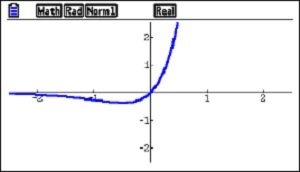
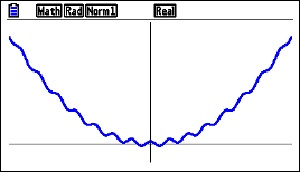
The question had the student examine the function f\left( x \right)=2x{{e}^{2x}} and, although it is easy enough to answer without, students were allowed to use their graphing calculator. A reasonable student probably looked at a graph of the function.

f\left( x \right)=2x{{e}^{2x}}

Part a: First the question asks the student to explore the end behavior of the function by finding two limits: \underset{x\to -\,\infty }{\mathop{\lim }}\,f\left( x \right) and \underset{x\to \infty }{\mathop{\lim }}\,f\left( x \right). The students should not depend on the graph here. As x\to -\infty , {{e}^{2x}}approaches zero and since the exponential function dominates the polynomial, \underset{x\to -\,\infty }{\mathop{\lim }}\,f\left( x \right)=0. In passing note that for x < 0 the function is negative and approaches zero from below. No work or explanation was required, but when teaching things like this be sure students know and can explain their answer without reference to their calculator graph.  For the second limit, since both factors increase without bound \underset{x\to \infty }{\mathop{\lim }}\,f\left( x \right)=\infty  If the student wrote \underset{x\to \infty }{\mathop{\lim }}\,f\left( x \right)=\text{DNE}, he received full credit.

Infinity is not a number, so there really is no limit in the second case; the limit DNE. But there are other ways a limit may not exist such as a jump discontinuity or an oscillating discontinuity.  DNE covers these as well as infinite limits. Saying a limit is infinite tells us more about the limit than DNE. It tells us that the function increases without bound; that eventually it becomes greater than any number.

Both answers are correct.

But we’re not done with this yet. We will come back to it before the question is done.

Part b: Students were asked to find and justify the minimum value of the function. Using the first derivative test, students proceeded by finding where the derivative is zero..

{f}'\left( x \right)=\left( 2x \right)\left( 2{{e}^{2x}} \right)+2{{e}^{2x}}=2{{e}^{2x}}\left( 2x+1 \right)=0

x=-\frac{1}{2}

f\left( -\tfrac{1}{2} \right)=2\left( -\tfrac{1}{2} \right){{e}^{2\left( -\tfrac{1}{2} \right)}}=-\frac{1}{e}\approx 0.368\text{ or }0.367

Justification: If x<-\tfrac{1}{2},\ {f}'\left( x \right)<0 and if x>-\tfrac{1}{2},\ {f}'\left( x \right)>0, therefore the absolute minimum is -\frac{1}{e} and occurs at x=-\frac{1}{2}.

All pretty straightforward

Part c: This part asked for the range of the function. Here the student must show that if he wrote DNE in part a, he knows that in fact the function grows without bound.

Putting together the answers from part a and part c, the range is f\left( x \right)\ge -\frac{1}{e}, which may also be written as \left[ -1/e,\infty\right). (The decimals could also be used here.)

Part d: asked students to consider functions given by y=bx{{e}^{bx}} where b was a non-zero number. The question required students to show that the absolute minimum value of all these functions was the same.

Most students did what was expected and preceded as in part b. The work is exactly the same as above except that all of the 2s become bs. The absolute minimum occurs at x=-\frac{1}{b} and y\left( -\tfrac{1}{b} \right)=-\frac{1}{e}.

BUT ….

Other students found a way completely without “calculus.” Can you find do that?

They realized that the given function as a horizontal expansion or compression, possibly including a reflection over the y-axis, of and therefore the range is the same for all these functions and so the minimum value must be the same. This received full credit. The rule of thumb is “don’t take off for good mathematics.”

Pretty cool!

The graphs of several cases are shown below

y=bx{{e}^{bx}}
b = -5 in blue, b = -1 in red, b = 2 in green, and b = 4 in magenta.

Teaching Suggestions

I can see using this in a pre-calculus class. The calculus (finding the minimum for b = 2 or in general) is straightforward. In a pre-calculus setting as an example of transformations it may be more useful. You could give students 6, or 8, or 10 examples with different values of b, both positive and negative.

  1. First ask students to investigate the end behavior by finding the limits as x approaches positive and negative infinity. The results will be similar. Have them write a summary considering two cases: b > 0 and b < 0.
  2. Graphing calculators have built-in operations that will find the x-coordinates or both coordinates of the minimum point of a function. Since we’re concerned with the transformation and not the calculus, let students use their graphing calculators to find the coordinates of the minimum point of each graph (as decimals). See if they can determine the x-coordinate in terms of b. They should also notice that y-coordinates will all be the same (about -0.367880).
  3. Finally, set the class to proving using their knowledge of transformation that the minimums are really all the same.

Calculus Camp

Today I welcome a guest blogger. Robert Vriesman writes about his Calculus Camp. The annual camp is a great review technique. I was honored to be invited this year and had a great time helping the kids. Thank you Robert for the Blog and the weekend with your students

Many high schools around the nation have only eight to fifteen kids taking Calculus in any given school year. So what are the teachers at the Los Angeles Center for Enriched Studies (LACES) doing differently along with generous help from professors, math professionals, and some parents doing to attract upwards of 200 students to take Calculus each year? The answer…Calculus Camp!

Calculus Camp was first organized by me fourteen years ago when I was LACES Department Chair. The camp began with only forty students and just a handful of teachers, but the excitement generated by the opportunity to go to camp to help them prepare for the College Board Advanced Placement Test increased the number of students taking Calculus each year. The past three years LACES has had over 200 students taking Advanced Placement mathematics.

LACES was already a high-achieving school, but this did not mean there were not a lot of challenges. The camp was large scale effort requiring a large-scale commitment on the part of the mathematics department. Our objectives of our Calculus Camp are:
• to create a support structure necessary to make high achievement by all AP mathematics students a reality.
• to enhance all students’ achievement by creating an environment that would cause them to take a new look at higher levels of mathematics.
• to build a mathematics program so strong and inviting that a large percentage of students-perhaps even every student-could be prepared to successfully complete challenging mathematics courses such as calculus before leaving LACES.
• to further increase participation in Advanced Placement Mathematics classes and to improve the pass rate of our students taking Advanced Placement Mathematics classes.
• to provide an opportunity for students to meet and work with people actively involved in a career in mathematics.

The students load the buses at noon on a Thursday to travel to Calculus Camp in the San Gabriel Mountains 90 minutes north of Los Angeles. The students are kept quite busy over the course of the weekend with two study sessions on Thursday, and three each on Friday and Saturday. Over the weekend they put in as many as 24 hours doing Calculus. They take a mock test on Sunday morning as a way of gauging their progress over the course of the weekend.

Teachers from LACES, other teachers, professors, and professional mathematicians are invited to come to Calculus Camp to help the students of LACES. Dr. Michael Raugh of Harvey Mudd College (retired), Dr. Kyran Mish formerly of the University of Oklahoma, and Dr. D. Lewis Mingori of UCLA (retired) have come back year after year to help the LACES students. This past year Lin McMullin attended the LACES Calculus Camp for the first time! Former colleagues of mine C. Dean Becker and Ken Bailey have also been a huge help over the years. This interaction with the adult professionals is something that is different from the ordinary in their lives. The benefit to the students is not measurable in a traditional sense, but it is undeniable for all those that see it working during the weekend. The past few years has seen an increase in the number of former LACES students who return to Calculus Camp to help the current LACES students. These former students returning to Calculus Camp is a testament to what the camp has meant to their lives.

The students work in groups of four or five; the teachers and mentors respond when a group needs assistance. It is the other students in the group that are the first resource. Teachers act not as a tutor, but as a mentor ready to help a group of students who are working together on a problem with a direction or a suggestion, not necessarily with a solution. This group of students is sitting in a room with other groups of students working on other problems; a community all working together to the same end. They gain confidence from the group experience to be able later to go it alone.

This slideshow requires JavaScript.

In between the study sessions there is lots of interaction among students, teachers, and mentors. Those at the camp see and feel the intangible benefits these students derive from the camp experience from this interaction. It was great to see an actuary named Alejandro Ortega playing volleyball with a group of students and to hear Nick Mitchell (a retired actuary) explain to a group of students at lunch explain just what Actuarial Science is. To see the college professors, interact with high school students, to see the students asking them questions in a comfortable setting in not an everyday occurrence.

What has all this meant to the students of the Los Angeles Center for Enriched Studies? We have had many more students go into fields involving mathematics than in previous years. There are at least three students who went to college intending to study Actuarial Science in the past two years alone. Our pass rate has improved dramatically on the College Board Advanced Placement Calculus Tests. More students are taking Precalculus courses than ever before because they too want to go to Calculus Camp. Out of a department of nine mathematics teachers, five different teachers are teaching a total of seven Advanced Placement Mathematics classes.

On Sunday morning the students take a mock AP test to demonstrate to themselves what they learned. It makes them fully aware of the testing format and the length of various sections of the exam so there are no surprises on the day of the actual AP test.

There is plenty of fun built into the schedule as well. There is a bonfire on Thursday night, and a concert on Friday night and a talent show on Saturday night. This year I invited a friend from mine from college days, Sgt. Major Woodrow English, U.S. Army (Ret.), who was the principal trumpet in the U.S. Army band in Washington, D.C. for 30 years to play a concert on Friday night (and reveille every morning). English came all the way from Virginia to attend the camp this year. The music he provided seemed to “set the tone” for the students. Listening to a world class musician and working with world class mathematicians inspired the students to work hard and to give their best. And “Woody” gained a new appreciation for teachers and their dedication to their students.

If you have questions about starting your own Calculus Camp contact me, Robert Vriesman, at rvriesman@hotmail.com.

Good Question 4: 2008 AB 10

Continuing my occasional series on Good Questions, today’s Good Question is a multiple-choice question from the 2008 AB Calculus exam, number 10. As an exam question it is only so-so, but it has a lot of potential for having a discussion of relative accuracy of Riemann sums in relation to the definite integral they approximate. The key to doing this is to look at the graph. The question relates the numerical and the graphical aspect of Riemann sums, two parts of the Rule of Four.

The question presented the graph of a function f, shown below and asked which of five answer choices has the least value. The choices were \displaystyle \int_{a}^{b}{f\left( x \right)}dx (which I will call I), the left Riemann sum approximation of the integral, L, the right Riemann sum approximation, R, the Midpoint Riemann sum approximation, M, and a Trapezoidal sum approximation, T. Each of the four approximations were to have 4 subintervals of equal length.

2008 AB 10

There are important things in the stem – namely that the graph is strictly decreasing and concave downward, and one unimportant thing – the number of subdivisions. As long as the graph is strictly monotonic and does not change concavity the number of subdivisions does not matter; the relative size of the five quantities will be the same. Therefore, to see which is least we can look at one subdivision covering the entire interval. That saves a lot of trouble and is worth discussing with your class. Usually, we let the number of subdivisions go off to infinity; here we go the other way.

Looking at a single interval from 1 to 3, it is easy to see by drawing or picturing the rectangle that the least Riemann sum will be R, the right Riemann sum.

So that answers the question, but there is a lot more you can do with the situation. The first that comes to mind is to have your students to put the five values in order from least to greatest. Stop here and try it for yourself.

R is the smallest and L is the largest. Since the top of a trapezoid between the endpoints of the function on the interval lies below the graph of the function, T is less than I.

So far we have R < T < I < L, but where does the midpoint Riemann sum fit in, and why?

2008 AB 10 b

Consider the figure above. C is the midpoint of segment AD.The area of the region between AD and the x-axis is the midpoint approximation. Segment BE is tangent to f(x) at C. Notice that \Delta ABC\cong \Delta DEC (Why?) and therefore, the area of the region between segment BE and the x-axis is the same as the area between segment AD and the x-axis. The midpoint approximation is the same as the area a trapezoid whose side is tangent to the graph at the midpoint of the interval and extending to the sides of the interval. So the midpoint approximation of the integral is greater than the integral. (The midpoint rectangle as the same area as the “midpoint trapezoid” and distinguishes it from the endpoint trapezoid).

Then R < T < I < M < L.

At least in this case.

In this case, the function was strictly decreasing and concave down. Have your class investigate other combinations of increasing and decreasing functions that are concave up and concave down. Ask your students, individually or in small groups, to investigate these different cases, and discover and justify that:

  1. There are four cases in all.
  2. The left sum is greatest, and the right sum is least when the function is strictly decreasing.
  3. The left sum is least, and the right sum is greatest when the function is strictly increasing.
  4. When the function is concave down, the endpoint trapezoid lies below the graph of the function and the midpoint trapezoid lies above the graph, therefore T < I < M.
  5. When the function is concave up, the endpoint trapezoid lies above the graph of the function and the midpoint trapezoid lies below the graph, therefore M < I < T.
  6. Consider cases where the function is below the x-axis.

Good Question 3 1995 BC 5

A word before we look at one of my favorite AP exam questions, I put some of my presentations in a new page. Look under the “Resources” tab above, and you will see a new page named “Presentations.” There are PowerPoint slides and the accompanying handouts from some talks I’ve given in the last few years. I also use them in my workshops and AP Summer Institutes.

This continue a discussion of some of my favorite question and how to use them in class.You can find the others by entering “Good Question” in the search box on the right.

Today we look at one of my favorite AP exam questions. This one is from the 1995 BC exam; the question is also suitable for AB students. Even though it is 20 years old, it is still a good question.  1995 was the first year that graphing calculators were required on the AP Calculus exams.They were allowed, but not required for all 6 questions.

1995 BC 5

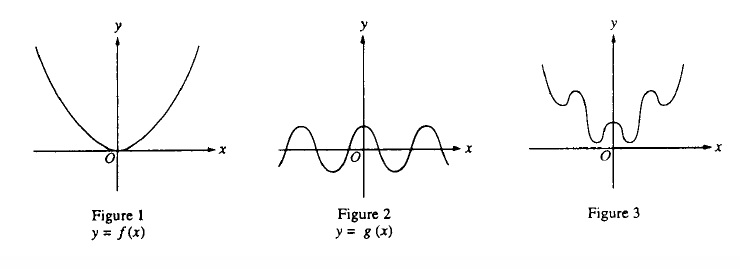
The question showed the three figures below and identified figure 1 as the graph of f\left( x \right)={{x}^{2}}  and figure 2 as the graph of g\left( x \right)=\cos \left( x \right).  The question then allowed as how one might think of the graph is figure 3 as the graph of h\left( x \right)={{x}^{2}}+\cos \left( x \right), the sum of these two functions. Not that unreasonable an assumption, but apparently not correct.

1995 BC 5

Part a: The students first were asked to sketch the graph of h\left( x \right) in a window with [–6, 6] x [–6, 40] (given this way). A box with axes was printed in the answer booklet.  This was a calculator required question and the result on a graphing calculator looks like this:


1995 BC 5

y={{x}^{2}}+\cos \left( x \right).
The window is [-6,6] x [-6, 40]

Students were expected to copy this onto the answer page. Note that the graph exits the screen below the top corners and it does not go through the origin. Both these features had to be obvious on the student’s paper to earn credit.

Part b: The second part of the question instructed students to use the second derivative of h\left( x \right) to explain why the graph does not look like figure 3.

\displaystyle \frac{dy}{dx}=2x-\sin \left( x \right)

\displaystyle \frac{{{d}^{2}}y}{d{{x}^{2}}}=2-\cos \left( x \right)

Students then had to observe that the second derivative was always positive (actually it is always greater than or equal to 1) and therefore the graph is concave up everywhere. Therefore, it cannot look like figure 3.

Part c: The last part of the question required students to prove (yes, “prove”) that the graph of y={{x}^{2}}+\cos \left( kx \right) either had no points of inflection or infinitely many points of inflection, depending on the value of the constant k.

Successful student first calculated the second derivative:

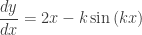
\displaystyle \frac{dy}{dx}=2x-k\sin \left( kx \right)

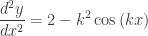
\displaystyle \frac{{{d}^{2}}y}{d{{x}^{2}}}=2-{{k}^{2}}\cos \left( kx \right)

Then considering the sign of the second derivative, if {{k}^{2}}\le 2, \frac{{{d}^{2}}y}{d{{x}^{2}}}\ge 0 and there are no inflection points (the graph is always concave up). But, if {{k}^{2}}>2, then since y” is periodic and changes sign, it does so infinitely many times and there are then infinitely many inflection points. See the figure below.

k = 8

k = 8


Using this question as a class exercise

Notice how the question leads the student in the right direction. If they go along with the problem they are going in the right direction. In class, I would be inclined to make them work for it.

  1. First, I would ask the class if figure 3 is the correct graph of h\left( x \right)={{x}^{2}}+\cos \left( x \right). I would let them, individually, in groups, or as a class suggest and defend an answer. I would not even suggest, but certainly not mind, if they used a graphing calculator.
  2. Once they determined the correct answer, I would ask them to justify (or prove) their conjecture. Again, no hints; let the class struggle until they got it. I may give them a hint along the lines of what does figure 3 have or do that the correct graph does not. (Answer: figure 3 changes concavity). Sooner or later someone should decide to check out the second derivative.
  3. Then I’d ask what could be the equation for a graph that does look like figure 3. You could give hints along the line of changing the coefficients of the terms of the second derivative. There are several ways to do this and all are worth considering.
    1. Changing the coefficient of the x2 term (to a proper fraction, say, 0.02) will do the trick. If that’s what they come up with fine – it’s correct.
    2. If you want to be picky, this causes the graph to go negative and figure 3 does not do that, but I ‘d let that go and ask if changing the coefficient of the cosine term in the second derivative can be done and if so how do you do that.
    3. This may be done by simply putting a number in front of the cosine term of the original function, say h\left( x \right)={{x}^{2}}+6\cos \left( x \right), but the results really do not look like figure 3,
    4. If necessary, give them the hint y={{x}^{2}}+\cos \left( kx \right)

1995 was the first year graphing calculators were required on the AP Calculus exams. They were allowed for all questions, but most questions had no place to use them. The parametric equation question on the same test, 1995 BC 1, was also a good question that made use of the graphing capability of calculators to investigate the relative motion of two particles in the plane.   The AB Exam in 1995 only required students to copy one graph from their calculator.

Both BC questions were generally well received at the reading. I know I liked them. I was looking forward to more of the same in coming years.

I was disappointed.

There was an attempt the following year (1997 AB4/BC4), but since then nothing investigating families of functions (i.e.  like these with a parameter that affects the shape of the graph) or anything similar has appeared on the exams. I can understand not wanting to award a lot of points for just copying the graph from your calculator onto the paper, but in a case like this where the graph leads to a rich investigation of a counterintuitive situation I could get over my reluctance.

But that’s just me.

Flipping (Part 2)

Today our guest blogger continues his discussion of Flipping begun last week. Bobby Barber is a mathematics teacher at Millville Senior High School in Millville, NJ. In these two posts he shares his experiences with Flipping his AP Calculus class. He asks that you reach out with questions, suggestions and stories of your own. Use the comment button at the end of the post. Bobby may be contacted directly at robert.barber.jr@millvillenj.gov 

Tips for Flipping…Things I’ve Learned Over the Past 9 Semesters

Start out slow. Flip one lesson, one chapter, one unit, one class…just flip SOMETHING. I have talked to a lot of teachers that say they need to try flipping, but they keep putting it off because they don’t know how to get started. Flipping is going to be outside of your comfort zone when you start, but you can’t be afraid to fail…it will get easier, and you’ll figure out what works for you and your students.

Don’t make the mistake of thinking the video is the most important thing…it’s not. The most important thing is having a plan for how you will run class now that the lecture portion has been removed (or at least drastically reduced). There is plenty of information out there to get ideas and I suggest you look for some, but the best ideas for your kids will be modifications of other people’s ideas that you come up with after giving it a try.

Videos are still important! There are a few things to consider when choosing the video(s) your students will watch:

1. How long will the video be? There are a couple of ideas out there on this concept. Some people suggest no more than a minute per grade level. Some say the same thing, but per age of the kids. Others say never over 10 minutes. I’m not a big fan of rules, but I would suggest the following guidelines: about 5 minutes max for elementary, 5 – 10 minutes for middle school, and under 20 minutes for high school students. I have found 10 – 15 minutes best for my high school kids, but I do have a couple of videos over 20 minutes. I talk to my class when I assign those videos and let them know that I need them to be ready for a long video and plan accordingly.

2. How do you know if your students watched the videos? Again, I have heard of many different ways to assess this and have tried several myself. Some people just watch their students doing the problems the next day in class and feel it is pretty obvious who watched the video and who did not. Others require students to show their notes at the beginning of class. I used to give a quick quiz to see who watched. I would ask a few basic questions and a couple that they couldn’t know without watching, like “what color was my shirt?”

An effective and useful way for many others and me is through an online class management system. There are many of them out there, but the best by far is EDpuzzle (www.edpuzzle.com). I have tried others and none compare. It allows you to embed questions in any video, yours or ones you found online. You can assign due dates for the videos and see how many times the students watched the whole video or specific parts of the video. I have been using EDpuzzle for a year and it has made my flipped classes twice as effective.

If you would like to see an example of a video on EDpuzzle, create a free account at www.edpuzzle.com. After signing in click, on EDpuzzle on the left and then search for “Bobby Barber” under videos. This will bring up all of my videos. The ones with me in front of the screen (in the middle of the videos that come up) are the ones I created.

3. How do you make sure every student has access to the videos? This is usually the cause of the most concern among potential flippers. Just because you teach in a low-income district, doesn’t mean you can’t find a way to get your videos to your students. A good number of your kids are going to have internet access. This means you can post your videos on EDpuzzle, YouTube, your teacher website, or some other medium. If students don’t have internet at home, they often have smart phones with Wi-Fi access. If your school has Wi-Fi, have the students download the videos to their phones in class through YouTube, iTunesU, or some other medium and watch the videos at home. You can also put your videos on a USB or DVD for students to take home. I have a couple of students every year that either go to the school library or come to my classroom and use my computer either before or after school or during their lunch or a study hall.

Even if students don’t have reliable internet, many have computers and more have DVD players or video game systems which allow them to play USB/DVDs. Finally, if none of these options work for one or more of your students, let them watch the video in class. More than likely, this will be a very small percent of your class. If you let them watch the video on your computer as a small group or have a laptop cart or other option available, you can differentiate instruction   to meet the needs of all of your students. Let the ones with the ability to watch the videos at home get started on problems or activities and have the others watch the video and finish their problems at home. You will have to cater this to your class/students, but I believe it will be worth it in the end.

4. What happens when students don’t watch the videos? I believe this is another problem that has different solutions depending on your situation. If a student is capable of watching the video and chooses not to, there must be a consequence. I know some elementary teachers that will make the kids watch the video in class and do worksheets instead of doing the more engaging activities the rest of the class does that day. I also make my students watch the video in class if they didn’t do the homework, and have them jump into whatever everyone else is doing when they are done. They still get a zero for their homework grade, but I like to minimize missed opportunities. Some teachers start class with a group share-out so students that didn’t get to watch the videos get to at least hear a summary from the ones who did in a small group setting.

5. Using Videos vs. Making Your Own: I started out using videos that were already made. There is so much to figure out when getting started flipping that spending the incredible amount of time to create quality videos may not be worth it at first. If you are using a video, you must watch and know every detail of it. You must also know exactly what you want your kids to get out of the next day in class and prepare a lesson that combines the information in the video with your own presentation to accomplish that. Spend your time on lesson planning early.

That being said, I have a lot more success and buy-in when students are watching my own videos. For them and many of their parents, it still feels like I’m teaching the class. It took me two years to create my videos, partially because I wasn’t sure flipping was going to work and partially because it takes a long time to create a good video teaching calculus or any other type of math. I create my videos exactly like I would teach a class. There is a camera in front of me with my presentation projected on the board. Many people I know refuse to be in front of a camera and do a screen cast. If you are uncomfortable putting your face/body on camera, I have two bits of advice. 1: get over it…you’re in front of your kids every day. Who cares if it is in the classroom or on their computer? 2: if you absolutely can’t get over it, make your video as interesting as possible. Voicing over a PowerPoint isn’t going to grasp the kids’ attention. Some people put pictures of their students doing problems. Others insert funny or interesting videos throughout the presentation. Whatever you do, ask yourself “Would I be able to watch and learn from this video?” before you expect your students to do it.

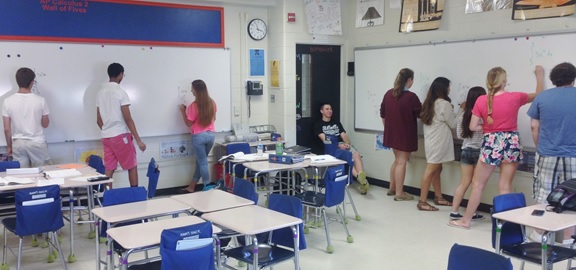
6. Classroom organization: I have put a lot of thought and a pretty good amount of research into how I set up my classroom. The most important aspect of my classroom is the whiteboard on every wall. The picture shows my students working at the whiteboards during class one day.Notice that all the students are involved.

Barber 2

I have also found that the kids are less worried about making mistakes on the whiteboards because they are able to erase mistakes and wrong answers quickly. With all the research I read on activity vs. learning, I don’t know what I would do without being able to have all my students actively doing their work at the boards every day.

I have always enjoyed teaching, but since I started flipping, my love of our profession has grown dramatically. I have been able to cover more material than just what is in our curriculum and dig deeper into all of the math that I teach. My students have been more successful on standardized tests and their confidence and interest in math has grown dramatically, in my opinion. If flipping is something you think your may be interested in trying, then figure out a way to give it a try. If you do, remember that there are no rules for flipping. As you look into what others are doing, find a variation that you think will work for you and adapt it to fit you and your students as you go.

If you are looking for help, suggestions, or advice on flipping your class, there are a ton of people who flip and I bet most of them would be happy to help. I certainly would be. For those of you on Twitter, the hash tag #flipclass is great and there is even a chat on Monday nights.

Thanks for reading this and good luck,

Bobby Barber

Flipping

Today I am happy to welcome a guest blogger. Bobby Barber is a mathematics teacher at Millville Senior High School in Millville, NJ. In this and the next post he shares his experiences with Flipping his AP Calculus class. He asks that you reach out with questions, suggestions, and stories of your own. Use the comment button at the end of the post. Bobby may be contacted directly at robert.barber.jr@millvillenj.gov 

What is a “Flipped” Class?

A flipped class is one where the traditional lecture and note taking is done outside of class time; usually by having students watch a video lesson. The students can re-watch all or parts of the video if they don’t understand something without worrying about interrupting the teacher or having the rest of the class know they don’t get something. Students then do practice problems that would previously be done for homework in class with peer and teacher support. Other projects, explorations, and activities are also done in class. Hence, the traditional in-class and at-home routines have been “flipped.”

Why I Flipped:

I started teaching AP Calculus in 2010 after 8 years of teaching regular level math classes. During my second year teaching, our school went to an integrated math curriculum (IMP) for our regular math classes.Bobby Barber The classes were discovery-based and very interactive and I loved teaching them. (Why we never used this for our advanced classes, I will never know.) I was one of two teachers that taught primarily IMP classes and we both had a lot of success with our students, both on local and state assessments. When our AP Calculus teacher changed positions, I was asked to teach the class.

I teach at the same high school that I attended, and my AP Calculus teacher was very popular and had a reputation as being a great teacher. I got a five on the AP exam when I was in his class, so I figured I would model my class after what he did: homework questions, lecture, examples, practice, homework, repeat.

Within a couple of weeks, I realized some things. First, I hated lecturing. Second, I wasn’t getting to know the kids at all, being that I was in the front of the room the whole time. My biggest problem, though, was that I was spending about half of each class going over homework problems. Almost every student was doing the homework and asking legitimate questions about it, but most of the questions had simple solutions. They messed up a sign, or a distribution, or some other arithmetic/algebraic concept that caused them to get the calculus question wrong. This gave them a negative attitude towards calculus, which they didn’t deserve.  I thought that if they could get help along the way to avoid these types of mistakes, they would enjoy and appreciate calculus more.

I decided to let them watch videos of the concepts at home and do problems in class.  During the summer that I thought of this, I found a lot of information on people already doing this and calling it a “flipped” classroom. I decided that I was going to try it during the next school year.

How I Started Flipping

Even though I was hell-bent on trying the flipped class out, I wasn’t sure how to do it. I teach in a Title 1 district where many students don’t have access to computers/internet at home. (This has improved drastically, but wasn’t great when I started). Also, no one had ever tried this at my school and I wasn’t sure what kind of support I would receive from the administration. I had other ideas for improving my classes, especially AP Calculus, so I decided to try them first. I had some success with these changes, but I still wasn’t convinced I was getting the most out of my time with the students, so I decided to give flipping a try.

I started by watching videos in class with the students. I would project the video and have the students take notes, then do a mini lesson afterwards highlighting and adding what I thought was necessary. I continued this for a chapter. The students seemed to like it, so I took it a step further and assigned videos for homework for the next chapter. I would post the videos on my website and e-mail the links to the students for them to watch at home. Students who didn’t have access would watch on my computer at the beginning of class each day. We then did problem sets in class and students helped each other and used me if they couldn’t figure something out themselves.

I was extremely happy with the results (just intuitive, but I knew I was on to something), so I went to my principal and guidance supervisor to request that I run my class like this permanently. Neither of them had heard of flipping, but once I explained what I wanted to do, they were both all for it. From some of the stories I have heard from colleagues in other schools and on social media, administrators can really ruin a school. I am in the exact opposite situation. My principal lets us try pretty much anything we think will help the students. Once I had her blessing, I ran with it and never looked back.

Benefits of flipping

I have seen a marked improvement in AP exam scores since I started flipping. I think there are several reasons for this improvement. Since flipping my class, I am able to cover way more material in class. On top of covering more material, I am able to cover that material at a deeper level. I have time for explorations, discovery, and quality student discussions in class, where I never had much time for that before because I was always rushing to get through the curriculum and answer students’ homework questions.

The one benefit that a flipped classroom gives me that I don’t know how else to get is the interaction with my students. I get to circulate and talk to every one of my students every day while they are doing math. I get to talk to them about their thought process with the math they are doing and about other things going on in their lives. I really get to know my students over the course of a semester and that helps me help them. I don’t know how else you can develop relationships with 50-75 kids seeing them for 85 minutes a day for 90 days (or whatever schedule your high school is on). These relationships are the biggest benefit of a flipped classroom. The students and I get to know and care about each other, which gives us extra motivation to work hard for each other.

Continued in the next post scheduled for Wednesday July 1, 2015