Jobs, Jobs, Jobs

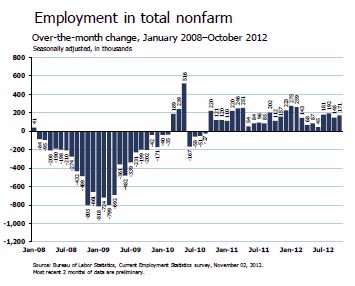
Here is a problem similar to those in the last two posts; this one is based on a graph. The numbers are a little hard to read (sorry), but perhaps we do not need them. (If you want to do the numbers it is the second graph from the source which is more readable. There are other graphs of this type in the source, if you want some more.)

The discussion is aimed at relating the graph which is a derivative with the net change it describes. Thus, we are looking at determining increasing, decreasing, and relative extreme value from the graph and foreshadowing how this can be done using integration concepts especially accumulation.
Source: The Bureau of Labor Statistics

Some questions to discuss.

    1. What are the units of this data, and what kind of units are they? (Thousands of jobs per month – a rate unit.)
    2. Ask the students how they would find the total change in employment over the period given and discuss this with them. (Do not make them do the computation, just discuss how.)
    3. Ask them to indicate on the graph when the total employment was the least and explain how they can tell from the graph (January 2010 – this is where the rate changes from negative to positive; this is the graph of a rate in thousands of jobs per month, therefore it is the derivative of jobs (employment)).
    4. Ask how they could verify this by computing. What would they compute month-by-month? (The total number of jobs lost or gained from the beginning of the period – the accumulated change in jobs.)
    5. During 2010 there is a local maximum in employment and another (local) minimum: when do they occur? How do you know without doing a computation?
    6. What additional information do you need to tell how many people actually had jobs at any time during this period? (The total number employed at the beginning of 2008 – the initial condition.)

Flying to Integrationland

Here is a problem similar to the one in the last post, but with foibles of its own.

The speed of an airplane in miles per hour is given at half-hour intervals in the table below. Approximately how far does the airplane travel in the three hours given in the table? How far is it from the airport?

Elapsed time (hours)   0 0.5 1 1.5 2 2.5 3
Speed  (miles per hour)    375    390    400    390    385    350    345

In addition to just finding the estimates, compare this situation with the Pump Problem from the last post. Some points to consider

    1. Answers between 1130 and 1145 miles are reasonable, if students proceed as they did with the Pump Problem. However, we cannot be sure since we do not know the speeds between the values recorded. In the Pump Problem we were told the pump was slowing down, so we could be sure the actual amount was between the values computed.
    2. Based on the information in the table what is the low and high estimates of the total distance? What assumptions do you make for these estimates? (Low = 1117.5 miles, high = 1157.5 miles assuming the plane flew at the slowest (fastest) speed in the table for the entirety of each 1/2-hour interval.)
    3. We also do not know where the plane started or which directions (plural) it was flying. So we have no way to tell how far it was from the airport (although we hope it gets to some airport eventually).
    4. What are the units? If we graph this as we did in the Pump Problem the various rectangles have dimensions of (miles/hour) by hours, so the “area” is miles (a linear unit).

Next: Jobs, Jobs, Jobs

The Old Pump

A tank is being filled with water using a pump that is old and slows down as it runs. The table below gives the rate at which the pump pumps at ten-minute intervals. If the tank initially has 570 gallons of water in it, approximately how much water is in the tank after 90 minutes?

Elapsed time (minutes)   0   10  20   30   40   50   60   70   80   90
Rate (gallons / minute)   42   40   38   35   35   32   28   20   19   10

And so begins integration.

Ask your students to do this problem alone. When they are ready (after a few minutes) collect their opinions.  They will not all be the same (we hope, because there is more than one reasonable way to approximate the amount). Ask exactly how they got their answers and what assumptions they made. Be sure they always include units (gallons).  Here are some points to make in your discussion – points that we hope the kids will make and you can just “underline.”

    1. Answers between 3140 and 3460 gallons are reasonable. Other answers in that range are acceptable. They will not use terms like “left-sum”, “right sum” and “trapezoidal rule” because they do not know them yet, but their explanations should amount to the same thing. An answer of 3300 gallons may be popular; it is the average of the other two, but students may not have gotten it by averaging 3140 and 3460.
    2. Ask if they think their estimate is too large or too small and why they think that.
    3. Ask what they need to know to give a better approximation – more and shorter time intervals.
    4. Assumptions: If they added 570 + 42(10) + 40(10) + … +19(10) they are assuming that the pump ran at each rate for the full ten minutes and then suddenly dropped to the next. Others will assume the rate dropped immediately and ran at the slower rate for the 10 minutes. Some students will assume the rate dropped evenly over each 10-minute interval and use the average of the rates at the ends of each interval (570 + 41(10) + 39(10) + … 14.5(10) = 3300).
    5. What is the 570 gallons in the problem for? Well, of course to foreshadow the idea of an initial condition. Hopefully, someone will forget to include it and you can point it out.
    6. With luck, someone will begin by graphing the data. If no one does, you should suggest it (as always) to help them see what they are doing graphically. They are figuring the “areas” of rectangles whose height is the rate in gallons/minute and whose width is the time in minutes. Thus the “area” is not really an area but a volume ((gal/min)(min) = gallons). In addition to unit analysis, graphing is important since you will soon be finding the area between the graph of a function and the x-axis in just this same manner.

Next post: Flying to Integrationland