Posts on Differential Equations – 1

Next in line are differential equations. Here are links to some past posts on differential equations

Differential Equations Outline of basic ideas for AB and BC calculus

Slope Fields

Euler’s Method – a BC only topic

Domain of a Differential Equation mentioned on the new Course and Exam Description

Good Question 6  2000 AB 4

Additional post on differential equations next week.


Domain of a Differential Equation

A reader recently asked me to do a post answering some questions about differential equations:

The 2016 AP Calculus course description now includes a new statement about domain restrictions for the solutions of differential equations. Specifically, EK 3.5A3 states “Solutions to differential equations may be subject to domain restrictions.” [The current 2020 CED uses the same wording in Essential Knowledge statement FUN-7.E.3] Could you write a blog post discussing (1) an example of how to determine the domain restriction; (2) speculating on whether one of the points for the differential equation on the free response will be allotted for specifying the restriction; and (3) speculating whether this concept could appear on the multiple choice and if so how.

First, let me compliment him on noticing EK 3.5A3. I overlooked it and have not seen anyone pick up on this yet. It seems to be a new item in the course description. Don’t panic. In the current 2020 CED EK FUN-7.E.3 says

A single question asking for the domain and range was asked before, but some time ago. Specifically, 2000 AB6 and 2006 AB 5 asked for the domain of the solution of a differential equation (see below for both). These are the only instances I can find that required students to find the domain of the solution. 

Since 2008 many of the scoring standards included the domain, but they were not required to earn any points. These are discussed below. The domains were included in the solution, I suspect, because the standards are made public, and the readers want to publish the most complete answer.

What is required of the domain?

The generally accepted requirements are that the solution of a differential equation must be a function whose domain (1) must be an open interval, (2) on which the differential equation is true, and (3) contains the initial condition. Comments:

  • The interval must be open since derivatives are not defined at the endpoints of intervals. The derivative is a two-sided limit and at an endpoint you can only approach from one side. While one-sided derivatives may be defined, they are a more burdensome requirement and not necessary.
  • Practically speaking, this means that the solution may not cross a vertical asymptote or go through a point where the function is undefined; it must stay on the side where the initial condition is.
  • The differential equation must be true in the sense that substituting the solution and its derivative(s) into the differential equation must result in an identity. (See 2007 AB 4(b) for practice).
  • And of course, the initial condition point’s x-coordinate must be in the domain.

Teachers sometimes ask why we cannot just skip over an asymptote or an undefined point. When you do this, you are then working with a piecewise function. No problems there, but consider that on the piece(s) outside the domain as described above, you could have any function you want and still meet the three requirements above.

Finding the domain.

Here are some examples. Notice that the differential equation, its solution, and the initial condition all come into consideration.

2000 AB 6: After finding the solution y=\frac{1}{2}\ln \left( 2{{x}^{3}}+e \right), finding the domain is a pre-calculus question, requiring one to solve the simple inequality 2{{x}^{3}}+e>0. The domain is \displaystyle x>\sqrt[3]{\frac{-e}{2}}.

2006 AB 5: Will be discussed below in answer to another question he asked.

2008 AB 5: The differential equation is undefined at x = 0 and the initial condition is to the right of this. So, the domain is all positive numbers.

2011 AB5/BC5: The domain is given in the stem; Time starts now and the differential equation applies “for the next 20 years”, so, 0 < x < 20

2013 AB 6: The solution is y=-\ln \left( -{{x}^{3}}+3{{x}^{2}}-1 \right), So the domain is all x such that x = 1 (the initial condition) and for which -{{x}^{3}}+3{{x}^{2}}-1>0. No further simplification was given. By graphing calculator the range is about 0.65270<x<2.89739.

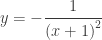
2013 BC 5: The solution, \displaystyle y=-\frac{1}{{{\left( x+1 \right)}^{2}}}, contains a vertical asymptote at x = –1. Since the initial condition is (0, –1) the domain is x > –1; the side of the asymptote containing the initial condition.

2014 AB 6: Neither the equation, nor the solution, \displaystyle y=3-2{{e}^{-\sin \left( x \right)}}, has any values for which x is undefined; so, the domain is all real numbers.

2016 AB 4: The differential equation is \displaystyle \frac{dy}{dx}=\frac{{{y}^{2}}}{x-1} with f(2) = 3. The solution \displaystyle y=\frac{1}{\tfrac{1}{3}-\ln \left( x-1 \right)}, has a vertical asymptote where the denominator is 0, namely x=1+{{e}^{1/3}}, and is undefined (because of the logarithm) for x\le 1. The largest open interval containing the initial condition is between these two values, namely 1<x<1+{{e}^{1/3}}

2017 AB 4: The endpoints of the domain are stated in the stem of the problem. The time t begins when the potato is removed from the oven so t > 0 and the differential equation in (c) is given for  t < 10. So the domain is 0 < t < 10.

2018 AB 6: Both the differential equation and its general solution are defined for all Real numbers: \displaystyle -\infty <x<\infty

All of these require no “calculus”- they are “find the domain” questions from pre-calculus with the concern about vertical asymptotes. There are some other considerations. A longer and far more detailed discussion of this can be found in “The Domain of Solutions to Differential Equations”, by former chief reader Larry Riddle.

I think that answers the first question my reader asked. As to his second and third questions, I guess the answer is yes. At some point students will be asked to state the domain of a differential equation. My guess is it will be a fairly easy one-point part of a free-response question. If solving the differential equation is necessary, then it seems too long for a multiple-choice question. This is all guesswork on my part; I have no knowledge of what’s on future exams.

2019 AB 4: The solution is a polynomial and there valid for all Real numbers.

2021 AB 6: The solution contains a power of e. The domain is all Real numbers.

2021 BC 4: The solution contains terms with ln(x). The domain is all x > 0.

2022 AB 5: The domain is all Real Numbers


My reader also asked about absolute value

Another question that may be related to this topic is the relevancy of the absolute value signs in the solutions to differential equations. When can they be kept in the solution, and when are they redundant?

Absolute values can really confuse kids. See my posts “Absolutely” and “Absolute Value.” Pre-calculus topics, yes, but they come back again and again.

Here are two examples about absolute values and domains:

2005 AB 6: After separating the variables and applying the initial condition we arrive at {{y}^{2}}=-2{{x}^{2}}+3. This is not a function; its graph is an ellipse. We cannot just write y=\pm \sqrt{-2{{x}^{2}}+3}, since that is not a function either. With the initial condition f(1) = –1, we have \sqrt{{{y}^{2}}}=\left| y \right|=-y. Then choose the half of the ellipse where y is negative -y=\sqrt{3-2{{x}^{2}}} and y=-\sqrt{3-2{{x}^{2}}}. The domain is -\sqrt{1.5}<x<\sqrt{1.5}.

2006 AB 5. The initial value question is to solve \displaystyle \frac{dy}{dx}=\frac{1+y}{x},x\ne 0,\text{ and }f\left( -1 \right)=1.

After a few steps we arrive at \left| 1+y \right|=C\left| x \right|. At the initial condition point 1+y>0 and therefore \left| 1+y \right|=1+y. Continuing, we arrive at y=2\left| x \right|-1. For the AP exam, we can stop here, since we have a function and algebraic simplification is not required.

The domain was asked for. Since it is given that x\ne 0, and there are no other “bad” places, the domain must be one side of the y-axis or the other. The initial condition tells us that the domain is to the left of the y-axis, x<0. Since, this is so, \left| x \right|=-x and the solution simplifies to y=-2x-1\text{ and }x<0


I really appreciate questions from readers, so if you want to ask about some topic please ask me at lnmcmullin@aol.com . I’m always looking for new topics to write about – or said a different way, I’m running out of ideas!


.

Revised 4-3-18

Revised 12-23-2018 to include the 2017 and 2018 differential equation questions.

Revised 11-23-2020 – 2019 exam

Revised 1-11-2021

Differential Equations (Type 6)

Differential equations are tested every year. The actual solving of the differential equation is usually the main part of the problem, but it is accompanied by a related question such as a slope field or a tangent line approximation. BC students may also be asked to approximate using Euler’s Method. Large parts of the BC questions are often suitable for AB students and contribute to the AB sub-score of the BC exam.

What students should be able to do

  • Find the general solution of a differential equation using the method of separation of variables (this is the only method tested).
  • Find a particular solution using the initial condition to evaluate the constant of integration – initial value problem (IVP).
  • NEW Determine the domain restrictions on the solution of a differential equation. See this post for more on this. 
  • Understand that proposed solution of a differential equation is a function (not a number) and if it and its derivative are substituted into the given differential equation the resulting equation is true. This may be part of doing the problem even if solving the differential equation is not required (see 2002 BC 5 – parts a, b and d are suitable for AB)
  • Growth-decay problems.
  • Draw a slope field by hand.
  • Sketch a particular solution on a (given) slope field.
  • Interpret a slope field.
  • Use the given derivative to analyze a function such as finding extreme values
  • For BC only: Use Euler’s Method to approximate a solution.
  • For BC only: use the method of partial fractions to find the antiderivative after separating the variables.
  • For BC only: understand the logistic growth model, its asymptotes, meaning, etc. The exams so far, have never asked students to actually solve a logistic equation IVP

Look at the scoring standards to learn how the solution of the differential equation is scored, and therefore, how students should present their answer. This is usually the one free-response answer with the most points riding on it. Starting in 2016 the scoring has changed slightly. The five points are now distributed this way:

  • one point for separating the variables
  • one point each for finding the antiderivatives
  • one point for including the constant of integration and using the initial condition – that is, for writing “+ C” on the paper with one of the antiderivatives and substituting the initial condition; finding is value is included in the “answer point.” and
  • one point, the “answer point”, for the correct answer. This point includes all the algebra and arithmetic in the problem.

A future post suggested by a reader and tentatively schooled for April 4, 2017, will discuss the domain of the solution of a differential equation. The domain is often included on the scoring standard, but unless it is specifically asked for in the question students do not need to include it. This is a new topic not previously on the Course Description.

Shorter questions on this concept appear in the multiple-choice sections. As always, look over as many questions of this kind from past exams as you can find.

For some previous posts on differential equations see January 5, 2015 and for post on related subjects see November 26, 2012,  January 21, 2013 February 16, 2013

Revised 3-21-17, 08:21 to reflect new point distribution.


Next Posts:

Friday March 24: Others (Type 7: related rates, implicit differentiation, etc.)

Tuesday March 28: for BC Parametric Equation (Type 8)

Friday March 31: For BC Polar Equations (Type 9)

Tuesday April 4: For BC Sequences and Series.

Friday April 7, 2017 The Domain of the solution of a differential equation.

The Logistic Equation

After my last post, I realized I have never written about the logistic growth model. This is a topic tested on the AP Calculus BC exam (and not on AB). Here is a brief outline of this topic.

Logistic growth occurs in situations where the rate of change of a population, y, is proportional to the product of the number present at any time, y¸ and the difference between the number present and a number, C > 0, called the carrying capacity.

As explained in my last post, some factor limits the overall population possible to an amount C. Ask your students to sketch what they think the graph of such a function may look like and explain why.

The population starts by growing rapidly and then slows down as it approaches C. For example, if a small population of rabbits is placed on an island, the population will grow rapidly until the food starts to run out. The population will eventually level off and not grow greater than there is food to support it.

In symbols, logistic growth is modeled by the differential equation

\displaystyle \frac{dy}{dt}=ky\left( C-y \right) , where k > 0 is the constant of proportionality, or by

\displaystyle \frac{dy}{dt}=Ky\left( 1-\frac{y}{C} \right) and K=Ck

The differential equation is solved using separation of variables followed by using the method of partial fraction to obtain two expressions that can be integrated. The actual solving of the differential equation has never been tested, nor has memorization of the solution. What has been tested is what the solution graph looks like and how those features apply in real situations.

The solution, which need NOT be memorized, is \displaystyle f\left( x \right)=\frac{C{{e}^{kCx}}}{{{e}^{kCx}}+kcD} (D is the constant of integration formally known as “+C.”)

The important features of the graph of the function can be found by examining the differential equation. This is an exercise consistent with MPAC 4: Connecting multiple representations and MPAC 5: Building notational fluency.

logisitc-de

The figure above shows the slope field for a typical logistic differential equation. The values of y where \frac{dy}{dt}=0 indicate the location of a horizontal asymptote. There are horizontal asymptotes at y = 0 and y = C.

For points between the asymptotes 0<y<C, all the factors of the differential equation are positive. This indicates that the function is increasing. Near y = 0 and y = C one factor or the other is small, approaching 0: the graph of the solution (heavy blue line) is leveling off and approaching y = C from below as an asymptote. If the graph is extended into the second quadrant (thin blue line), it approaches the x-axis from above as an asymptote.

If the initial condition is greater than C then the (C – y) factor is negative, and the solution function is decreasing and approaching the asymptote y = C from above. If the number of rabbits put on the island is more than the carrying capacity, the population decreases (the poor rabbits starve).

The differential equation is a quadratic in y. Moving from the initial condition to right the slope of the tangent lines are positive and increasing, so the solution’s graph is concave upwards. After y=\tfrac{1}{2}C the values of the slope (differential equation) remain positive but decrease indicating that the graph is now increasing and concave down. After this point the two factors of the differential equation switch values; that is, moving the same distance left and right of this point the product will be the same, but the values of each factor will have switched. Thus, the point where y=\tfrac{1}{2}C is not only a point of inflection, but also a point of symmetry of the graph.

The maximum value occurs of the first derivative (the differential equation) is at y=\tfrac{1}{2}C. This can be determined from the properties of a quadratic expression or from the second derivative,

\displaystyle \frac{{{d}^{2}}y}{d{{t}^{2}}}=k\left( y\left( -1 \right)+\left( C-y \right)\left( 1 \right) \right)\cdot \frac{dy}{dt}=k\left( C-2y \right)\frac{dy}{dt}.

The second derivative is 0 at y=\tfrac{1}{2}C. This is a point of inflection, the place where the function is increasing most rapidly.

Here is a Desmos demonstration that can be used to investigate the logistic differential equation, its slope field, and solution.


These ideas have all been tested on various BC exams. I cannot quote the questions here, but you may look them up for yourself.

Free-response:

2004 BC 5: (a) asymptotes as limits, and (b) when is the population growing fastest.

2008 BC 6: (a) sketch logistic equation on given slope field for two initial conditions – one between the asymptotes and one above the carrying capacity

Multiple-choice:

2003 BC 21: asymptote as a limit

2008 AB 22: Even though not an AB topic, the translation from words to symbols of the logistic model was tested on the 2008 AB multiple-choice exam. The idea was the translating, not knowledge of the logistic model.

2008 BC 24 given graph, identify differential equation.

2012 BC 14 identify logistic differential equation

There are also logistic questions on the restricted multiple-choice BC exams from 2013, 2014, and 2016; you’ll have to find them for yourself.


If you would like to experiment with logistic equations try graphing using Winplot for PC, Winplot for MACs, Geogebra, or some other program that will graph slope fields and solutions and has sliders. Desmos does not currently graph slope fields, but the solution graph can be produced.

For the differential equation enter \frac{dy}{dx}=ky\left( C-y \right) with sliders for k and C.

If you just want to look at the solution, use any grapher with sliders. The solution can be graphed as \displaystyle f\left( x \right)=\frac{C{{e}^{kCx}}}{{{e}^{kCx}}+kcD} with D, the constant of integration, added as a third slider.

Revised and Desmos Demo link added May 12, 2022

Is this going to be on the exam?

confused-teacherRecently there was a discussion on the AP Calculus Community bulletin board regarding whether it was necessary or desirable to have students do curve sketching starting with the equation and ending with a graph with all the appropriate features – increasing/decreasing, concavity, extreme values etc., etc. – included. As this is kind of question that has not been asked on the AP Calculus exam, should the teacher have his students do problems like these?

The teacher correctly observed that while all the individual features of a graph are tested, students are rarely, if ever, expected to put it all together. He observed that making up such questions is difficult because getting “nice” numbers is difficult.

Replies ran from No, curve sketching should go the way of log and trig tables, to Yes, because it helps connect f. f ‘ and f ‘’, and to skip the messy ones and concentrate on the connections and why things work the way they do. Most people seemed to settle on that last idea; as I did. As for finding questions with “nice” numbers, look in other textbooks and steal borrow their examples.

But there is another consideration with this and other topics. Folks are always asking why such-and-such a topic is not tested on the AP Calculus exam and why not.

The AP Calculus program is not the arbiter of what students need to know about first-year calculus or what you may include in your course. That said, if you’re teaching an AP course you should do your best to have your students learn everything listed in the 2019 Course and Exam Description book and be aware of how those topics are tested – the style and format of the questions. This does not limit you in what else you may think important and want your students to know. You are free to include other topics as time permits.

Other considerations go into choosing items for the exams. A big consideration is writing questions that can be scored fairly.  Here are some thoughts on this by topic.

Curve Sketching

If a question consisted of just an equation and the directions that the student should draw a graph, how do you score it? How accurate does the graph need to be? Exactly what needs to be included?

An even bigger concern is what do you do if a student makes a small mistake, maybe just miscopies the equation? The problem may have become easier (say, an asymptote goes missing in the miscopied equation and if there is a point or two for dealing with asymptotes – what becomes of those points?) Is it fair to the student to lose points for something his small mistake made it unnecessary for him to consider? Or if the mistake makes the question so difficult it cannot be solved by hand, what happens then? Either way, the student knows what to do, yet cannot show that to the reader.

To overcome problems like these, the questions include several parts usually unrelated to each other, so that a mistake in one part does not make it impossible to earn any subsequent points. All the main ideas related to derivatives and graphing are tested somewhere on the exam, if not in the free-response section, then as a multiple-choice question.

(Where the parts are related, a wrong answer from one part, usually just a number, imported into the next part is considered correct for the second part and the reader then can determine if the student knows the concept and procedure for that part.)

Optimization

A big topic in derivative applications is optimization. Questions on optimization typically present a “real life” situation such as something must be built for the lowest cost or using the least material. The last question of this type was in 1982 (1982 AB 6, BC 3 same question). The question is 3.5 lines long and has no parts – just “find the cost of the least expensive tank.”

The problem here is the same as with curve sketching. The first thing the student must do is write the equation to be optimized. If the student does that incorrectly, there is no way to survive, and no way to grade the problem. While it is fair to not to award points for not writing the correct equation, it is not fair to deduct other points that the student could earn had he written the correct equation.

The main tool for optimizing is to find the extreme value of the function; that is tested on every exam. So here is a topic that you certainly may include the full question in you course, but the concepts will be tested in other ways on the exam.

The epsilon-delta definition of limit

I think the reason that this topic is not tested is slightly different. If the function for which you are trying to “prove” the limit is linear, then \displaystyle \delta =\frac{\varepsilon }{\left| m \right|} where m is the slope of the line – there is nothing to do beside memorize the formula. If the function is not linear, then the algebraic gymnastics necessary are too complicated and differ greatly depending on the function. You would be testing whether the student knew the appropriate “trick.”

Furthermore, in a multiple-choice question, the distractor that gives the smallest value of must be correct (even if a larger value is also correct).

Moreover, finding the epsilon-delta relationship is not what’s important about the definition of limit. Understanding how the existence of such a relationship say “gets closer to” or “approaches” in symbols and guarantees that the limit exists is important.

Volumes using the Shell Method

I have no idea why this topic is not included. It was before 1998. The only reason I can think of is that the method is so unlike anything else in calculus (except radial density), that it was eliminated for that reason.

This is a topic that students should know about. Consider showing it too them when you are doing volumes or after the exam. Their college teachers may like them to know it.

Integration by Parts on the AB exam

Integration by Parts is considered a second semester topic. Since AB is considered a one-semester course, Integration by Parts is tested on the BC exam, but not the AB exam. Even on the BC exam it is no longer covered in much depth: two- or more step integrals, the tabular method, and reduction formulas are not tested.

This is a topic that you can include in AB if you have time or after the exam or expand upon in a BC class.

Newton’s Method, Work, and other applications of integrals and derivatives

There are a great number of applications of integrals and derivatives. Some that were included on the exams previously are no longer listed. And that’s the answer right there: in fairness, you must tell students (and teachers) what applications to include and what will be tested. It is not fair to wing in some new application and expect nearly half a million students to be able to handle it.

Also, remember when looking through older exams, especially those from before 1998, that some of the topics are not on the current course description and will not be tested on the exams.

Solution of differential equations by methods other than separation of variables

Differential equations are a huge and important area of calculus. The beginning courses, AB and BC, try to give students a brief introduction to differential equations. The idea, I think, is like a survey course in English Literature or World History: there is no time to dig deeply, but the is an attempt to show the main parts of the subject.


While the choices are somewhat arbitrary, the College Board regularly consults with college and university mathematics departments about what to include and not include. The relatively minor changes in the new course description are evidence of this continuing collaboration. Any changes are usually announced two years in advance. (The recent addition of density problems unannounced, notwithstanding.) So, find a balance for yourself. Cover (or better yet, uncover) the ideas and concepts in the course description and if there if a topic you particularly like or think will help your students’ understanding of the calculus, by all means include it.


PS: Please scroll down and read Verge Cornelius’ great comment below.


Happy Holiday to everyone. There is no post scheduled for next week; I will resume in the new year. As always, I like to hear from you. If you have anything calculus-wise you would like me to write about, please let me know and I’ll see what I can come up with. You may email me at lnmcmullin@aol.com


.

Good Question 6: 2000 AB 4

2000 AB 4 Water tankAnother of my favorite questions from past AP exams is from 2000 question AB 4. If memory serves it is the first of what became known as an “In-out” question. An “In-out” question has two rates that are working in opposite ways, one filling a tank and the other draining it.

In subsequent years we saw a question with people entering and leaving an amusement park (2002 AB2/BC2), sand moving on and off a beach (2005 AB 2), another tank (2007 AB2), an oil leak being cleaned up (2008 AB 3), snow falling and being plowed (2010 AB 1), gravel being processed (2013 AB1/BC1), and most recently water again flowing in and out of a pipe (2015 AB1/BC1). The in-between years saw rates in one direction only but featured many of the same concepts.

The questions give rates and ask about how the quantity is changing. As such, they may be approached as differential equation initial value problems, but there is an easier way. This easier way is that a differential equation that gives the derivative as a function of a single variable, t, with an initial point \left( {{t}_{0}},y\left( {{t}_{0}} \right) \right) always has a solution of the form

y\left( t \right)=y\left( {{t}_{0}} \right)+\int_{{{t}_{0}}}^{t}{{y}'\left( x \right)dx}.

This is sometimes called the “accumulation equation.” The integral of a rate of change {y}'\left( t \right) gives the net amount of change over the interval of integration [{{t}_{0}},t]. When this is added to the initial amount the result is an expression that gives the amount at any time t.
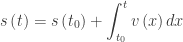
In a motion context, this same idea is that the position at any time t, is the initial position plus the displacement:

\displaystyle s\left( t \right)=s\left( {{t}_{0}} \right)+\int_{{{t}_{0}}}^{t}{v\left( x \right)dx} where v\left( t \right)={s}'\left( t \right)

The scoring standard gave both forms of the solution. The ease of the accumulation form over the differential equation solution was evident and subsequent standards only showed this one.

2000 AB 4

The question concerned a tank that initially contained 30 gallons of water. We are told that water is being pumped into the tank at a constant rate of 8 gallons per minute and the water is leaking out at the rate of \sqrt{t+1} gallons per minute.

Part a asked students to compute the amount of water that leaked out in the first three minutes. There were two solutions given. The second solves the problem as an initial value differential equation:

Let L(t) be the amount that leaks out in t minutes then

\displaystyle \frac{dL}{dt}=\sqrt{t+1}

L\left( t \right)=\frac{2}{3}{{\left( t+1 \right)}^{3/2}}+C

L\left( 0 \right)=\frac{2}{3}{{\left( 0+1 \right)}^{3/2}}+C=0 since nothing has leaked out yet, so C = -2/3

L\left( t \right)=\frac{2}{3}{{\left( t+1 \right)}^{3/2}}-\frac{2}{3}

L\left( 3 \right)=\frac{14}{3}

The first method, using the accumulation idea takes a single line:

\displaystyle L\left( 3 \right)=\int_{0}^{3}{\sqrt{t+1}dt}=\left. \frac{2}{3}{{\left( t+1 \right)}^{3/2}} \right|_{0}^{3}=\frac{2}{3}{{\left( 4 \right)}^{3/2}}-\frac{2}{3}{{\left( 1 \right)}^{3/2}}=\frac{14}{3}

I think you’ll agree this is easier and more direct.

Part b asked how much water was in the tank at t = 3 minutes.  We have 30 gallons to start plus 8(3) gallons pumped in and 14/3 gallons leaked out gives 30 + 24 – 14/3 = 148/3 gallons.

This part, worth only 1 point, was a sort of hint for the next part of the question.

Part c asked students to write an expression for the total number of gallons in the tank at time t.

Following part b the accumulation approach gives either

\displaystyle A\left( t \right)=30+8t-\int_{0}^{t}{\sqrt{x+1}dx}  or

\displaystyle A\left( t \right)=30+\int_{0}^{t}{\left( 8-\sqrt{x+1} \right)dx}.

The first form is not a simplification of the second, but rather the second form is treating the difference of the two rates, in minus out, as the rate to be integrated.

The differential equation approach is much longer and looks like this:

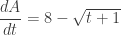
\displaystyle \frac{dA}{dt}=8-\sqrt{t+1}

A\left( t \right)=8t-\frac{2}{3}{{\left( t+1 \right)}^{3/2}}+C

A\left( 0 \right)=30=8(0)-\frac{2}{3}{{\left( 0+1 \right)}^{3/2}}+C, so C=\frac{92}{3}

A\left( t \right)=8t-\frac{2}{3}{{\left( t+1 \right)}^{3/2}}+\frac{92}{3}

Again, this is much longer. In recent years when asking student to write an expression such as this, the directions included a phrase such as “write an equation involving one or more integrals that gives ….” This pretty much leads students away from the longer differential equation initial value problem approach.

Part d required students to find the time when in the interval 0\le t\le 120 minutes the amount of water in the tank was a maximum and to justify their answer. The usual method is to find the derivative of the amount, A(t), set it equal to zero, and then solve for the time.

{A}'\left( t \right)=8-\sqrt{t+1}

Notice that this is the same regardless of which of the three forms of the expression for A(t) you start with. Thus, an excellent example of the Fundamental Theorem of Calculus used to find the derivative of a function defined by an integral. Or you could just start here without reference to the forms above: the overall rate in the rate in minus the rate out.

{A}'\left( t \right)=0 when t = 63

This is a maximum by the First Derivative Test since for 0 < t < 63 the derivative of A is positive and for 63 < t <120 the derivative of A is negative.

There is an additional idea on this part of the question in the Teaching Suggestions below.


I like this question because it is a nice real (as real as you can hope for on an exam) situation and for the way the students are led through the problem. I also like the way it can be used to compare the two methods of solution.  Then the way they both lead to the same derivative in part d is nice as well. I use this one a lot when working with teachers in workshops and summer institutes for these very reasons.

Teaching Suggestions

  • Certainly, have your students work through the problem using both methods. They need to learn how to solve an initial value problem (IVP) and this is good practice. Additionally, it may help them see how and when to use one method or the other.
  • Be sure the students understand why the three forms of A(t) in part c give the same derivative in part d. This makes an important connection with the Fundamental theorem of Calculus.
  • Like many good AP questions part d can be answered without reference to the other parts. The question starts with more water being pumped in than leaking out. This will continue until the rate at which the water leaks out overtakes the rate at which it is being pumped in. At that instant the rate “in” equals the rate “out” so you could start with 8=\sqrt{t+1}. After finding that t = 63, the answer may be justified by stating that before this time more water is being pumped in than is leaking out and after this time the rate at which water leaks out is greater than the rate at which it is pumped in, so the maximum must occur at t = 63.
  • And as always, consider the graph of the rates.

2000 AB 4

I used this question as the basis of a lesson in the current AP Calculus Curriculum Module entitled Integration, Problem Solving and Multiple Representations © 2013 by the College Board. The lesson gives a Socratic type approach to this question with a number of questions for each part intended to help the teacher not only work through this problem but to bring out related ideas and concepts that are not in the basic question. The module is currently available at AP sponsored workshops and AP Summer Institutes. Eventually, it will be posted at AP Central on the AB and BC Calculus Home Pages.

Euler’s Method for Making Money

Chip Rollinson is a teacher at Buckingham Browne & Nichols School in Cambridge, Massachusetts. Today’s post is a note he sent to the AP Calculus Community bulletin board that I found interesting. I will share it with you with his permission. I made some minor edits. Chip wrote on February 5, 2015:

I had an epiphany today about the relationship between Euler’s Method and compounding growth. I had never made the connection before. I thought it was cool so I decided I needed to share it.

Consider the differential equation \frac{dA}{dt}=rA with the condition A(0) = P. Solving this equation gives A\left( t \right)=P{{e}^{rt}}, but let’s ignore this for now.

Let’s look at this differential equation using Euler’s Method.

Leonhard Euler1707 - 1783

Leonhard Euler
1707 – 1783

Let’s start with a step size of \tfrac{1}{12} and use (0, P) as the “starting point.”

After one step, you arrive at the point \displaystyle \left( \tfrac{1}{12},P+\tfrac{r}{12}P \right)=\left( \tfrac{1}{12},P\left( 1+\tfrac{r}{12} \right) \right)

After 2 steps, you arrive at the point \displaystyle \left( \tfrac{2}{12},P+\tfrac{2}{12}P+\tfrac{{{r}^{2}}}{144}P \right)=\left( \tfrac{2}{12},P{{\left( 1+\tfrac{r}{12} \right)}^{2}} \right)

After 3 steps, you arrive at the point \displaystyle \left( \tfrac{3}{12},P+\tfrac{3}{12}rP+\tfrac{3}{144}{{r}^{2}}P+P\tfrac{3}{1728}{{r}^{3}} \right)=\left( \tfrac{3}{12},P{{\left( 1+\tfrac{r}{12} \right)}^{3}} \right)

After 4 steps, you arrive at the point \displaystyle \left( \tfrac{4}{12},P{{\left( 1+\tfrac{r}{12} \right)}^{4}} \right)

And so on …

After 12 steps, you arrive at the point \displaystyle \left( 1,P{{\left( 1+\tfrac{r}{12} \right)}^{12}} \right)

After 120 steps, you arrive at the point \displaystyle \left( 10,P{{\left( 1+\tfrac{r}{12} \right)}^{120}} \right)

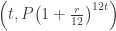
After 12t steps, you arrive at the point \displaystyle \left( t,P{{\left( 1+\tfrac{r}{12} \right)}^{12t}} \right)

Do these y-values look familiar? It’s the amount you’d have if you were compounding monthly with a yearly interest rate of r for a year, 10 years, and t years.

If the step size were \displaystyle \tfrac{1}{365} instead, you would arrive at the points

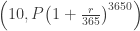
\displaystyle \left( 1,P{{\left( 1+\tfrac{r}{365} \right)}^{365}} \right), and \left( 10,P{{\left( 1+\tfrac{r}{365} \right)}^{3650}} \right), and \displaystyle \left( t,P{{\left( 1+\tfrac{r}{365} \right)}^{365t}} \right).

These y-values are the amount you’d have if you were compounding daily for a year, 10 years, and t years.

If the step size were \tfrac{1}{n}, the point after t years is \displaystyle \left( t,P{{\left( 1+\tfrac{r}{n} \right)}^{nt}} \right)

If n went to infinity, you would arrive at the point \displaystyle \left( t,P{{e}^{rt}} \right), the y-value for continuously compounding. This is the solution of  the differential equation mentioned above.

I’d never made this connection before, but it makes perfect sense now.

The actual problem that got me thinking about all of this was:

Suppose that you now have $6000, you expect to save an additional $3000 during each year, and all of this is deposited in a bank paying 4% interest compounded continuously.

This generates the differential equation: \displaystyle \frac{dA}{dt}=0.04t+3000

This was a fun one to do out. I started with a step size of 1/12 and then made them smaller. I derived the solution from Euler’s Method!


So writes Chip Rollinson. He included the following links to his computations: here and here

Then there were some interesting comments from others.

1. Mark Howell pointed out that if \displaystyle \frac{dy}{dx}=f\left( x \right), that is if the derivative is a function of x only, then Euler’s method is the same as a left Riemann sum approximation.

This would make a good exercise for your students to show given a derivative, a starting point, and a small number of steps. Try \frac{dy}{dx}={{x}^{3}}, and use Euler’s Method with 4 steps starting at (0, 0) and then a left-Riemann sum with 4 terms to approximate \int_{0}^{1}{{{x}^{3}}dx},  (Answer: \tfrac{9}{64})

2. Dan Teague went further and pointed out that this is really the development of the Fundamental Theorem of Calculus for a particular function. He contributed this development of the concept.

So Thank You Chip for this and the several other comments you’ve contributed to other post on this blog. And thank you Mark and Dan for your contributions.