The Shapes of a Graph

In my last post we discussed the five shapes of a graph. Hopefully, that activity, which is posted under the Resources tab above, helped your students discover that

  • A function is increasing and concave up, on any interval where its first derivative is positive and its second derivative is positive, like y = sin(x) on \left( \tfrac{3\pi }{2},2\pi \right).
  • A function is increasing and concave down, on any interval were its first derivative is positive and its second derivative is negative, like y = sin(x) on  \left( 0,\tfrac{\pi }{2} \right).
  • A function is decreasing and concave up, on any interval where its first derivative is negative and its second derivative is positive, like y = sin(x) on \left( \pi ,\tfrac{3\pi }{2} \right).
  • A function is decreasing and concave down, on any interval where its first derivative is negative and its second derivative is negative, like y = sin(x) on \left( \tfrac{\pi }{2},\pi \right).
  • To which we will add a function is linear where its first derivative is constant and its second derivative is zero.

Separating the increasing/decreasing behavior from the concavity:

  • On an interval where the first derivative is positive the graph is increasing, and on an interval where the first derivative is negative the function is decreasing.
  • On an interval where the second derivative is positive the function is concave, on an interval where the second derivative is negative the graph is concave down.

Be careful when presenting the ideas above.

None of them consider what happens if one of the other of the derivatives is zero or undefined. There is an important theorem which says, and we must be careful here, “If for all x in an interval, {f}'\left( x \right)>0 , then the function is increasing on that interval.”

True enough, but what about y = x3 on an interval containing the origin? Well, the theorem does not apply, since the derivative is not positive everywhere on the interval. The theorem says nothing about what happens when the derivative is zero, only what happens when it is positive.  In such cases we need to return to the definition of increasing (which incidentally does not mention derivatives), to determine that y = x3 is increasing on any interval containing the origin (any interval, anywhere, in fact).

Another thing to be careful of is this: Functions increase or decrease on intervals, not at points. If you are asked if a function is increasing or decreasing at a point, or “Is the velocity increasing when t = ….” interpret the question as asking, “Is there a small open interval containing the point, on which the function is increasing or decreasing.”

Using the derivative to give this kind of information about the graph is a big part of the calculus and one of the important uses of derivatives. We can determine information by working with the equation of the derivative. We can also work from the graph of the derivative. This is often easier since it is easy to tell from the graph when the derivative is positive or negative. From the graph of the derivative, we can also see where the derivative is increasing or decreasing, and this tells us the sign of the second derivative and hence about the concavity of the function. I will discuss this in a later post.

Next: Joining the Pieces
Derivative Practice – Graphs

Another way to practice the derivative rules.

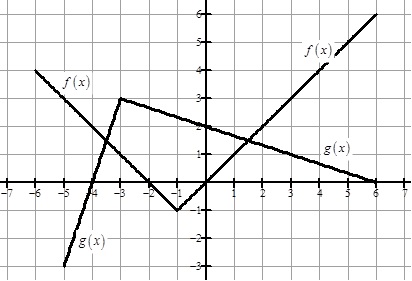
The graph below shows two piecewise defined functions, f and g, each consisting of two line segments.

  1. If h\left( x \right)=2g\left( x \right)-5f\left( x \right) calculate {h}'\left( 3 \right)
  2. If j\left( x \right)=f\left( x \right)g\left( x \right) calculate {j}'\left( -4 \right)
  3. If k\left( x \right)={{x}^{2}}f\left( x \right) calculate {k}'\left( 5 \right)
  4. If  r\left( x \right)=f\left( g\left( x \right) \right)  calculate {r}'\left( 0 \right)
  5. Write the equation of the line tangent to the graph of y=2+f\left( x \right)g\left( x \right) at the point  \left( -4,2 \right).

There are a lot more like these that you can ask from the same graph; or make up your own graph and questions.

Answers:  1. -17/3,     2. 6,     3.  75,     4. -1/3,     5. y = 2 + 6(x + 4)   (Corrected 10-3-12 19:10)

Derivative Practice – Numbers

Here is an example of how to help your students practice their derivative rules in a different way. Tomorrow another different approach.
Let f be a differentiable function. The table below gives values of f and g their first derivatives at selected values of x

x   -2    0   2   4   6
 f\left( x \right) -8 0 –2 2 5
 {f}'\left( x \right)  2  4 –3 –1 0
 g\left( x \right) 2 4 5 6 5
 {g}'\left( x \right) 1 2 4 3  2
    1. If h\left( x \right)=f\left( x \right)+3g\left( x \right) find  {h}'\left( 2 \right)
    2. If \displaystyle j\left( x \right)=\frac{f\left( x \right)}{g\left( x \right)} find  {j}'\left( 4 \right)
    3. If  r\left( x \right)=f\left( g\left( x \right) \right)  find  {r}'\left( 0 \right)
    4. If  s\left( x \right)=g\left( f\left( x \right) \right)  find  {s}'\left( 2 \right)
    5. If  q\left( x \right)=g\left( x \right)f\left( x \right) find  {q}'\left( -2 \right)
    6. Approximate  {g}'\left( 3 \right)
    7. Write an equation of the line tangent to g at the at the point where = 0.

Answers:

1. 9,     2. -1/3,     3. -2,     4. -3,     5. -5,     6. 1/2,    7.  y=4+2(x-0) or y = 4+2

The Chain Rule

Except for the simplest functions, a procedure known as the Chain Rule is very helpful and often necessary to find derivatives. You can start with an example such as finding the derivative of  {{\left( 2x+7 \right)}^{2}}.  Most students will expand the binomial to get 4{{x}^{2}}+28x+49 and differentiate the result to get 8x+28. They will try the same approach with {{\left( 2x+7 \right)}^{3}} and then you can hit them with {{\left( 2x+7 \right)}^{53}}.  They will see the need for a short cut at once. What to do?

The explanation runs like this. Let u\left( x \right)={{x}^{53}} and let v\left( x \right)=2x+7. Then our original expression becomes {{\left( 2x+7 \right)}^{53}}=u\left( v\left( x \right) \right) a composition of functions. The Chain Rule is used for differentiating compositions. Students must get good at recognizing compositions. The differentiation is done from the outside, working inward.  It is done in the exact opposite order than the procedure for evaluating expression. To evaluate the expression above you (1) evaluate the expression inside the parentheses and the (2) raise that result to the 53 power. To differentiate you (1) use the power rule to differentiate the 53 power of whatever is inside, this gives 53{{\left( 2x+7 \right)}^{52}}, the (2) differentiate the \left( 2x+7 \right) which give 2 and multiply the results: 53{{\left( 2x+{{7}^{52}} \right)}^{52}}(2)=106{{\left( 2x+7 \right)}^{52}}. Symbolically, this looks like {u}'\left( v\left( x \right) \right){v}'\left( x \right) or {f}'\left( g\left( x \right) \right){g}'\left( x \right). This can be extended to compositions of more than two functions:

\displaystyle \frac{d}{dx}f\left( g\left( h\left( x \right) \right) \right)={f}'\left( g\left( h\left( x \right) \right) \right){g}'\left( h\left( x \right) \right){h}'\left( x \right)

The cartoon below is from Courtney Gibbons’ great collection of math cartoons (http://brownsharpie.courtneygibbons.org/) may help you kids remember this:


I have been looking for a way to illustrate the Chain Rule graphically, but to no avail. The closest I could come up with is this: Consider f\left( x \right)=\sin \left( 3x \right). This function takes on all the values of y=\sin \left( x \right) in order in one-third the time. (That is its period is one-third of the period of y=\sin \left( x \right). Since this is true, it must go through the values three times as fast; thus, its derivative (it’s rate of change) must be three times the derivative of the sine: {f}'\left( x \right)=3\cos \left( 3x \right).

The students will need some practice on using the Chain Rule. I suggest a number of simple (single compositions) first and then a few longer ones and maybe one or two “monsters” just for fun once they get the idea.

The Chain Rule doesn’t end with just being able to differentiate complicated expressions; it will also form the basis for implicit differentiation, finding the derivative of a function’s inverse and Related Rate problems among others things.

Finally, here is a way to develop the Chain Rule which is probably different and a little more intuitive from what you will find in your textbook. (After a suggestion by Paul Zorn on the AP Calculus EDG October 14, 2002)

Let f be a function differentiable at x=a, and let g be a function that is differentiable at x=b and such that g\left( b \right)=a. Then, near x=a we can use the local linear approximation of f and g to find  \frac{d}{dx}f\left( g\left( b \right) \right):

f\left( x \right)\approx f\left( a \right)+{f}'\left( a \right)\left( x-a \right)

f\left( g\left( x \right) \right)\approx f\left( a \right)+{f}'\left( a \right)\left( g\left( x \right)-a \right)=f\left( a \right)+{f}'\left( a \right)g\left( x \right)-a {f}'\left( a \right)

\displaystyle \frac{d}{dx}f\left( g\left( x \right) \right)=0+{f}'\left( a \right){g}'\left( x \right)-0

\displaystyle\frac{d}{dx}f\left( g\left( b \right) \right)={f}'\left( g\left( b \right) \right){g}'\left( b \right)

Derivative Rules III

The Quotient Rule

This approach to the quotient rule is credited to Maria Gaetana Agnesi (1718 – 1799) who wrote the first known mathematics textbook Analytical Institutions (1748) to help her brothers learn algebra.

The quotient rule can also be proven from the definition of derivative. But here is a simpler approach – as a corollary of the product rule.

Begin by letting \displaystyle  h\left( x \right)=\frac{f\left( x \right)}{g\left( x \right)}.

Then

f\left( x \right)=h\left( x \right)g\left( x \right) and {f}'\left( x \right)=g\left( x \right){h}'\left( x \right)+h\left( x \right){g}'\left( x \right).

Then solving for {h}'\left( x \right):

\displaystyle {h}'\left( x \right)=\frac{{f}'\left( x \right)-h\left( x \right){g}'\left( x \right)}{g\left( x \right)}

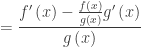
\displaystyle =\frac{{f}'\left( x \right)-\frac{f\left( x \right)}{g\left( x \right)}{g}'\left( x \right)}{g\left( x \right)}

\displaystyle =\frac{g\left( x \right){f}'\left( x \right)-f\left( x \right){g}'\left( x \right)}{{{\left( g\left( x \right) \right)}^{2}}}

Mnemonics

I’m not really one for mnemonics. I cannot spell SOHCOHTOA without saying to myself, “sine, opposite over hypotenuse; cosine, adjacent …” It seems better to me anyway to have student just memorize the formulas in words using the correct terms:

The derivative of a product is the first factor times the derivative of the second plus the second factor times the derivative of the first.

The derivative of a quotient is the denominator times the derivative of the numerator minus the numerator times the derivative of the denominator all divided by the square of the denominator.

But whatever works for you. Lo Di Hi

The Derivative Rules II

The Product Rule

Students naturally figure that the derivative of the product of two functions is the product of their derivatives. So first you must disabuse them of this idea. That is easy enough to do.

Consider two functions and their derivatives  f\left( x \right)={{x}^{7}}\text{ with }{f}'\left( x \right)=7{{x}^{6}} and g\left( x \right)={{x}^{5}}\text{ with }{g}'\left( x \right)=5{{x}^{4}}. So now f\left( x \right)g\left( x \right)={{x}^{12}} and \frac{d}{dx}\left( f\left( x \right)g\left( x \right) \right)=12{{x}^{11}}. Is this {f}'\left( x \right){g}'\left( x \right)=35{{x}^{10}}? No it is not!

But all is not lost. How can we get the correct answer from the original functions and their derivatives? Start with the 12; this comes from adding the 7 and 5 so the correct answer must be something along the lines of
12{{x}^{11}}=7{{x}^{6}}\_\_\_\_\_+5{{x}^{4}}\_\_\_\_\_

From the expression we already have what can we put in the blank spaces to get the similar terms with {{x}^{11}}? How about the original functions?
12{{x}^{11}}=7{{x}^{6}}\underline{{{x}^{5}}}+5{{x}^{4}}\underline{{{x}^{7}}}

And there is the product rule right there

You can use this same idea with other products.

You may also use the definition of derivative which you can find in most books, but bringing in zero in the form of -f\left( x+h)g\left( x \right) \right)+f\left( x+h)g\left( x \right) \right) is hardly something you would expect anyone to figure out by themselves. As I mentioned, I’m more into explaining than proving.

(This example is one of many I learned from Paul Foerster. Thanks again, Paul)


Here is another approach suggested by Dick Sisley. Thank you, Dick.

If students already know the Chain Rule:

Then–let h(x)= f(x)* f(x) = (f(x))^2 (this is a key equivalence.)

Next use the Chain Rule to get h'(x)= 2*f(x)*f ‘(x)= 2*(f ‘(x)*f(x)).

Now note that 2*(f ‘(x)*f(x))= f ‘(x)* f(x) + f ‘(x)* f(x)

The key step is then to let h(x) = f(x)*g(x) and ask students to use the result for f ‘(x)*f(x) to conjecture the result for f(x)*g(x).  There have always been some who come up with f ‘(x)*g(x) + f(x)*g'(x).  Others come up with other, non-equivalent conjectures.  But there is a way to evaluate the likelihood of every conjecture.

Use h(x)= f(x)*f(x)= x * x. We know the result should be 2*x.

Use h(x)= f(x)*f(x) = x^2 * x. We know the result should be 3*x^2.

etc.

We can experiment with products such as sin(x)*x^2.  If we use the correct conjecture pattern, we can test the reasonableness of the result using the numerical derivative feature of a graphing calculator on values the students select.

Updated 11-6-2013


Next The Quotient Rule.

The Derivative Rules I

The time is approaching when you will want and need to find derivatives quickly. I am afraid that, with the exception of the product rule, I have no particularly clever ideas of how to how to teach this.

I am inclined to offer some explanation, short of a lot of proofs, to students as to why the rules and procedure are what they are. To that end I would start with some simple formulas using the (limit) definition of derivative.

  • The derivative of constant times a function is the constant times the derivative of the function. This is easy enough to show from the definition since constants may be factors out of limits
  • Likewise, the derivative of a sum or difference of functions is the sum of difference of the derivatives of the functions. This too follows easily from the properties of limits.
  • For powers, keeping in mind the guesses from mention previously in the previous two posts “The Derivative I and II”, I suggest the method that all the books show. For example to find the derivative of x3 write

\displaystyle \underset{h\to 0}{\mathop{\lim }}\,\frac{{{\left( x+h \right)}^{3}}-{{x}^{3}}}{h}=\underset{h\to 0}{\mathop{\lim }}\,\frac{{{x}^{3}}+3{{x}^{2}}h+3x{{h}^{2}}+{{h}^{3}}-{{x}^{3}}}{h}

\displaystyle =\underset{h\to 0}{\mathop{\lim }}\,\left( 3{{x}^{2}}h+3x{{h}^{2}} \right)=3{{x}^{2}}

And perhaps a one or two more until the students are convinced of the pattern.

  • For trigonometric functions follow your textbook: use the definition and the formula for the sine of the sum of two numbers along with the two special limits.

The next post will concern the product and quotient rules.