March

The AP Calculus exams this year are on Tuesday morning May 5, 2015. Most of you will be finishing your new work this month and getting ready to review. As usual I like to stay a little ahead of where you are so you have time to consider what is offered here.

To help you plan ahead, below are links to previous posts specifically on reviewing for the AP Calculus exams and on the type questions that appear on the free-response sections of the exams.

I suggest you review by topic spending 1 – 3 days on each type so that students can see the things that are asked for and the different ways they are asked. Most of the questions include topics taught at different times during the year; students are not used to this. By considering each type separately students will learn how to pull together what they have been studying all year.

Many of the same ideas are tested in smaller “chunks” on the multiple-choice sections, so looking at the type should help with not only free-response questions but many of the multiple-choice questions as well. You may also find multiple-choice questions for each of the types and assign a few of them along with the corresponding free-response type.

Ideas for Reviewing for the AP Calculus Exams

Calculator Use on the AP Exams (AB & BC)

Interpreting Graphs AP Type Questions 1  chalkboard_math_notes

The Rate/Accumulation Question AP Type Question 2

Area and Volume Questions AP Type Question 3

Motion on a Line AP Type Question 4

The Table Question AP Type Question 5

Differential Equations AP Type Question 6

Implicit Relations and Related Rates AP Type Question 7 

Parametric and Vector Equations AP Type Question 8 (BC)

Polar Curves AP Type Question 9 (BC)

Sequences and Series AP Type Question 10 (BC)

I’ll be traveling this month to do some workshops and will not be posting too much new until I return.

Variations on a Theme by ETS

Experienced AP calculus teacher use as many released exam questions during the year as they can. They are good questions and using them gets the students used to the AP style and format.  They can be used “as is”, but many are so rich that they can be tweaked to test other concepts and to make the students think wider and deeper.  

Below is a multiple-choice question from the 2008 AB calculus exam, question 9.

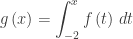
 2008 mc9The graph of the piecewise linear function f  is shown in the figure above. If \displaystyle g\left( x \right)=\int_{-2}^{x}{f\left( t \right)\,dt}, which of the following values is the greatest?

(A)  g(-3)         (B)  g(-2)         (C)  g(0)         (D)  g(1)         (E)  g(2)

I am now going to suggest some ways to tweak this question to bring out other ideas. Here are my suggestions. Some could be multiple-choice others simple short constructed response questions. A few of these questions, such as 3 and 4, ask the same thing in different ways.

      1. Require students to show work or justify their answer even on multiple-choice questions. So for this question they should write, “The answer is (D) g(1) since x = 1 is the only place where {g}'\left( x \right)=f\left( x \right) changes from positive to negative.” 
      2. Ask, “Which of the following values is the least?” (Same choices)
      3. Find the five values listed.
      4. Put the five values in order from smallest to largest.
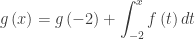
      5. If \displaystyle g\left( x \right)=g\left( -2 \right)+\int_{-2}^{x}{f\left( t \right)dt} and the maximum value of g is 7, what is the minimum value?
      6. If \displaystyle g\left( x \right)=g\left( -2 \right)+\int_{-2}^{x}{f\left( t \right)dt} and the minimum value of g is 7, what is the maximum value?
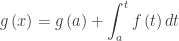
      7. Pick any number (not just an integers) in the interval [–3, 2] to be a and change the stem to read, “If \displaystyle g\left( x \right)=g\left( a \right)+\int_{a}^{x}{f\left( t \right)dt} ….” And then ask any of the questions above – some answers will be different, some will be the same. Discussing which will not change and why makes a worthwhile discussion.
      8. Change the equation in the stem to \displaystyle g\left( x \right)=3x+\int_{-2}^{x}{f\left( t \right)dt} and ask the questions above. Again most of the answers will change. Also this question and the next start looking like some free-response questions. Compare them with 2011 AB 4 and 2010 AB 5(c)
      9. Change the equation in the stem to \displaystyle g\left( x \right)=-\tfrac{3}{2}x+\int_{-2}^{x}{f\left( t \right)dt} and ask the questions above. This time most of the answers will change.
      10. Change the graph and ask the same questions.

Not all questions offer as many variations as this one. For some about all you can do is use them “as is” or just change the numbers.

Any other adaptations you can think of?

What is your favorite question for tweaking?

 Math in the News Combinatorics and UPS

Revised: August 24, 2014

Getting Ready for the Exam

I think the idea of writing this blog came to me about this time last year when folks were looking for last-minute advice to give their students before the AP calculus exams. I had some ideas of my own and collected some from others. Here is a list in no particular order.

The review time

  • Concentrate your reviewing on the things you don’t know (yet). Try to pick up those details you are not too sure of.
  • Work as many actual AP problems as you can, but concentrate on the form and ideas. None of these questions will be on the test, but many very much like these will be.
  • With, or without your class, find one (or more) of the released exams and take it in one sitting with the time allowed for each section.  This is to get you used to the real timing and the fact that you may not finish one or more sections.

The day before the test

  • Take a good look at the various formulas you will need; be sure you have them memorized correctly.
  • Put fresh batteries in you calculator and be sure it is in radian mode.
  • Take the afternoon and evening off. Relax. Do something fun.
  • Get to bed early and get a good night’s sleep.
  • Have a good breakfast.
  • Bring a snack for the short break between the two sections of the test.
  • Get Psyched!

During the test

  • Don’t panic! There is no extra credit for 100%. You may miss quite a few points and still get a 5; and quite a few more and get a 3.
  • Concentrate on the things you know. If you don’t know a how to do a problem, go onto the next one.
  • Keep your eye on the clock. Just before the multiple-choice sections are over, bubble in anything you left blank – there is no penalty for guessing.
  • On the free-response section, do not do arithmetic or algebraic simplification – it is not required and simplifying a correct answer incorrectly will lose a point. And it wastes time.
  • Don’t get bogged down in a problem – if you are not getting anywhere, stop and go to the next part or next question.

Good Luck!

Calculator Use on the AP Exams

In my final post on reviewing for the AP Calculus exams I return to calculator use.

I hope everyone has been using calculators all year long. (My opinion is that students should be given a CAS calculator, or CAS computer program, or now even an iPad CAS app on the first day of Algebra 1 before they get their books – or earlier. But we’ll save that for another post.)

The exam will not instruct students when or if to use a calculator on a particular question. Sometimes the multiple-choice answers will provide a big hint (if the choices are decimals), other times not. On the free-response questions if the problem can be done by calculator it is expected that students will use their calculator – they don’t have to, but there is no credit for finding an antiderivative or a derivative by hand. It is the numerical answer that counts.

Here again is what students are allowed to do on the exams with their calculator without showing any additional work.

  • Graph a function in a window. They may have to determine the window themselves.
  • Solve an equation. This is usually best done by graphing both sides and finding the point(s) of intersection, but any equation solving routine in the calculator may be used.
  • Find the numerical value of a derivative at a point.
  • Evaluate a definite integral.

For the last three items students should write what they are doing on their paper. That is, write the equation, the definite integral or {v}'\left( 3.5 \right)= followed by the number from their calculator. Use standard notation not calculator syntax.

For anything else, the work must be shown. Calculators can find extreme values, but readers will look for the appropriate “calculus” and not just the answer. In fact, a correct answer with no supporting work may not receive any credit.

Another handy skill is to be able to store and recall the numbers found without retyping them on their calculator. This saves time, students are less likely to make a typing mistake, and it avoids round off error.

Answers from calculators should be correct to three places after the decimal point. This does not mean they must be rounded or truncated; more places may be given as long as the first three are correct.

Remember that arithmetic simplification is not required. Only answers from calculators need to be given as decimals. If the computation gives 1 + 1, or 6\pi  or ½ + cos(3) or \sin \left( \tfrac{\pi }{6} \right) then the answer may be left that way. This also applies to a long expression resulting from a Riemann sum. Once the answer consists of all numbers, stop! You cannot make the answer any better and if you make a mistake or type the wrong key, then the final answer will be wrong and the point will be lost.
Be careful not to round too soon. If, for example, a student find the limits of integration and rounds them to three places to write on their paper, they will have earned the point given for limits of integration. BUT if these rounded values are then used to compute the integral and the rounding causes the final answer to not be correct to three places then they will lose the answer point.

Finally, get a copy of the directions for the two parts of the exam and go over them with your students before the test. Be sure students understand them.

Good luck to your students on the exam. Nah, luck has nothing to do with it. You prepared them well, they will do well.

Interpreting Graphs

AP Type Questions 1

The long name is “Here’s the graph of the derivative, tell me things about the function.”

Most often students are given the graph identified as the derivative of a function. There is no equation given and it is not expected that students will write the equation (although this may be possible); rather, students are expected to determine important features of the function directly from the graph of the derivative. They may be asked for the location of extreme values, intervals where the function is increasing or decreasing, concavity, etc. They may be asked for function values at points.

The graph may be given in context and student will be asked about that context. The graph may be identified as the velocity of a moving object and questions will be asked about the motion and position. (Motion problems will be discussed as a separate type in a later post.)

Less often the function’s graph may be given and students will be asked about its derivatives.

What students should be able to do:

  • Read information about the function from the graph of the derivative. This may be approached as a derivative techniques or antiderivative techniques.
  • Find where the function is increasing or decreasing.
  • Find and justify extreme values (1st  and 2nd derivative tests, Closed interval test, aka.  Candidates’ test).
  • Find and justify points of inflection.
  • Find slopes (second derivatives, acceleration) from the graph.
  • Write an equation of a tangent line.
  • Evaluate Riemann sums from geometry of the graph only.
  • FTC: Evaluate integral from the area of regions on the graph.
  • FTC: The function, g(x), maybe defined by an integral where the given graph is the graph of  the integrand, f(t), so students should know that if,  \displaystyle g\left( x \right)=g\left( a \right)+\int_{a}^{t}{f\left( t \right)dt} then  {g}'\left( x \right)=f\left( x \right)  and  {{g}'}'\left( x \right)={f}'\left( x \right).

The ideas and concepts that can be tested with this type question are numerous. The type appears on the multiple-choice exams as well as the free-response. They have accounted for almost 25% of the points available on recent test. It is very important that students are familiar with all of the ins and outs of this situation.

As with other questions, the topics tested come from the entire year’s work, not just a single unit. In my opinion many textbooks do not do a good job with these topics.

Study past exams; look them over and see the different things that can be asked.

For some previous posts on this subject see October 151719, 24, 26, 2012 January 25, 28, 2013

The AP Calculus Exams

I assume that most of my readers are AP Calculus teachers. The year is coming to an end and it is time to think about reviewing for the exams. For the next few weeks my posts will discuss how to review for the AP calculus exams. Don’t panic if you’re not done yet; it’s too early for that. I am just trying to stay ahead of you so you’ll be able to think this over before its time to use it.

The first post will be some general information about the exam for your students. After that there will be a series of post on each of the “type” problems that appear on the free-response sections exams. A good way to review is to spend 2 – 3 days on each type so that students can see what and how each topic is tested. Doing so will help them not only with the free-response questions, but also with the multiple-choice questions which test the same concepts in bits and pieces.

I would like you to share your ideas as well. Please respond by clicking on “Comments” at the end of each post with your suggestions. You can also find what I’ve written about specific topics by using the search box or the categories list in the right-side column, or by clicking on any of the words in the tag cloud at the bottom of the page. This will bring up all the post about that topic.

Ideas for Reviewing for the AP Exams

Part of the purpose of reviewing for the AP calculus exams is to refresh your students’ memory on all the great things you’ve taught them during the year. The other purpose is to inform them about the format of the exam, the style of the questions, the way they should present their answer and how the exam is graded and scored.

Using AP questions all year is a good way to accomplish some of this. Look through the released multiple-choice exam and pick questions related to whatever you are doing at the moment. Free-response questions are a little trickier since the parts of the questions come from different units. These may be adapted or used in part.

At the end of the year, I suggest you review the free-response questions by type – table questions, differential equations, area/volume, rate/accumulation, graph, etc. That is, plan to spend a few days doing a selection of questions of one type so that student can see how the way that type question can be used to test a variety of topics. Then go onto the next type. Many teachers keep a collection of past free-response questions filed by type rather than year. This makes it easy to study them by type.

In the next few posts I will discuss each type in turn and give suggestions about what to look for and how to approach the question.

Simulated Exam

Plan to give a simulated exam. Each year the College Board makes a full exam available. The exams for 1998, 2003, 2008 are available at AP Central and the 2012 and the 2013 exams are available through your audit website. If possible find a time when your students can take the exam in 3.25 hours. Teachers often do this on a weekend. This will give your students a feel for what it is like to work calculus problems under test conditions. If you cannot get 3.25 hours to do this give the sections in class using the prescribed time. Some teachers schedule several simulated exam. Of course you need to correct them and go over the most common mistakes.

Explain the scoring

There are 108 points available on the exam; each half is worth the same – 54 points. The number of points required for each score is set after the exams are graded.

For the AB exam the points required for each score out of 108 point are, very approximately:

  • for a 5 – 69 points,
  • for a 4 – 52 points,
  • for a 3 – 40 points,
  • for a 2 – 28 points.

The numbers are similar for the BC exams are again very approximately:

  • for a 5 – 68 points,
  • for a 4 – 58 points,
  • for a 3 – 42 points,
  • for a 2 – 34 points.

The actual numbers are not what is important. What is important is that students can omit or get wrong a large number of questions and still get a good score. Students may not be used to this (since they skip or get wrong so few questions on your tests). They should not panic or feel they are doing poorly if they miss a number of questions. If they understand and accept this in advance they will calm down and do better on the exams. Help them understand they should gather as many points as they can, and not be too concerned if the cannot get them all. Doing only the first 2 parts of a free-response question will probably put them at the mean for that question. Remind them not to spend time on something that’s not working out, or that they don’t feel they know how to do.

Resources

Here are several resources that will help you get started:

  • “The AP Calculus Exam: How, not only to Survive, but to Prevail…” – Advice for students on the format of the exam and do’s and don’ts for the exam. Print this and share it with your students.
  • The  AB Directions and BC Directions. Yes, this is boiler plate stuff, but take a few minutes to go over it with your students. They should not have to see the directions for the first time on the day of the exam. I have highlighted some of the more important directions
  • Calculator Skills – share this information with your students, if you have not already done so. There are only about 12 -15 points on the entire exam which require a calculator. A calculator alone will not get anyone a 5 (or even a 2). Nevertheless, the points are there and usually pretty easy to earn. The real reason calculators and other technology are so important is that when used throughout the year, they help students better understand the calculus.

The next post: The Graph Stem Question