Why Existence Theorems?

An existence theorem is a theorem that says, if the hypotheses are met, that something, usually a number, must exist.

For example, the Mean Value Theorem is an existence theorem: If a function f is defined on the closed interval [a, b] and differentiable on the open interval (a, b), then there exists a number c in the open interval (a, b) such that \displaystyle {f}'\left( c \right)\left( {b-a} \right)=f\left( b \right)-f\left( a \right).

The phrase “there exists” also means “there is” and “there is at least one.” In fact, it is a good idea when seeing an existence theorem to reword it using each of these other phrases. “There is at least one” reminds you that there may be more than one number that satisfies the condition. The mathematical shorthand for these phrases is an upper-case E written backwards: \displaystyle \exists .

  • …then there is a number c in the open interval (a, b) such that…
  • …then there is at least one number c in the open interval (a, b) such that…
  • …then \displaystyle \exists c in the open interval (a, b) such that…

Textbooks, after presenting an existence theorem, usually follow-up with some exercises asking you to actually find the value that exists: “Find the value of c guaranteed by the Mean Value Theorem for the function … on the interval ….” These exercises may help you remember the formula involved.

But, the important thing about most existence theorems is that the number exists, not what the number is.

Other important existence theorems in calculus

The Intermediate Value Theorem

If f is continuous on the interval [a, b] and M is any number between f(a) and f(b), then there exists a number c in the open interval (a, b) such that f(c) = M.

Another wording of the IVT: If f is continuous on an interval and f changes sign in the interval, then there must be at least one number c in the interval such that f(c) = 0

Extreme Value Theorem

If f is continuous on the closed interval [a, b], then there exists a number c in [a, b] such that \displaystyle f\left( c \right)\ge f\left( x \right) for all x in the interval.

Another wording: Every function continuous on a closed interval has (i.e. there exists) a maximum value in the interval.

If f is continuous on the closed interval [a, b], then there exists a number c in [a, b] such that \displaystyle f\left( c \right)\le f\left( x \right) for all x in the interval. Or: Every function continuous on a closed interval has (i.e. there exists) a minimum value in the interval.

Critical Points

If f is differentiable on a closed interval and \displaystyle {f}'\left( x \right) changes sign in the interval, then there exists a critical point in the interval.

Rolle’s theorem

If a function f is defined on the closed interval [a, b] and differentiable on the open interval (a, b) and f(a) = f(b), then there must exist a number c in the open interval (a, b) such that \displaystyle {f}'\left( c \right)=0.

Mean Value Theorem – Other forms

If I drive a car continuously for 150 miles in three hours, then there is a time when my speed was exactly 50 mph.

If a function f is defined on the closed interval [a, b] and differentiable on the open interval (a, b), then there is a point on the graph of f where the tangent line is parallel to the segment between the endpoints.

Cogito, ergo sum

And finally, we have Descartes’ famous “theorem:” Cogito, ergo sum (in Latin) or in the original French, Je pense, donc je suis, translated as “I think, therefore I am” proving his own existence.


Why Definitions?

Definitions name things; mathematical definitions name things very precisely.

A good definition (in mathematics or anywhere) names the thing defined in a sentence that,

  1. Puts the thing into the nearest class of similar objects.
  2. Gives its distinguishing characteristic (not all its attributes, only those that set it apart).
  3. Uses simpler (previously defined) terms.
  4. Is reversible.

An example from geometry: A rectangle is a parallelogram with one right angle.

THING DEFINED: rectangle.

NEAREST CLASS OF SIMILAR OBJECTS: parallelogram.

DISTINGUISHING CHARACTERISTIC: one right angle. The other characteristics – the other three right angles, opposite sides parallel, opposite sides congruent, etc. – can all be proven as theorems based on the properties of a parallelogram and the one right angle. No need to mention them in the definition. This also helps keep the definition as short as possible.

PREVIOUSLY DEFINED TERMS: parallelogram, right angle. These you are assumed to know already; they have been previously defined.

IS REVERSIBLE: This means that, if someone gives you a rectangle, then without looking at it you know you have a parallelogram and it has a right angle, AND if someone gives you a parallelogram with a right angle, you may be absolutely sure it is a rectangle. In fact, you could write the definition the other way around: A parallelogram with one right angle, is a rectangle. Either way is okay.

Definitions often use the phrase … if, and only if.... For example: A parallelogram is a rectangle if, and only if, it has a right angle. The phrase indicates reversibility: the statement and its converse (and therefore, its contrapositive and inverse) are true.

When you get a new term or concept defined in calculus (or anywhere else), take a minute to learn it. Look for the nearest class of similar things, its distinguishing characteristics, and be sure you understand the previously defined terms. Try reversing it; say it the other way around. At that point you’ll pretty much have it memorized.

Definitions are never proved. There is nothing to prove; they just name something. Statements in mathematics that need to be proved are called theorems.

Finally, you may take the words in bold above as the definition of a definition!


Why Theorems?

All the important things in mathematics are written as theorems.

Theorems are statements of mathematical facts that have been proven to be true based on axioms, definitions, and previously proved theorems. They summarize information in a general way so that it may be applied to specific new situations.

All the rules, formulas, laws, etc. that you study in mathematics are really theorems.

The form of a theorem is IF one or more things are true, THEN something else is true. For example, IF a function is differentiable at a point, THEN it is continuous at the point.

The IF part is called the hypothesis (the function is differentiable at a point) and the THEN part is called the conclusion (the function is continuous at the point). 

The word “implies” can replace the IF and the THEN. So, the theorem above may be shortened to “Differentiability implies continuity.” When this happens be sure you understand what has been omitted.

HINT: It is always a good idea when learning a new theorem to identify the hypothesis and the conclusion for yourself.

Proof

The proof of a theorem is an outline of the reasoning that shows how previous results (axioms, definitions, and previous theorems) lead to the conclusion. They are carefully written to convince mathematicians and other interested people that the theorem is true.

In AP Calculus, you will not prove every theorem. The reason you as beginning calculus students should look at proof is (1) to help you understand why the theorem is true, and (2) to begin learning how to do proof yourself.

Good news / bad news: You will not be asked to prove theorems on the AP Calculus exams. You will be asked to “justify your answer” or “show your reasoning” or the like. To do this you will need to state that hypotheses of the theorem you are using are true for the situation in the question and therefore, you may say that the conclusion applies in this case. To use the theorem in the example, you would have to establish that the function you are given is differentiable, then you may say it is continuous.

for any theorem, you need to know and understand both the hypothesis and the conclusion.

Related Statement: The Contrapositive

The contrapositive of a theorem is a statement that says if the original theorem’s conclusion is false, then its hypothesis is false. This makes sense: When the original hypothesis is true, the conclusion must be true. So, if the conclusion is false something must be wrong with the hypothesis. For any theorem, its contrapositive is always a true theorem.

The contrapositive of the example above is “If a function is not continuous at a point, then it is not differentiable there.” In fact, this particular contrapositive is one you will be using soon.

 Related Statement: The Converse

The converse of a theorem is formed by interchanging the hypothesis and the conclusion. The converse of our example is “If a function is continuous at a point, then it is differentiable there.” This statement is false! There are continuous functions that are not differentiable. An example is the absolute value function at the origin.

Converses may or may not be true. They must be proved separately, if possible. It is a mistake to assume the converse is true without first proving it. This mistake is so common it has a name; it is called the fallacy of the converse.

Related Statement: The Inverse

The inverse is (hold on tight) the contrapositive of the converse. It states that if the original hypothesis is false, then the original conclusion is false. for our example: “If a function is not differentiable, then it is not continuous.” (This example is false.)

The inverse is not necessarily true; it is true if the converse is true. Like the theorem / contrapositive pair, the converse / inverse pair are true or false together. Sometimes all four are true, sometimes not.

Finally, any of the four statements may be considered “the theorem” and the other three will change their names accordingly. The theorem states the idea in the form in which it is usually used. The converse, if it is important and true, is given and proved separately at the same time. The contrapositive and the inverse go along for the ride and do not have to be proved separately.


Differentiability Implies Continuity

An important theorem concerning derivatives is this:

If a function f is differentiable at x = a, then f is continuous at x = a.

The proof begins with the identity that for all x\ne a

\displaystyle f\left( x \right)-f\left( a \right)=\left( {x-a} \right)\frac{{f\left( x \right)-f\left( a \right)}}{{x-a}}

\displaystyle \underset{{x\to a}}{\mathop{{\lim }}}\,\left( {f\left( x \right)-f\left( a \right)} \right)=\underset{{x\to a}}{\mathop{{\lim }}}\,\left( {\left( {x-a} \right)\frac{{f\left( x \right)-f\left( a \right)}}{{x-a}}} \right)=\underset{{x\to a}}{\mathop{{\lim }}}\,\left( {x-a} \right)\cdot \underset{{x\to a}}{\mathop{{\lim }}}\,\frac{{f\left( x \right)-f\left( a \right)}}{{x-a}}

\displaystyle \underset{{x\to a}}{\mathop{{\lim }}}\,\left( {f\left( x \right)-f\left( a \right)} \right)=0\cdot {f}'\left( a \right)=0

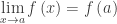
And therefore, \underset{{x\to a}}{\mathop{{\lim }}}\,f\left( x \right)=f\left( a \right)

Since both sides are finite, the function is continuous at x = a.


The converse of this theorem is false: A continuous function is not necessarily differentiable. A counterexample is the absolute value function which is continuous at the origin but not differentiable there. (The slope approaching from the left is not equal to the slope from the right.)

This is a theorem whose contrapositive is used as much as the theorem itself. The contrapositive is,

If a function is not continuous at a point, then it is not differentiable there.

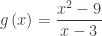
Example 1: A function such as  \displaystyle g\left( x \right)=\frac{{{{x}^{2}}-9}}{{x-3}} has a (removable) discontinuity at x = 3, but no value there.

So, in the limit definition of the derivative, \displaystyle \text{ }\!\!~\!\!\text{ }\underset{{h\to 0}}{\mathop{{\lim }}}\,\frac{{g\left( {3+h} \right)-g\left( 3 \right)}}{h} there is no value of g(3) to use, and the derivative does not exist.

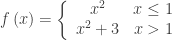
Example 2:  \displaystyle f\left( x \right)=\left\{ {\begin{array}{*{20}{c}} {{{x}^{2}}} & {x\le 1} \\ {{{x}^{2}}+3} & {x>1} \end{array}} \right.. This function has a jump discontinuity at x = 1.

Since the point (1, 1) is on the left part of the graph, if h > 0, f\left( {1+h} \right)-f\left( 1 \right)>3 and the limit  will always be a number greater than 3 divided by zero and will not exist. Therefore, even though the slopes from both side of x =1 approach the same value, namely 2, the derivative does not exist at x = 1.

This also applies to a situation like example 1 if f(3) were some value that did not fill in the hole in the graph.


On the AP Calculus exams students are often asked about the derivative of a function like those in the examples, and the lack of continuity should be an immediate clue that the derivative does not exist. See 2008 AB 6 (multiple-choice).

Just as important are questions in which the function is given as differentiable, but the student needs to know about continuity. Just remember: differentiability implies continuity. See 2013 AB 14 in which you must realize the since the function is given as differentiable at x = 1, it must be continuous there to solve the problem.


Continuity of the Derivative

A question that comes up is, if a function is differentiable is its derivative differentiable? The answer is no. While almost always the derivative is also differentiable, there is this counterexample:

\displaystyle f\left( x \right)=\left\{ {\begin{array}{*{20}{c}} {{{x}^{2}}\sin \left( {\frac{1}{x}} \right)} & {x\ne 0} \\ 0 & {x=0} \end{array}} \right.

The first line of the function has a removable oscillating discontinuity at x = 0, but since the \displaystyle {{x}^{2}} factor squeezes the function to the origin; the added condition that \displaystyle f\left( 0 \right)=0 makes the function continuous. Differentiating gives

\displaystyle {{f}^{'}}\left( x \right)={{x}^{2}}\cos \left( {\frac{1}{x}} \right)\left( {\frac{{-1}}{{{{x}^{2}}}}} \right)+2x\sin \left( {\frac{1}{x}} \right)=-\cos \left( {\frac{1}{x}} \right)+2x\sin \left( {\frac{1}{x}} \right)

And now there is no way to get around the oscillating discontinuity at x = 0.


Then there is this – Existence Theorems

Existence Theorems

An existence theorem is a theorem that says, if the hypotheses are met, that something, usually a number, must exist.

For example, the Mean Value Theorem is an existence theorem: If a function f is defined on the closed interval [a, b] and differentiable on the open interval (a, b), then there exists a number c in the open interval (a, b) such that \displaystyle {f}'\left( c \right)\left( {b-a} \right)=f\left( b \right)-f\left( a \right).

The phrase “there exists” can also mean “there is” and “there is at least one.” In fact, it is a good idea when seeing an existence theorem to reword it using each of these other phrases. “There is at least one” reminds you that there may be more than one number that satisfies the condition. The mathematical symbol for these phrases is an upper-case E written backwards: \displaystyle \exists .

Textbooks, after presenting an existence theorem, usually follow-up with some exercises asking students to find the value for a given function on a given interval: “Find the value of c guaranteed by the Mean Value Theorem for the function … on the interval ….” These exercises may help students remember the formula involved but are not very useful otherwise.

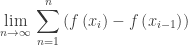
The important thing about most existence theorems is that the number exists, not what the number is. To illustrate this, let’s consider the Fundamental Theorem of Calculus. After partitioning the interval [a, b] into subintervals at various values, xi, we consider the limit of the sum

\displaystyle \underset{{n\to \infty }}{\mathop{{\lim }}}\,\sum\limits_{{n=1}}^{n}{{\left( {f\left( {{{x}_{i}}} \right)-f\left( {{{x}_{{i-1}}}} \right)} \right)}}.

Write out a few terms and you will see that is a telescoping series and its limit is \displaystyle f\left( b \right)-f\left( a \right).

The expression \displaystyle {f\left( {{{x}_{i}}} \right)-f\left( {{{x}_{{i-1}}}} \right)} resembles the right side of the Mean Value Theorem above. Since all the conditions are met, the MVT tells us that in each subinterval \displaystyle [{{x}_{{i-1}}},{{x}_{i}}] there exists a number, call it ci , such that

\displaystyle {f}'\left( {{{c}_{i}}} \right)\left( {{{x}_{i}}-{{x}_{{i-1}}}} \right)=f\left( {{{x}_{i}}} \right)-f\left( {{{x}_{{i-1}}}} \right) and therefore

\displaystyle \underset{{n\to \infty }}{\mathop{{\lim }}}\,\sum\limits_{{n=1}}^{n}{{\left( {f\left( {{{x}_{i}}} \right)-f\left( {{{x}_{{i-1}}}} \right)} \right)}}=\underset{{n\to \infty }}{\mathop{{\lim }}}\,\sum\limits_{{n=1}}^{n}{{{f}'\left( {{{c}_{i}}} \right)\left( {{{x}_{i}}-{{x}_{{i-1}}}} \right)}}=f\left( b \right)-f\left( a \right)

No one is concerned what these ci are, just that there are such numbers, that they exist. (The second limit above is then defined as the definite integral so \displaystyle \underset{{n\to \infty }}{\mathop{{\lim }}}\,\sum\limits_{{n=1}}^{n}{{{f}'\left( {{{c}_{i}}} \right)\left( {{{x}_{i}}-{{x}_{{i-1}}}} \right)}}=\int_{a}^{b}{{{f}'\left( x \right)dx=}}f\left( b \right)-f\left( a \right) – The Fundamental Theorem of Calculus.)

Other important existence theorems in calculus

The Intermediate Value Theorem

If f is continuous on the interval [a, b] and M is any number between f(a) and f(b), then there exists a number c in the open interval (a, b) such that f(c) = M.

If f is continuous on an interval and f changes sign in the interval, then there must be at least one number c in the interval such that f(c) = 0

Extreme Value Theorem

If f is continuous on the closed interval [a, b], then there exists a number c in [a, b] such that \displaystyle f\left( c \right)\ge f\left( x \right) for all x in the interval. Every function continuous on a closed interval has (i.e. there exists) a maximum value in the interval.

If f is continuous on the closed interval [a, b], then there exists a number c in [a, b] such that \displaystyle f\left( c \right)\le f\left( x \right) for all x in the interval. Every function continuous on a closed interval has (i.e. there exists) a minimum value in the interval.

Critical Points

If f is differentiable on a closed interval and \displaystyle {f}'\left( x \right) changes sign in the interval, then there exists a critical point in the interval.

Rolle’s theorem

If a function f is defined on the closed interval [a, b] and differentiable on the open interval (a, b) and f(a) = f(b), then there must exist a number c in the open interval (a, b) such that \displaystyle {f}'\left( c \right)=0.

MVT – other forms

If I drive a car continuously for 150 miles in three hours, then there is a time when my speed was exactly 50 mph.

If a function f is defined on the closed interval [a, b] and differentiable on the open interval (a, b), then there is a point on the graph of f where the tangent line is parallel to the segment between the endpoints.

Taylor’s Theorem

If f is a function with derivatives through order n + 1 on an interval I containing a, then, for each x in I , there exists a number c between x and a such that

\displaystyle f\left( x \right)=\sum\limits_{k=0}^{n}{\frac{{{f}^{\left( k \right)}}\left( a \right)}{k!}{{\left( x-a \right)}^{k}}}+\frac{{{f}^{\left( n+1 \right)}}\left( c \right)}{\left( n+1 \right)!}{{\left( x-a \right)}^{n+1}}

The number \displaystyle R=\frac{{{f}^{\left( n+1 \right)}}\left( c \right)}{\left( n+1 \right)!}{{\left( x-a \right)}^{n+1}} is called the remainder. The equation above says that if you can find the correct c the function is exactly equal to Tn(x) + R. Notice the form of the remainder is the same as the other terms, except it is evaluated at the mysterious c. The trouble is we almost never can find the c without knowing the exact value of f(x), but; if we knew that, there would be no need to approximate. However, often without knowing the exact values of c, we can still approximate the value of the remainder and thereby, know how close the polynomial Tn(x) approximates the value of f(x) for values in x in the interval, i. See Error Bounds and the Lagrange error bound.

Cogito, ergo sum

And finally, we have Descartes’ famous “theorem” Cogito, ergo sum (in Latin) or the original French, Je pense, donc je suis, translated as “I think, therefore I am” proving his own existence.



Y the FTC?

So, you’ve finally proven the Fundamental Theorem of Calculus and have written on the board:

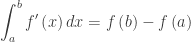
\displaystyle \int_{a}^{b}{{{f}'\left( x \right)dx=f\left( b \right)-f\left( a \right)}}

And the students ask, “What good is that?” and “When are we ever going to use that?” Here’s your answer.

There are two very important uses of this theorem. Show them BOTH uses right away to help your students see why the FTC is so useful and important.

First, in words the theorem says that “the integral of a rate of change is the net amount of change.” So, if you are given a rate of change (as you are every year on the AP Calculus exam) and asked to find the amount of change (as you are every year on the AP Calculus exam), this is what you use, Show an example such as 2015 AB 1/BC1 that states,

“The rate at which rainwater flows into a drain pipe is modeled by the function R, where R\left( t \right)=20\sin \left( {\frac{{{{t}^{2}}}}{{35}}} \right) cubic feet per hour….

“(a) How many cubic feet of rainwater flow into the pipe during the 8-hour time interval ?”

The answer is of course, \displaystyle \int_{0}^{8}{{20\sin \left( {\frac{{{{t}^{2}}}}{{35}}} \right)dt}}. (Which they will soon learn how to evaluate.)

Second, a more immediate use is to avoid all that work you’ve been doing setting up Riemann sums and finding their limits. No more of that! Give them this integral to evaluate:

\displaystyle \int_{2}^{7}{{2xdx}}

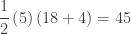
Draw the trapezoid representing the area between the graph of y=2x and the x-axis on the interval [2,7] and find its area =  \displaystyle \frac{1}{2}\left( 5 \right)\left( {18+4} \right)=45
Then ask, “Does anyone know of a function whose derivative is 2x?” Let them think for a minute and someone will say, “Yeah, it’s {{x}^{2}}”  And then show them

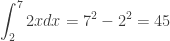
\displaystyle \int_{2}^{7}{{2xdx}}={{7}^{2}}-{{2}^{2}}=45

Then go for a harder one:  \displaystyle \int_{0}^{{\frac{\pi }{2}}}{{\cos \left( x \right)dx}}

“Does anyone know a function whose derivative is \cos \left( x \right)?”

“Why yes, it’s \sin \left( x \right)

So, \displaystyle \int_{0}^{{\frac{\pi }{2}}}{{\cos \left( x \right)dx}}=\sin \left( {\frac{\pi }{2}} \right)-\sin \left( 0 \right)=1-0=1

That was easy!

If you want to challenge them and review some functions of the “special angles” try this one:

\displaystyle \int_{{\frac{\pi }{6}}}^{{\frac{{4\pi }}{3}}}{{\cos \left( x \right)dx}}=\sin \left( {\frac{{4\pi }}{3}} \right)-\sin \left( {\frac{\pi }{6}} \right)=\frac{{\sqrt{3}}}{2}-\frac{1}{2}

Tie the two parts together: Look at the graph of y=\sin \left( x \right). How much does it change from 0 to \frac{\pi }{2}? How much does it change from \frac{\pi }{6} to \frac{{4\pi }}{3}?

Sum up, by looking ahead:

  1. “The function whose derivative is …” is called the antiderivative.
  2. Using antiderivatives to evaluate definite integrals is easy; the hard part is finding the antiderivatives, since they are not all as straightforward as the two examples above. So, next we need to spend a few weeks learning how to find antiderivatives.[1]
  3. Given a derivative, finding its antiderivative is also the start of solving differential equations. This, too, will soon be a concern in the course.

[1] As I’ve written before, this is where it seems logical place to teach antiderivatives. Now students have a reason to find them. Teaching antidifferentiation after differentiation, before integration, seems like an intellectual exercise. Sure, it’s fun, but now we have a need for it.


Inverses

This series of posts reviews and expands what students know from pre-calculus about inverses. This leads to finding the derivative of exponential functions, ax, and the definition of e, from which comes the definition of the natural logarithm.

Inverses Graphically and Numerically

The Range of the Inverse

The Calculus of Inverses

The Derivatives of Exponential Functions and the Definition of e and This pair of posts shows how to find the derivative of an exponential function, how and why e is chosen to help this differentiation.

Logarithms Inverses are used to define the natural logarithm function as the inverse of ex. This follow naturally from the work on inverses. However, integration is involved and this is best saved until later. I will mention it then.

Two new post coming soon: