Back to School 2025

School starts soon. Some places have already started. Here are some links to posts that will give you some help and ideas for getting off to a good start.

Getting Started Some suggestions.

The First Week A short series of exercises that will introduce your students to the concepts they will be learning about all year: Limits, Derivatives, and Integrals. This is a contribution from Paul A. Foerster. Thank you, Paul.

Pacing for AP Calculus. Suggestions on planning the year in AP Calculus.

On Grading and On Scaling. Yes, you should scale your tests. Here’s why.

DESMOS

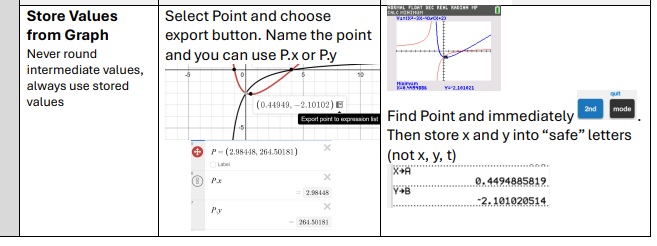
The online graphing utility Desmos has fast become a go-to site for AP Calculus. It is easy to learn and, in many ways, easier to use than graphing calculators. (Not to mention, cheaper.) Since Desmos is available during the exam there is no reason not to use it all year. It is available for computers, and as an app for smart phones and tablets.

Click here for an expanded note on how to use Desmos for the four things students are required to do with technology on the AP Calculus Exam. The note also shows and compares how to do the same things on a TI-84, so if you are familiar with the TI-84 the change will be easy enough. (August 20, 2025: The link is to a newer version than was published two days ago. It includes computing derivatives and definite integrals.)

This was developed by Crista Hamilton, who teaches AP Calculus at the Maggie Walker Governor’s School for Government and International Studies in Richmond, Virginia. She has kindly allowed me to share it with you. Thank you, Crista.  

The current image has no alternative text. The file name is: desmos.jpg

Whether Desmos or graphing calculators, you can and should use technology for more than the four things required for the exam. Students should use technology not just to verify their results but also as a tool to investigate, explore, and experiment. Encourage your students to use Desmos and/or their graphing calculator whenever they are doing math.

HAVE A GREAT YEAR!


Starting the Year

As you get ready to start school, here are some thoughts on the first week in AP Calculus. I looked back recently at several of the “first week of school” advice posts I offered in the past. Here’s a summary with some new ideas.

  • DON’T REVIEW! Yes, students have forgotten everything they ever learned in mathematics, but if you reteach it now, they will forget it again by the time they need it next week or next January. So, don’t waste the time, rather, plan to review material from kindergarten through pre-calculus when the topics come up during the year. Plan for short reviews. For instance, when you study limits, you will need to simplify rational expressions – that’s when you review rational expressions. Months from now you’ll be looking at inverse functions, that’s when you review inverses.
  • Make a copy of the “Mathematical Practices” and the “Course at a Glance” from the Current AP Calculus Course and Exam Description (p. 14 and p. 20 – 23) and give them to your students. Check off the topics as you do them during the year. Or give them the more detailed Unit Guide (e.g., p. 32 – 33 for Unit 1 Limits) as you start each unit. Either way, have your students check off the topics (1) as you teach them and (2) when they understand them.
  • In keeping with Unit 1 Topic 1, you may want to start with a brief introduction to calculus. Several years ago, when I first started this blog, Paul A. Foerster, was nice enough to share some preview problems. They give a taste of derivatives and integrals in the first week of school and get the kids into calculus right off the bat. Here is an updated version. Paul, who retired a few years ago after 50 (!) years of teaching, is Teacher Emeritus of Mathematics of Alamo High Heights School in San Antonio, Texas. He is the author of several textbooks including Calculus: Concepts and Applications. More information about the text and accompanying explorations can be found on the first page of the explorations. Thank you, Paul!
  • If you are not already a member, I suggest you join the AP Calculus Community. We have over 23,000 members all interested in AP Calculus. The community has an active bulletin board where you can ask and answer questions about the courses. Questions often ask how to better teach a topic – get hints and share your ideas. Teachers and the College Board post resources for you. College Board official announcements are also posted here. I moderate of the community, and I hope to see you there!
  • If you haven’t done so already, read your Instructional Planning Report (IPR). Especially helpful will by the comparison of your classes mean scores with the state and global mean scores for each question. If yours are higher great; if lower, that’s where you might need to do something different.

This blog has been written with teachers in mind. Students are always welcome to read it. You may give links to any of the posts you think your class may be interested in.

This year I plan to write a new series of posts especially for students. It will be called “The Why Series.” The inspiration was Why Radians, one of my most read posts. The posts will be short pieces introducing units and parts of units that (I hope) will explain why the topic is important, where the topic is leading. The first post “Why Limits” will appear soon.

Lesson Plans

A half-dozen decades ago (really!), when I first started out teaching, we were given a large grade book that included pages for lesson plans. For each week of the year there were two facing pages ruled into thirty two-inch squares.

We were expected to write our lesson plans in the squares. A lesson plan consisted of something like “Product and Chain rule” or “Factor perfect square trinomials” or even just “Section 4.7.” Also, you were expected to include the homework assignment. We had to have plans written for at least two weeks in advance. Principals could collect these (although they rarely did) and check up on you.

Lesson planning changed over the years. Even though no one ever checked up on us, I soon started including more in my lesson plans. The suggested structure came to include “behavioral objectives:” brief statements of what the student should be able to do once the lesson was taught. Not a bad idea. Schools started to require the teacher to write these on the board at the beginning of the class, so students would know what they were expected to learn to do. An even better idea.

As time went on and lecturing got a bad name, you were supposed to include activities (other than copying down what you wrote on the board) in your lesson. Also, a good idea.

 All this came to mind when I was asked to look at a website that offered FREE lesson plans for AP Calculus AB.

The website is Calc-medic.com. There are 150 daily lesson plans closely following the AB Calculus Course and Exam Description. The lessons are free and available to AP Calculus AB teachers. All you need to do is register. (BC lessons are planned, but since all AB topics are also BC topics, the plans will help BC teachers as well.)

If nothing more, they are a good pacing guide. BUT there is a lot more.

Before you continue, I suggest you read Tips for Lesson Planning from the Calc-Medic Blog. It discusses lesson planning, and I am sure it will be helpful whether you follow their lesson or write your own.

They call their approach “Experience First, Formalize Later” (EFFL). Each of the Calc-Medic EFFL lesson plans is organized like this:

Learning Objectives: A statement of what the lesson will teach.

Success Criteria: One or more succinct first-person statements of what students should be able to do: “I can use …”, “I can determine …”, “I can reason …”, “I can distinguish ….”

Quick Lesson Plan: Each lesson consists of four segments: (1) an activity – 15 minutes, (2) debrief [the activity] – 10 minutes, (3) Important Ideas – 10 minutes, and (4) check your understanding – 20 minutes. More about this shortly.

A brief Overview of the topic.

Teaching Tips – items you should be sure to mention with hints.

Exam Insights – notes on how the topic may appear on the exams and reference to specific AP exam questions.

Student Misconceptions – a discussion of things that may confuse students or that they may overlook.


The Activity.

Each lesson has a handout in PDF or DOCX (so you can adapt it) and an annotated Answer Key to the activity. This is the heart of the lesson plan.

The entire lesson is in the activity handout. It begins with a set of questions that will lead the students to the topic of the lesson. These are often close to AP format and have questions based on analytic, graphic, tabular and/or a written stem. Regardless of the way the question is presented, student writing is usually included.

The activity includes a box for student notes (summarized in the answer key).

Practice questions are in the “check your understanding” part of the lesson. Teachers can use the annotated answer sheet to help decide what to present to the students and help them make their notes. To help the teacher, answers are in blue, and annotations are in red.

The lessons do not include any homework assignments. Nor are the lessons linked to any textbook. This allows you to adapt them to your textbook and situation. The authors do assign homework. They explain their philosophy in “How Do We Assign Homework?” from the blog.

There is the old generic lesson plan: (1) Tell them what you’re going to tell them, (2) Tell them, and (3) Tell them what you’ve told them. This works for classes that are primarily lectures. The EFFL lessons at Calc-Medic are more of a discovery approach. The “Activity” leads students up to the new concept(s) presented. This is then firmed up in the “Debrief” and “Important Ideas” parts of the plan and practiced in “Check Your Understanding.”

There are occasional suggestions of where to find off-site information related to the lesson, such as College Board Curriculum Modules and this blog. Links to this information are not provided; it would be helpful if they were.

Tests and Quizzes are not included. However, when the lesson calls for a test or quiz there are detailed suggestions on how to write and grade the assessment. These are generic, but nonetheless useful. There are suggestions of what to include when writing the assessment (e.g., calculator problems), what question topics to include (specific to the topics assessed), grading tips, and reflections.

The last twenty lessons are a 4-week day-by-day review for the AP Exam. Some, but by no means all, of the review lessons are linked to the Calc-medic “Review Course.” Everything mentioned above is free; the full “Review Course” is available for a per student fee.

Calc-medic has added a searchable database to all the AP Calculus free-response questions since 1998. You may find it here.


Also worth your time is the Calc-Medic Blog with posts on topics related to AP Calculus and teaching AP Calculus. There are posts on pedagogy, the AP Exams, original videos by the authors, slide decks, and discussion of individual topics in more detail. These provide helpful insights for the teacher. It would help if these were linked to and from the lesson(s) they discuss, and if they had “tags.”


Mathmedic.com, companion website. contains similar lesson plans for Algebra 1, Geometry, Algebra 2, and Precalculus. The 180 Days of Precalculus lesson plans are not aligned with the upcoming AP Precalculus course, but lessons for this course are planned in time for the 2023 – 2024 school year. BC lesson plans are also in the works.


The sites are the work of Sarah Stecher and Barb Montgomery, teachers at East Kenwood High School in Kenwood, Michigan. They are both experienced AP Calculus Teachers. They have done a fabulous job with the lessons and their Calc-Medic Website. Both new and experienced teachers will find the lesson plans and blog helpful.

I cannot recommend Calc-Medic more highly.


ALSO:Last year I reviewed an iPad app called A Little Calculus. This app demonstrates graphically all the main concepts of AB and BC Calculus. It is quite easy to use and a quick way to prepare and present good visual examples for your class. The app has recently been updated to allow you to save and recall your own examples. Several new topics have been added. If you are not familiar with it, take a look.


P.S. Hope you like the Blog’s new look!

Updated August 15, 18, 22, 2022, March 9, 2923

Get(ting) ready

August and the school year is about to start!

As I did last year, this year my weekly posts will point you to previous posts on topics that will be coming up a week or two later. I try to stay a little ahead of you so you’ll have time to read them and incorporate what you feel is helpful into your plans. I will occasionally write some new posts as ideas come to me. (You could help them come by sending them. Send your questions and suggestions to LinMcMullin2@gmail.com)

Resources

First, here are some suggestions on pacing.

The Course and Exam Description

  • The Course and Exam Description  (CED)This is the official course description from the College Board. The individual list of topics that are tested on the exams (the Concept Outline) begins on page 11 and are listed in the Essential Knowledge (EK) column along with its Big Idea (BI), and Learning Outcome (LO) . Also, you will find the Mathematical Practices (MPACs) starting on page 8. These apply to all the topics.


  • To help you organize all this see my post on Getting Organized using Trello boards. A board listing all the Essential Knowledge and MPAC items are included.

Exam Questions

AP Calculus teachers should have a collection of the past AP Exams handy. Use them for homework, quizzes, and test through the year. Study them yourself to understand the content and style of the questions. Here are some places to find them:

  • The College Board has “home pages” for each course with links to past exams and other good information. AB Home Page and BC Home Page.


  • Another good reference is Ted Gott’s free-response question index and his MC unsecure Index by topic 1998 to 2018 The indices reference all the released free-response and multiple-choice questions. They are Excel spreadsheets. Each question is referenced to its Key Idea, LO and EK and includes a direct link to the text of the question. Click on the drop-down arrow at the top of each column and choose questions exactly on the EK you want to see. Ted plans to update this after the new multiple-choice questions are released. I will let you know when and where it is available. Thank you again, Ted!


  • I have an index of a different sort. It lists the ten Type Problems and which question, multiple-choice and free-response, that are of each type. You can find it here. This will be updated when the 2018 exams become available.


  • Past free-response questions that have been released along with commentary, actual student samples, and data can be found at AB FRQ on AP Central and here BC FRQ on AP Central. Be aware that these are available to anyone including your students.


  • Multiple-choice questions from actual exams are also available. The 2012 exam in the blue box on the course home pages (see above). This is open to anyone including students. More recent exams can be found at your audit website under “secure document” on the lower left side. This must be kept confidential because teachers use them for practice exams – they may not be posted on-line, on your school website or elsewhere, or even allowed out of your classroom on paper. Unfortunately, some teachers have not obeyed these rules and the exams can be found online by students with very little effort. Be aware that, nevertheless, your students may have access to the secure questions. For my suggestion on how to handle that see A Modest Proposal.

The AP Calculus Community

  • Finally, if you are not already a member, I suggest you join the AP Calculus Community. We are fast approaching 17,000 members all interested in AP Calculus. The community has an active bulletin board where you can ask and answer questions about the courses. Teachers and the College Board also post resources for you to use. College Board official announcements are also posted here. I am the moderator of the community and I hope to see you there!

Have a great year!

PS: Here is a link to some precalculus topics that come up in calculus

Getting Ready

Today we continue to look at some previous posts that I hope will help you and your students throughout the year. We begin with some posts on graphing calculator use and then a few general things in three posts on beginning the year, followed by some mathematics I hope students know before they start studying the calculus.

Graphing Calculators

There are four things that students may, and are required to know how to do, for the AP Exams. But graphing calculators are not required just to answer a few questions on the exams. They are to encourage investigations and experimentation in all math classes. And not just graphing calculator use but all kinds of appropriate technology. So, don’t restrict yourself and your students to only those operations required on the exam. That said, here are previous posts on exam calculator use; as the year goes on there will be other posts on the use of graphing calculators and other technology in your class.

Starting School

A little late perhaps …

These posts discuss basic ideas that I always hoped students knew about mathematics before starting calculus


.

AP Calculus Resources

So, soon time to start another year – both for you and for me. In my over 200 posts to this blog I’ve discussed a lot of calculus topics in hopes that it may help some of my readers teach or learn about calculus. The problem is that I’ve sort of run out of topics and ideas. Nevertheless, I will write more. I would like your ideas, suggestions, and questions about calculus and teaching calculus. You may email me at lnmcmullin@aol.com. Thanks.

My plans for this year are to point you to some of my previous posts. Each week, to stay ahead of you, I will list links to previous posts that you may find helpful in the next week or two.

This post lists links to resources that AP Calculus teachers should have handy for reference during the year.

  • The Course and Exam Description  This is the official course description from the College Board. The individual list of topics that are tested on the exams (the Concept Outline) begins on page 11 and are listed in the Essential Knowledge (EK) column along with its Big Idea (BI), and Learning Outcome (LO) . Also, you will find the Mathematical Practices (MPACs) starting on page 8. These apply to all the topics. I have posts on each separately: see Mathematical Practices,  MPAC 1, MPAC 2, MPAC 3, MPAC 4, MPAC 5, and MPAC 6. Also, you will find a list of Instructional Approaches that outlines various ideas for use in your classes – and not just your calculus classes. The book also contains sample free-response and multiple-choice questions that show how the MPACs and Essential Knowledge item are related to each question.
 

  • To help you organize all this see my post on Getting Organized using Trello boards. A board listing all the Essential Knowledge and MPAC items are included.


  • Another good reference is MC unsecure Index by topic 1998 to 2018. This lists ALL the free-response questions from 1998 to the present (2016). This is an Excel spreadsheet. Each question is referenced to its Key Idea, LO and EK and includes a direct link to the text of the question. Click on the drop-down arrow at the top of each column and choose questions exactly on the EK you want to see. Ted plans to update this after the new multiple-choice questions are released. I will let you know when and where it is available. Thank you again, Ted!  Updated to include the 2017 FRQs. (August 2, 2017)


  • I have an index of a different sort. It lists the ten Type Problems and which question, multiple-choice and free-response, that are of each type. You can find it here. This will be updated when the 2017 exams become available.


  • The College Board has “home pages” for each course with links and other good information. AB Home Page and BC Home Page.


  • Past free-response questions that have been released along with commentary, actual student samples, and data can be found at AB FRQ on AP Central and here BC FRQ on AP Central. Be aware that these are available to anyone including your students.


  • Multiple-choice questions from actual exams are also available. The 2012 exam in the blue box on the course home pages (see above). This is open to anyone including students. More recent exams can be found at your audit website under “secure document” on the lower left side. This must be kept confidential because teachers use them for practice exams – they may not be posted on-line, on your school website or elsewhere, or even allowed out of your classroom on paper. Unfortunately, some teachers have not obeyed these rules and the exams can be found online by students with very little effort. Be aware that your students may have access to them. For my suggestion on how to handle that see A Modest Proposal.


  • Finally, if you are not already a member, I suggest you join the AP Calculus Community. A of the end of July, we have 15,210 members all interested in AP Calculus. The community has an active bulletin board where you can ask and answer questions about the courses. Teachers and the College Board also post resources for you to use. College Board official announcements are also posted here. I am the moderator of the community and I hope to see you there!

Have a great year!


Intermediate Weather

I found a curious fact in a textbook today that relates to the Intermediate Value Theorem [1]. It claimed that if you draw a circle of any size on a map, there will be two diametrically opposite points on the circle at which the temperature will be the same!

This might make an interesting example when you are talking about the IVT.

The proof goes like this:

Assume the temperature varies continuously between every pair of points. Draw a circle of any radius on your map. Put a polar coordinate system on the map with the pole at the center of the circle and let theta  be the angle formed by a line through the pole and the polar axis in the usual way. Let \theta be the temperature at any point on the circle on the line that makes an angle of \theta  with the polar axis. Then consider the function, f that gives the difference in temperature between two diametrically opposite points at angles of \theta  and \theta +\pi :

f(\theta )=T(\theta )-T(\theta +\pi )

Case I:If f(0)=T(0)-T(\pi )=0 then T(0)=T(\pi ) and we have our two points.

Case II: If f(0)=T(0)-T(\pi )>0, then~T(0)>T(\pi ), indicating that as the angle increases from 0 to \pi , the temperature has a net decrease. Then, on the other half of the circle from \pi to 2\pi  the temperature must increase f(\pi )=T(\pi )-T(2\pi )=T(\pi )-T(0)<0. (Since T(0)=T(\pi )). Therefore, by the Intermediate Value Theorem there is some value \theta =c, between 0 and \pi  where f(c)=0 and T(c)=T(c+\pi )

Case III is like Case II with f(0)<0.

Without so many equations, this says that if you keep track of the temperature difference at the ends of the diameter on the way around the first half of the circle and find a net decrease in the temperature difference, then on your way around the second half of the circle (returning to the starting point) you must see a net increase. Somewhere between the decrease and the increase you must have a point where the difference is zero – the temperatures at the ends will be the same.

Now, I wasn’t really convinced. Yes, I believe proofs, but still…. So, I looked at a weather map [2]

Weather

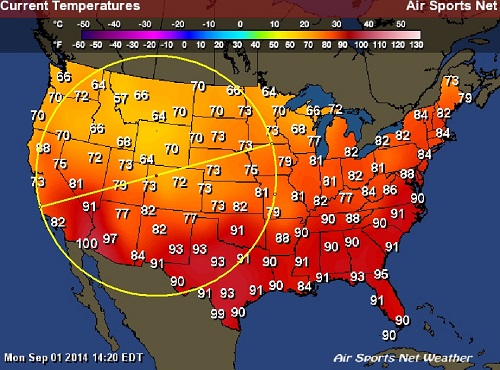
Consider the circle drawn on the map. From Iowa to Canada the temperature decreases from 79 to 66. Meanwhile over in California the temperature increases from 73 near San Francisco to 82 in Los Angeles. With a little visual interpolation, the temperatures at the ends of the diameter seem to be about equal. Try it with your own weather map.

Make your own circle and space the temperatures evenly on both sides. The diameter with the same temperatures will be ¼ of the way around. Try again with unevenly spaced temperatures; you will still find a place.

This is similar to the mountain climbing problem: If you climb a mountain during certain hours one day and climb back down during the same hours the next day, then there will be a place that you pass at the same time on both days.

_______________________________

References:

[1] Calculus by Rogowski and Cannon, Second edition, Section 2.8 exercise 26

[2] Air Sports New Weather for September 1, 2014, 14:20 EDT

Revised September 3, 2014 12:50 to fix some problems with the equations appearing properly.