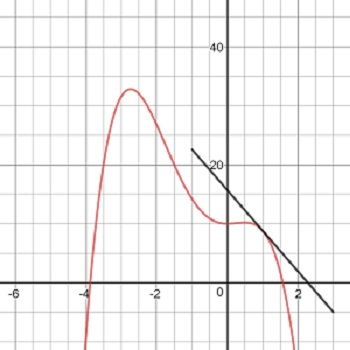
Units

I had a question from a reader recently asking about how to determine the units for derivatives and integrals.

Derivatives: The units of the derivative are the units of dy divided by the units of dx, or the units of the dependent variable (f(x) or y) divided by the units of the independent variable (x). The reason for this comes from the definition of the derivative:

\displaystyle {f}'\left( x \right)=\underset{{\Delta x\to 0}}{\mathop{{\lim }}}\,\frac{{f\left( {x+\Delta x} \right)-f\left( x \right)}}{{\Delta x}}

In the quotient the numerator has the units of f and in the denominator the has the same units as x.

Definite Integrals: The units of a definite integral are the units of the integrand f(x) multiplied by the units of dx. This comes directly from the definition of a definite integral:

\displaystyle \int_{a}^{b}{{f\left( x \right)dx}}=\underset{{n\to \infty }}{\mathop{{\lim }}}\,\sum\limits_{{i=1}}^{n}{{f\left( {{{x}_{i}}^{*}} \right)\frac{{b-a}}{n}}}

The factor (ba) has the same units a x, the independent variable, and the f(x) has whatever units it has. From the Riemann sum we can see that since these factors are multiplied, that product is the units of the definite integral.

The integrand is the derivative of its antiderivative (by the FTC) and so its units are often derivative units (miles per hour, furlongs per fortnight, etc.). When multiplied by (ba)/n its units “cancel” the units of the denominator of f(x) and the result is the units of the numerator of f(x).  This is not always the case*, therefore, multiplying the units is safest.


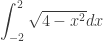
*The definite integral \displaystyle \int_{{-2}}^{2}{{\sqrt{{4-{{x}^{2}}}}dx}} gives the area of a semi-circle of radius 2 feet. The units of the radical are feet and represent the vertical distance from the x-axis to a point in the semi-circle; the dx is the horizontal side of the Riemann sum rectangles also in feet. Both are measured in the same linear units and the area is their product: feet times feet or square feet.


Implicit Differentiation and Inverses

Implicit differentiation of relations is done using the Chain Rule. 

Implicit Differentiation (from last Friday’s post. I discovered I never did a post on this topic before!)

Implicit differentiation of parametric equations

A Vector’s Derivative

The inverse series 

This series of posts reviews and expands what students know from pre-calculus about inverses. This leads to finding the derivative of exponential functions, ax, and the definition of e, from which comes the definition of the natural logarithm. 

Inverses Graphically and Numerically

The Range of the Inverse

The Calculus of Inverses

The Derivatives of Exponential Functions and the Definition of e  and This pair of posts shows how to find the derivative of an exponential function, how and why e is chosen to help this differentiation.

Logarithms Inverses are used to define the natural logarithm function as the inverse of ex. This follow naturally from the work on inverses. However, integration is involved and this is best saved until later. I will mention it then.


Implicit Differentiation

I discovered in doing next week’s post that I apparently never wrote about implicit differentiation. So here goes – an extra post this week!

Implicit Differentiation

The technique of implicit differentiation allows you to find slopes of relations given by equations that are not written as functions or may even be impossible to write as functions.

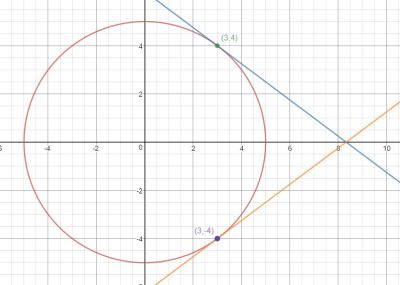
Example 1: A good way to start investigating this idea is to give your class the equation of a circle, say {{x}^{2}}+{{y}^{2}}=25 and ask them to find the slope of the tangent line (the derivative) where x = 3. No hints, just let them try.

Most students will hit upon solving for y and then differentiating:

y=\pm \sqrt{{25-{{x}^{2}}}}

\displaystyle \frac{{dy}}{{dx}}=\frac{{-2x}}{{\pm 2\sqrt{{25-{{x}^{2}}}}}}=\frac{{-x}}{{\pm \sqrt{{25-{{x}^{2}}}}}}

There are two points where x = 3: (3, 4) and (3, –4) at the first point the slope is – ¾ and at the second ¾.

Then show them another way – implicit differentiation.

To use this technique, assume that y is a function of x, but do not bother to find that function. Then using the chain rule on any terms containing a y. For{{x}^{2}}+{{y}^{2}}=25 , we have

\displaystyle 2x+2y\frac{{dy}}{{dx}}=0

Then solve for the derivative

\displaystyle \frac{{dy}}{{dx}}=-\frac{x}{y}

We see that this is the same as we found the first time, since y=\pm \sqrt{{25-{{x}^{2}}}}! There is a slight advantage here: we can now find the slopes from the coordinates without solving or dealing with the plus/minus sign. *
Example 2: Now let’s consider a more difficult example. Find the derivative of {{x}^{2}}+4{{y}^{2}}=7+3xy. To solve for y here is possible but somewhat difficult (Hint: use the quadratic formula). We can continue writing {y}' for dy/dx.

2x+8y{y}'=0+3x{y}'+3y

Note that the last term on the right is differentiated using the product rule.  Since this happens fairly often, students need to be reminded of it.

Now solving for {y}'gives

\displaystyle {y}'=\frac{{3y-2x}}{{8y-3x}}

Then we can find the derivatives at specific points by substituting the coordinates of the point. At the point (3,2) on the curve, the slope is \displaystyle {y}'=\frac{{3\left( 2 \right)-2\left( 3 \right)}}{{8\left( 2 \right)-3\left( 3 \right)}}=\frac{0}{7}=0

Note: the derivative of an implicit relation usually involves both the x and y coordinates.

Second Derivatives

This idea can be repeated to find second and higher derivatives.

Example 1 continued: In the first example with \displaystyle \frac{{dy}}{{dx}}=\frac{{-x}}{y}  we differentiate using the quotient rule:

\displaystyle  {{y}'}'=\frac{{y(-1)-(-x){y}'}}{{{{y}^{2}}}}

The second derivative is a function, not just of x and y, but also of {y}'. We can replace it with the first derivative and simplify.

\displaystyle  {{y}'}'=\frac{{-y+x\left( {\frac{{-x}}{y}} \right)}}{{{{y}^{2}}}}=\frac{{-{{y}^{2}}-{{x}^{2}}}}{{{{y}^{3}}}}=-\frac{{25}}{{{{y}^{3}}}}

(This might be a good time to do a quick review of simplifying complex fractions; they occur often in implicit differentiation problems.)

To find the value of the second derivative at a given point we can substitute into either of the two expressions above. At (3, –4) where the derivative has been previously found to be ¾ we have \displaystyle  {{y}'}'=\frac{{y(-1)-(-x){y}'}}{{{{y}^{2}}}}=\frac{{\left( {-4} \right)\left( {-1} \right)-\left( {-3} \right)\left( {\frac{3}{{-4}}} \right)}}{{{{{\left( {-4} \right)}}^{2}}}}=-\frac{{-16-9}}{{-48}}=\frac{{25}}{{48}}

Or we can use the second form

\displaystyle {{y}'}'=-\frac{{25}}{{{{y}^{3}}}}=-\frac{{25}}{{{{{\left( {-4} \right)}}^{3}}}}=\frac{{25}}{{48}}

Example 2 continued: The second example was taken from an AB Calculus exam (2004 AB 4). The first part gave the first derivative and asked students to show that it was correct. This was done (instead of just asking the students to find the first derivative) so that students would be sure to have the correct derivative to use later in the question.

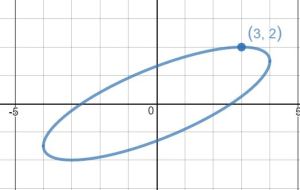
The second part asked students to show that the tangent line is horizontal at the point where x = 3. This included finding the coordinates of the point, (3, 2) and showing that it is on the curve.

The third part of the question asked students to determine whether the point from part (b) was a relative maximum, a relative minimum or neither, and to justify their answer. Since there is no way to determine how the sign of the first derivative changes at the point the First Derivative Test cannot be used. Likewise, the Candidates’ Test (a/k/a the closed interval test) cannot be used without solving for y, and determining the domain of each part. That leaves the Second Derivative Test as the easiest choice.

\displaystyle {y}'=\frac{{3y-2x}}{{8y-3x}}  at (3,2) \displaystyle {y}'=\frac{{3\left( 2 \right)-2\left( 3 \right)}}{{8\left( 2 \right)-3\left( 3 \right)}}=0

\displaystyle {{y}'}'=\frac{{\left( {8y-3x} \right)\left( {3{y}'-2} \right)-\left( {3y-2x} \right)\left( {8{y}'-3} \right)}}{{{{{\left( {8y-3x} \right)}}^{2}}}}

Substituting the values into this without doing the algebra to remove the first derivative gives

\displaystyle \begin{array}{l}{{y}'}'=\frac{{\left( {8\left( 2 \right)-3\left( 3 \right)} \right)\left( {0-2} \right)-\left( {3\left( 2 \right)-2\left( 3 \right)} \right)\left( {8\left( 0 \right)-3} \right)}}{{{{{\left( {8\left( 2 \right)-3\left( 3 \right)} \right)}}^{2}}}}=\frac{{\left( {16-9} \right)\left( {-2} \right)-0}}{{{{{\left( {16-9} \right)}}^{2}}}}=-\frac{2}{7}\\\end{array}

So, the point (3, 2) is a relative maximum.

The graph of the relation, an ellipse is shown below.

* Incidentally, there is another clever way of doing example 1: The radius to any point on a circle centered at the origin has a slope of y/x.  Since tangents to circles are perpendicular to the radii drawn to the point of tangency, the slope of the tangent must be –x/y.




The Chain Rule

Most of the function students are faced with in beginning calculus are compositions of the Elementary Functions. The Chain Rule allows you to differentiate composite functions easily. The posted listed below are ways to introduce and then use the Chain Rule.

Experimenting with a CAS – Chain Rule  Using a CAS to discover the Chain Rule

Power Rule Implies Chain Rule and Foreshadowing the Chain Rule the same ideas.

The Chain Rule


Differentiation Techniques

Maria Gaetana Agnesi

So, no one wants to do complicated limits to find derivatives. There are easier ways of course. There are a number of quick ways (rules, formulas) for finding derivatives of the Elementary Functions and their compositions. Here are some ways to introduce these rules; these are the subject of this week’s review of past posts.

Why Radians?

The Derivative I        Guessing the derivatives from the definition

The Derivative II      Using difference Quotient to graph and guess

The Derivative Rules I    The Power Rule

The Derivative Rules II       Another approach to the Product Rule from my friend Paul Foerster

The Derivative Rules III     The Quotient Rule developed using the Power Rule, an approach first suggested  by Maria Gaetana Agnesi (1718 – 1799) who was helping her brother learn the calculus.

Next week: The Chain Rule.


Difference Quotients

Difference quotients are the path to the definition of the derivative. Here are three posts exploring difference quotients.

Difference Quotients I  The forward and backward difference quotients

Difference Quotients II      The symmetric difference quotient and seeing the three difference quotients in action.  Showing that the three difference quotients converge to the same value.

Seeing Difference Quotients      Expands on the post immediately above and shows some numerical and graphical approaches using calculators and Desmos.

 Tangents and Slopes You can use this Desmos app now to preview some of the things that he tangent line can tell us about the graph of a function or save (or reuse) it for later when concentrating on graphs. Discuss slope in relation to increasing, decreasing, concavity, etc.

At Just the Right Time

Stamp out Slope-intercept Form


Working up to the derivative.

While limit is what makes all of the calculus work, people usually think of calculus as starting with the derivative. The first problem in calculus is finding the slope of a line tangent to a graph at a point and then writing the equation of that tangent line.

Local Linearity is the graphical manifestation of differentiability. If you zoom-in of the graph of a function (at a point where we will soon say the function is differentiable), the graph eventually looks like a line: the graph appears to be straight, and its slope is the number we will call its derivative.

To do this we need to zoom-in numerically. Zooming-in numerically is accomplished by finding the slope of a secant line, a line that intersects the graph twice, and then finding the limit of that slope as the two points come closer together.

This week’s posts start with local linearity and tangent lines. They lead to the difference quotient and the equation of the tangent line.

Local Linearity I

Local Linearity II      Working up to difference quotient. The next post explains this in more detail.

Tangent Lines approaching difference quotients on calculator by graphing tan line.

Next week: Difference Quotients.