Polar Equations

Ideally, as with parametric and vector functions, polar curves should be introduced and covered thoroughly in a pre-calculus course. Questions on the BC exams have been concerned with calculus ideas related to polar curves. Students have not been asked to know the names of the various curves (rose, curves, limaçons, etc.). The graphs are usually given in the stem of the problem, but students should know how to graph polar curves on their calculator, and the simplest by hand.

What students should know how to do:

  • Calculate the coordinates of a point on the graph,
  • Find the intersection of two graphs (to use as limits of integration).
  • Find the area enclosed by a graph or graphs: Area =\displaystyle A=\tfrac{1}{2}\int_{{{\theta }_{1}}}^{{{\theta }_{2}}}{(r(}θ\displaystyle ){{)}^{2}}dθ
  • Use the formulas x\left( \theta  \right)\text{ }=~r\left( \theta  \right)\text{cos}\left( \theta  \right)~~\text{and}~y\left( \theta  \right)\text{ }=~r(\theta )\text{sin}\left( \theta  \right)~  to convert from polar to parametric form,
  • Calculate \displaystyle \frac{dy}{d\theta } and \displaystyle \frac{dx}{d\theta } (Hint: use the product rule on the equations in the previous bullet).
  • Discuss the motion of a particle moving on the graph by discussing the meaning of \displaystyle \frac{dr}{d\theta } (motion towards or away from the pole), \displaystyle \frac{dy}{d\theta } (motion in the vertical direction) or \displaystyle \frac{dx}{d\theta } (motion in the horizontal direction).
  • Find the slope at a point on the graph, \displaystyle \frac{dy}{dx}=\frac{dy/d\theta }{dx/d\theta }.

This topic appears only occasionally on the free-response section of the exam instead of the Parametric/vector motion question. The most recent on the released exams were in 2007,  2013, 2014, and 2017. If the topic is not on the free-response then 1, or maybe 2 questions, probably finding area, can be expected on the multiple-choice section.

Shorter questions on these ideas appear in the multiple-choice sections. As always, look over as many questions of this kind from past exams as you can find.


Here are the few post I have written on polar curves and polar graphing.

Limaçons   A discussion of how polar curves are graphed

Back in the summer of 2014 I got interested in some polar equations and wrote a series of post on them which include some gifs showing how they are graphed. They are nothing that will appear on the AP exams. You can use them as enrichment if you like.

Rolling Circles

Roulettes and Calculus

Epitrochoids

Epicycloids

Hypocycloids and Hypotrochoids

Roulettes and Art – 1  

Roulettes and Art – 2


Getting Ready

Today we continue to look at some previous posts that I hope will help you and your students throughout the year. We begin with some posts on graphing calculator use and then a few general things in three posts on beginning the year, followed by some mathematics I hope students know before they start studying the calculus.

Graphing Calculators

There are four things that students may, and are required to know how to do, for the AP Exams. But graphing calculators are not required just to answer a few questions on the exams. They are to encourage investigations and experimentation in all math classes. And not just graphing calculator use but all kinds of appropriate technology. So, don’t restrict yourself and your students to only those operations required on the exam. That said, here are previous posts on exam calculator use; as the year goes on there will be other posts on the use of graphing calculators and other technology in your class.

Starting School

A little late perhaps …

These posts discuss basic ideas that I always hoped students knew about mathematics before starting calculus


.

Writing on the AP Calculus Exams

The goals of the AP Calculus program state that, “Students should be able to communicate mathematics and explain solutions to problems both verbally and in well written sentences.” For obvious reasons the verbal part cannot be tested on the exams; it is expected that you will do that in your class. The exams do require written answers to a number of questions. The number of points riding on written explanations on recent exams is summarized in the table below.

 Year AB BC
2007 9 9
2008 7 8
2009 7 3
2010 7 7
2011 7 6
2012 9 7
2013 9 7
2014 6 3

The average is between 6 and 8 points each year with some years having 9. That’s the equivalent of a full question. So this is something that should not be overlooked in teaching the course and in preparing for the exams. Start long before calculus; make writing part of the school’s math program.

That a written answer is expected is indicated by phrases such as:

  • Justify you answer
  • Explain your reasoning
  • Why?
  • Why not?
  • Give a reason for your answer
  • Explain the meaning of a definite integral in the context of the problem.
  • Explain the meaning of a derivative in the context of the problem.
  • Explain why an approximation overestimates or underestimates the actual value

How do you answer such a question? The short answer is to determine which theorem or definition applies and then show that the given situation specifically meets (or fails to meet) the hypotheses of the theorem or definition.

Explanations should be based on what is given in the problem or what the student has computed or derived from the given, and be based on a theorem or definition. Some more specific suggestions:

  • To show that a function is continuous show that the limit (or perhaps two one-sided limits) equals the value at the point. (See 2007 AB 6)
  • Increasing, decreasing, local extreme values, and concavity are all justified by reference to the function’s derivative. The table below shows what is required for the justifications. The items in the second column must be given (perhaps on a graph of the derivative) or must have been established by the student’s work.
Conclusion Establish that
y is increasing y’ > 0  (above the x-axis)
y is decreasing y’ < 0   (below the x-axis)
y has a local minimum y’ changes  – to + (crosses x-axis below to above) or {y}'=0\text{ and }{{y}'}'>0
y has a local maximum y’ changes + to –  (crosses x-axis above to below) or {y}'=0\text{ and }{{y}'}'<0
y is concave up y’ increasing  (going up to the right) or {{y}'}'>0
y is concave down y’ decreasing  (going down to the right) or {{y}'}'<0
y has point of inflection y’ extreme value  (high or low points) or {{y}'}' changes sign.
  •  Local extreme values may be justified by the First Derivative Test, the Second Derivative Test, or the Candidates’ Test. In each case the hypotheses must be shown to be true either in the given or by the student’s work.
  • Absolute Extreme Values may be justified by the same three tests (often the Candidates’ Test is the easiest), but here the student must consider the entire domain. This may be done (for a continuous function) by saying specifically that this is the only place where the derivative changes sign in the proper direction. (See the “quiz” below.)
  • Speed is increasing on intervals where the velocity and acceleration have the same sign; decreasing where they have different signs. (2013 AB 2 d)
  • To use the Mean Value Theorem state that the function is continuous and differentiable on the interval and show the computation of the slope between the endpoints of the interval. (2007 AB 3 b, 2103 AB3/BC3)
  • To use the Intermediate Value Theorem state that the function is continuous and show that the values at the endpoints bracket the value in question (2007 AB 3 a)
  • For L’Hôpital’s Rule state that the limit of the numerator and denominator are either both zero or both infinite. (2013 BC 5 a)
  • The meaning of a derivative should include the value and (1) what it is (the rate of change of …, velocity of …, slope of …), (2) the time it obtains this value, and (3) the units. (2012 AB1/BC1)
  • The meaning of a definite integral should include the value and (1) what the integral gives (amount, average value, change of position), (2) the units, and (3) what the limits of integration mean. One way of determining this is to remember the Fundamental Theorem of Calculus \displaystyle \int_{a}^{b}{{f}'\left( x \right)dx}=f\left( b \right)-f\left( a \right). The integral is the difference between whatever f represents at b and what it represents at a. (2009 AB 2 c, AB 3c, 2013 AB3/BC3 c)
  • To show that a theorem applies state and show that all its hypotheses are met. To show that a theorem does not apply show that at least one of the hypotheses is not true (be specific as to which one).
  • Overestimates or underestimates usually depend on the concavity between the two points used in the estimates.

A few other things to keep on mind:

  • Avoid pronouns. Pronouns need antecedents. “It’s increasing because it is positive on the interval” is not going to earn any points.
  • Avoid ambiguous references. Phrases such as “the graph”, “the derivative” , or “the slope” are unclear. When they see “the graph” readers are taught to ask “the graph of what?” Do not make them guess. Instead say “the graph of the derivative”, “the derivative of f”, or “the slope of the derivative.”
  • Answer the question. If the question is a yes or no question then say “yes” or “no.” Every year students write great explanations but never say whether they are justifying a “yes” or a “no.”
  • Don’t write too much. Usually a sentence or two is enough. If something extra is in the explanation and it is wrong, then the credit is not earned even though the rest of the explanation is great.

As always, look at the scoring standards from past exam and see how the justifications and explanations are worded. These make good templates for common justifications. Keep in mind that there are other correct ways to write the justifications.

QUIZ

Here is a quiz that can help your students learn how to write good explanations.

Let f\left( x \right)={{e}^{x}}\left( x-3 \right) for 0\le x\le 5. Find the location of the minimum value of f(x). Justify your answer three different ways (without reference to each other).

The minimum value occurs at x = 2. The three ways to justify this are the First Derivative Test, the Second Derivative Test and the Candidates’ Test. (Don’t tell your students what they are – they should know that.) Then compare and contrast the students’ answers. Let them discuss and criticize each other’s answers.


calculus

Amortization

This is an example of how sequences and series are used in “real life.”  It could be used in a calculus class or an advanced math class.

When you borrow money to buy a house or a car you are making a kind of loan called a mortgage. Paying off the loan is called amortizing the loan.amortization

The amount you borrow is called the principal. You agree to pay a fixed payment at regular intervals, usually monthly. The payment includes interest on the amount owed during the previous month plus a bit more to decrease the principal. Each month your payment decreases the remaining principal, so in the next month a little less goes to interest and a little more goes to paying off the principal. Let’s say you borrow A dollars (the principal) and agree to pay a monthly interest rate of r%, for a period of n months.

How much is the fixed (constant) monthly payment, P, so that after n months the loan and interest will be paid off?

After one month you make a payment and you now owe {{A}_{1}} = the original amount plus the interest on this amount minus the payment, P.

{{A}_{1}}=A+Ar-P=A\left( 1+r \right)-P

After the second payment is made you owe {{A}_{2}} =  {{A}_{1}}, plus the interest {{A}_{1}r}, minus the payment, P.

{{A}_{2}}=\left( A\left( 1+r \right)-P \right)+\left( A\left( 1+r \right)-P \right)r-P=A{{\left( 1+r \right)}^{2}}-P\left( 1+r \right)-P

And likewise after the third month:

{{A}_{3}}=\left( A{{\left( 1+r \right)}^{2}}-P\left( 1+r \right)-P \right)+\left( A{{\left( 1+r \right)}^{2}}-P\left( 1+r \right)-P \right)r-P

{{A}_{3}}=A{{\left( 1+r \right)}^{3}}-P{{\left( 1+r \right)}^{2}}-P\left( 1+r \right)-P

And after the fourth month a pattern emerges:

{{A}_{4}}=A{{\left( 1+r \right)}^{4}}-P{{\left( 1+r \right)}^{3}}-P{{\left( 1+r \right)}^{2}}-P\left( 1+r \right)-P

{{A}_{4}}=A{{\left( 1+r \right)}^{4}}-P\sum\limits_{k=0}^{3}{{{\left( 1+r \right)}^{k}}}

And so on so that after n months the amount you owe is:

{{A}_{n}}=A{{\left( 1+r \right)}^{n}}-P\sum\limits_{k=0}^{n-1}{{{\left( 1+r \right)}^{k}}}

The sigma expression represents a finite geometric series. The sum of such a series with a first term of 1 and a common ratio of R sum is given by

\displaystyle {{S}_{n}}=\frac{1-{{R}^{n}}}{1-R}.

Therefore

\displaystyle {{A}_{n}}=A{{\left( 1+r \right)}^{n}}-P\left( \frac{1-{{\left( 1+r \right)}^{n}}}{1-\left( 1+r \right)} \right)=A{{\left( 1+r \right)}^{n}}-P\left( \frac{{{\left( 1+r \right)}^{n}}-1}{r} \right)

But after n months you have paid off the loan and you owe An = 0

\displaystyle 0=A{{\left( 1+r \right)}^{n}}-P\left( \frac{{{\left( 1+r \right)}^{n}}-1}{r} \right)

This equation may be solved for P the monthly payment:

\displaystyle P=\frac{Ar{{\left( 1+r \right)}^{n}}}{{{\left( 1+r \right)}^{n}}-1}.

The equation above is a formula for finding the payment on a mortgage. For example, to borrow $25,000 for a car at 3% per year (r = 0.0025 per month) for 5 years (n = 60) the monthly payment is

\displaystyle \frac{25,000\left( 0.0025 \right){{\left( 1+0.0025 \right)}^{60}}}{{{\left( 1+0.0025 \right)}^{60}}-1}=\$449.22.

Of course, in “real life” someone looks up the amount on the internet and we all believe them. But now you can do it yourself and have some math fun at the same time.

Extremes without Calculus

There was an interesting question last week on the AP Calculus Community Bulletin Board. A teacher was working with polynomial functions in her pre-calculus class and the class had learned how to find the roots, and how the roots and their multiplicities affected the graph. Her question was whether there is a way to determine the number of extreme values (maximums and minimums) without using calculus.

You might want to work this yourself before reading on.

Before we go into more detail recall two facts about polynomial functions with real coefficients:

  • As a corollary to the Fundamental Theorem of Algebra, we know that a polynomial function of degree n has exactly n factors some of which may be the same. Therefore, the polynomial has exactly n roots, again not necessarily different. The multiplicity of a root is the number of times the corresponding factor appears in the factorization.
  • Between any two consecutive roots there is exactly one turning point. (You may need some calculus to justify this. If there were more than one turning point between two consecutive roots, there must be at least three of them. Then the derivative would have more zeros than the original polynomial, which of course cannot happen.

One reader suggested a method for dealing with cubics which I think generalizes to any polynomial. The method is this: Subtract the constant term from the polynomial. This translates the graph so that it will contain the origin. The translated graph is congruent to the original and therefore will have the same number of extreme values.

Red Graph: y={{x}^{3}}-4{{x}^{2}}+3x+4
Blue Graph: y={{x}^{3}}-4{{x}^{2}}+3x

Find the Real roots of the translated polynomial.  Then the number of turning points for both polynomials can be found this way (assuming, for the moment, that all the roots are Real numbers):

  1. For each distinct root, count 1
  2. For each root of even multiplicity, count 1
  3. Each root of odd multiplicity greater than one, ( 3, 5, 7, …), count 0

The number of turning points will be one less than the total.

Example P(x)=x{{\left( x-1 \right)}^{4}}{{\left( x-2 \right)}^{3}}{{\left( x-3 \right)}^{8}}, the count is 4 + 2 + 0 = 6. Turning points = 5

The reasoning goes something like this (for a polynomial with Real coefficients and constant term of zero):

  1. A linear polynomial has one root and no turning points.
  2. Each time you multiply by a different linear factor you add one root and one turning point.
  3. Each time you multiply by several of the same factor you already used to end with an even power for that factor, you add no roots, but you add one turning point (on the x-axis at the root).
  4. Each time you multiply by several of the same factor you already used to end with an odd power for that factor, you add no roots, and no turning points, since the graph will cross the axis at such a value.
  5. Then the count scheme above will then give the number of turning points.

Another approach is this: consider a polynomial with n distinct roots and (n – 1) turning points spread out along the number line. Now move two adjacent roots together (resulting in a root of multiplicity 2).  The turning point between them moves onto the x-axis. You have lost a root but not a turning point; thus, in the count item 1 decreases by one, so to compensate you increase item 2 by one to get the same total. Now move a third adjacent root to the place of the other two to get a root of multiplicity 3: this time you lose another root, and a turning point so decreasing item 1 will keep the number of turning points given by the count correct.

Did I miss anything? Yes. I did not consider translated polynomials with Complex roots. That’s because I have not (yet) figured that out.  I’m pretty sure that a unfactorable quadratic factor (i.e.  one with Complex conjugate roots) does not add any turning points to the graph, but I haven’t quite convinced myself.  Any suggestions?

Limaçons

When I first started getting interested in roulettes I began in polar form graphing limaçons. Without going into as much detail as with the roulettes, I offer just one today.

I found this Winplot illustration instructive as to how polar graphs are formed and just how the graphs work and relate to rectangular form graphs of the same functions. So this could be used as a first example, or an investigation of its own.

For my example we will consider the limaçon, or a cardioid with an inner loop, given below (using t for the usual theta, since the LaTex translator doesn’t seem to be able to handle thetas).

r\left( t \right)=1.4-2\sin \left( t \right)

In polar form {{r}_{1}}\left( t \right)=1.4 is a circle with center at the pole and radius of 1.4.This is shown in light blue in the figures.

The polar curve {{r}_{2}}\left( t \right)=2\sin \left( t \right) is a circle with center at \left( 1,\tfrac{\pi }{2} \right) and radius of 1. This is shown in orange in the figures below.

The graph in the example isr\left( t \right)={{r}_{2}}\left( t \right)-{{r}_{1}}\left( t \right)  the directed distance (length of the vector) from {{r}_{1}}\left( t \right) to {{r}_{2}}\left( t \right) and is shown by the green arrow in figures 1, 3, and 4.
The blue arrow is congruent to the green with its tail at the pole; its point traces the limaçon shown in black. (Click to enlarge.)

  •  In figure 1, the distance is positive and both arrows point in the same direction along the rotating ray.
  • In figure 2, the two circles intersect and the distance between them is zero. The limaçon goes through the origin.
  • In figure 3, the curves have changed position and the directed distance is negative. The blue arrow points in the negative direction opposite to the rotating ray drawing the inner loop.
  • In figure 4, the arrows return to pointing in the same direction, but are longer due to the fact that the distance runs from the orange circle to the far side of  the light blue circle forming the bottom outside loop

In the clip below the limaçon is drawn as the black ray rotates from 0 to 2\pi  radians. Watch how the green and blue arrows (always the same length, but not the same direction), work to draw the limaçon.
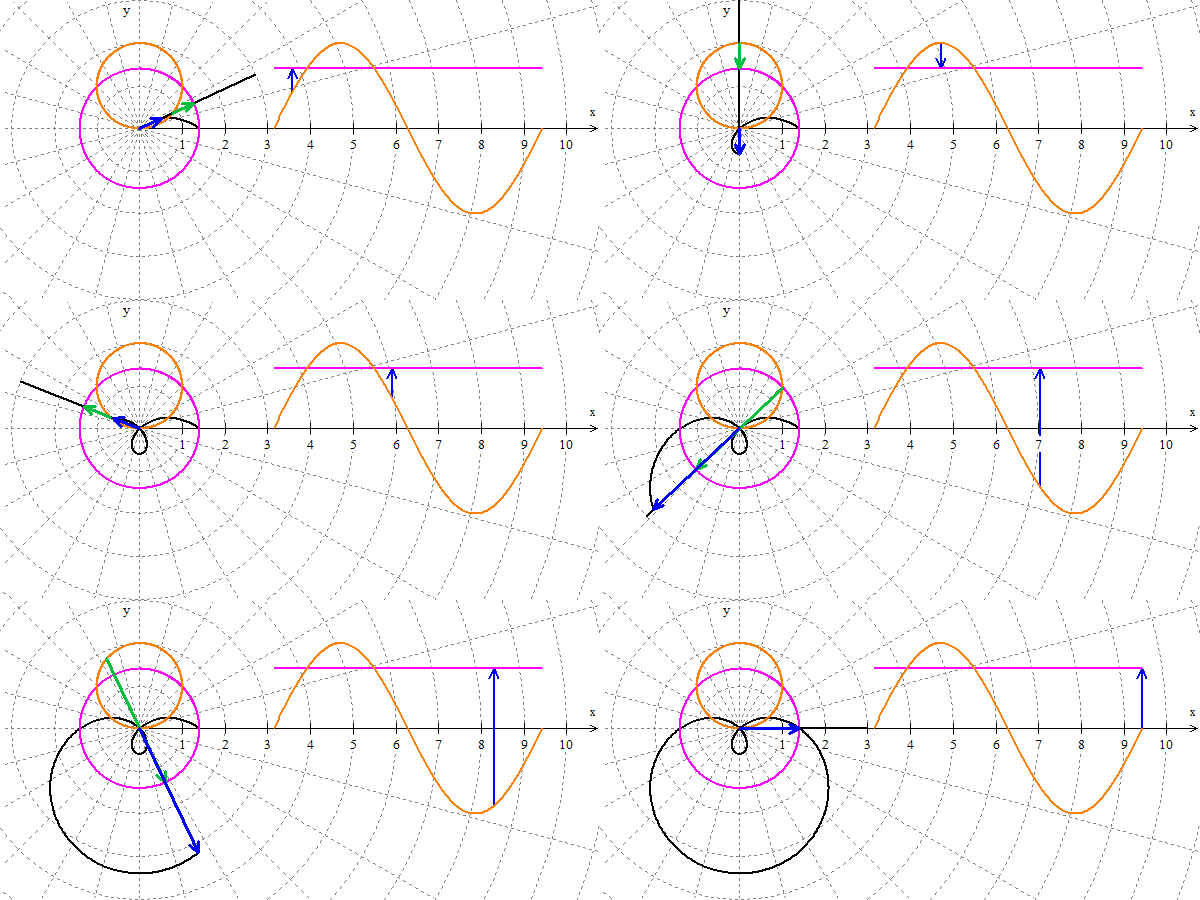
On the right side of the clip are the two functions graphed in rectangular form. The blue arrow on the right is the same length as the blue arrow on the left and gives the directed distance from {{r}_{1}}\left( t \right)  to {{r}_{2}}\left( t \right). This form is probably more familiar to students and may help them see the relationships.

A limaçon being graphed.

A limaçon being graphed.

This form is probably more familiar to students and may help them see the relationships. The Winplot file may be downloaded here. If you or your students what to investigate further, click on the Winplot graph and then CTRL+SHIFT+N to see the notes; they will also tell you how to change the A, B, and R sliders to change the curves.

Roulettes and Art – 2

Continuing with our discussion of ways to produce interesting designs with the Roulette Generator (RG) for Winplot, here are some hints on making more detailed designs using more than one function.

Hint #5: Adding more graphs to the first: You may add other graphs by selecting the roulette and/or velocity equations from the Inventory (CTRL+I) and clicking “dupl”  to duplicate the equation. Then click the duplicate and then “edit” and change the sign in front of the S in both equations. This will let you graph S and –S at the same time. This will give you two congruent graphs with the first rotated 2\pi /n from the first. (From the previous posts: if \left| R \right|=\tfrac{n}{d} then there are d dips, loops, or cusps in n full revolutions). Both graphs will have the same R value.  

You may also change the color of all the graphs.

Here is a graph with that idea. The values are in the caption.

R = -0.322, S = -0.3 (blue) and S = +0.3 (green) and their derivatives (orange and   xxx  15 Revolutions

R = -0.322, S = -0.3 (blue) and S = +0.3 (green) and their derivatives (orange and gray),
15 Revolutions

Hint #6: Plotting Density (PD) (Winplot RG only) also affects the final drawing. Graphers work by calculating a number of points and joining them with straight segments. The default plotting density is 1. Usually this results in a nice graph with smooth looking curves because the segments are very short. If your graph looks like a bunch of segments, select the equation in the Inventory, click “edit”, and increase the plotting density (to 10 or 100 or more) and the curves will no longer look like segments. Of course, you may want them to look like segments. The graph below shows how PD works. The graph on the left has a plotting density of 10. The center graph is a detail of the first with the same PD. The plot on the right is the same as the center graph but with a plotting density of 100.

Hint #7: In addition to PD, Winplot is very sensitive to image size and zooming in and out. Once you have a graph you like, experiment with zooming in and our (page-up and page-down keys) or dragging the corners of the frame. You will see a lot of different graphs.

Your turn: Try making this graph below with S=\pm \tfrac{1}{3}, R = 0.00667 and slightly less than a full revolution. Make the image size (under the file tab) 12.3 x 12.3 (the units are cm.), or 465 x 465 pixels (type @ after the number to use pixels). Amazing!
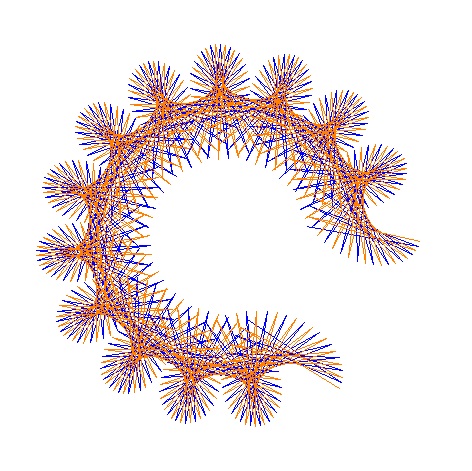
R6-3a


Every slight change makes a whole new design. Start with your own values. I would like to see what you and your students come up with. When you get the perfect one, e-mail it to me as a .jpg file and I will post it. (Please include the SR, and other data.