
Definitions are similar to theorems, but are true in both directions; technically, this means that the statement and its converse are both true (
The definition of continuity is a good example: A function f is continuous at x = a if, and only if, these three things are true
(1) 
(2) 
(3) 
“Play” with it: consider cases where only 2 of the 3 requirements are true – is the function still continuous? What would happen if you removed the requirements about finite numbers?
To use a theorem, one must be sure all the hypotheses are true. To use a definition, one may say that either part is true once you have established that the other part is true. So, if you know a function is continuous at a point, then the three statements are true; or if you can show the three statements are true, you may say the function is continuous.
Here’s an example: A typical AP problem might give a piecewise defined function and ask if it is continuous at the place where the domain is divided.
To get credit for justifying an answer of “yes”, students must show that all the requirements of the definition are met. Specifically, they must show that the limit as x approaches that point must equal the value of the function at that point (and both are finite). In turn, to show that this limit exist the student must show that the hypotheses of the theorem that says if the two one-sided limits are equal to the same number, then that number is the limit.
To get credit for an answer of “no”, the student must show that (only) one of the hypotheses is false.
Finally, as with theorems, express definitions in words. With your students, “play” with the theorem or definition by making changes to the hypotheses and seeing how that affects the conclusion. Look at the graphs. Don’t just state the definition and expect students to understand it, remember it and use it correctly.
 ), its
  ), its
  ) and its
  ) by looking at graphs of each case. (For the IVT the converse and inverse are false. The contrapositive of any true theorem is also true.)
 – for any – for every – for all
 increases on the closed interval
 ![\left[ -\tfrac{\pi }{2},\tfrac{\pi }{2} \right]](https://s0.wp.com/latex.php?latex=%5Cleft%5B+-%5Ctfrac%7B%5Cpi+%7D%7B2%7D%2C%5Ctfrac%7B%5Cpi+%7D%7B2%7D+%5Cright%5D&bg=ffffff&fg=333333&s=0&c=20201002) and the function decreases on the closed interval
and the function decreases on the closed interval ![\left[ \tfrac{\pi }{2},\tfrac{3\pi }{2} \right]](https://s0.wp.com/latex.php?latex=%5Cleft%5B+%5Ctfrac%7B%5Cpi+%7D%7B2%7D%2C%5Ctfrac%7B3%5Cpi+%7D%7B2%7D+%5Cright%5D&bg=ffffff&fg=333333&s=0&c=20201002) . The fact that
. The fact that  is in both intervals is not a problem since it is in the intervals, not at the point, that the function increases or decreases. This is because
  is larger than all (every, any) values in
  is increasing on any (all, every) interval containing the origin, yet
  . The AP exams do not make a big deal of this; they accept either open or closed intervals for increasing or decreasing.

 . The graph will show a horizontal asymptote at y = 1.
 approaches the x-axis as an asymptote, it follows that
  . (The fact that this graph crosses the x-axis many times on its trip to infinity is not a concern; the axis is still an asymptote.)
 , the functions all have a vertical asymptote of x = 0.
 near x = 3 and as
  . Relate the values and their signs to the graph. (Divide by a small number get a big number; divide by a big number, get a small number.)
 has no value at x = 2 (f(2) does not exist), but as you get closer to x = 2 the function value gets closer to 4 (
 ).
). with a gap or hole at the point (2, 4). Another example:
 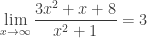 since, the graph gets closer to y = 3 as you go farther to the right. The line y = 3 is a horizontal asymptote.
 and since the fraction gets smaller as |x| gets larger, the function approaches 3 from above when x > 0 and from below when x < 0 (why?)
 Teaching Calculus