Good Question 1: 2008 AB 6

When I started this blog several years ago I was hoping my readers would ask questions that we could discuss or submit ideas for additional topics to write about. This has not really happened, but I’m still very open to the idea. (That was a HINT.) Since that first year when I had the entire curriculum ahead of me, I have written less not because I dislike writing, but because I am low on ideas.

The other day, I answered a question posted on the AP Calculus Community bulletin board about AB calculus exam question. It occurred to me that this somewhat innocuous looking question was quite good. So I decided to start an occasional series on good questions, from AP exams or elsewhere, that can be used to teaching beyond the actual things asked in the question.  (My last post might be in this category, but that was written several months ago.)

In discussing these questions, I will make numerous comments about the question and how to take it further in your class. My idea is not just to show how to write a good answer, but rather to use the question to look deeper into the concepts involved.

Good Question #1: 2008 AB Calculus exam question 6.

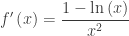
The stem gave students the function \displaystyle f\left( x \right)=\frac{\ln \left( x \right)}{x},\quad x>0. Students were also told that \displaystyle {f}'\left( x \right)=\frac{1-\ln \left( x \right)}{{{x}^{2}}}.

  1. The first thought that occurs is why they gave the derivative. The reason is, as we will see, that the first derivative is necessary to answer the first three parts of the question. Therefore, a student who calculates an incorrect derivative is going to be in big trouble (and the readers may have a great deal of work to do reading with the student’s incorrect work). The derivative is calculated using the quotient rule, and students will have to demonstrate their knowledge of the quotient rule later in this question; there is no reason to ask them to do the same thing twice.
  2. If you are using this with a class, you can, and probably should, ask your students to calculate the first derivative. Then you can see how many giving the derivative would have helped.
  3. When discussing the stem, you should also discuss the domain, x > 0, and the x-intercept (1, 0). Other features of the graph, such as end behavior, are developed later in the question, so they may be put on hold briefly.

Part a asked students to write an equation of the tangent line at x = e2. To do this students need to do two calculations: \displaystyle f\left( {{e}^{2}} \right)=\frac{2}{{{e}^{2}}} and \displaystyle {f}'\left( {{e}^{2}} \right)=-\frac{1}{{{e}^{4}}}. An equation of the tangent line is \displaystyle y=\frac{2}{{{e}^{2}}}-\frac{1}{{{e}^{4}}}\left( x-{{e}^{2}} \right).

  1. Writing the equation of a tangent line is a very important skill and should be straightforward. The point-slope form is the way to go. Avoid slope-intercept.
  2. The tangent line is used to approximate the value of the function near the point of tangency; you can throw in an approximation computation here.
  3. After doing part c, you should return here and discuss whether the approximation is an overestimate or an underestimate and how you can tell. (Answer: underestimate, since the graph is concave up here.)
  4. After doing part c, you can also ask them to write the tangent line at the point of inflection and whether approximations near the point of inflection are overestimates or an underestimates, and why. (Answer: Since the concavity change here, it depends on which side of the point of inflection the approximation is made. To the left is an overestimate; to the right is an underestimate.)

Part b asked students to find the x-coordinate of the critical point, determine whether it is a maximum, a minimum, or neither, and to “justify your answer.” To earn credit students had to write the equation \displaystyle {f}'\left( x \right)=0 and solve it getting x = e. They had to state that this is a maximum because  “{f}'\left( x \right)changes from positive to negative at x = e.”

This is a very standard AP exam question. To expand it in your class:

  1. Discuss how you know the derivative changes sign here. This will get you into the properties of the natural logarithm function.
  2. Discuss why the change in sign tells you this is a maximum. (A positive derivative indicates an increasing function, etc.)
  3. After doing part c, you can return here and try the second derivative test.
  4. The question asks for “the” critical point, hinting that there is only one. Students should learn to pick up on hints like this and be careful if their computation produces more or less than one.
  5. At this point we have also determined that the function is increasing on the interval \left( -\infty ,e \right] and decreasing everywhere else. The question does not ever ask this, but in class this is worth discussing as important features of the graph. On why these are half-open intervals look here.

Part c told students there was exactly one point of inflection and asked them to find its x-coordinate.  To do this they had to use the quotient rule to find that \displaystyle {{f}'}'\left( x \right)=\frac{-3+2\ln \left( x \right)}{{{x}^{3}}}, set this equal to zero and find the x-coordinate to be x = e3/2.

  1. The question did not require any justification for this answer. In class you should discuss what a justification would look like. The reason is that the second derivative changes sign here. So now you need to discuss how you know this.
  2. Also, you can now determine that the function is concave down on the interval \left( -\infty ,{{e}^{3/2}} \right) and concave up on the interval \left({{e}^{3/2}},\infty \right). Ask your class to justify this.

Part d asked student to find \displaystyle \underset{x\to 0+}{\mathop{\lim }}\,\frac{\ln \left( x \right)}{x}. The answer is -\infty . While this seems almost like a throwaway tacked on the end because they needed another point, it is the reason I like this question.

  1. The question is easily solved: \displaystyle \underset{x\to 0+}{\mathop{\lim }}\,\frac{\ln \left( x \right)}{x}=\underset{x\to 0+}{\mathop{\lim }}\,\frac{1}{x}\cdot \underset{x\to 0+}{\mathop{\lim }}\,\ln \left( x \right)=\left( \infty \right)\left( -\infty \right)=-\infty .
  2. While tempting, the limit cannot be found by L’Hôpital’s Rule, because on substitution you get \frac{-\infty }{0},which is not one of the forms that L’Hôpital’s Rule can handle.
  3. The reason I like this part so much is that we have already developed enough information in the course of doing the problem to find this limit! The function is increasing and concave down on the interval \left( -\infty ,e \right). Moving from the maximum to the left, the function crosses the x-axis at (1, 0), keeps heading south, and gets steeper. So the limit as you approach the y-axis from the right is negative infinity.This is the left-side end behavior.
  4. What about the right-side end behavior? (You ask your class.) Well, the function is positive and decreasing to the right of the maximum and becomes concave up after x = e3/2. Thus, it must flatten out and approach the x-axis as an asymptote.
  5. That \displaystyle \underset{x\to \infty }{\mathop{\lim }}\,\frac{\ln \left( x \right)}{x}=0 is clear from the note immediately above. This limit can be found by L’Hôpital’s Rule since it is an indeterminate of the type \infty /\infty . So, \displaystyle \underset{x\to \infty }{\mathop{\lim }}\,\frac{\ln \left( x \right)}{x}=\underset{x\to \infty }{\mathop{\lim }}\,\frac{\tfrac{1}{x}}{1}=0.
  6. Notice also that the first derivative approaches zero as x approaches infinity. This indicates that the function’s graph approaches the horizontal as you travel farther to the right. The second derivative also approaches zero as x approaches infinity indicating that the function’s graph is becoming flatter (less concave).

This question and the discussion is largely done analytically (working with equations). We did find a few important numbers in the course of the work. Hopefully, you students discussed this with many good words. To complete the Rule of Four, here is the graph.

2008 AB 6 - 1

And here is a close up showing the important features of the graph and the corresponding points on the derivatives.
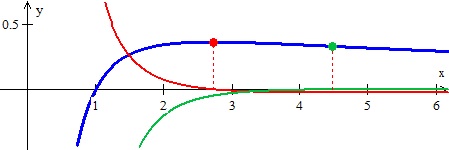
The function is shown in blue, the derivative and maximum in red, and the second derivative and the point of inflection in green.

The function is shown in blue, the derivative and maximum in red, and the second derivative and the point of inflection in green.

Finally, this function and the limit at infinity is similar to the more pathological example discussed in the post of October 31, 2012 entitled Far Out!

Half-full and Half-empty

A thought experiment:

Suppose you had a container with a rectangular base whose length runs from x = a to x = b, with a width of one inch. The container has four vertical rectangular sides. You put a piece of, say, plastic into the container which fits snugly along the bottom and four sides. The top of the piece is irregular and has the equation y = f(x).  If the plastic were to melt, how high up the sides would the melted plastic rise?

Half-full 1

One way to think about this is to consider the final level, L. When melted, the plastic above the final level must fill in the part below, leaving a rectangle with the same area as that under the original function’s levels. (The one-inch width will remain the same and not affect the outcome.)

Half-full 2

So the original area is \displaystyle \int_{a}^{b}{f\left( x \right)dx} and the final area is L\left( b-a \right). Since these are the same, we can write an equation and solve it for L.

\displaystyle L\left( b-a \right)=\int_{a}^{b}{f\left( x \right)dx}

\displaystyle L=\frac{\int_{a}^{b}{f\left( x \right)dx}}{b-a}

But that’s the equation for the average value of a function!

What a surprise!

Well, not a surprise for you, the teacher. This might be a good way to sneak up on the average value of a function idea for your students while giving them a good visual idea of the concept.

A Vector’s Derivatives

A question on the AP Calculus Community bulletin board this past Sunday inspired me to write this brief outline of what the derivatives of parametric equations mean and where they come from.

The Position Equation or Position Vector

A parametric equation gives the coordinates of points (x, y) in the plane as functions of a third variable, usually t for time. The resulting graph can be thought of as the locus of a point moving in the plane as a function of time. This is no different than giving the same two functions as a position vector, and both approaches are used. (A position vector has its “tail” at the origin and its “tip” tracing the path as it moves.)

For example, the position of a point on the flange of a railroad wheel rolling on a horizontal track (called a prolate cycloid) is given by the parametric equations

x\left( t \right)=t-1.5\sin \left( t \right)

y\left( t \right)=1-1.5\cos \left( t \right).

Or by the position vector with the same components \left\langle t-1.5\sin \left( t \right),1-1.5\cos \left( t \right) \right\rangle .

Derivatives and the Velocity Vector

The instantaneous rate of change in the y-direction is given by dy/dt, and dx/dt gives the instantaneous rate of change in the x-direction. These are the two components of the velocity vector \displaystyle \vec{v}\left( t \right)=\left\langle \frac{dx}{dt},\frac{dy}{dt} \right\rangle .

In the example, \displaystyle \vec{v}\left( t \right) =\left\langle 1-1.5\cos \left( t \right),1.5\sin \left( t \right) \right\rangle . This is a vector pointing in the direction of motion and whose length, \displaystyle \sqrt{{{\left( \frac{dx}{dt} \right)}^{2}}+{{\left( \frac{dy}{dt} \right)}^{2}}}, is the speed of the moving object.

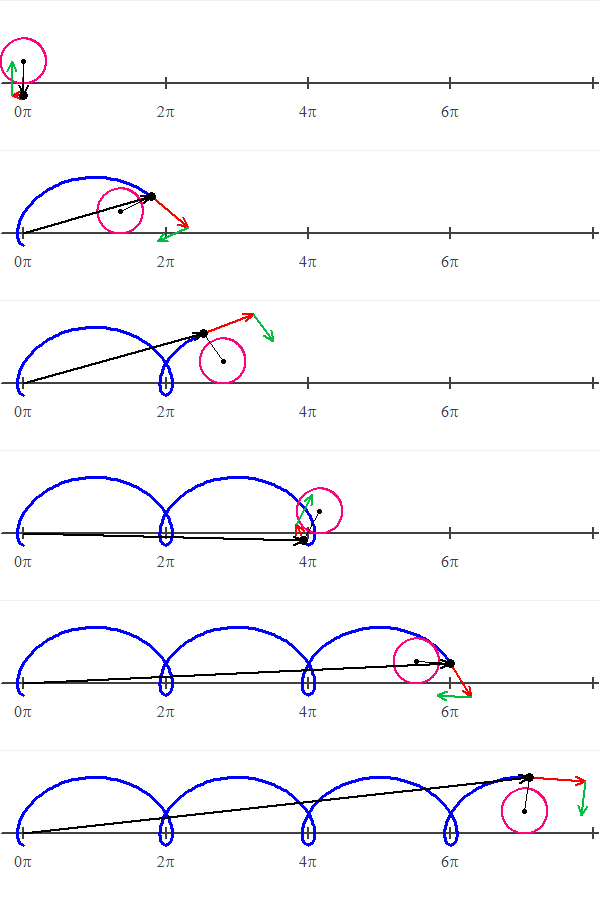
In the video below the black vector is the position vector and the red vector is the velocity vector. I’ve attached the velocity vector to the tip of the position vector. Notice how the velocitiy’s length as well as its direction changes. The velocity vector pulls the object in the direction it points and there is always tangent to the path.  This can be seen when the video pauses at the end and in the two figures at the end of this post.

Blog Cycloid 1

The slope of the tangent vector is the usual derivative dy/dx. It is found by differentiating dy/dt implicitly with respect to x. Therefore, \displaystyle \frac{dy}{dx}=\frac{dy}{dt}\cdot \frac{dt}{dx}.

There is no need to solve for t in terms of x since dt/dx is the reciprocal of dx/dt, instead of multiplying by dt/dx we can divide by dx/dt: \displaystyle \frac{dy}{dx}=\frac{dy/dt}{dx/dt}.

In the example, \displaystyle \frac{dy}{dx}=\left( 1.5\sin \left( t \right) \right)\frac{dt}{dx}=\left( 1.5\sin \left( t \right) \right)\left( \frac{1}{1-1.5\cos \left( t \right)} \right)=\frac{1.5\sin \left( t \right)}{1-1.5\cos \left( t \right)}

Second Derivatives and the Acceleration Vector

The components of the acceleration vector are just the derivatives of the components of the velocity vector

In the example, \displaystyle \vec{a}\left( t \right)=\left\langle 1.5\sin \left( t \right),1.5\cos \left( t \right) \right\rangle

The usual second derivative \displaystyle \frac{{{d}^{2}}y}{d{{x}^{2}}} is found by differentiating dy/dx, which is a function of t, implicitly with respect to x:


\displaystyle \frac{{{d}^{2}}y}{d{{x}^{2}}}=\left( \frac{d}{dt}\left( \frac{dy}{dx} \right) \right)\left( \frac{dt}{dx} \right)=\frac{\frac{d}{dt}\left( dy/dx \right)}{dx/dt}

In the example,

\displaystyle \frac{{{d}^{2}}y}{d{{x}^{2}}}=\left( \frac{d}{dt}\left( \frac{1.5\sin \left( t \right)}{1-1.5\cos \left( t \right)} \right) \right)\left( \frac{1}{1-1.5\cos \left( t \right)} \right)

\displaystyle =\frac{\left( 1-1.5\cos \left( t \right) \right)\left( 1.5\cos \left( t \right) \right)-\left( 1.5\sin \left( t \right) \right)\left( 1.5\sin \left( t \right) \right)}{{{\left( 1-1.5\cos \left( t \right) \right)}^{2}}}\cdot \frac{1}{\left( 1-1.5\cos \left( t \right) \right)}

\displaystyle =\frac{1.5\cos \left( t \right)-{{1.5}^{2}}}{{{\left( 1-1.5\cos \left( t \right) \right)}^{3}}}

The acceleration vector is the instantaneous rate of change of the velocity vector. You may think of it as pulling the velocity vector in the same way as the velocity vector pulls the moving point (the tip of the position vector). The video below shows the same situation as the first with the acceleration vectors in green attached to the tip of the velocity vector.

Blog Cycloid 2Here are two still figures so you can see the relationships. On the left is the starting position t = 0 with the y-axis removed for clarity. At this point the red velocity vector is \left\langle -0.5,0 \right\rangle indicating that the object will start by moving directly left. The green acceleration vector is \left\langle 0,1.5 \right\rangle pulling the velocity and therefore the object directly up. The second figure shows the vectors later in the first revolution. Note that the velocity vector is in the direction of motion and tangent to the path shown in blue.

Euler’s Method

Differential Equations 3 – Euler’s Method

Since not all differential equation initial values problems (IVP) can be solved, it is often necessary to approximate the solution. There are several ways of doing this. The one that AP students are required to know is Euler’s Method.

The idea behind Euler’s Method is to first write the equation of the line tangent to the solution at the initial condition point. To find the approximate value of the solution near the initial condition, then take short steps from the initial point to the point with the x-value you need.

Since you have the initial point and the differential equation will give you the slope, it is easy to write the equation of the tangent line. You then approximate the point on the solution by using the point on this line a short distance (called the step-size or \Delta x) from the initial point. The first step is exactly the local linear approximation idea.

Next, you write the equation of another line through the approximated point using the differential equation to give you the slope at the approximated point (i.e. not the point on the curve which you do not know). This gives you a second (approximate) point.

Then you repeat the process (called iteration) until you get to the x-value you need.

The equations look like this:

x_{n}={{x}_{n-1}}+\Delta x

{{y}_{n}}={{y}_{n-1}}+{f}'({{x}_{n-1}},{{y}_{n-1}})\Delta x

The first equation says that the x-values increase by the same amount each time. \Delta x may be negative if the required value is at an x-value to the left of the initial point.

The second equation gives the y-value of a point on the line through the previous point where the slope, {f}'({{x}_{n-1}},{{y}_{n-1}}), is found by substituting the coordinates of the previous point into the differential equation. It has the form of the equation of a line.

Example: Let f be the solution of the differential equation \displaystyle \frac{dy}{dx}=3x-2y with the initial point (1, 3). Approximate the value of f(2) using Euler’s method with two steps of equal size.
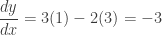
Solution: At the initial point \displaystyle \frac{dy}{dx}=3(1)-2(3)=-3. Then

{{x}_{1}}=1.5 and {{y}_{1}}=3+(3(1)-2(3))(0.5)=1.5

Now using the point (1.5, 0.5) where \displaystyle \frac{dy}{dx}=3(1.5)-2(0.5)=3.5

{{x}_{2}}=2 and {{y}_{2}}=0.5+(3.5)(0.5)=2.25

Therefore, \left( 2 \right)\approx 2.25. The exact value is 2.5545. A better approximation could be found using smaller steps.

Some textbooks and some teachers make tables to organize this procedure. This is fine, but not necessary on the AP exams. Showing the computations as above will earn the credit. It is easy to remember: you are just writing the equation of a line.

There are calculator programs available on-line that will compute successive iterations of Euler’s method and others that will compute and graph the values so you can examine the approximate solution graph. Of course in real situations computers using this or more advanced techniques can produce approximate numerical solutions to initial value problems.

Here is a graphical look at what Euler’s Method does. Consider this easy IVP: \displaystyle \frac{dy}{dx}={{e}^{x}} with the initial condition y\left( 0 \right)=1. The screen is two units wide extending from x = 0 to x = 2.  The calculator graph below shows three graphs. The top graph is the particular solution y={{e}^{x}}. (I said it was easy.) The lower graph shows an approximate solution with the rather large step size of \Delta x=1 with the two points connected; look closely and you will see the two segments. The middle graph has a step size of \Delta x=0.25. There are 8 segments, but they appear to be a smooth curve approximating the solution. Notice it is closer to the actual solution graph. An even smaller step size would show an even smoother graph closer to the particular solution.Euler

Slope Fields

Differential Equation 2 – Slope Fields

Of course, we always want to see the graph of an equation we are studying. The graph of a differential equation is a slope field.  A first derivative expressed as a function of x and y gives the slope of the tangent line to the solution curve that goes through any point in the plane.

Slope fields make use of this by imposing a grid of points evenly spaced across the Cartesian plane. At each point the value of the derivative is calculated and a short segment with that slope is drawn. These segments graphed together form the slope field.

Here is the slope field for the differential equation \displaystyle \frac{dy}{dx}=-\frac{x}{y}

Slope field 1

A good way to introduce slope fields to your class is to put or project a coordinate system on the board. Give each student one or two points (1, –3), (1, –2), (1, –1), (1, 1), (1, 2), etc. Have them calculate the derivative at their point(s) and then come to the board and draw a short segment through their point(s) with the slope they calculated. The result will be a slope field.  (This is, in fact, a common free-response question on the AP exams. Students are given a graph with 9 – 12 points plotted and they are asked to use them to draw a slope field for a given differential equation.)

The big idea with slope fields is to use them to get an idea of what the solutions look like, especially if the differential equation cannot be solved.  The solutions are lurking in the slope field. What do they look like in the figure? Circles of course. We solved this differential equation in the last post. The general solution is {{x}^{2}}+{{y}^{2}}={{C}^{2}}. Of course, they are not all that simple.

Since the solution graphs are lurking in the slope field, the next thing to do is to use the slope field to sketch a particular solution.  After plotting the initial condition (a point) students should draw a curve through the point that follows the slope field from edge to edge in both directions.

In the previous post (example 2) we found the particular solution of  \displaystyle \frac{dy}{dx}=-\frac{x}{y} with the initial condition point (4, –3) to be y=-\sqrt{25-{{x}^{2}}}. This is shown drawn on the slope field in the next graph. The black dot is the point (4, –3). Notice how the solution graph follows the slope field, but does not necessarily hit any of the segments. The solution will touch a segment only if the midpoint of the segment happens to be on the solution – this is not usually the case.

Slope field 2

Slope fields are tedious and time-consuming to draw by hand. It’s a job for computers. There are various graphing calculator programs available on the internet. Calculator screens are not the best for seeing slope fields; they are too small, and you should be sure to always be in a square window (or the slopes will not look right).

There are many websites that will draw slope fields and solution curves for you.  You can try this one. The figures in this post were done with Winplot (of course, my favorite). The good ones let you draw and animate solution curves over the slope field. (I have not found a good slope field generator app for iPads; if anyone makes apps, consider this a hint.)

Here is a brief example that shows how powerful an animated graph can be. In Winplot, follow the path Window > 2-dim > Equa > differential > dy/dx.  Enter the differential equation in the box and adjust the other settings as necessary.  Be sure you are in a square window (CTRL+Q).

The example below is from the 2002 BC exam question 5: dy/dx=2y-4x. Notice that this equation is not separable; students were not expected to solve it. They were asked to draw the solution curves through the two points (0, 1) and (0, –1) shown here in blue. These points are marked on the graph (Equa > point > (x,y)). The general solution, found by CAS, is y=C{{e}^{2x}}+2x+1. Enter this (Equa > 1.Explicit) and open the C slider (Anim > individual > C).

In the video below the C values go from –5 to 5. They stop momentarily at the two initial condition points (C = –2 for (0,–1) and C = 0 for (0, 1)). These are what the students were expected to sketch.

Slope field

The point is to see how the different values of C affect the equation, each giving its own particular solution, and to see the different solution hiding in the slope field.

Winplot may be downloaded here.

A DESMOS program that will draw slope fields is here.

Differential Equations

Differential Equations 1

The next several posts will cover the fundamentals of the topic of differential equations at least as far as is needed for an AP Calculus course. We will begin at the beginning.

What is a differential equation?

A differential equation is an equation with one or more derivatives in it. It may be very simple such as \displaystyle \frac{dy}{dx}=2x, or more complicated such as \displaystyle \frac{{{d}^{2}}y}{d{{x}^{2}}}+3\frac{dy}{dx}-4y=\cos \left( x \right) or even more complicated.

Why do we need differential equations?

It is often not possible to determine directly a regular function that applies to a real situation. However, we may be able to measure how something is changing with respect to time. The change with respect to time is a derivative and gives us a differential equation. Once in college, as you may remember, there are entire courses devoted to using and solving differential equations. Power series (a BC topic) are often used to approximate or find the solution to a differential equation.

What is the solution to a differential equation?

The solution of a differential equation is not a number. For the first equations we will consider the short answer is that a solution is a function that when substituted into the differential equation along with its derivatives produces a true statement (an identity).

As you may suspect differential equations, at least the easy ones, are solved by integrating. Thus the solution of \frac{dy}{dx}=2x  first appears to be y={{x}^{2}}. But we quickly realize that y={{x}^{2}}+17 and  also y={{x}^{2}}+2\pi  check when substituted into the given equation. In fact any equation with the form y={{x}^{2}}+C, where C is any constant will check. Because of this we first define the general solution of a differential equation as a function with one or more constants that satisfies the given differential equation.

In order to evaluate the constant(s) we are often given an initial condition. An initial condition is the value of the solution function for a particular value of the independent variable, in other words, a point on the solution’s graph. Once the constant is evaluated, we have what’s called a particular solution.

So if the solution of \frac{dy}{dx}=2x contains the point (4, 7), then the particular solution is y={{x}^{2}}-9. A differential equation with an initial condition is called an initial value problem or an IVP.

How do you solve a differential equation?

There is no one method that will let you solve any differential equation. They are not all as simple as the example above. That’s why entire courses are devoted to solving differential equations. AP Calculus students are expected to know only one of the many methods. (This is because there is only time for the briefest introduction of the topic.) The method is called separation of variables. Not all differential equations can be solved by this method; the second example at the top for example requires a much different approach (that is not tested on the AP calculus exams).

To use the method of separation of variables follow these steps:

(1) by multiplying and dividing rewrite, the equation with the x and dx factors on one side and the y and dy factors on the other side.

(2) Then integrate both sides and

(3) Include a constant of integration.

(4) Use the initial condition to evaluate the constant and

(5) Give the particular solution solved for y.

Example 1: For the very simple example we have been using the work looks like this:

Step 1 Separate the variables: dy=2xdx

Steps 2 and 3 Integrate and include the constant of integration. Note that there is a different constant on both sides, but they are immediately combined into one constant that is usually put with the x-terms: y={{x}^{2}}+C

Step 4 Use the initial condition to find C7={{4}^{2}}+C;\quad C=-9

Stem 5 Write the solution by solving for yy={{x}^{2}}-9

Example 2: An average difficulty question. Find the particular solution of the differential equation \displaystyle \frac{dy}{dx}=-\frac{x}{y} such that the point (4, –3) lies on the solution.

Step 1: ydy=-xdx

Step 2 and 3: \displaystyle \frac{1}{2}{{y}^{2}}=-\frac{1}{2}{{x}^{2}}+C  or {{y}^{2}}=-{{x}^{2}}+C.  Multiplying by 2 to simplify things, The constant in the second form is not the same as in the first. However, it is just another constant so it is okay to call it C again.

Step 4: {{(-3)}^{3}}=-{{\left( 4 \right)}^{2}}+C so C=25

Step 5: {{y}^{2}}=-{{x}^{2}}+25 and y=-\sqrt{25-{{x}^{2}}}

Since the solution must be a function it is necessary to solve for y by taking the square root of both sides. The negative sign is chosen because the initial condition requires a negative value for y. The solution is a semi-circle, the bottom half of the full circle.

Example 3: A bit more difficult, but the steps are the same. Find the particular solution of the differential equation \displaystyle \frac{dy}{dx}=\frac{y-1}{{{x}^{2}}} with the initial condition f\left( 2 \right)=0. (From the 2008 AB calculus exam question 5c.)
Step 1:\displaystyle \frac{dy}{y-1}=\frac{dx}{{{x}^{2}}}

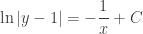
Steps 2 and 3: \displaystyle \ln \left| y-1 \right|=-\frac{1}{x}+C

Step 4: When x = 2, y =0  so \displaystyle \ln \left| 0-1 \right|=-\frac{1}{2}+C;\quad C=\frac{1}{2}

Step 5: Solve for y: \displaystyle \ln \left| y-1 \right|=-\frac{1}{x}+\frac{1}{2}

Raise e to the power on each side to remove the natural logarithm. (Students like to call this “E-ing.”)

\displaystyle {{e}^{\ln }}^{\left| y-1 \right|}={{e}^{-\frac{1}{x}+\frac{1}{2}}}

\displaystyle \left| y-1 \right|={{e}^{-\frac{1}{x}+\frac{1}{2}}}

Near the initial point (2, 0) \left( y-1 \right)<0, so \left| y-1 \right|=-\left( y-1 \right)=1-y, so

\displaystyle 1-y={{e}^{-\frac{1}{x}+\frac{1}{2}}}

\displaystyle y=1-{{e}^{-\frac{1}{x}+\frac{1}{2}}}

The graph of the solution is the part of the graph shown below for which x>0. See note 2 below:

DEq graph

Two final notes:

  1. The business with the absolute values is important. Students seem to prefer just ignoring the absolute values, but of course you cannot do that. A similar thing occurred in example 2: since you need the square root of one side you must decide, based on the initial condition, whether to use a plus or a minus sign with the radical. Some practice with both these situations is needed.
  2. Since \left( y-1 \right)<0,\quad y<1. In order to make this so, x>0. This is the domain of the solution. Technically, the domain of the particular solution of a differential equation must be an open interval that contains the initial condition, and on which the differential equation is true. Practically, this means that the graph must go through the initial condition point but may not cross an asymptote or contain a point where the function is not defined. The solution in the example is undefined at x = 0. It approaches the y-axis as a vertical asymptote from the left and approaches the point (0,1) from the right. AP students were not required to sort all this out, but a simple graph of the solution will show what’s happening. For more on the domain (which is not really tested) click here.
  3. For you techies: The graph was made on an iPad using an app called Good Grapher Pro. This is an excellent grapher for 2D and 2D graphs that zoom easily by pinching the screen (of course).


January

Happy New Year!

The January posts from past years finish the methods of integration thread from December and then go onto applications of integration: area between graphs, volume, and average value of a function. The month ends with a series on accumulation and functions defined by integrals.These run into February, so I’ve included them in the list below.

The most popular post from past Januarys by far is the AP Accumulation Question post. It is in the featured list below along with some others from past Januarys.

Later this month look for a new series of post on differential equations

January 2, 2013 Integration by Parts – 1

January 4, 2013 Integration by Parts – 2

January 7, 2013 Area Between Curves

January 9, 2013 Volume of Solids with Regular Cross-sections

January 11, 2013 Volumes of Revolution

January 14, 2013 Why You Never Need Cylindrical Shells

January 16, 2013 Average Value of a Function

January 19, 2013 Most Triangles are Obtuse! What is the probability that a triangle picked at random will be acute? An average value problem.

January 21, 2103 Accumulation: Need an Amount? Accumulation 1: If you need an amount, look around for a rate to integrate.

January 23, 2013 AP Accumulation Questions Accumulation 2: AP Exam Rate/Accumulation Questions

January 25, 2014 Improper Integrals and Proper Areas

January 26, 2013 Graphing with Accumulation 1 Accumulation 3: Graphing Ideas in Accumulation – Increasing and decreasing

January 28, 2013 Graphing with Accumulation: Accumulation 4: Graphing Ideas in Accumulation – Concavity

January 30, 2013 Stamp Out Slope-intercept Form! Accumulation 5: Lines

February 2, 2013: Accumulation and Differential Equations Accumulation 6: Differential equations

February 4, 2013: Painting a Point Accumulation 7: An application (of paint)