Related Rate Questions

Related Rate Questions

 Related Rate questions are an application of derivative. If two or more quantities help model the same situation, then their derivatives are related and may be used to examine their rates of change. these are called related rate problems. They appear on the AP Calculus exams usually as part of a free-response or a multiple-choice question.

Related Rates Problems 1 

 Related Rate Problems II

Good Question 9  Baseball and Related Rates

Painting a Point  Mostly integration, but with a Related Rate tie-in.


Revised from a post of November 7, 2017

Other Derivative Applications

Some final applications of derivatives

L’Hospital’s Rule 

Locally Linear L’Hospital’s Demonstration of the proof

L’Hospital Rules the Graph

Good Question An AP Exam question that can be used to delve deeper into L’Hospital’s Rule (2008 AB 6)

Related Rate problems

Related Rates Problems 1 

 Related Rate Problems II

Good Question 9  Baseball and Related Rates

Painting a Point  Mostly integration, but with a Related Rate tie-in.


Other Topics (Type 7)

Any topic in the Course and Exam Description may be the subject of a free-response question. The two topics listed here have been the subject of full free-response questions or major parts of them.

Implicitly defined relations and implicit differentiation

These questions may ask students to find the first or second derivative of an implicitly defined relation. Often the derivative is given and students are required to show that it is correct. (This is because without the correct derivative the rest of the question cannot be done.) The follow-up is to answer questions about the function such as finding an extreme value, second derivative test, or find where the tangent is horizontal or vertical.

What students should know how to do

  • Know how to find the first derivative of an implicit relation using the product rule, quotient rule, the chain rule, etc.
  • Know how to find the second derivative, including substituting for the first derivative.
  • Know how to evaluate the first and second derivative by substituting both coordinates of a given point. (Note: If all that is needed is the numerical value of the derivative then the substitution is often easier if done before solving for dy/dx or d2y/dx2 and as usual the arithmetic need not be done.)
  • Analyze the derivative to determine where the relation has horizontal and/or vertical tangents.
  • Write and work with lines tangent to the relation.
  • Find extreme values. It may also be necessary to show that the point where the derivative is zero is actually on the graph and to justify the answer.

Simpler questions about implicit differentiation my appear on the multiple-choice sections of the exam.

Related Rates

Derivatives are rates and when more than one variable is changing over time the relationships among the rates can be found by differentiating with respect to time. The time variable may not appear in the equations. These questions appear occasionally on the free-response sections; if not there, then a simpler version may appear in the multiple-choice sections. In the free-response sections they may be an entire problem, but more often appear as one or two parts of a longer question.

What students should know how to do

  • Set up and solve related rate problems.
  • Be familiar with the standard type of related rate situations, but also be able to adapt to different contexts.
  • Know how to differentiate with respect to time, that is find dy/dt even if there is no time variable in the given equations. using any of the differentiation techniques.
  • Interpret the answer in the context of the problem.
  • Unit analysis.

Shorter questions on both these concepts appear in the multiple-choice sections. As always, look over as many questions of this kind from past exams as you can find.

For some previous posts on related rate see October 8, and 10, 2012 and for implicit relations see November 14, 2012


Next Posts:

Friday March 31: For BC Polar Equations (Type 9)

Tuesday April 4: For BC Sequences and Series.

Friday April 7, 2017 The Domain of the solution of a differential equation.

Good Question 9

This is a good question that leads to other good questions, both mathematical and philosophical. A few days ago this question was posted on a private Facebook page for AP Calculus Readers. The problem and illustration were photographed from an un-cited textbook.

Player 1 runs to first base [from home plate] at a speed of 20 ft/s while player 2 runs from second base to third base a speed of 15 ft/s. Let s be the distance between the two players. How fast is s changing when player 1 is 30 feet from home plate and Player 2 is 60 feet from second base. [A figure was given showing that the distance between the bases is 90 feet.]

baserunners 2-8-16

Some commenters indicated some possible inconsistencies in the question, such as assuming the Player 2 is on second base when Player 1 leaves home plate. In this case the numbers don’t make sense. So, someone suggested this must be a hit-and-run situation. To which someone else replied that with a lead of that much it’s really a stolen base situation. So, the first thing to be learned here is that even writing a simple problem like this you need to take some of the real aspects into consideration. But this doesn’t change the mathematical aspects of the problem.

One of the things I noticed before I attempted to work out the solution was that Player 2 is the same distance from third base as Player 1 is from home plate. I verbalized this as “players are directly across the field from each other.” I filed this away since it didn’t seem to matter much. Wrong!

Then I worked on the problem two ways. These are shown in the appendix at the end of this post. I discovered (twice) that s’ = 0; at the moment suggested in the question the distance is not changing.

Then it hit me. Doh! – I didn’t have to do all that. So, I posted this solution (which I now notice someone beat me to):

At the time described, the players are directly across the field from each other (90 feet apart). This is the closest they come. The distance between them has been decreasing and now starts to increase. So, at this instant s is not changing (s‘ = 0).

The Philosophical Question

Then the original poster asked for someone “to post [actual] work done in calculus” and “to see some related rates.” So, I posted some “calculus” and got to thinking – the philosophical question – isn’t my first answer calculus?

I think it is. It makes use of an important calculus concept, namely that as things change, at the minimum place, the derivative is zero. Furthermore, the justification (that the distance changes from decreasing to increasing at the minimum implies the derivative is zero) is included. * Why do you need variables?

Also, this solution is approached as an extreme value (max/min) problem rather than a related rate problem. This shows a nice connection between the two types of problems.

The Related (but not related rate) Good Question

So here is another calculus question with none of the numbers we’ve grown to expect:

Two cars travel on parallel roads. The roads are w feet apart. At what rate does the distance between the cars change when the cars are w feet apart?

Notice:

  • That the cars could be travelling in the same or opposite directions.
  • Their speeds are not given.
  • You don’t know when or where they started; only that at some time they are opposite each other (w feet apart).
  • In fact, they could start opposite each other and travel in the same direction at the same speed, remaining always w feet apart.
  • One car could be standing still and the other just passes it.

But you can still answer the question.

(*Continuity and differentiability are given (or at least implied) in the original statement of the problem.)

 Appendix

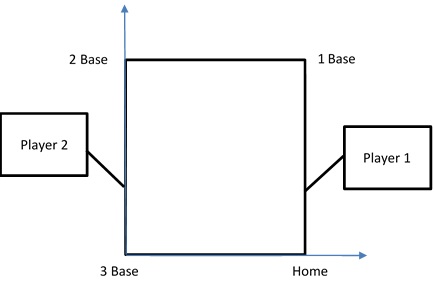
My first attempt was to set up a coordinate system with the origin at third base as shown below.

Blog 2-8-16

Then, taking the time indicated in the problem as t = 0, the position of Player 1 is (90, 30 + 20t) and the position of player 2 is (0, 30 – 15t). Then the distance between them is

s=\sqrt{{{90}^{2}}+{{\left( 30-15t-\left( 30+20t \right) \right)}^{2}}}=\sqrt{{{90}^{2}}+{{\left( -35t \right)}^{2}}}

and then

\displaystyle {s}'\left( t \right)=\frac{2\left( -35t \right)\left( -35 \right)}{2s}\text{ and }{s}'\left( 0 \right)=0

This is correct, but for some reason I was suspicious probably because zeros can hide things. So I re-stated this time taking t = 0 to be one second before the situation described in the problem. Now player 1’s position is (90, 10+20t) and player 2’s position is (0, 45-15t).


s\left( t \right)=\sqrt{{{90}^{2}}+{{\left( 45-15t-\left( 10+20t \right) \right)}^{2}}}=\sqrt{{{90}^{2}}+{{\left( 30-35t \right)}^{2}}}

\displaystyle {s}'\left( t \right)=\frac{2\left( 35-35t \right)\left( -35 \right)}{2s}\text{ and }{s}'\left( 1 \right)=0

.

____________________________________________

Implicit Relations & Related Rates

AP Type Questions 7

Implicitly defined relations and implicit differentiation

These questions may ask students to find the first or second derivative of an implicitly defined relation. Often the derivative is given and students are required to show that it is correct. (This is because without the correct derivative the rest of the question cannot be done.) The follow-up is to answer questions about the function such as finding an extreme value, second derivative test, or find where the tangent is horizontal or vertical.

What students should know how to do

  • Know how to find the first derivative of an implicit relation using the product rule, quotient rule, the chain rule, etc.
  • Know how to find the second derivative, including substituting for the first derivative.
  • Know how to evaluate the first and second derivative by substituting both coordinates of the point. (Note: If all that is needed is the numerical value of the derivative then the substitution is often easier if done before solving for dy/dx or d2y/dx2.)
  • Analyze the derivative to determine where the relation has horizontal and/or vertical tangents.
  • Write and work with lines tangent to the relation.
  • Find extreme values. It may also be necessary to show that the point where the derivative is zero is actually on the graph.

Related Rates

Derivatives are rates and when more than one variable is changing over time the relationships among the rates can be found by differentiating with respect to time. The time variable may not appear in the equations. These questions appear occasionally on the free-response sections; if not there, then a simpler version may appear in the multiple-choice sections. In the free-response sections they may be an entire problem, but more often appear as one or two parts of a longer question.

What students should know how to do

  • Set up and solve related rate problems.
  • Be familiar with the standard type of related rate situations, but also be able to adapt to different contexts.
  • Know how to differentiate with respect to time, using any of the differentiation techniques.
  • Interpret the answer in the context of the problem.
  • Unit analysis.

Shorter questions on both these concepts appear in the multiple-choice sections. As always, look over as many questions of this kind from past exams as you can find.

For some previous posts on related rate see October 8, and 10, 2012 and for implicit relation s see November 14, 2012

Painting a Point

Accumulation 7: An application (of paint)

Suppose you started with a point, the origin to be specific, and painted it. You put on layers and layers of paint until your point grows to a sphere with radius r. Let’s stop and admire your work part way through the job; at this point the radius is {{x}_{i}} and 0\le {{x}_{i}}\le r.

How much paint will you need for the next layer?

Easy: you need an amount equal to the surface area of the sphere, 4\pi {{x}_{i}}^{2}, times the thickness of the paint. As everyone knows paint is thin, specifically \Delta x thin. So we add an amount of paint to the sphere equal to 4\pi {{x}^{2}}\left( \Delta x \right).

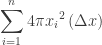
The volume of the final sphere must be the same as the total amount of paint. The total amount of paint must be the (Riemann) sum of all the layers or \displaystyle \sum\limits_{i=1}^{n}{4\pi {{x}_{i}}^{2}\left( \Delta x \right)}. As usual \Delta x is very thin, tending to zero as a matter of fact, so the amount of paint must be

\displaystyle \underset{\Delta x\to 0}{\mathop{\lim }}\,\sum\limits_{i=1}^{n}{4\pi {{x}_{i}}^{2}\left( \Delta x \right)=\int_{0}^{r}{4\pi {{x}^{2}}}dx=\left. \tfrac{4}{3}\pi {{x}^{3}} \right|_{0}^{r}=\tfrac{4}{3}\pi {{r}^{3}}}.

A standard related rate problem is to show that the rate of change of the volume of a sphere is proportional to its surface area – the constant of proportionality is dr/dt. So it should not be a surprise that the integral of this rate of change of the surface area is the volume. The integral of a rate of change is the amount of change.

Interestingly this approach works other places as long as you properly define “radius:”

  • A circle centered at the origin with radius x and perimeter of 2\pi x, gains area at a rate equal to its perimeter times the “thickness of the edge” \Delta x: \displaystyle A=\underset{n\to \infty }{\mathop{\lim }}\,\sum\limits_{k=1}^{n}{2\pi x\Delta x}=\int_{0}^{r}{2\pi x\,dx=\pi {{r}^{2}}}
  • A square centered at the origin with “radius” x with sides whose length are s =2 x, gains area at a rate equal to its perimeter (8x) times the “thickness of the edge” \Delta x:  \displaystyle A=\underset{n\to \infty }{\mathop{\text{lim}}}\,\sum\limits_{k=1}^{n}{8x\Delta x=\int_{0}^{x}{8x\,dx}}=4{{x}^{2}}={{(2x)}^{2}}={{s}^{2}}
  • A cube centered at the origin with “radius” x and edges of length 2x, gains volume at a rate equal to its surface area, 6(4{{x}^{2}}), times the “thickness of the face” \Delta x – think paint again: V=\underset{n\to \infty }{\mathop{\text{lim}}}\,\sum\limits_{k=1}^{n}{\text{6(4}{{\text{x}}^{2}})\Delta x}=\int_{0}^{x}{24{{x}^{2}}dx}=8{{x}^{3}}={{(2x)}^{3}}={{s}^{3}}

Related Rate Problems II

If you look in most textbooks for related rate questions you will find pretty much the same related rate problems: ladders sliding down walls, people walking away from lamppost, water running into or out of cone shaped tanks, etc.

Here are two somewhat different related problems you may like.

  1. A girl starts riding down an escalator at the same time a boy starts riding up a parallel escalator. The escalators are 5 meters apart, 30 meters long, and they both move at the rate of 1 m/sec.
    1. How fast is the distance between the kids changing 10 seconds later? (Answer: -1.789 m/sec.)
    2. Variation: Suppose that the girl is moving at 1 m/sec and the boy at 3 m/sec. The boy reaches the end of the escalator first and stands there. Now how fast is the distance between them changing 8 seconds after they start?  (1.486 m/sec)
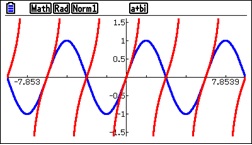
    3. Variation: With the situation given in part b., write and graph a piece-wise defined function that gives the distance between the kids.  Find where this graph is continuous but not differentiable. Why does this happen? (Answer: the boy reaches the top in 10 seconds and stands still. Up to this point the distance between them is represented by a hyperbola; here it now becomes a different parabola with an abrupt change in the graph. At this point, the function is not differentiable. This second parabola appears almost linear from the 10 second point on.
  1. A 60-foot-long rope is attached to a pulley 36 feet above the ground. A lantern his attached to one end of the rope and a man holds the other end on the top of his head 6 feet off the ground. He walks away at the rate of 5 feet/sec.
    1. Find the rate at which the distance between the pulley and the top of the man’s head is changing when he is 40 feet from the point directly under the pulley? (Answer: 4 ft./sec.)
    2. Find the rate of change of the length of the man’s shadow when he is 40 feet from a point directly under the pulley? (Answer:  -0.90 ft./sec.)
    3. (Extension – extreme value problem, rather difficult) When the man starts walking the lantern is at the height of his head and his shadow is infinitely long. When is the tip of the man’s shadow closest to the point directly under the pulley and how far away is it? (Answer: At t = 3.654 sec the tip of the shadow is 39.658 feet from the point under the pulley.)

These two questions are from Audrey Weeks’ Calculus in Motion. This is a really good package of dynamic illustrations of calculus concepts and AP Exams free-response question that runs on Geometer’s Sketchpad. For more information click here. The related rate sections include both standard and non-standard problems.

Corrections made September 17, 2014, March 6, 2022