NCTM Calculus Panel Discussion

The annual AP Calculus Panel Discussion at the NCTM Annual meeting was held on Saturday April 28, 2018. The principal speaker was Stephen Davis, the chief reader for calculus. Stephen has made his slides available for anyone who is interested. The slides are here http://www.ncaapmt.org/archive/crTalks/nctm-apr2018-notes.pdf .

The items highlighted in blue are the ones Stephen discussed in detail. Thank you to Stephen for making them available to everyone. The last slide for each of the 9 questions contains comments on the scoring of the question.

Here are a few notes I took at the meeting about specific problems from the 2017 operational (Main US) exam:

  1. AB3/BC3 (d) Avoid words like “pointy” it is better to discuss the one-sided limits.
  2. AB4/BC4 (b) Students need to be able to jump into the middle of the problem. Some students solved the differential equation, then differentiated the answer to get to the equation that was given.
  3. AB5 Sign charts appear on the standards. This is not a change; sign charts are excellent ways to organize information. However, sign charts should not be used as justifications; readers want students to write about what they the sign chart tells them.
  4. AB 6 (d) Justify by showing (saying) that the hypotheses of the theorem or definition are met.
  5. BC 2 (c) Students had trouble understanding that w(theta) = g(theta) – f(theta) was. They seemed not to understand what g and w represented graphically.
  6. BC 5 (d) Either the integral test or the limit comparison test may be used. Students need to state the conditions of whichever test they use.
  7. Communication is becoming more important in all questions.

Teachers should look at and study the “Chief Reader Report” that is available for each exam on the same page as the questions and scoring standards at AP Central. The sample student responses are also helpful in understanding what is and is not a good response.


A Few More Things

The AP Calculus AB and BC exams are scheduled for Tuesday May 15, 2018 at 08:00 local time. That’s about 5 weeks away. I’ve posted all my review notes, finishing well ahead of time so, if you find something useful in them, you’ll have time to incorporate it into your review. I hope you find them helpful. The links to the 12 review posts are at the end of this post. 

What this also means is that I finished my year before you. There will be only occasional posts between now and August when I’ll start again going through the year. Should I find something interesting to write about, I’ll post it. To be sure you don’t miss anything, I suggest you click on the “Follow Teaching Calculus” link at the very bottom of the right hand column. This will inform you of new post by email. Meanwhile, if you have any questions, suggestions, or anything you’d like my thoughts on please email me at lnmcmullin@aol.com or add a comment at the end of any post.

Happy reviewing. Good luck to your students on the exam!

For today a few short items, including a great new resource. 


On grading practice exams

When going over their students’ work on the real AP Exam questions teachers often get bogged down in the minutia of grading. They want, quite naturally, to give their students every point they earned, but not more than that. They have questions like, “What is they forget the dx?”  or “Do they have to include units?” This is my suggestion originally posted to the AP Calculus Community bulletin board a few weeks ago:

As exam time nears, teachers become concerned about exactly what to give credit for and what not to give credit for when grading their students’ work on past AP free-response questions.

Chief Reader Stephen Davis recently posted a note on the grading of a fictitious exam question showing how 2 points might have been awarded on a L’Hospital’s Rule question.  The note is interesting because it shows the detail that exam leaders consider when deciding what to accept and what not; it shows the detail that readers must keep in mind while grading. This type of detail with the examples is given to the readers in writing for each part of each question. With about 500,000 exams each year, this level of detail is necessary for fairness and consistency in the scoring.

BUT, as teachers preparing your students for the exam you really don’t need to be concerned about all the fine points (2.5 pages’ worth) as readers do. Encourage your students to answer the question correctly and show the required work. This is shown on the scoring standard for each question (on Stephen’s sample it is in the ruled area directly below the question). Don’t worry about the fine points – what if I say this, instead of that. If your students try to answer and show their work but miss or overlook something, the readers will do their best to follow the student’s work and give him or her the points they have earned.

Why show your students the minimum they can get away with? That does not help them! Do your students a favor: score the review problems more stringently than the readers. If their answer is not quite right, take off some credit and help them learn how to do better. It will help them in the long run.


NCTM AP Calculus Panel Discussion

This is an invitation to everyone attending NCTM Annual Meeting in Washington D.C. Please join us for the annual AP Calculus Panel Discussion.

Date: Saturday April 28, 2018 from 8:00 to 10:30 AM

Location:  Room 159AB in the Walter E. Washington Convention Center, Washington D.C.

The tentative speakers are

·         Stephen Davis, chief reader for AP Calculus who will discuss the 2017 exams

·         Stephanie Ogden, from the College Board

·         Karen Hyers member of the calculus development committee

·         Mark Howell long time reader, table leader and author

·         Lin McMullin Moderator of the AP Calculus Community and your host.

After the panel discussion there will be a question and answer period, and a raffle.

No RSVP is necessary. Just come, meet the panelists, and enjoy the discussion.

The panel is sponsored jointly by D & S Marketing System, Inc., Bedford, Freeman and Worth, and HP.


A new Index of Multiple-choice Questions

Once again we have Ted Gott to thank for a new spreadsheet collating each multiple-choice question with the Learning Objective (LO) and the Essential Knowledge (EK) listed in the Course and Exam Description.

Here is the link to the new Type Analysis 2018

And here again is his Free-response Index by topic

THANK YOU, TED !


And Finally

As I’m sure you are aware, the College Board makes past exams available to teachers to use in their class as assignments, on quizzes and tests, and as good review material for the AP exams. To keep students from seeing them the exams are made secure and available only to teachers with an audit for the course. Teachers are not allowed to post them anywhere on-line, even their own web page. They may not let students take them from their classroom.

Alas, the exams are available on-line; students can find them.

The College Board takes this seriously; it is a violation of the College Board’s copyright. The CB’s lawyers contact the person or group who posted them and make them take them down. But more exams pop up. Please, follow the rules and do not post anything. If you or your students do find a secure exam (2013, 2014, 2015, 2016, or 2017) please send the URL to me at lnmcmullin@aol.com and I’ll send it to the CB. You may also send it directly to the CB at copyrightviolations@collegeboard.org.

I have little faith that this will keep the exams off-line or keep students from finding them. To that end I refer you to a suggestion I made in a previous post, A Modest Proposal: Don’t count the exams for any sort of grade. Use them only to help students find out what they do not understand.


Schedule of the review notes and questions by type. 


NCTM Calculus Panel Notes

This past week I attended the NCTM Annual Meeting in San Antonio, Texas. For many years now, the sessions included a panel discussion on AP Calculus. This year Stephen Davis, chief reader for AP Calculus, was the principal speaker. I would like to share a few of his comments and insights some of which may help your students on the upcoming exams.

One of the things I recommend in preparing your students for the exam is to go over the directions to both parts of the exam. You should especially explain the three-decimal place rule and the (non-) simplification policy.

This year there will be a slight change in the free-response directions. This change is not a policy change; the change in the wording was made to emphasize what has been the policy for some years. Here is the new wording of the first bullet of the free-response directions with the changes underlined:

Show all your work, even though a question may not explicitly remind you to do so. Clearly label any functions graphs, tables, or other objects that you use. Justifications require that you give mathematical reasons, and that you verify the needed conditions under which relevant theorems, properties, definitions, or tests are applied. Your work will be scored on the correctness and completeness of your methods as well as your answers. Answers without supporting work will usually not receive credit.

For an example of the first underlining sentence, consider 2016 AB 2. This is a linear motion (Type 2) question. Part (a) asks “At time t = 4, is the particle speeding up or slowing down?” According to the scoring standards, two points could be earned for “conclusion with reason.” This means that a correct conclusion of “slowing down” received no credit, because no work was shown. Correct work includes the computation of the velocity and acceleration at t = 4 and indication they since they have different signs the particle is slowing down.

In the same exam, 2016 BC 4 (c) illustrates the second underlined sentence above. This was a L’Hôpital’s Rule question. Just writing

\displaystyle \underset{x\to -1}{\mathop{\lim }}\,\left( \frac{g\left( x \right)-2}{3{{\left( x+1 \right)}^{2}}} \right)=\underset{x\to -1}{\mathop{\lim }}\,\left( \frac{{g}'\left( x \right)}{6\left( x+1 \right)} \right)=-\frac{1}{3}

does not earn the point. Students must indicate that they are using L’Hôpital’s Rule preferably by stating that the limits of the numerators and denominators at each stage are zero.

Another example from 2016 AB 3/BC 3 (Type 3): This problem showed the graph of a function f and asked about the function g defined as g\left( x \right)=\int_{2}^{x}{f\left( t \right)dt}. Students were required to specifically state that {g}'\left( x \right)=f\left( x \right) somewhere, somehow, in some part of the question, showing that they understood the relationship implied by the Fundamental Theorem of Calculus.

People started asking questions of the kind they ask on the AP Calculus Community Bulletin Board. They are “what if” questions: What if a student forgets the dx?  What if the student gives open intervals and they should be closed? What if they use the x as the upper limit of integration and in the integrand? What if …? What if …?

Here is a comment I wrote a few days ago for the Community Bulletin board that Stephen was kind enough to mention:

I am sure you teach your students to do the problems correctly, use proper notation, and, even though this is not an English exam, to spell things correctly. You may deduct points in your class for failing to do any of that, or constantly remind them.

As others have pointed out, the readers do their best to give kids the credit they earn and there are not enough points to go around for some mistakes. The procedures for dx and missing parentheses etc. are not something you even need to tell or even mention to your students. Why would you? In scoring the mock exams take off when they make these mistakes. The mock exams should be a little harder than the real thing – that will only help the kids.

To answer your question: students will get full credit on the exams if they do everything right, and sometimes with a little less than everything right. Don’t show your students the minimum they can get away with. They don’t need to know that and it does not help them.

The exceptions are the algebraic and numerical simplifying rules and the three or more-decimal place rule.


A Logistics Graph???

Stephen included slide above in his presentation. It shows the growth in the number of students taking the AP Calculus exams since they first stared in 1956. The AB/BC split first happened in 1969. For years, we have been looking at what looked like exponential growth knowing this wasn’t possible. This kind of growth surely must be logistic since there is an upper limit to the number of students who could take the exam, namely the number of kids in high school.

So, have we reached the point where the numbers start to level off? Or is this just a slight pause such as happened around 1989 and again around 1995? Stay tuned.


Sequences and Series (Type 10 for BC only)

Convergence tests for series appear on both sections of the BC Calculus exam. In the multiple-choice section, students may be asked to say if a sequence or series converges or which of several series converge.

The Ratio test is used most often to determine the radius of convergence and the other tests to determine the exact interval of convergence by checking the convergence at the end points. Click here for a Convergence test chart students should be familiar with; this list is also on the resource page.

On the free-response section there is usually one full question devoted to sequences and series. This question usually involves writing a Taylor or Maclaurin polynomial for a series.

Students should be familiar with and able to write several terms and the general term of a series. They may do this by finding the derivatives and constructing the coefficients from them, or they may produce the series by manipulating a known or given series. They may do this by substituting into a series, differentiating it or integrating it.

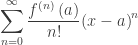
The general form of a Taylor series is \displaystyle \sum\limits_{n=0}^{\infty }{\frac{{{f}^{\left( n \right)}}\left( a \right)}{n!}{{\left( x-a \right)}^{n}}}; if a = 0, the series is called a Maclaurin series.

What Students Should be Able to Do 

  • Use the various convergence tests to determine if a series converges. The test to be used is rarely given so students need to know when to use each of the common tests. For a summary of the tests click: Convergence test chart.
  • Write the terms of a Taylor or Maclaurin series by calculating the derivatives and constructing the coefficients of each term.
  • Distinguish between the Taylor series for a function and the function. Do NOT say that the Taylor polynomial is equal to the function (this will lose a point); say it is approximately equal.
  • Determine a specific coefficient without writing all the previous coefficients.
  • Write a series by substituting into a known series, by differentiating or integrating a known series, or by some other algebraic manipulation of a series.
  • Know (from memory) the Maclaurin series for sin(x), cos(x), ex and \displaystyle \tfrac{1}{1-x} and be able to find other series by substituting into them.
  • Find the radius and interval of convergence. This is usually done by using the Ratio test and checking the endpoints.
  • Be familiar with geometric series, its radius of convergence, and be able to find the number to which it converges, \displaystyle {{S}_{\infty }}=\frac{{{a}_{1}}}{1-r}. Re-writing a rational expression as the sum of a geometric series and then writing the series has appeared on the exam.
  • Be familiar with the harmonic and alternating harmonic series. These are often useful series for comparison.
  • Use a few terms of a series to approximate the value of the function at a point in the interval of convergence.
  • Determine the error bound for a convergent series (Alternating Series Error Bound and Lagrange error bound). See my post of  February 22, 2013.
  • Use the coefficients (the derivatives) to determine information about the function (e.g. extreme values).
  • Understand absolute and conditional convergence. If the series of the absolute values of the terms of a series converges, then the original series is said to absolutely convergent (or converges absolutely). If the series of absolute values diverges, then the original series may (or may not) converge; if it converges it is said to be conditionally convergent.


This list is quite long, but only a few of these items can be asked in any given year. The series question on the free-response section is usually quite straightforward. Topics and convergence test may appear on the multiple-choice section. As I have suggested before, look at and work as many past exam questions to get an idea of what is asked and the difficulty of the questions. Click on Power Series in the “Posts by Topic” list on the right side of the screen to see previous posts on Power Series.


The concludes the series of posts on the type questions in review for the AP Calculus exams.


Next Post

Friday April 7, 2017 The Domain of the solution of a differential equation.


Polar Curves (Type 9 for BC only)

Ideally, as with parametric and vector functions, polar curves should be introduced and covered thoroughly in a pre-calculus course. Questions on the BC exams have been concerned with calculus ideas related to polar curves. Students have not been asked to know the names of the various curves (rose, curves, limaçons, etc.). The graphs are usually given in the stem of the problem, but students should know how to graph polar curves on their calculator, and the simplest by hand.

What students should know how to do:

  • Calculate the coordinates of a point on the graph,
  • Find the intersection of two graphs (to use as limits of integration).
  • Find the area enclosed by a graph or graphs: Area =\displaystyle A=\tfrac{1}{2}\int_{{{\theta }_{1}}}^{{{\theta }_{2}}}{(r(}θ\displaystyle ){{)}^{2}}dθ
  • Use the formulas x\left( \theta  \right)\text{ }=~r\left( \theta  \right)\text{cos}\left( \theta  \right)~~\text{and}~y\left( \theta  \right)\text{ }=~r(\theta )\text{sin}\left( \theta  \right)~  to convert from polar to parametric form,
  • Calculate \displaystyle \frac{dy}{d\theta } and \displaystyle \frac{dx}{d\theta } (Hint: use the product rule on the equations in the previous bullet).
  • Discuss the motion of a particle moving on the graph by discussing the meaning of \displaystyle \frac{dr}{d\theta } (motion towards or away from the pole), \displaystyle \frac{dy}{d\theta } (motion in the vertical direction) or \displaystyle \frac{dx}{d\theta } (motion in the horizontal direction).
  • Find the slope at a point on the graph, \displaystyle \frac{dy}{dx}=\frac{dy/d\theta }{dx/d\theta }.

This topic appears only occasionally on the free-response section of the exam instead of the Parametric/vector motion question. The most recent on the released exams were in 2007,  2013, 2014, and 2017. If the topic is not on the free-response then 1, or maybe 2 questions, probably finding area, can be expected on the multiple-choice section.

Shorter questions on these ideas appear in the multiple-choice sections. As always, look over as many questions of this kind from past exams as you can find.


Next post:

Tuesday April 4: For BC Sequences and Series.

Friday April 7, 2017 The Domain of the solution of a differential equation.


.

Parametric/Vector Question (Type 8 for BC only)

I have always had the impression that the AP exam assumed that parametric equations and vectors were first studied and developed in a pre-calculus course. In fact, many schools do just that. It would be nice if students knew all about these topics when they started BC calculus. Because of time considerations, this very rich topic is not fully developed in BC calculus.

That said, the parametric/vector equation questions only concern motion in a plane. I will try to address the minimum that students need to know to be successful on the BC exam. Certainly, if you can do more and include a unit in a pre-calculus course do so.

Another concern is that most calculus textbooks jump right to vectors in 3-space while the exam only tests motion in a plane and 2-dimensional vectors. (Actually, the equations and ideas are the same with an extra variable for the z-direction)

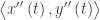
In the plane, the position of a moving object as a function of time, t, can be specified by a pair of parametric equations x=x\left( t \right)\text{ and }y=y\left( t \right) or the equivalent vector \left\langle x\left( t \right),y\left( t \right) \right\rangle . The path is the curve traced by the parametric equations or the tips of the position vector. .

The velocity of the movement in the x- and y-direction is given by the vector \left\langle {x}'\left( t \right),{y}'\left( t \right) \right\rangle . The vector sum of the components gives the direction of motion. Attached to the tip of the position vector this vector is tangent to the path pointing in the direction of motion.

The length of this vector is the speed of the moving object. \text{Speed }=\sqrt{{{\left( {x}'\left( t \right) \right)}^{2}}+{{\left( {y}'\left( t \right) \right)}^{2}}}. (Notice that this is the same as the speed of a particle moving on the number line with one less parameter: On the number line \text{Speed}=\left| v \right|=\sqrt{{{\left( {x}'\left( t \right) \right)}^{2}}}.)

The acceleration is given by the vector \left\langle {{x}'}'\left( t \right),{{y}'}'\left( t \right) \right\rangle .

What students should know how to do:

  • Vectors may be written using parentheses, ( ), or pointed brackets, \left\langle {} \right\rangle , or even \vec{i},\vec{j} form. The pointed brackets seem to be the most popular right now, but all common notations are allowed and will be recognized by readers.
  • Find the speed at time t\text{Speed }=\sqrt{{{\left( {x}'\left( t \right) \right)}^{2}}+{{\left( {y}'\left( t \right) \right)}^{2}}}
  • Use the definite integral for arc length to find the distance traveled \displaystyle \int_{a}^{b}{\sqrt{{{\left( {x}'\left( t \right) \right)}^{2}}+{{\left( {y}'\left( t \right) \right)}^{2}}}}dt. Notice that this is the integral of the speed (rate times time = distance).
  • The slope of the path is \displaystyle \frac{dy}{dx}=\frac{{y}'\left( t \right)}{{x}'\left( t \right)}. See this post for more on finding the first and second derivatives with respect to x.
  • Determine when the particle is moving left or right,
  • Determine when the particle is moving up or down,
  • Find the extreme position (farthest left, right, up, down, or distance from the origin).
  • Given the position find the velocity by differentiating; given the velocity find the acceleration by differentiating.
  • Given the acceleration and the velocity at some point find the velocity by integrating; given the velocity and the position at some point find the position by integrating. These are just initial value differential equation problems (IVP).
  • Dot product and cross product are not tested on the BC exam, nor are other aspects.

Shorter questions on these ideas appear in the multiple-choice sections. As always, look over as many questions of this kind from past exams as you can find.


Next Posts:

Friday March 31: For BC Polar Equations (Type 9)

Tuesday April 4: For BC Sequences and Series.(Type 10)


.

Other Topics (Type 7)

Any topic in the Course and Exam Description may be the subject of a free-response question. The two topics listed here have been the subject of full free-response questions or major parts of them.

Implicitly defined relations and implicit differentiation

These questions may ask students to find the first or second derivative of an implicitly defined relation. Often the derivative is given and students are required to show that it is correct. (This is because without the correct derivative the rest of the question cannot be done.) The follow-up is to answer questions about the function such as finding an extreme value, second derivative test, or find where the tangent is horizontal or vertical.

What students should know how to do

  • Know how to find the first derivative of an implicit relation using the product rule, quotient rule, the chain rule, etc.
  • Know how to find the second derivative, including substituting for the first derivative.
  • Know how to evaluate the first and second derivative by substituting both coordinates of a given point. (Note: If all that is needed is the numerical value of the derivative then the substitution is often easier if done before solving for dy/dx or d2y/dx2 and as usual the arithmetic need not be done.)
  • Analyze the derivative to determine where the relation has horizontal and/or vertical tangents.
  • Write and work with lines tangent to the relation.
  • Find extreme values. It may also be necessary to show that the point where the derivative is zero is actually on the graph and to justify the answer.

Simpler questions about implicit differentiation my appear on the multiple-choice sections of the exam.

Related Rates

Derivatives are rates and when more than one variable is changing over time the relationships among the rates can be found by differentiating with respect to time. The time variable may not appear in the equations. These questions appear occasionally on the free-response sections; if not there, then a simpler version may appear in the multiple-choice sections. In the free-response sections they may be an entire problem, but more often appear as one or two parts of a longer question.

What students should know how to do

  • Set up and solve related rate problems.
  • Be familiar with the standard type of related rate situations, but also be able to adapt to different contexts.
  • Know how to differentiate with respect to time, that is find dy/dt even if there is no time variable in the given equations. using any of the differentiation techniques.
  • Interpret the answer in the context of the problem.
  • Unit analysis.

Shorter questions on both these concepts appear in the multiple-choice sections. As always, look over as many questions of this kind from past exams as you can find.

For some previous posts on related rate see October 8, and 10, 2012 and for implicit relations see November 14, 2012


Next Posts:

Friday March 31: For BC Polar Equations (Type 9)

Tuesday April 4: For BC Sequences and Series.

Friday April 7, 2017 The Domain of the solution of a differential equation.