Absolute Value

The answers to the True-False quiz at the end of the last post are all false. This brings us to absolute value, another topic I want to concentrate on for my upcoming Algebra 1 class. Absolute value becomes a concern in calculus too which I will discuss as the last example below.

There a several “definitions” of absolute value that I’ve seen over the years which I mostly do not like

  • The number without a sign – awful: all numbers except zero have a sign
  • The distance from zero on the number line – true, but not too useful especially with variables
  • The larger of a number and its opposite – true, but not to useful with variables

So I propose to give them an algorithm: If the number is positive, then the absolute value is the same number; if the number is negative, then its absolute value is its opposite. Of course, this is really the definition.

So I’ll soon express this in symbols

\left| a \right|=\left\{ \begin{matrix} a & \text{if }a\ge 0 \\ -a & \text{if }a<0 \\ \end{matrix} \right.

Now interestingly this is probably the first piecewise defined function an Algebra 1 student may see, or at least the first one that’s not artificial.  So this is a good place to start talking about piecewise defined function and the importance of talking about the domain. And of course, we’ll have to take a look at the graph.

Sometimes we will have to start solving equations and inequalities with absolute values. So here is the next thing I understand but do not like and will try to avoid. Solve the equation: \left| x \right|=3 , Answer including work: x=\pm 3. But I think a longer way around is also better:

If x<0 then \left| x \right|=-x=3 so x=-3 or if x>0, then \left| x \right|=x=3 Solution: x=3 or x=-3.

Longer? Sure. I hope that by making the students write that a few times that when they get to solving  \left| x \right|>3 that it will be natural to say

If  x<0 then \left| x \right|=-x>3  so x<-3 or if x>0, then \left| x \right|=x>3 Solution:  x<-3 or x>3

The last case may take a little more discussion. Solve \left| x \right|<3. Starting the same way

If x<0 then \left| x \right|=-x<3 so x>-3 which really means -3<x<0

if x>0, then \left| x \right|=x<3 which really means 0\le x<3 . Then the union of these two sets looks like an intersection. The solution is -3<x<3

Quite often the equation and the two types of inequalities are treated as separate problems: with = you go with \pm  on the other side, with > you have a union pointing away from the origin and with < you have somehow an intersection.  Who needs to remember all that when this idea works all the time?

Example:  Solve \left| 4x-10 \right|<8

If 4x-10<0, then x<\tfrac{5}{2} and \left| 4x-10 \right|=-\left( 4x-10 \right)=-4x+10<8, so -4x<-2 and x>\tfrac{1}{2} or more precisely  \tfrac{1}{2}  If latex 4x-10\ge 0$, then x\ge \tfrac{5}{2}  and \left| 4x-10 \right|=4x-10<8, so 4x<18 and x<\tfrac{9}{2} or more precisely \tfrac{5}{2}<x<\tfrac{9}{2}. The union again becomes an intersection and the answer is \tfrac{1}{2}<x<\tfrac{9}{2}

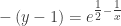
Finally an example from calculus. On the 2008 AB exam, question 5 asked student to find the particular solution of a differential equation with the initial condition f\left( 2 \right)=0. After separating the variables, integrating, including the “+C” and substituting the initial condition students arrived at this equation which they now need to solve for y:

 \displaystyle \left| y-1 \right|={{e}^{\tfrac{1}{2}-\tfrac{1}{x}}}

How can you lose the absolute value sign? Simple, near the initial condition where y = 0,  \left( y-1 \right)<0 so replace \left| y-1 \right| with -\left( y-1 \right) and then go ahead and solve for y

 \displaystyle -\left( y-1 \right)={{e}^{\tfrac{1}{2}-\tfrac{1}{x}}}

\displaystyle y=1-{{e}^{\tfrac{1}{2}-\tfrac{1}{x}}}

I don’t think I’ll try this one in Algebra 1, but maybe it will come in handy when they get to calculus.

The Opposite of Negative

Next year, for the first time in 15 years, I am going to be teaching high school full-time. While I have enjoyed writing and working primarily with teachers for the last 15 years, I’m looking forward to “going back to the classroom” as they say. It looks like I’ll be teaching BC calculus and Algebra 1 – two of my favorite classes. I’m very positive about that.

With that in mind I have been thinking of some of the things I want to be sure I get right in the Algebra 1 classes to get the kids off to a good start. So a few of my blogs in the coming year may be on Algebra 1 topics with the view of having students do things right from the start and not having to relearn things when they get to calculus.

So here is the first thing I want to be sure to work on: the m-dash also known as the minus sign.

According to Wikipedia:

The minus sign (−) has three main uses in mathematics:

  1. The subtraction operator: A binary operator to indicate the operation of subtraction, as in 5 − 3 = 2. Subtraction is the inverse of addition.
  2. Directly in front of a number and when it is not a subtraction operator it means a negative number. For instance −5 is negative 5.
  3. A unary operator that acts as an instruction to replace the operand by its opposite. For example, if x is 3, then −x is −3, but if x is −3, then −x is 3. Similarly, −(−2) is equal to 2.

Using the same symbol understandably can confuse beginning math students. I am not going to invent new symbols so I will just have to be careful with what I say and let the kids say. And I have to say it right , if I expect them to.

When used between two numbers or two expressions with variables the symbol means subtraction. That’s pretty easy to spot and understand in context.  But when used alone in front of something the minus sign means different things.

The m-dash may always be read “opposite.” So “–a” is read “the opposite of a” and not “negative a.”  Likewise, –5 is read “the opposite of five.”

There is only one instance where the m-dash may be read “negative.” When it is used in front of a number it indicates a negative number so      “–5” is also correctly read “negative five.” This is the only time the m-dash should be read “negative.”  Things like “–a” should always be read “the opposite of a” and never read “negative a.”

There was a time when the folks who write math books tried to make the distinction by using a slightly raised dash to indicate negative number so negative 3 was written  “–3.” This has carried over into calculators where the key marked “(–)” is used for “negative” and “opposite.” and is printed on the screen as a shorter and slightly raised dash. The subtraction key is only used for subtraction.

Oh, if it were only that simple. What do you do with –(–5)? Not really a problem the “opposite of the opposite of 5” and the “opposite of negative 5” are both 5.

I’ll know I’ve succeeded when everyone can get 100% on this little True-False quiz:

  1. The opposite of a number is a negative.
  2. –x < 0
  3. x > 0
  4. | x | = x
  5. |– x |= x

Answers are in my next post.


Revised 10-27-2018

A Standard Problem?

Sometimes even the simplest problems can lead to interesting places. I got interested in this ordinary textbook problem a few months ago while observing an AB calculus class. Here is how my thinking went written as a series of exercises:

Original exercise: Find the point(s) on the parabola y = x2 that are closest to the point (0, 2).

The solution is straightforward:

Let z(x) be the distance from (0, 2) to the point (x, x2). Then \displaystyle z\left( x \right)=\sqrt{{{\left( x-0 \right)}^{2}}+{{\left( {{x}^{2}}-2 \right)}^{2}}}and setting the derivative equal to zero, we find the critical points at x = 0 a local maximum and x=-\sqrt{\tfrac{3}{2}} and x=\sqrt{\tfrac{3}{2}} both absolute minimums located symmetrically to the y-axis.

The students had some trouble understanding what was going on. I suggested they consider a point moving along the parabola starting high on the left side. As the point comes down the graph its distance from \left( 0,2 \right) gets shorter until it reaches some minimum length somewhere. Then the distance gets longer again until – where? Obviously, at the origin. Then symmetry takes over and the distance decreases again until it reaches a second minimum directly across the y-axis from the first point, after which it increases forever.

Exercise 1: Sketch the graph of the distance function, z(x), on top of the graph of the parabola. Give the exact coordinates of the maximum point without doing any computations. Discuss the y-coordinates of the minimum points.

It then occurred to me that there is nothing sacred about (0, 2). We could use any point on the y-axis, . Or could we? I pictured a circle centered at the point (0, a) on the y-axis tangent to the parabola (i.e. tangent to the tangent line of the parabola). The radius of such a circle is the minimum distance for that y-axis center point.

Exercise 2: If the point is below the origin then obviously the minimum distance is the distance directly up to the origin. There are places above the x-axis where the origin is the closest point. For what values of a is the origin the closest point? Use the circle mentioned above to explain how this is possible.

The distance graph that we drew above has a W shape similar to the shape of some 4th degree polynomials (note: z(x) is not a 4th degree polynomial, it is not even a polynomial). So next I drew the graph of z’(x), the first derivative of z; this graph is similar to a cubic polynomial (again it is not a polynomial)

Exercise 3: Without actually computing the derivative’s equation, sketch the graph of the derivative with the graph of the parabola and the distance function’s graph. Be sure the critical points are where they should be.

Exercise 4: Use a graphing program or a graphing calculator do draw the parabola, z(x) and z’(x) and use it to check your sketches.

Project: Using a suitable program (Winplot, Geogebra, etc.) set up an animation that will show all the features discussed above. It should show the parabola which does not move, the movable point (0, a), the circle tangent to the parabola, z(x) and z’(x). These last 3 should move with the slider for a.

At this point I noticed that the derivative changed concavity 4 times (up-down-up-down). The origin is one of 3 points of inflection. I wondered if there was anything interesting about the location of the points of inflection.

Exercise 5: Find the coordinates of the points of inflection of z’(x). Are they related to any of the features in the problem? (Use a CAS for this one.)

The solutions can be found here: Closest Point Problem Solution.

Looking Ahead

Well the AP calculus exams are over. I hope all your students did well.

I’ll be cutting down the number of posts for the next few months. I will try to post once a week or so when I find something interesting. Remember if you click one of the RSS feeds or the “Follow this Blog” at the bottom of the right hand column you can get the postings without coming directly here.

In August I plan to go back to teaching high school for the first time in 15 years. I will be filling in for a friend who is going on sabbatical. That should be interesting and fun.

This blog was stared in August 2012 and I tried to do post on topics that would help a few weeks ahead of when I though most people would be teaching them. So you can go through the year monthly from the archives section on the right. Starting this coming August I hope to fill in the gaps from the first year by writing on topics I missed or expanding on the previous ones.

In the meanwhile, I’ll be working on the third edition of my book Teaching AP Calculus. I hope it will be out early next year.

Hope you have  relaxing and productive summer!

Today’s the Day

For all the AP Calculus teachers out there, my best wishes for your students today as they take the big test. I hope they all do well and all your hard work and effort pays off.

Getting Ready for the Exam

I think the idea of writing this blog came to me about this time last year when folks were looking for last-minute advice to give their students before the AP calculus exams. I had some ideas of my own and collected some from others. Here is a list in no particular order.

The review time

  • Concentrate your reviewing on the things you don’t know (yet). Try to pick up those details you are not too sure of.
  • Work as many actual AP problems as you can, but concentrate on the form and ideas. None of these questions will be on the test, but many very much like these will be.
  • With, or without your class, find one (or more) of the released exams and take it in one sitting with the time allowed for each section.  This is to get you used to the real timing and the fact that you may not finish one or more sections.

The day before the test

  • Take a good look at the various formulas you will need; be sure you have them memorized correctly.
  • Put fresh batteries in you calculator and be sure it is in radian mode.
  • Take the afternoon and evening off. Relax. Do something fun.
  • Get to bed early and get a good night’s sleep.
  • Have a good breakfast.
  • Bring a snack for the short break between the two sections of the test.
  • Get Psyched!

During the test

  • Don’t panic! There is no extra credit for 100%. You may miss quite a few points and still get a 5; and quite a few more and get a 3.
  • Concentrate on the things you know. If you don’t know a how to do a problem, go onto the next one.
  • Keep your eye on the clock. Just before the multiple-choice sections are over, bubble in anything you left blank – there is no penalty for guessing.
  • On the free-response section, do not do arithmetic or algebraic simplification – it is not required and simplifying a correct answer incorrectly will lose a point. And it wastes time.
  • Don’t get bogged down in a problem – if you are not getting anywhere, stop and go to the next part or next question.

Good Luck!

What’s a Mean Old Average Anyway?

Students often confuse the several concepts that have the word “average” or “mean” in their title. This may be partly because not just the names, but the formulas associated with each are very similar, but I think the main reason may be that they are keying in on the word “average” rather than the full name.

Here are the three items. We will assume that the function f is continuous on the closed interval [a, b] and differentiable on the open interval (a, b):

1.  The average rate of change of a function over the interval is simply the slope of the line from one endpoint of the graph to the other.

 \displaystyle \frac{f\left( b \right)-f\left( a \right)}{b-a}

2. The mean (or average) value theorem say that somewhere in the open interval (a, b) there is a number c such that the derivative (slope) at x = c is equal to the average rate of change over the interval.

\displaystyle {f}'\left( c \right)=\frac{f\left( b \right)-f\left( a \right)}{b-a}

3. The average value of a function is literally the average of all the y-coordinates on the interval. It is the vertical side of a rectangle whose base extends on the x-axis from x = a to x =b and whose area is the same as the area between the graph and the x-axis and the function over the same interval.

\displaystyle \frac{\int_{a}^{b}{f\left( x \right)dx}}{b-a}

Notice that when you evaluate the integral, the result looks very much like the ones above. This formula is also called the mean value theorem for integrals or the integral form of the mean value theorem. No wonder people get confused.

The three are closely related. Consider a position-velocity-acceleration situation. The average rate of change of position (#1 above) is the average value of the velocity (#3) and somewhere the velocity must equal this number (#2). Similarly, the average rate of change of velocity (#1) is the average acceleration (#3) and somewhere in the interval the acceleration (derivative of velocity) must equal this number (#2).

These ideas are tested on the AP calculus exams sometimes in the same question. See for example 2004 AB 1 parts c and d.

So, help your students concentrate on the entire name of the concepts, not just the “average” part.