The Teaching Calculus Blog 2025 – 2026

Another year and another AP Calculus exam: Thank you again for reading and using the blog. I am not going away. If something new or interesting comes up in calculus or the AP Calculus program, I will jump in with a new post.

I do monitor the site and If you have any questions on teaching calculus, calculus in general, or a specific mathematics question please email me here or add a comment to any post. (Don’t be bashful: I like to answer your questions.)

The blog and all its resources will be here. Please use them and give the links to your colleagues and students. As always, you are welcome to reproduce anything here for use in your classroom.

If you are new to the blog, the drop-down menus under the header will help you find your way around the blog.

  • The Blog Guide is the place to start. Most of my posts are linked to the appropriate unit in the AP Calculus Course and Exam Description (CED) and the other general topics in that list.
  • The AP Calculus CED has other links to posts to units in the AP Calculus Course and Exam Description.
  • An Exam Index and Type Analysis has past multiple-choice abd free-response questions indexed by my ten types.
  • The Resources tab lists post by month and other resources.
  • The Presentations tab has links to PowerPoints slides on various topics that I have done over the years. Feel free to download them and use them with your class if you think they will be useful to them.
  • The Videos tab has some very old videos on various topics. You can also find them directly on Vimeo.com; search for Lin McMullin.
  • The Website has some things from a previous website.

You may also find posts using the Search box, Post by Topic and Archives features on the right side of the page. Just enter or look for the topic you are interested in.

I hope you have another good year and find the blog helpful. Thanks again for reading all these years.
Teaching Calculus 2024 – 25

Review time is approaching. Here is the link to the AP Calculus Exams Review Posts

AP Calculus Exam Review Posts

Thank you for your support and encouragement for the Teaching Calculus blog. I’ve enjoyed writing the posts and answering your questions since 2012. This coming year, I will be stepping away from this blog; I am not planning any new posts.

The blog and all its resources will be here for the foreseeable future. Please use them and give the links to your colleagues and students. As always, you are welcome to reproduce anything here for use in your classroom.

I am not going away. If something new or interesting comes up in calculus or the AP Calculus program, I will jump in with a new post. If you have any questions on teaching calculus, calculus in general, or a specific mathematics question please email me here or add a comment to any post. (Don’t be bashful: I like to answer your questions.)

If you are new to the blog, the drop-down menus under the header will help you find your way around the blog.

  • The Blog Guide is the place to start. Most of my posts are linked to the appropriate unit in the AP Calculus Course and Exam Description (CED) and the other general topics in that list.
  • The AP Calculus CED has other links to posts to units in the AP Calculus Course and Exam Description.
  • An Exam Index and Type Analysis has past multiple-choice abd free-response questions indexed by my ten types.
  • The Resources tab lists post by month and other resources.
  • The Presentations tab has links to PowerPoints slides on various topics that I have done over the years. Feel free to download them and use them with your class if you think they will be useful to them.
  • The Videos tab has some very old videos on various topics. You can also find them directly on Vimeo.com; search for Lin McMullin.
  • The Website has some things from a previous website.

You may also find posts using the Search box, Post by Topic and Archives features on the right side of the page. Just enter or look for the topic you are interested in.

I hope you have a good year and find the blog helpful. Thanks again for reading all these years.

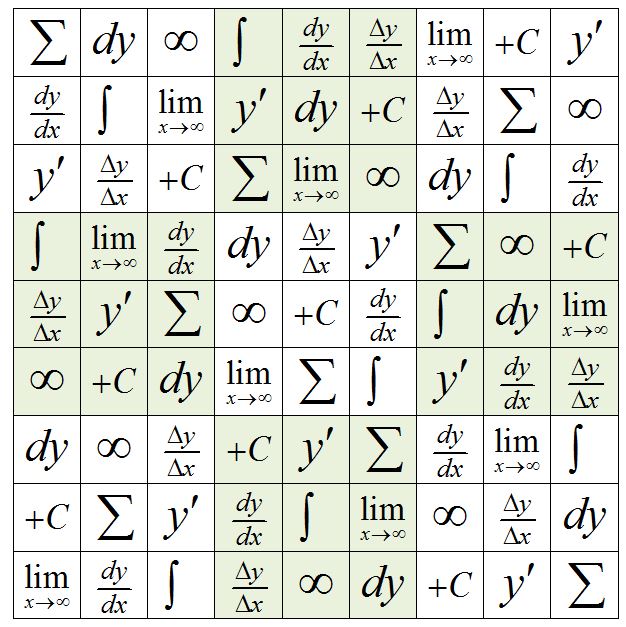
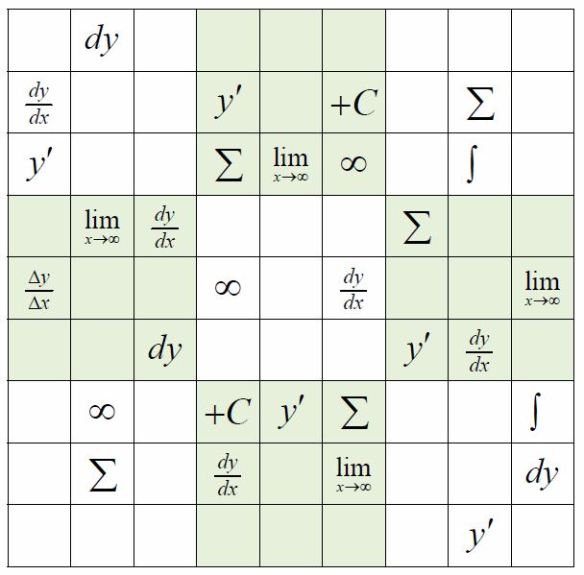
Meanwhile here is a little calculus sudoku to keep you busy.

Solution

The Why Series

Since 2012 this blog has been written with teachers in mind, hence the title “Teaching Calculus.” Students may read it too; I hope they do and find it helpful. Please share any of the posts that you think will be helpful with them.

This year I plan to write a series of posts for students. The first post will appear next Tuesday August 22, 2023. It’s called “Why Limits?” and will discuss briefly why we use limits and how they fit into calculus. Following weeks will see post on Infinity, continuity, and then derivatives.

My idea is to introduce the topics, to help students sort through what they are about to learn, and why. I will not be providing detailed notes; that’s your job. I hope I can provide a thorough line so students can get an idea of where they are going in calculus and why.

If you find the posts helpful, please share the link with your students. Ask them to “Like” the post (If they like the post) or add comments, suggestions, and especially their questions using the “Leave a Reply” link at the very end of each post.

Following the timing suggested in the Course and Exam Description, the posts will be timed to appear at least a week before you get to the topic (even longer for schools starting in September). This is so you may read them in advance and decide which to share. Give the links to your class when they fit your schedule.

As always, I am happy to have your suggestions for posts and your students’.

Visualizing Unit 9

As you probably realize by now, I think graphs, drawing and other visuals are a great aid in teaching and learning mathematics. Desmos is a free graphing app that many teachers and students use to graph and make other illustrations. Demonstrations can be made in advance and shared with students and other teachers.

Recently, I was looking a some material from Unit 9 Parametric Equation, Polar Coordinates, and Vector-Valued Functions, BC topics, from the current AP Calculus CED. I ended up making three new Desmos illustrations for use in this unit. They will also be useful in a precalculus course introducing these topics. Hope you find them helpful.

Polar Graph Demo

Link

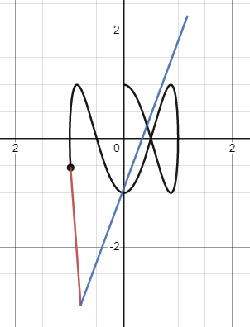
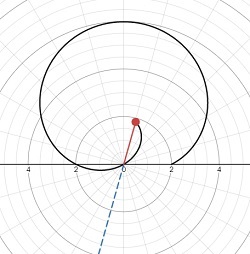
You may replace the polar equation with any polar equation you are interested in. There are directions in the demo. Moving the “a” slider will show a ray rotating around the pole. The “a” value is the angle, \displaystyle \theta , in radians between the ray and the polar axis. On the ray is a segment with a point at its end. This segment’s length is \displaystyle \left| {r\left( \theta \right)} \right|. As you rotate the ray you can see the polar graph drawn. When \displaystyle r(\theta )<0 the segment extend in the opposite direction from the ray.

This demo may be used to introduce or review how polar equation work. An interesting extension is to enter something for the argument of the function that is not an integer muntiple of \displaystyle \theta and extend the domain past \displaystyle 2\pi , for example \displaystyle r=2+4\sin (1.2\theta )

Basic Parametric and Vector Demo

LInk

A parametric equation and the vector equation of the same curve differ only in notation. So, this demo works for both. Following the directions in the demo, you may see the graph being drawn using the “a” slider. You may turn on (1) the position vector and its components, (2) add the velocity vector attached to the moving point and “pulling” it to its new position, and (3) the acceleration vector “pulling” the velocity vector.

You may enter any parametric/vector equation. When you do, you will also have to enter its first and second derivative. Follow the directions in the demonstration.

Cycloids and their vectors

Link

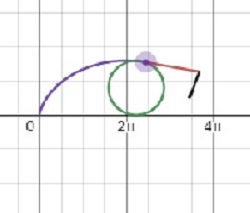
This demo shows the path on a rolling wheel called a cycloid. The “a” slider moves the position of the point on the wheel. The point may be on the rim of the wheel (\displaystyle a=r, on the interior of the wheel (\displaystyle a<r), or outside the wheel (\displaystyle a>r  – think the flange on a train wheel). Use the “u” slider to animate the drawing. The velocity and acceleration vectors are shown; they may be turned off. The velocity vector is tangent to the curve (not to the circle) and seems to “pull” the point along the curve. The acceleration vector “pulls” the velocity vector. The equation in this demo should not be changed.

The last two demonstrations give a good idea of how the velocity and acceleration vectors affect the movement of the point.

Hope you find these helpful.

.

Blog Guide

As I am not doing many new posts these days, I want to call your attention to the “Blog Guide” tab above. This tab will guide you to the information on the blog. It will help sort through the approximately five hundred posts and find those that concern the topic you are interested in.

The “Before Calculus” section discusses things usually taught before calculus.

The “Pedagogy” sections had notes on pacing, teaching, testing, grading, and scoring.

The “Graphing Calculator Use” page contains links to what students should know and be able to do on the AP Calculus Exam with their graphing calculator. There are also links to how to use a graphing calculator to teach some of the topics in the course.

The “AP Exam Review” has links to the ten common type questions on the exams with notes on what students should know about each of them. Good for review and as you teach each topic during the year.

Then there are links to the ten units, different from the type questions, in the current Course and Exam Description for AP Calculus AB and BC.

The “Good Questions” links are to specific questions, mostly from past AP exams, which are discussed in detail. They explore the richness of the question.

“Odds and Ends” has links to, well, odds and ends – other posts you may find interesting and helpful.


Meanwhile: An interesting article “How I Rewired My Brain to Become Fluent in Math”

Today and Tomorrow

Today is this blog’s tenth anniversary!

 My first post was on July 15, 2012. At the time I was working with the Arkansas Advanced Initiative for Math and Science. I was thinking of a series of emails with teaching hints for the calculus teachers I was working with. It occurred to me that a blog format would be more useful to them and to others who stumbled across it. So, that’s how all this all got started.

This is my 492nd post in addition to the 98 pages available from the menu bar. As of this morning, the blog has had, 956,803 visitors and 1,628,857 page views – and counting.

Teaching mathematics is more than just proving the theorems and doing the standard examples.  I certainly have not posted about everything there is to know about calculus – which would be difficult, since I don’t know everything. It was never my intent to write an online calculus book or even cover all the topics in the course description. Textbooks do that well enough. I hoped to provide some insight and ideas to help teachers explain things.

But I seem to have little more to add. I have found little new to write about recently. For the past few years, as you’ve probably noticed, many of my post were lists of links to past posts of actual calculus content.

So, I’ve spent some time this month looking at all my past posts and sorting out the ones with real content from those linking to the content posts. I’ve added a new drop-down menu to the navigation bar at the top of the screen called Blog Guide. Here you will find all the content posts organized in a way that I hope you will find useful. (The “link” posts are not there but are still available if you’ve bookmarked any of them.)

Please take a minute to look at the Blog Guide. I hope its organization will help you find your way around. (The “Search, “Posts by Topics,” and the “archives” on the sidebar will also help.)  

From now on, the blog will be on autopilot, so-to-speak. There will be few new posts. If I get an interesting idea, I will share it, but will not be posting regularly.

Some of my best inspiration comes from readers. So, if you have a calculus topic you would like me to discuss or expand on, please email me here and I’ll see what I can do. (The address is also on the navigation bar under “About.”), Also, I would appreciate you letting me know of any typos or broken links.

If you click on the “Follow” link in the sidebar, you will receive an email whenever a new post appears.

I hope to have helped you at least a little and hope to continue to do so. Thanks for reading and supporting TeachingCalculus.com.

Enjoy your summer and have a good school year.

Starting the Year

As you get ready to start school, here are some thoughts on the first week in AP Calculus. I looked back recently at some of the “first week of school” advice I offered in the past. Here’s a quick (actually, a bit longer then I planned) summary with some new ideas.

  1. The last time I taught AP Calculus during review time a student asked if there was a list of what’s on the exam. Duh! Why didn’t I think of that? So, I made copies of the list (from the old Acorn Book) and gave it to everyone. I should have done that on Day 1. So, my first suggestion is to make a copy of the “Mathematical Practices” and the “Course at a Glance” from the 2019 AP Calculus Course and Exam Description (p. 14 and p. 20 – 23) and give them to your students. Check off the topics as you do them during the year. 
  1. DON’T REVIEW! Yes, students have forgotten everything they ever learned in mathematics, but if you reteach it now, they will forget it again by the time they need it next week or next January. So, don’t waste the time, rather, plan to review material from Kindergarten thru pre-calculus when the topics come up during the year. Include short reviews in your lesson plans. For instance, when you study limits you will need to simplify rational expressions – that’s when you review rational expressions. When you look at the graphs of the trigonometric functions, that’s when to review the graphs of the parent functions, a lot of the terminology related to graphs, discontinuities, asymptotes, and even the values of the trigonometric functions of the special angles. Months from now you’ll be looking at inverse functions, that’s when you review inverses.
  1. In keeping with Unit 1 Topic 1, you may want to start with a brief introduction to calculus. Several years ago, when I first started this blog, Paul A. Foerster, was nice enough to share some preview problems. They give a taste of derivatives and integrals in the first week of school and get the kids into calculus right off the bat. Here is an updated version. Paul, who retired a few years ago after 50 (!) years of teaching, is Teacher Emeritus of Mathematics of Alamo High Heights School in San Antonio, Texas. He is the author of several textbooks including Calculus: Concepts and Applications. More information about the text and accompanying explorations can be found on the first page of the explorations. Thank you, Paul!
  1. If you are not already a member, I suggest you join the AP Calculus Community. We have over 18,000 members all interested in AP Calculus. The community has an active bulletin board where you can ask and answer questions about the courses. Teachers and the College Board also post resources for you to use. College Board official announcements are also posted here. I am the moderator of the community and I hope to see you there!
  1.  Here are some links to places on this blog that you may find helpful:
    1. Pacing– organizing your year.
    2. Check the Resource page from this blog.
    3. Calculator information:
    4. Miscellany: These posts discuss basic ideas that I always hoped students knew about mathematics before starting calculus

Adapting 2021 BC 6 the last in the series on adapting questions from the 2021 exam will appear in two weeks on Auguest 31, 2021


Revised August 16, 2021