Good Question 2: 2002 BC 5

This is the second in my occasional series on good questions, good from the point of view of teaching about the concepts involved. This one is about differential equations and slope fields. The question is from the 2002 BC calculus exam. Question 5. while a BC question, all but part b are suitable for AB classes.

2002 BC 5

The stem presented the differential equation \displaystyle \frac{dy}{dx}=2y-4x. Now the only kind of differential equation that AP calculus students are expected to be able to solve are those that can be separated. This one cannot be separated, so some other things must be happening.

Part a concerns slope fields. Often on the slope field questions students are asked to draw a slope field of a dozen or so points. While drawing a slope field by hand is an excellent way to help students learn what a slope fields is, in “real life” slope fields are rarely drawn by hand. The real use of slope fields is to investigate the properties of a differential equation that perhaps you cannot solve. It allows you to see something about the solutions. And that is what happens in this question.

In the first part of the question students were asked to sketch the solutions that contained the points (0, 1) and (0, –1). These points were marked on the graph. The solutions are easy enough to draw.
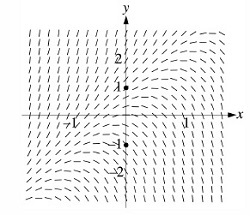
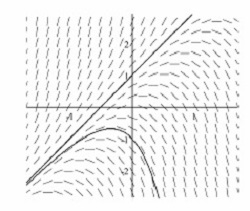
But the question did not stop there, as we shall see, using the slope field could help in other parts of the question.

Part c: Taking these out of order, we will return to part b in a moment. Part c told students that there was a number b for which y = 2x + b is a solution to the differential equation. Students were required to find the value of b and (of course) justify their answer.

There are two approaches. Since y = 2x + b is a solution, we can substitute it into the differential equation and solve for b. Since for this solution dy/dx = 2 we have


2=2\left( 2x+b \right)-4x

2=4x+2b-4x

1=b

So b = 1 and the solution serves as the justification.

The other method, I’m happy to report, had some students using the slope field. They noticed that the solution through the point (0, 1) is, or certainly appears to be, the line y = 2x + 1. So students guessed that b  = 1 and then checked their guess by substituting y = 2x + 1 into the differential equation:

2=2\left( 2x+1 \right)-4x

2=4x+2=4x

2=2

The solution checks and the check serves as the justification.

I like the second solution much better, because it uses the slope field as slope field are intended to be used.

Incidentally, this part was included because readers noticed in previous years that many students did not understand that the solution to a differential equation could be substituted into the differential equation to obtain a true equation as was necessary using either method for part b.

There is yet another approach. Since the solution is given as linear the second derivative must by 0. So


\displaystyle \frac{{{d}^{2}}y}{d{{x}^{2}}}=2\frac{dy}{dx}-4=2\left( 2y-4x \right)-4

2\left( 2y-4x \right)-4=0

4y-8x-4=0

4y=8x+4

y=2x+1

And again b = 1

Returning to part b.

Part b asked students to do an Euler’s method approximation of f(0.2) with two equal steps  of the solution of the differential equation through (0, 1). The computation looks like this:

f\left( 0.1 \right)\approx 1+\left( 2\left( 1 \right)-4\left( 0 \right) \right)\left( 0.1 \right)=1.2

f\left( 0.2 \right)\approx 1.2+\left( 2\left( 1.2 \right)-4\left( 0.1 \right) \right)\left( 0.1 \right)=1.4

So far so good. But this is is about the solution through the point (0, 1). Again referring to the slope field, there is no reason to approximate (except that students were specifically told to do so). Substituting into y = 2x + 1, f(0.2) = 1.4 exactly!

Part d: In the last part of the question students were asked to consider a solution of the differential,  g, that satisfied the initial condition g(0) = 0, a solution containing the origin. Students were asked to determine if g(x) had a local extreme at the origin and, if so, to tell what kind (maximum or minimum), and to justify their answer.

Looking again at the slope field it certainly appears that there is a maximum at the origin, and since substituting (0, 0) into the differential equation gives dy/dx = 2(0) – 4(0) = 0, it appears there could be an extreme there. So now how do we determine and justify if this is a maximum or minimum? We cannot use the Candidates’ Test (Closed Interval Test) since we do not have a closed interval, nor can we easily determine if there are any other points nearby where the derivative is zero (there are). Therefore, the First Derivative Test does not help. That leaves the Second Derivative Test.

To use the Second Derivative Test we must use implicit differentiation. (Notice that two unexpected topics now appear extending the scope of the question in a new direction).

\displaystyle \frac{{{d}^{2}}y}{d{{x}^{2}}}=2\frac{dy}{dx}-4

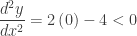
At the origin dy/dx = 0 as we already determined, so
\displaystyle \frac{{{d}^{2}}y}{d{{x}^{2}}}=2\left( 0 \right)-4<0

Therefore, since at x = 0, the first derivative is zero and the second derivative is negative the function g(x) has a maximum value at (0, 0) by the Second Derivative Test .

More: Can we solve the differential equation? Yes. The solution has two parts. First we solve the homogeneous differential equation \frac{dy}{dx}=2y, ignoring the –4x for the moment. This is easily solved by separating the variables y=C{{e}^{2x}}, which can be checked by substituting.

Because the differential equation contains x and y and ask ourselves what kind of function might produce a derivative of 2y – 4x? Then we assume there is a solution of the form y = Ax + B where A and B are to be determined and proceed as follows.

\displaystyle \frac{dy}{dx}=2y-4x

A=2\left( Ax+B \right)-4x=\left( 2A-4 \right)x+2B

Equating the coefficients of the like terms we get the system of equations:

A=2B

0=2A-4

A=2\text{ and }B=1

Putting the two parts together the solution is y=C{{e}^{2x}}+2x+1. This may be checked by substituting. Notice that when C = 0 the particular solution is y = 2x + 1, the line through the point (0, 1).

(Extra: It is not unreasonable to think that instead of y = Ax + B we should assume that the solution might be of the form y = Ax2 + Bx + C. Substitute this into the differential equation and show why this is not the case; i.e. show that A = 0, B = 2 and C = 1 giving the same solution as just found.)

Using a graphing program like Winplot, we can consider all the solutions. Below the slope field is graphed using a slider for C to animate the different solutions. The video below shows this with the animation pausing briefly at the two solutions from part a. Notice the maximum point as the graphs pass through the origin.

Slope field

But wait! There’s more!

The next post will take this question further – Look for it soon.

Update June 27, 2015. Third solution to part c added.

Good Question 1: 2008 AB 6

When I started this blog several years ago I was hoping my readers would ask questions that we could discuss or submit ideas for additional topics to write about. This has not really happened, but I’m still very open to the idea. (That was a HINT.) Since that first year when I had the entire curriculum ahead of me, I have written less not because I dislike writing, but because I am low on ideas.

The other day, I answered a question posted on the AP Calculus Community bulletin board about AB calculus exam question. It occurred to me that this somewhat innocuous looking question was quite good. So I decided to start an occasional series on good questions, from AP exams or elsewhere, that can be used to teaching beyond the actual things asked in the question.  (My last post might be in this category, but that was written several months ago.)

In discussing these questions, I will make numerous comments about the question and how to take it further in your class. My idea is not just to show how to write a good answer, but rather to use the question to look deeper into the concepts involved.

Good Question #1: 2008 AB Calculus exam question 6.

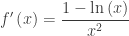
The stem gave students the function \displaystyle f\left( x \right)=\frac{\ln \left( x \right)}{x},\quad x>0. Students were also told that \displaystyle {f}'\left( x \right)=\frac{1-\ln \left( x \right)}{{{x}^{2}}}.

  1. The first thought that occurs is why they gave the derivative. The reason is, as we will see, that the first derivative is necessary to answer the first three parts of the question. Therefore, a student who calculates an incorrect derivative is going to be in big trouble (and the readers may have a great deal of work to do reading with the student’s incorrect work). The derivative is calculated using the quotient rule, and students will have to demonstrate their knowledge of the quotient rule later in this question; there is no reason to ask them to do the same thing twice.
  2. If you are using this with a class, you can, and probably should, ask your students to calculate the first derivative. Then you can see how many giving the derivative would have helped.
  3. When discussing the stem, you should also discuss the domain, x > 0, and the x-intercept (1, 0). Other features of the graph, such as end behavior, are developed later in the question, so they may be put on hold briefly.

Part a asked students to write an equation of the tangent line at x = e2. To do this students need to do two calculations: \displaystyle f\left( {{e}^{2}} \right)=\frac{2}{{{e}^{2}}} and \displaystyle {f}'\left( {{e}^{2}} \right)=-\frac{1}{{{e}^{4}}}. An equation of the tangent line is \displaystyle y=\frac{2}{{{e}^{2}}}-\frac{1}{{{e}^{4}}}\left( x-{{e}^{2}} \right).

  1. Writing the equation of a tangent line is a very important skill and should be straightforward. The point-slope form is the way to go. Avoid slope-intercept.
  2. The tangent line is used to approximate the value of the function near the point of tangency; you can throw in an approximation computation here.
  3. After doing part c, you should return here and discuss whether the approximation is an overestimate or an underestimate and how you can tell. (Answer: underestimate, since the graph is concave up here.)
  4. After doing part c, you can also ask them to write the tangent line at the point of inflection and whether approximations near the point of inflection are overestimates or an underestimates, and why. (Answer: Since the concavity change here, it depends on which side of the point of inflection the approximation is made. To the left is an overestimate; to the right is an underestimate.)

Part b asked students to find the x-coordinate of the critical point, determine whether it is a maximum, a minimum, or neither, and to “justify your answer.” To earn credit students had to write the equation \displaystyle {f}'\left( x \right)=0 and solve it getting x = e. They had to state that this is a maximum because  “{f}'\left( x \right)changes from positive to negative at x = e.”

This is a very standard AP exam question. To expand it in your class:

  1. Discuss how you know the derivative changes sign here. This will get you into the properties of the natural logarithm function.
  2. Discuss why the change in sign tells you this is a maximum. (A positive derivative indicates an increasing function, etc.)
  3. After doing part c, you can return here and try the second derivative test.
  4. The question asks for “the” critical point, hinting that there is only one. Students should learn to pick up on hints like this and be careful if their computation produces more or less than one.
  5. At this point we have also determined that the function is increasing on the interval \left( -\infty ,e \right] and decreasing everywhere else. The question does not ever ask this, but in class this is worth discussing as important features of the graph. On why these are half-open intervals look here.

Part c told students there was exactly one point of inflection and asked them to find its x-coordinate.  To do this they had to use the quotient rule to find that \displaystyle {{f}'}'\left( x \right)=\frac{-3+2\ln \left( x \right)}{{{x}^{3}}}, set this equal to zero and find the x-coordinate to be x = e3/2.

  1. The question did not require any justification for this answer. In class you should discuss what a justification would look like. The reason is that the second derivative changes sign here. So now you need to discuss how you know this.
  2. Also, you can now determine that the function is concave down on the interval \left( -\infty ,{{e}^{3/2}} \right) and concave up on the interval \left({{e}^{3/2}},\infty \right). Ask your class to justify this.

Part d asked student to find \displaystyle \underset{x\to 0+}{\mathop{\lim }}\,\frac{\ln \left( x \right)}{x}. The answer is -\infty . While this seems almost like a throwaway tacked on the end because they needed another point, it is the reason I like this question.

  1. The question is easily solved: \displaystyle \underset{x\to 0+}{\mathop{\lim }}\,\frac{\ln \left( x \right)}{x}=\underset{x\to 0+}{\mathop{\lim }}\,\frac{1}{x}\cdot \underset{x\to 0+}{\mathop{\lim }}\,\ln \left( x \right)=\left( \infty \right)\left( -\infty \right)=-\infty .
  2. While tempting, the limit cannot be found by L’Hôpital’s Rule, because on substitution you get \frac{-\infty }{0},which is not one of the forms that L’Hôpital’s Rule can handle.
  3. The reason I like this part so much is that we have already developed enough information in the course of doing the problem to find this limit! The function is increasing and concave down on the interval \left( -\infty ,e \right). Moving from the maximum to the left, the function crosses the x-axis at (1, 0), keeps heading south, and gets steeper. So the limit as you approach the y-axis from the right is negative infinity.This is the left-side end behavior.
  4. What about the right-side end behavior? (You ask your class.) Well, the function is positive and decreasing to the right of the maximum and becomes concave up after x = e3/2. Thus, it must flatten out and approach the x-axis as an asymptote.
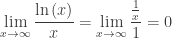
  5. That \displaystyle \underset{x\to \infty }{\mathop{\lim }}\,\frac{\ln \left( x \right)}{x}=0 is clear from the note immediately above. This limit can be found by L’Hôpital’s Rule since it is an indeterminate of the type \infty /\infty . So, \displaystyle \underset{x\to \infty }{\mathop{\lim }}\,\frac{\ln \left( x \right)}{x}=\underset{x\to \infty }{\mathop{\lim }}\,\frac{\tfrac{1}{x}}{1}=0.
  6. Notice also that the first derivative approaches zero as x approaches infinity. This indicates that the function’s graph approaches the horizontal as you travel farther to the right. The second derivative also approaches zero as x approaches infinity indicating that the function’s graph is becoming flatter (less concave).

This question and the discussion is largely done analytically (working with equations). We did find a few important numbers in the course of the work. Hopefully, you students discussed this with many good words. To complete the Rule of Four, here is the graph.

2008 AB 6 - 1

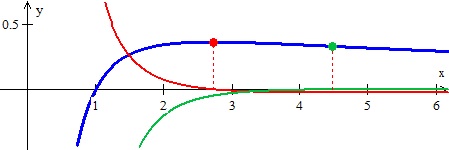
And here is a close up showing the important features of the graph and the corresponding points on the derivatives.

The function is shown in blue, the derivative and maximum in red, and the second derivative and the point of inflection in green.

The function is shown in blue, the derivative and maximum in red, and the second derivative and the point of inflection in green.

Finally, this function and the limit at infinity is similar to the more pathological example discussed in the post of October 31, 2012 entitled Far Out!

The Marble and the Vase

A fairly common max/min problem asks the student to find the point on the parabola f\left( x \right)={{x}^{2}} that is closest to the point A\left( 0,1 \right).  The solution is not too difficult. The distance, L(x), between A and the point \left( x,{{x}^{2}} \right) on the parabola  is given by

\displaystyle L\left( x \right)=\sqrt{{{\left( x-0 \right)}^{2}}+{{\left( {{x}^{2}}-1 \right)}^{2}}}=\sqrt{{{x}^{4}}-{{x}^{2}}+1}

And the minimum distance can be found when

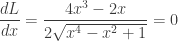
\displaystyle \frac{dL}{dx}=\frac{4{{x}^{3}}-2x}{2\sqrt{{{x}^{4}}-{{x}^{2}}+1}}=0

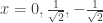
This occurs when x=0,\frac{1}{\sqrt{2}},-\frac{1}{\sqrt{2}}. The local maximum is occurs when x = 0. The (global) minimums are the other two values located symmetrically to the y-axis.

_________________________

Somewhere I saw this problem posed in terms of a marble dropped into a vase shaped like a parabola. So I think of it that way. This accounts for the title of the post. The problem is, however, basically a two-dimensional situation.

In this post I would like to expand and explore this problem. The exploration will, I hope, give students some insight and experience with extreme values, and the relationship between a graph and its derivative. I will pose a series of questions that you could give to your students to explore. I will answer the questions as I go, but you, of course, should not do that until your students have had some time to work on the questions.

Graphing technology and later Computer Algebra Systems (CAS) will come in handy.

_________________________

1. Consider a general point A\left( 0,a \right) on the y-axis. Find the x-coordinates of the closest point on the parabola in terms of a.

The distance is now given by

\displaystyle L\left( x \right)=\sqrt{{{\left( x-0 \right)}^{2}}+{{\left( {{x}^{2}}-a \right)}^{2}}}=\sqrt{{{x}^{4}}+\left( 1-2a \right){{x}^{2}}+{{a}^{2}}}

\displaystyle \frac{dL}{dx}=\frac{2{{x}^{3}}+\left( 1-2a \right)x}{\sqrt{{{x}^{4}}+2\left( 1-2a \right){{x}^{2}}+{{a}^{2}}}}

And \frac{dL}{dx}=0 when x=0,\frac{\sqrt{2\left( 2a-1 \right)}}{2},-\frac{\sqrt{2\left( 2a-1 \right)}}{2}

The (local) maximum is at x = 0. The other values are the minimums. The CAS computation is shown at the end of the post. This is easy enough to do by hand.

2. Discuss the equation {{L}^{2}}={{x}^{2}}+{{\left( x-a \right)}^{2}} in relation to this situation.

This is the equation of a circle with center at A with radius of L. At the minimum distance this circle will be tangent to the parabola.

3. What happens when a=\tfrac{1}{2} and when a<\tfrac{1}{2}?

When  a=\tfrac{1}{2}, the three zeroes are the same. The circle is tangent to the parabola at the origin and a is the minimum distance.

When a<\tfrac{1}{2}, the circle does not intersect the parabola. Notice that in this case two of the roots of \frac{dL}{dt}=0 are not Real numbers.

4. Consider the distance, L(x), from point A to the parabola. As x moves from left to right describe how this length changes. Be specific. Sketch the graph of this distance y = L(x). Where are its (local) maximum and minimum values, relative to the parabola and the circle tangent to the parabola?

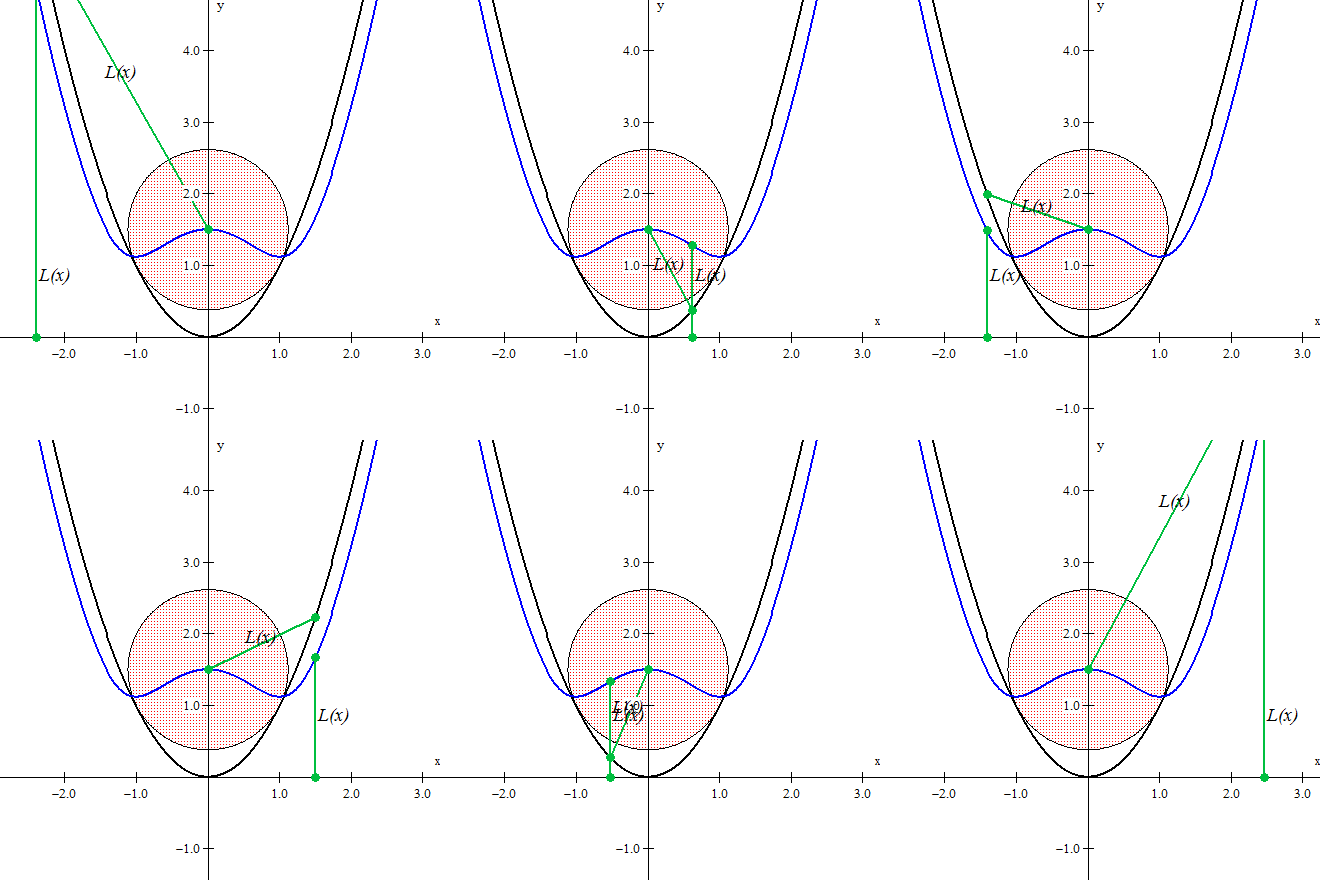
The clip below illustrates the situation. The two segments marked L(x) are congruent. The graph of y = L(x) is a“w” shape similar to but not quartic polynomial. The minimums occur directly under the points of tangency of the circle and the parabola. The local maximum is directly over the origin. Is it coincidence that the graph goes through the center of  the circle? Explain.

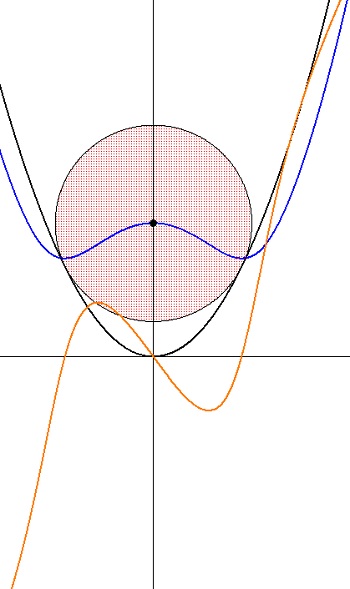
Vase 15. Graph y=\frac{dL}{dx}  and compare its graph with the graph of y=L(x)

vase 4

L(x) is the blue graph and and L'(x) is the orange graph.
Notice the concavity of L'(x)

6.  The graph of y=\frac{dL}{dx} appears be concave up, then down, then (after passing the origin) up, and then down again. There are three points of inflection. Find their x-coordinates in terms of a. How do these points relate to y = L(x) ? (Use a CAS to do the computation)

The points of inflection of the derivative can be found from the second derivative of the derivative (the third derivative of the L(x)). The abscissas are x=-\sqrt{a},x=0,\text{ and }\sqrt{a}. The CAS computation is shown below

Vase 2a

CAS Computation for questions 1 and 6.