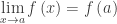
Definition of the Derivative – Unit 2

This is a re-post and update of the second in a series of posts from last year. It contains links to posts on this blog about the definition of the derivative for your reference in planning. Other updated post on the 2019 CED will come throughout the year, hopefully, a few weeks before you get to the topic. 

Unit 2 contains topics rates of change, difference quotients, and the definition of the derivative (CED – 2019 p. 51 – 66). These topics account for about 10 – 12% of questions on the AB exam and 4 – 7% of the BC questions.

Topics 2.1 – 2.4: Introducing and Defining the Derivative 

Topic 2.1: Average and Instantaneous Rate of Change. The forward difference quotient is used to introduce the idea of rate of change over an interval and its limit as the length of the interval approaches zero is the instantaneous rate of change.

Topic 2.2: Defining the derivative and using derivative notation. The derivative is defined as the limit of the difference quotient from topic 1 and several new notations are introduced. The derivative is the slope of the tangent line at a point on the graph. Explain graphically, numerically, and analytically how the three representations relate to each other and the slope.

Topic 2.3 Estimating the derivative at a point.  Using tables and technology to approximate derivatives is used in this topic. The two resources in the sidebar will be helpful here.

Topic 2.4: Differentiability and Continuity. An important theorem is that differentiability implies continuity – everywhere a function is differentiable it is continuous.  Its converse is false – a function may be continuous at a point, but not differentiable there. A counterexample is the absolute value function, |x|, at x = 0.

One way that the definition of derivative is tested on recent exams which bothers some students is to ask a limit like

\displaystyle \underset{{x\to 0}}{\mathop{{\lim }}}\,\frac{{\tan \left( {\tfrac{\pi }{4}+x} \right)-\tan \left( {\tfrac{\pi }{4}} \right)}}{x}.

From the form of the limit students should realize this as the limit definition of the derivative. The h in the definition has been replaced by x. The function is tan(x) at the point where \displaystyle a=\tfrac{\pi }{4}. The limit is \displaystyle {{\sec }^{2}}\left( {\tfrac{\pi }{4}} \right)=2.

Topics 2.5 – 2.10: Differentiation Rules

The remaining topics in this chapter are the rules for calculating derivatives without using the definition. These rules should be memorized as students will be using them constantly. There will be additional rules in Unit 3 (Chain Rule, Implicit differentiation, higher order derivative) and for BC, Unit 9 (parametric and vector equations).

Topic 2.5: The Power Rule

Topic 2.6: Constant, sum, difference, and constant multiple rules

Topic 2.7: Derivatives of the cos(x), sin(x), ex, and ln(x). This is where you use the squeeze theorem.

Topic 2.8. The Product Rule

Topic 2.9: The Quotient Rule

Topic 2.10: Derivative of the other trigonometric functions

The rules can be tested directly by just asking for the derivative or its value at a point for a given function. Or they can be tested by requiring the students to use the rule of an general expression and then find the values from a table, or a graph. See 2019 AB 6(b)


The suggested number of 40 – 50 minute class periods is 13 – 14 for AB and 9 – 10  for BC. This includes time for testing etc. Topics 2.1, 2,2, and 2.3 kind of flow together, but are important enough that you should spend time on them so that students develop a good understanding of what a derivative is. Topics 2.5 thru 2.10 can be developed in 2 -3 days, but then time needs to be spent deciding which rule(s) to use and in practice using them. The sidebar resource in the CED on “Selecting Procedures for Derivative” may be helpful here.


Other post on these topics

DEFINITION OF THE DERIVATIVE

Local Linearity 1  The graphical manifestation of differentiability with pathological examples.

Local Linearity 2   Using local linearity to approximate the tangent line. A calculator exploration.

Discovering the Derivative   A graphing calculator exploration

The Derivative 1  Definition of the derivative

The Derivative 2   Calculators and difference quotients

Difference Quotients 1

Difference Quotients II

Tangents and Slopes

         Differentiability Implies Continuity

FINDING DERIVATIVES 

Why Radians?  Don’t do calculus without them

The Derivative Rules 1  Constants, sums and differences, powers.

The Derivative Rules 2  The Product rule

The Derivative Rules 3  The Quotient rule


Here are links to the full list of posts discussing the ten units in the 2019 Course and Exam Description.the 2019 versions.

2019 CED – Unit 1: Limits and Continuity

2019 CED – Unit 2: Differentiation: Definition and Fundamental Properties.

2019 CED – Unit 3: Differentiation: Composite , Implicit, and Inverse Functions

2019 CED – Unit 4 Contextual Applications of the Derivative  Consider teaching Unit 5 before Unit 4

2019 – CED Unit 5 Analytical Applications of Differentiation  Consider teaching Unit 5 before Unit 4

2019 – CED Unit 6 Integration and Accumulation of Change

2019 – CED Unit 7 Differential Equations  Consider teaching after Unit 8

2019 – CED Unit 8 Applications of Integration   Consider teaching after Unit 6, before Unit 7

2019 – CED Unit 9 Parametric Equations, Polar Coordinates, and Vector-Values Functions 

2019 CED Unit 10 Infinite Sequences and Series


Limits and Continuity – Unit 1

This is a re-post and update of the first in a series of posts from last year. It contains links to posts on this blog about the topics of limits and continuity for your reference in planning. Other updated post on the 2019 CED will come throughout the year, hopefully, a few weeks before you get to the topic. 

Unit 1 contains topics on Limits and Continuity. (CED – 2019 p. 36 – 50). These topics account for about 10 – 12% of questions on the AB exam and 4 – 7% of the BC questions.

Logically, limits come before continuity since limit is used to define continuity. Practically and historically, continuity comes first. Newton and Leibnitz did not have the concept of limit the way we use it today. It was in the early 1800’s that the epsilon-delta definition of limit was first given by Bolzano (whose work was overlooked) and then by Cauchy, Jordan, and Weierstrass. But, their formulation did not use the word “limit”, rather the use was part of their definition of continuity. Only later was it pulled out as a separate concept and then returned to the definition of continuity as a previously defined term. See Which Came First?

Students should have plenty of experience in their math courses before calculus with functions that are and are not continuous. They should know the names of the types of discontinuities – jump, removable, infinite, oscillating etc.and the related terms such as asymptote. As you go through this unit, you may want to quickly review these terms and concepts as they come up.

(As a general technique, rather than starting the year with a week or three of review – which the students need but will immediately forget again – be ready to review topics as they come up during the year as they are needed – you will have to do that anyway. See Getting Started #2)

Topics 1.1 – 1.9: Limits

Topic 1.1: Suggests an introduction to calculus to give students a hint of what’s coming. See Getting Started #3

Topic 21.: Proper notation and multiple-representations of limits.

There is an exclusion statement noting that the delta-epsilon definition of limit is not tested on the exams, but you may include it if you wish. The epsilon-delta definition is not tested probably because it is too difficult to write good questions. Specifically, (1) the relationship for a linear function is always  \delta =\frac{\varepsilon }{{\left| m \right|}}  where m is the slope and is too complicated to compute for other functions, and (2) for a multiple-choice question the smallest answer must be correct. (Why?)

Topic 1.3: One-sided limits.

Topic 1.4: Estimating limits numerically and from tables.

Topic 1.5: Algebraic properties of limits.

Topic 1.6: Simplifying expressions to find their limits. This can and should be done along with learning the other concepts and procedures in this unit.

Topic 1.7: Selecting the proper procedure for finding a limit. The first step is always to substitute the value into the limit. If this comes out to be number than that is the limit. If not, then some manipulation may be required. This can and should be done along with learning the other concepts and procedures in this unit.

Topic 1.8: The Squeeze Theorem is mainly used to determine  \underset{{x\to 0}}{\mathop{{\lim }}}\,\frac{{\sin \left( x \right)}}{x}=1 which in turn is used in finding the derivative of the sin(x). (See Why Radians?) Most of the other examples seem made up just for exercises and tests. (See 2019 AB 6(d)). Thus, important, but not too important.

Topic 1.9: Connecting multiple-representations of limit. This can and should be done along with learning the other concepts and procedures in this unit. Dominance, Topic 15, may be included here as well (EK LIM-2.D.5)

Topics 1.10 – 1.16 Continuity

Topic 1.10: Here you can review the different types of discontinuities with examples and graphs.

Topic 1.11: The definition of continuity. The EK statement does not seem to use the three-hypotheses definition. However, for the limit to exist and for f(c) to exist, they must be real numbers (i.e. not infinite). This is tested often on the exams, so students should have practice with verifying that (all three parts of) the hypothesis are met and including this in their answers.

Topic 1.12: Continuity on an interval and which Elementary Functions are continuous for all real numbers.

Topic 1.13: Removable discontinuities and handing piecewise – defined functions

Topic 1.14: Vertical asymptotes and unbounded functions. Here be sure to explain the difference between limits “equal to infinity” and limits that do not exist (DNE). See Good Question 5: 1998 AB2/BC2.

Topic 1.15: Limits at infinity, or end behavior of a function. Horizontal asymptotes are the graphical manifestation of limits at infinity or negative infinity. Dominance is included here as well (EK LIM-2.D.5)

Topic 1.16: The Intermediate Value Theorem (IVT) is a major and important result of a function being continuous. This is perhaps the first Existence Theorem students encounter, so be sure to stop and explain what an existence theorem is.


The suggested number of 40 – 50 minute class periods is 22 – 23 for AB and 13 – 14 for BC. This includes time for testing etc. If time seems to be a problem you can probably combine topics 3 – 5, topics 6 -7, topics 11 – 12. Topics 6, 7, and 9 are used with all the limit work.


There are three other important limits that will be coming in later Units:

The definition of the derivative in Unit 2, topics 1 and 2

L’Hospital’s Rule in Unit 4, topic 7

The definition of the definite integral in Unit 6, topic 3.

Posts on Continuity

CONTINUITY To help understand limits it is a good idea to look at functions that are not continuous. Historically and practically, continuity should come before limits. On the other hand, the definition of continuity requires knowing about limits. So, I list continuity first. The modern definition of limit was part of Weierstrass’ definition of continuity.

Which Came First? (7-28-2020)

Continuity (8-13-2012)

Continuity (8-21-2013) The definition of continuity.

Continuous Fun (10-13-2015) A fuller discussion of continuity and its definition

Right Answer – Wrong Question (9-4-2013) Is a function continuous even if it has a vertical asymptote?

Asymptotes (8-15-2012) The graphical manifestation of certain limits

Fun with Continuity (8-17-2012) the Diriclet function

Far Out! (10-31-2012) When the graph and dominance “disagree” From the Good Question series

Posts on Limits

Why Limits? (8-1-2012)

Deltas and Epsilons (8-3-2012) Why this topic is not tested on the AP Calculus Exams.

Finding Limits (8-4-2012) How to…

Dominance (8-8-2012) See limits at infinity

Determining the Indeterminate (12-6-2015) Investigating an indeterminate form from a differential equation. From the Good Question series.

Locally Linear L’Hôpital (5-31-2013) Demonstrating L’Hôpital’s Rule (a/k/a L’Hospital’s Rule)

L’Hôpital’s Rules the Graph (6-5-2013)


Here are links to the full list of posts discussing the ten units in the 2019 Course and Exam Description. the 2019 versions

2019 CED – Unit 1: Limits and Continuity

2019 CED – Unit 2: Differentiation: Definition and Fundamental Properties.

2019 CED – Unit 3: Differentiation: Composite , Implicit, and Inverse Functions

2019 CED – Unit 4 Contextual Applications of the Derivative  Consider teaching Unit 5 before Unit 4

2019 – CED Unit 5 Analytical Applications of Differentiation  Consider teaching Unit 5 before Unit 4

2019 – CED Unit 6 Integration and Accumulation of Change

2019 – CED Unit 7 Differential Equations  Consider teaching after Unit 8

2019 – CED Unit 8 Applications of Integration   Consider teaching after Unit 6, before Unit 7

2019 – CED Unit 9 Parametric Equations, Polar Coordinates, and Vector-Values Functions 

2019 CED Unit 10 Infinite Sequences and Series


Which Came First?

In one of my math classes – it may have been calculus – many decades ago, we started by determining what kind of functions we were going to study. A good part of the answer was continuous functions. Looking closely, you will find that almost all the theorems in beginning calculus require that the function be continuous on an interval as one of their hypotheses (The interval could be all Real numbers.) Later theorems require that the function be differentiable, but, as you will learn, if a function is differentiable, then it is continuous. So, calculus studies continuous functions (or those that are not continuous at only a few points).

A function is continuous on an interval, roughly speaking, you can draw its graph from one side of the interval to the other without taking the pencil off the paper. Thus, if a function has a hole, a vertical asymptote, a jump, or oscillates wildly it is not continuous. Continuity is first determined for a function at a point in it domain. Then this is extended to all the points in an interval.

Students come across functions that are not continuous long before they encounter calculus and limits. They see functions with asymptotes, jumps, and holes long before calculus. Discussing continuity gives a reason to talk about limits informally and how the idea of “getting closer to” a point works. This eventually leads to the idea of a limit and the need to define the term.

The definition of continuity at a point that is used most often is this:

A function f is continuous at x=a if, and only if, (1)  f\left( a \right) exists, (2)  \underset{{x\to a}}{\mathop{{\lim }}}\,f\left( x \right) exists, and (3)  \underset{{x\to a}}{\mathop{{\lim }}}\,f\left( x \right)=f\left( a \right).

The first two conditions are probably included to prevent beginning students from thinking that if the value and the limit are both “infinite” as in the case with some vertical asymptotes, then the function is continuous. In fact, the two things can only be equal if they are finite.

The definition of limit (which is not tested on either AP Calculus exam) states that

 \underset{{x\to a}}{\mathop{{\lim }}}\,f\left( x \right)=L, if, and only if, for every number \varepsilon >0 there exists a number  \delta >0 such that if \left| {x-a} \right|<\delta , then \left| {f\left( x \right)-L} \right|<\varepsilon .

It was in the early 1800’s that the epsilon-delta definition of limit was first given by Bolzano (whose work was overlooked) and then by Cauchy, Jordan, and Weierstrass..Historically, the definition of continuity was first given by Karl Weierstrass (1815 – 1897) and  Camille Jordan (1838 – 1922). Their definition is:

A Real valued function is continuous at  x=a, if and only if, for every number \varepsilon >0 there exists a number  \delta >0 such that if \left| {x-a} \right|<\delta , then \left| {f\left( x \right)-L} \right|<\varepsilon .

As you can see, the original definition is simply the modern definition of limit applied to the concept of continuity.

So, which came first, continuity or limits?

Calculus textbooks and the 2019 Course and Exam Description for AP Calculus’s first unit begins with limits (lessons 1.2 to 1.9) and then continuity (lessons 1.10 – 1.16). They are being logical: the concept of limit is needed to define continuity.

So, logically you need limits to talk about continuity. Practically, continuity, or lack thereof, comes first. Students should be familiar with continuous graphs and the types of discontinuities before they start calculus. The calculus course will formalize things and make the ideas precise using limits.

______________________________

Stretch your brain a bit: Almost all the functions you will study are continuous at all but a few (a finite number) of places. If that were not so, there would not be much calculus you could “do.” But, consider the Dirichlet function:

D\left( x \right)=\left\{ {\begin{array}{*{20}{c}} 0 & {\text{if }x\text{ is irrational}} \\ 1 & {\text{if }x\text{ is rational}} \end{array}} \right.

Since there are always rational numbers between any two irrational numbers, and irrational numbers between any to rational numbers, this function is not continuous anywhere! No point is adjacent to any other point.

And a little more stretch: Discuss the continuity at x = 1 of this function:

L\left( x \right)=\left\{ {\begin{array}{*{20}{c}} x & {\text{ if }x\text{ is irrational}} \\ 1 & {\text{if }x\text{ is rational}} \end{array}} \right.


Next Tuesday, I will begin posting the lists of references to blog posts about topics related to the units of the 2019 Course and Exam Description for AP Calculus beginning with Unit 1: Limits and Continuity.


Scoring Different Versions of the Same Test

Many, perhaps all, of you, are looking at a vastly different teaching situation in the Fall. A teacher wrote to me recently asking if I could describe how he could give several versions of a test on the same material to his online classes and scale them so as to be fair everyone even though one test version may unintentionally be more or less difficult than another.

The AP program is able, as well as anyone, to give different tests from year to year and within the same year and adjust the scores (5,4,3,2,1) so they indicate the same knowledge of the subject even though the questions are different. The process is described here and how different versions of the same exam are handled here.

AP Exam questions, including multiple-choice questions, take several years to develop and are pre-tested on students before they ever appear on an AP Exam. A few questions are reused from the previous year to help compare the difficulty of the two exams. I do not see how a teacher with a small number of students (compared to the AP Calculus numbers) can use a similar approach with their classes.

Nevertheless, the concern about testing outside of a traditional classroom exists. Teachers are rightly concerned about students collaborating on take-home tests. Giving several versions will help to prevent this. But how do you grade them fairly?

No two tests on the same material can be of equal difficulty whether written by the College Board or a teacher. In the blog post On Scaling that appears in the gallery below various ways of scaling tests are discussed. It occurred to me that the “Kennedy Scale” can be adapted to the current situation.

The Kennedy Scale – used to handle multiple versions of the same test.

In Assessing True Academic Success [1] by Dan Kennedy suggest this method. The entire article is worth reading every year and discusses a lot about assessment, besides just scaling.

Kennedy writes of his method, “Mathematically, the effect of scaling is to adjust the mean, a primary goal, and reduce the standard deviation, a secondary effect that helps me keep the entire class engaged.” “[Teachers] can challenge [their] students to do just about anything, then see how far they can go. …[Students] are freed from the burden of getting a certain percent right, so they can concentrate on doing as much as they can as well as they can.”

Here is how the method works. First, determine the class mean you desire. Kennedy suggests a class average of 82 for regular classes, 85 for electives, and 90 for advanced. These are based on his school wide empirical (historical) data. You may use your own data or just what you think is reasonable.

Using two data points (class mean, desired mean) and (highest score, 99 or 100), write the equation of the line through these points expressing the scaled score as a function of number of points a student earns. Use this function to scale the test.

Making the “desired mean” the same for each version of the test should go a long way to making the students’ scores indicate the same knowledge of the material. This method may be used even if the possible points on a version is not 100.


Doing the calculations.

The On Scaling post contains a TI-8x program that will for the calculations for you.

Dan Anderson, another reader of this blog, sent this link to a Desmos graph he made that will calculate the Kennedy scale score for your tests. Once you open it, save it to your Desmos files. It works like this:

  • Enter the 4 numbers in the left column:
    • AverageRawScore for the version you are scaling,
    • DesiredAverage the same for all versions,
    • MaxRawScore for the current version, and
    • DesiredMax probably 99 or 100.
  • The scaled scores will appear in the table in the lower left.
  • The graph shows all the scores from 0 to 100. To graph just your scores, delete everything in the xi column and enter your scores (in any order). The scaled scores appear in the second column of the table and the pairs are graphed.
  • The two highlighted points are (AverageRawScore, DesiredAverage) and (MaxRawScore, DesiredMax). These may be dragged to see the effect of changing them.

A final caution: If the AverageRawScore is greater than or equal to the DesiredAverage (or even close), then some scores may be scaled down. You probably want to avoid this (although, it is consistent with the idea).

And a final thought: There is no need for each version to have the same number of points or that 100 be the maximum possible. Include a question that will stretch their thinking – if some or most miss it, the scale will take care of that and not hurt them. This may make them feel more confident and prepare them for the AP Calculus Exam where most students, even those who earn a 5, do not answer all the questions.

Stay well and hang on!


[1] Assessing True Academic Success   by Dan Kennedy, The Mathematics Teacher, September 1999, page 462 – 466).


Summertime

Summertime and the living is easy, or so they sing. The school year is over, quite a year as it turned out. Looking ahead I do not plan on a lot of posts for the blog. I am going to do a little more reorganization to make things easier to find. In August I will start re-posting links to blog posts by the units in the AP Calculus Course and Exam Description, so they will be handy as you plan for next year.

I am always looking for things to write about, so if you have any suggestions, comments, problems, questions, or ideas, please write and I will try to help. I like and need ideas for posts.

Meanwhile, stay safe. Wear a mask and socially distance while you are out. Here in New York folks have been doing that for the last three months or more and it has helped as our state number continue to improve. Please be careful.

Have a good summer!


Testing, but Not for Calculus

While calculus teachers are concerned with the new format of this year’s AP Calculus exams, there is other testing that is important now: tests for disease. Today’s post is not about calculus; mathematically, it is about conditional probability. In the big picture, it is about tests for disease and their accuracy. .

No test for any disease is totally accurate. Here are some notes on the concerns with testing.

The results of a health-related test fall into four categories. Before listing them I will define some variables:

  • Let n be the number of people tested
  • Let r be the proportion of the population tested who have the disease. 0 < r < 1. This number must be an estimate.
  • Let a be the accuracy of the test. That is, the proportion of the test results that are correct (true). No test is 100% accurate, so 0 < a < 1. The tests are developed with known samples, so a is based on that result. See [3] for values of actual tests.

The four categories of results are:

  • True positive results (T+). The person tested has the disease and the test correctly identifies indicates this \displaystyle T+=nra
  • True negative results (T-). The person tested does not have the disease and the test correctly indicates this \displaystyle T-=na\left( {1-r} \right)
  • False positive result (F+). The person tested does not have the disease, but the test incorrectly indicates they do.\displaystyle F+=n\left( {1-r} \right)\left( {1-a} \right)
  • False negative result (F-). The person tested has the disease and the test incorrectly indicates they do not. \displaystyle F-=nr\left( {1-a} \right)

The concern is with the latter two categories.

  • The proportion of positive results that are false is the false positive rate (also called the sensitivity) – the number of false positive results divided by the total number of positive results = \displaystyle \frac{{(1-r)(1-a)}}{{ra+(1-r)(1-a)}}. The n has simplified out of the expression. Even for accurate tests, this number may be quite large.
  • The proportion of negative results that are false is the false negative rate (also called the specificity) – the number of false negative results divided by the total number of false results = \displaystyle \frac{{r(1-a)}}{{a(1-r)+r(1-a)}}. The n has simplified out of the expression.
…[A]accuracy needs to be high. The prevalence of Covid-19 is estimated at around 5% in the US, and at this low level the risk of false positives becomes a major problem. If a serological test [a blood test for the virus’s antibodies] has 90% specificity, its positive predictive value will be 32.1% – meaning nearly 70% of positive results will be false. At this same disease prevalence, a test with 95% specificity will lead to a 50% false positive rate. Only at 99% specificity does the false positive rate become anywhere near acceptable, and even here 16% of positive results would still be wrong.

Elizabeth Cairns at Evaluate 

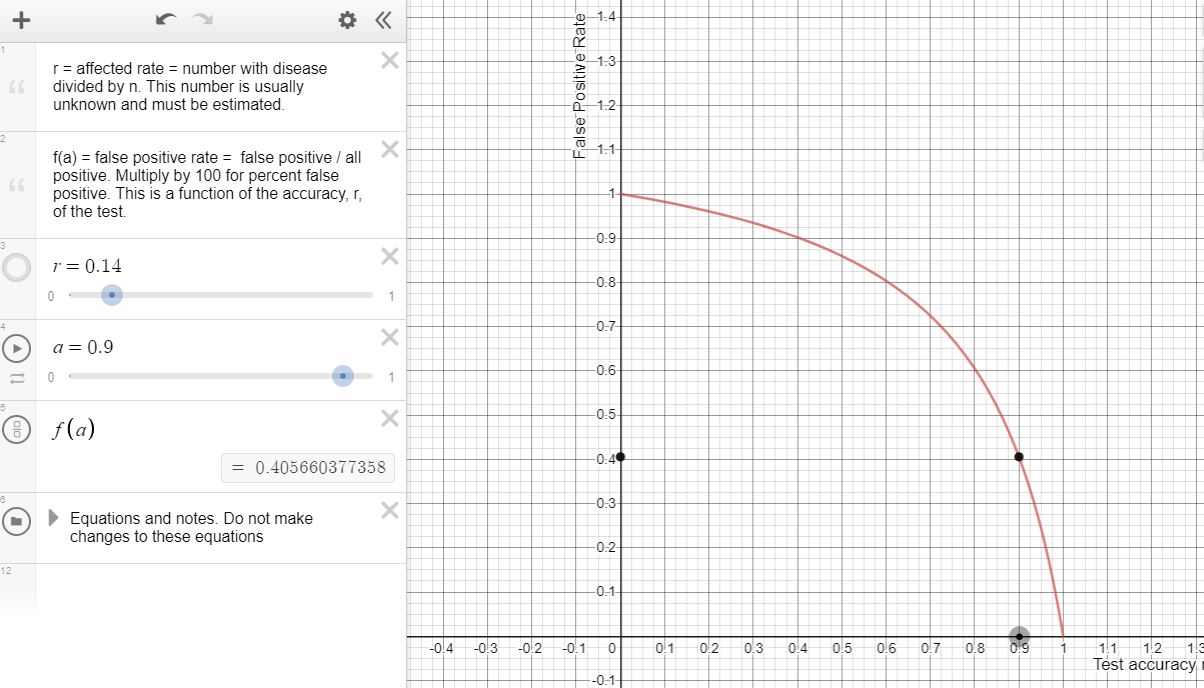
To examine the false positive rate, you may use this Desmos graph. Use the r-slider to adjust the proportion of the population that is believed to be affected. Use the a-slider to change the accuracy of the test. The number given by f(a) is the false positive rate.

Last week the results of a preliminary random sample of New York state residents for Covid-19 indicated a state-wide infection rate of 14% (r = 0.14). (This, I hope, is high, but it is what we have at the moment.) The accuracy of the test was not given. Assuming a 90% accuracy rate (a = 0.90), gives a false positive rate of just over 40% (f(0.90) = 0.406). Even at 95% accuracy (a = 0.95), the false positive rate is 50%. The graph below is set for these values. You may investigate other settings using the link above.

This is the concern. About 40% of the positive results are false; the people are told they have the disease, but they do not. Only about 60% of the positive results are correct. We don’t know which among the positive results really have the disease. We cannot tell for any individual, yet they all must be treated as though they have the disease using up valuable resources.

This happens because a very large number of people do not have the disease: the inaccuracy of the test produces a large number of false positive results. This concern is inherent in all such tests and must be accounted for. It is very important to have extremely accurate tests or to be able to account for the false positives.

A similar graph for the false negative results is here. Using the same values as above, the false negative rate is about 1.7%. These people have the disease but are told they don’t. This too is a concern, since they won’t get treated.

Please stay well and stay home.


REFERENCES

  1. False Positive Rates
  2. Sensitivity and Specificity
  3. Covid-19 Antibody Tests Face a Very Specific Problem This article contains a list of the accuracy figures (sensitivity (false positive rate) and  specificity (false negative rate)) of the currently available tests for SARS-CoV-2, the virus that causes Covid-19.
  4. The Evaluate website has good daily updates on worldwide Covid-19 data.

..


AP Calculus Exams Update

Here is the latest information on the 2020 AP Calculus Exams as of April 3, 2020. Updated 4/29/2020

Update: A message from the AP Program 4/28/2020

Subject: How to Prepare Your Students for the 2020 AP Exams

Dear Colleagues,

Additional information is now available to help guide you and your students through the exam day experience.

New Resources

 2020 AP Testing Guide (.pdf/10.9 MB): The guide, designed for educators to walk their students through test day, provides information about:

    • The AP Exam e-ticket
    • Five steps to take before test day
    • Understanding the test day experience
    • Exam scores, credit, and placement
  • 2020 AP Exam Day Checklist (.pdf/526 KB): Teachers should have their students complete this checklist for each exam they take and keep it next to them while testing.
  • Explainer Videos: New videos are available to give students quick, easily accessible information about their test day experience, what they need to do to prepare, exam security, and more. Explore the playlist.

Other Reminders

 AP Exam Demo (available May 4): AP students should use the clickable exam demo to practice the different ways to submit their exam responses. The demo will help students confirm that their testing device will be able to access and run the online exam. If they can’t access the demo, the final slide of the Testing Guide can help them troubleshoot. The sample content in the demo will be the same for all users and isn’t a practice exam. We’ll send educators and students an email to remind them when the demo is available. Please encourage your students to take this important preparation step.

  • Educator Webinars: Trevor Packer, the head of the AP Program, will walk participants through the 2020 AP Testing Guide. AP staff will answer questions during the presentation. This series of webinars includes:
    • The above exams will be administered using a new dedicated app, the AP World Languages Exam App. Students taking these exams must use this app on smartphones or tablets. This free app will be available for download from the Apple App Store and Google Play Store the week of May 11. We’ll email students and their teachers to let them know when the app is available to download. Visit our site for more details.

 A video walk-through of the test-taking experience will be available the week of May 4.

    • Details on accommodations for the above exams are also now available.
    • If your students are unsure about accessing the app, or if they don’t have a device, they can fill out this survey (or you can complete it on their behalf) as soon as possible so we can help support them (applicable to U.S. and U.S. territories).

Thank you for all that you’re doing for your students.

Sincerely,

Advanced Placement Program

General Information from the College Board

The previous announcement of March 20, 2020 from the College Board with details on the exam and what is and is not covered is here.

The College Board’s full email of April 3, 2020 is here.

A video of Trevor Packard’s online discussion on Thursday April 2, 2020 is here.

Video of the webinar for Math and Computer Science Teachers from April 14, 2020 is here.

The announcement regarding the exams published April 3, 2020 is here.  Scroll down to the calculus sections for full exam details. Highlights are below.

The College Board’s Coronavirus Update page is here with information for teachers and students. This includes a FAQ page.

AP Calculus AB and BC 

The AB exam will cover only Units 1 – 7 of the 2019 Course and Exam Description (NOT Unit 8)

The BC exam will cover only Units 1 – 8, and Unit 10 topics 2, 5, 7, 8, and 11 of the 2019 Course and Exam Description (NOT Unit 9 or Unit 10 topics 1, 3, 4, 6, 9, 10, 12, 13,14, and 15).

The format will be two free-response questions.

    • The first multi-focus free-response question counts 60% and assess knowledge and skills from 2 or more units. Students will be allowed 25 minutes followed by 5 minutes to upload the answers. Once uploaded, students may not return to this question.
    • The second multi-focus free-response question counts 40% assess knowledge and skills from 2 or more units. Students will be allowed 15 minutes followed by 5 minutes to upload the answer.
    • Questions on the 2020 AP Calculus BC Exam are designed such that a graphing calculator or other calculator is not required. However, use of a calculator is allowed. Simple (“four-function”) calculators are freely available as apps for computers and phones (i.e. most or all internet-connected devices), and can be installed beforehand for use on the exam.
    • No arithmetic or calculations will be required beyond what can readily be done with pencil and paper. As always, AP Calculus BC students are advised to submit “unsimplified” numeric answers, in order to avoid risking arithmetical errors not related to calculus.
    • Accommodations for students who are entitled to them will be allowed. At the moment, I have no information on how this will work. I will edit this if/when I know.
    • Video of the webinar for Math and Computer Science Teachers from April 14, 2020 is here.

Other information

Most exams will have one or two free-response questions, and each question will be timed separately. Students will need to write and submit their responses within the allotted time for each question.

    • Students will be able to take exams on any device they have access to—computer, tablet, or smartphone. They’ll be able to type and upload their responses or write responses by hand and submit a photo via their cell phones.
    • For most subjects, the exams will be 45 minutes long, plus an additional 5 minutes for uploading. Students will need to access the online testing system 30 minutes early to get set up.
    • Again, The announcement regarding the exams published April 3, 2020 is here.  Scroll down to the calculus sections for full exam details.

Exam Dates

The AP Calculus Exams AB and BC will be administered online on Tuesday May 12, 2020 simultaneously worldwide, specifically:

    • Eastern time zone at 2:00 p.m.
    • Central time zone at 1:00 p.m.
    • Mountain time zone at 12:00 noon
    • Pacific time zone at 11:00 a.m.
    • Alaska time zone at 10:00 a.m.
    • Hawai’i time zone at 8:00 a.m.
    • Greenwich Mean Time (GMT) 6:00 p.m. (18:00)

Make Up Exams for Calculus will be Tuesday June 2, 2020 at 20:00 GMT (8 p.m.) That’s

    • 4:00 p.m. Eastern,
    • 3:00 p.m. Central,
    • 2:00 p.m. Mountain,
    • 1:00 p.m. Pacific,
    • 12:00 noon Alaska
    • 10:00 a.m. Hawai’i

Review Links

Links to my review blogs are below. The “type” numbers are not the same as the CED unit numbers. One type may and probably does require knowledge from several of the CED Units.


Revised 4/9/2020: Additions and corrections.