Optimization – Reflections


First, a new resource has been added to the resource page.  An index of all free-response questions from 1971 – 2018 listed by major topics. These were researched by by Kalpana Kanwar a teacher at Wisconsin Heights High School. Thank you Kalpana! They include precalculus topics that were tested on the exams before 1998. These may be good for your precalculus classes. (Remember that the course description underwent major changes in 1998 and some topics were dropped at that time. These include the “A” topics (precalculus), Newton’s Method, work, volume by cylindrical shells among others. Be careful, when assigning old questions; they’re good, but they may no longer be tested.) 


Optimizations problems are situations in which some item is to be made as large or small as possible. Often this is the minimum cost of producing something, or to maximize profit, or to make the largest area or volume with the least material.

While these problems are found in most of the textbooks, they almost never appear on the AP Calculus Exams. The reason for this is that the first step is to write the equation that models the situation. This step does not involve any “calculus.” If a student cannot do this or does it incorrectly, then there is no way to earn the calculus points that follow. On the exams, students are given an expression and asked to find its maximum or minimum value.

Nevertheless, the problems can be interesting and are useful in a practical sense. Reflection is one of my favorites: show that the angle of incidence equals the angle of reflection. In the figure below, light travels from a point A to point D on a reflecting surface CE and then to point B by the shortest total distance. Show that this implies that the angle α between AD and the normal to the surface is equal to the angle β between the normal and DB. The angle α is called the angle of incidence and the angle β is called the angle of reflection.
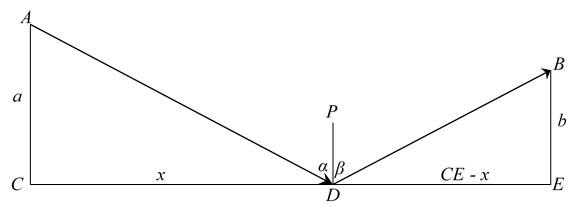
Using the lengths marked in the drawing,  \overline{{AC}},\overline{{PD}} and \overline{{BE}} are all perpendicular to  \overline{{CE}} the total distance is AD + DB. Therefore:

AD+DB=\sqrt{{{{a}^{2}}+{{x}^{2}}}}+\sqrt{{{{b}^{2}}+{{{\left( {CE-x} \right)}}^{2}}}}

To find the minimum distance find the derivative of AD + DB and set it equal to zero.

\displaystyle \frac{{2x}}{{2\sqrt{{{{a}^{2}}+{{x}^{2}}}}}}+\frac{{-2\left( {CE-x} \right)}}{{2\sqrt{{{{b}^{2}}+{{{\left( {CE-x} \right)}}^{2}}}}}}=0

Then

\displaystyle \frac{x}{{\sqrt{{{{a}^{2}}+{{x}^{2}}}}}}=\frac{{\left( {CE-x} \right)}}{{\sqrt{{{{b}^{2}}+{{{\left( {CE-x} \right)}}^{2}}}}}}

Now, we need to be clever:

\displaystyle \frac{x}{{\sqrt{{{{a}^{2}}+{{x}^{2}}}}}}=\cos \left( {ADC} \right)=\cos \left( \beta  \right) and

\displaystyle \frac{{\left( {CE-x} \right)}}{{\sqrt{{{{b}^{2}}+{{{\left( {CE-x} \right)}}^{2}}}}}}=\cos \left( {BDE} \right)=\cos \left( \alpha  \right)

And therefore, \displaystyle \alpha =\beta  QED.

See the illustration of this in Desmos here and see an easier way to do this problem.


The conic sections all have interesting reflection properties that are quite useful.

The Ellipse: A light ray leaving one focus of an ellipse is reflected by the ellipse through the other focus of the ellipse. The angle of incidence and the angle of reflection are between the segments to the foci and the normal to the ellipse.

The computation is done using a Computer Algebra System (CAS) and is shown below, the line-byline explanation follows:
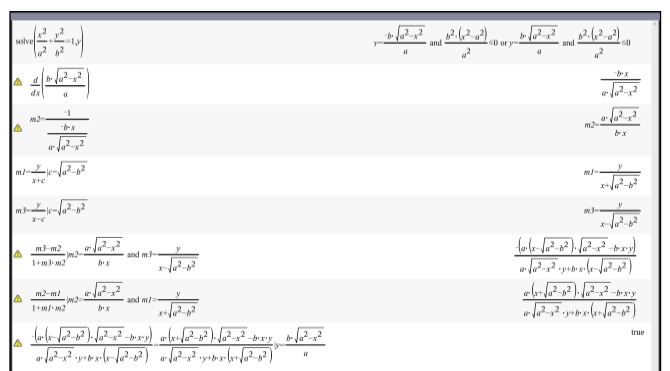
  • The first line starts with the ellipse \frac{{{{x}^{2}}}}{{{{a}^{2}}}}+\frac{{{{y}^{2}}}}{{{{b}^{2}}}}=1 with a > b > 0. Solving for y there are two equations, the second one is for the upper half that we will use below. The other for the lower half.
  • The second line finds the derivative of y and the third line, m2 is the slope of the normal, the opposite of the reciprocal of the derivative.
  • The fourth and fifth lines are the slopes, m1 and m3, are the slopes from the point on the ellipse to the foci. The “such that” bar, |, indicates that what follows it is substituted into the expression.
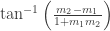
  • The next two lines compute the inverse tangent of angle rotated counterclockwise between the segments to the foci and the normal. This uses the formula from analytic geometry: {{\tan }^{{-1}}}\left( {\frac{{{{m}_{2}}-{{m}_{1}}}}{{1+{{m}_{1}}{{m}_{2}}}}} \right)
  • The last line shows that the expression from the two lines above it are equal, indicated by the “true” on the right.
An illustration using Desmos is here. Ellipses are used as reflectors in medical and dental equipment so that a relatively dim light source can be concentrated at the place where the doctor or dentist is working without “blinding” everyone in the room. There are also ceilings that reflect sound from one focus to the other without anyone elsewhere in the room hearing. These are only a few of their uses.

The hyperbola: A light ray from one focus of a hyperbola is reflected as though it came from the other focus. This is true whether the reflection is from the side nearer the focus or farther from the focus (reflection from the convex or the concave side.

The computation is like the ellipse computation with only a few sign changes. I will not reproduce it here. If you want to try use \displaystyle \frac{{{{x}^{2}}}}{{{{a}^{2}}}}-\frac{{{{y}^{2}}}}{{{{b}^{2}}}}=1 and  c=\sqrt{{{{a}^{2}}+{{b}^{2}}}}.

There is a Desmos illustration here. Use the p-slider to move the point. The left side shows the reflection from the “outside” surface; the right side shows the reflection from the “inside” surface.

Hyperbolas are used in telescopes and magnifying mirrors to enlarge the image.

The Parabola: A light ray from the focus is reflected parallel to the axis of symmetry of the parabola Or you can go the other way: light traveling parallel to the axis is reflected to the focus.

If you try to prove this on use  x=a{{y}^{2}} to avoid working with an undefined slope. The focus is at  \left( {\frac{a}{4},0} \right).

There is a Desmos illustration here

Parabolic reflectors are used in various kinds of spotlight and telescopes and for radar dishes. They are also used for satellite dishes for cable TV; you may have one at home.


A Lesson on Sequences

This blog post describes a lesson that investigates some ideas about sequences that are not stressed in the AP Calculus curriculum. The lesson could be an introduction to sequences. I think the lesson would work in an Algebra I course and is certainly suitable for a pre-calculus course. The investigation is of irrational numbers and their decimal representation. The successive decimal approximations to the square root of 2 is an example of a non-decreasing sequence that is bounded above and therefore converges.

Students do not need to know any of that as it will be developed in the lesson. Specifically, don’t even mention square roots, the square root of 2, or even irrational numbers until a student mention something of the sort.

This is not an efficient algorithm for finding square roots. There are far more efficient ways.

We begin with some preliminaries.

Preliminaries

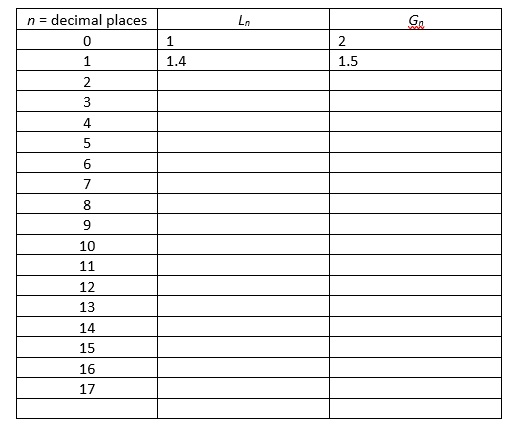
  • There is a blank table that you can copy for students to use here.
  • There is a summary of the new terms used and completed table Sequence Notes. Do not give this out until after the lesson is completed.
  • We will be working with some rather long decimal numbers that will need to be squared. Scientific and graphing calculators usually compute with 14 digits and give their results rounded to 12 digits. Since ours will quickly get longer than that, I suggest you use WolframAlpha. This can be used with a computer online (at wolframalpha.com) or with an app available for smart phones and tablets. It is best if students have this website or app for their individual use.

Students will enter their numbers as shown below. Specifying “30 digits” will produces answers long enough for our purpose. To speed things up, students can edit the current number by changing the last digit in the entry line. When you get started you may have to show students how to do this. Students will need internet access.

  Computer                                                                                 Smart phone

The Lesson

The style of the lesson is Socratic. You, the teacher, will present the problem, explain how they are to go about it, and ask leading questions as appropriate. Some questions are suggested; be ready to ask others.  Later, you will have to explain (define) some new words, but as much as possible let the class suggest what to do. Drag things out of them, rather than telling them.

To begin – Produce some data

Explain to the class that they are going to generate and investigate two lists of numbers (technically called sequences). Each new member of the lists will be a number with one more decimal place than the preceding number.

The first list, whose members are called Ln, will be the largest number with the given number of decimal places, n, whose square is less than two. The subscript, n, stands for the number of decimal places in the number.

Ask: “What is the largest integer whose square is less than 2?” Answer 1, so, L0 = 1. Ask: What is the largest one place decimal whose square is less than 2?”  Answer L1 =1.4.

The second list, Gn, will be the smallest number whose square is greater than 2. So, G0 = 2 and G1 = 1.5. Notice that 1.42 = 1.96 < 2 and 1.52 = 2.25 > 2

Divide the class into 10 groups named Group 0, Group 1, Group 2, …, Group 9. In each round the groups will append their “name” to the preceding decimal and square the resulting number. Group 0 squares 1.40, group 1, squares 1.41, group 2 squares 1.42, etc. using WolframAlpha.

Ask which groups have squares less than two and enter the largest in Ln, the next number will be the smallest number whose square is greater than 2; enter it in Gn.

Complete the table by entering the largest number whose square is less than 2 in the Ln column and the smallest number whose square is greater than 2 in the Gn column. At each stage, each group appends their digit to the most recent Ln . Project or write the table on the board. Students may fill in their own copy. A completed table is here: Sequence Notes and definitions

Next – Lead a discussion

When the table is complete, prompt the students to examine the lists and come up with anything and everything they observe whether it seems important or not. Accept and discuss each observation and let the others say what they think about each observation. (Obviously, don’t deprecate or laugh at any answer – after all at this point, we don’t know what is and is not significant.)

There are (at least) three observations that are significant to what we will consider next. Hopefully, someone will mention them; keep questioning them until they do. They are these, although students may use other terms:

  1. Ln is non-decreasing. Students may first say Ln is increasing. Pause if they do and look at L12 and L13, and L15 and L16. Ask how they know Ln is non-decreasing (because each time we add a digit on the end, you get a bigger number).
  2. Likewise, Gn is non-increasing.
  3. For all n, Ln < Gn, and the numbers differ only in the last digit, and with the last digits differing by 1.

Direct instruction: Explain these ideas and terms (definition)

  • A sequence is a list or set of numbers in a given order.
  • A sequence is bounded above if there exists a number greater than or equal to all the terms of the sequence. The smallest upper bound of a sequence is called its least upper bound (l.u.b.)
  • A sequence is bounded below if there exists a number less than or equal to all the terms of the sequence. The largest lower bound is called the greatest lower bound (g.l.b.)

More questions: Apply these terms to the sequence Ln with questions like these:

  • Is Ln bounded above, below, or not bounded? (Bounded above)
  • Give an example of a number greater than all the terms of Ln. (Many answers: 1,000,000, 4, 2, 1.415, etc. and, in fact, any and every number in Gn)
  • What is the l.u.b. of Ln? Can you think of the smallest number that is an upper bound of this sequence? (Yes, \sqrt{2}. Don’t tell them this – drag it out of them if necessary.) Why? How do you know this?
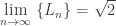
  • Make the class convince you that for all n, \displaystyle \underset{{n\to \infty }}{\mathop{{\lim }}}\,\left\{ {{{L}_{n}}} \right\}=\sqrt{2}

Ask similar questions about Gn.

  • Is Gn bounded above, below, or not bounded? (Bounded below)
  • Give an example of a number less than all the terms of Ln. (Many answers: any negative number, zero, 1, 1.414, etc. Any and every number in Ln)
  • What is the g.l.b. of Gn? Can you think of the greatest number that is a lower bound of this sequence? (Yes, \sqrt{2}) Why? How do you know this?
  • Make the class convince you that for all n, \displaystyle \underset{{n\to \infty }}{\mathop{{\lim }}}\,\left\{ {{{G}_{n}}} \right\}=\sqrt{2}


Summing Up

Ask, “What’s happening with the numbers in the Ln sequence?” and “What’s happening to the numbers in the Gn sequence?”

The answer you want is that they are getting closer to \sqrt{2}, one from below, the other from above. (As always, wait for a student to suggest this and then let the others discuss it.)

Once everyone is convinced, explain how mathematicians say and write, “gets closer to”:

Mathematicians say that \sqrt{2} is the limiting value (or limit) of both sequences. They write \displaystyle \underset{{n\to \infty }}{\mathop{{\lim }}}\,\left\{ {{{L}_{n}}} \right\}=\sqrt{2} and \displaystyle \underset{{n\to \infty }}{\mathop{{\lim }}}\,\left\{ {{{G}_{n}}} \right\}=\sqrt{2}.

Explain very carefully that while n\to \infty is read, “n approaches infinity,” that infinity, \infty , is not a number. The symbol n\to \infty means that n gets larger without bound or that n gets larger than all (any, every) positive numbers.

In a more technical sense there is an infinite series \displaystyle \sum\limits_{{n=0}}^{\infty }{{{{a}_{n}}\cdot {{{10}}^{{-n}}}}} where \displaystyle {{a}_{n}} is one of the digits 0, 1, 2, 3, …, 9, but there is no formula for listing the values of \displaystyle {{a}_{n}}. However, the sequence of partial sum of this series is the sequence \displaystyle \left\{ {{{L}_{n}}} \right\} which converges to \displaystyle \sqrt{2}. Therefore, \displaystyle \sum\limits_{{n=0}}^{\infty }{{{{a}_{n}}\cdot {{{10}}^{{-n}}}=\sqrt{2}}}

\displaystyle \sqrt{2} is an Irrational number, but this same procedure may be used to find decimal approximation of roots of rational numbers as well. However, for Rational numbers, there are easier ways.

Finally, Irrational numbers are exactly those that cannot be written as repeating (or terminating) decimals. They “go on forever” with no pattern. The decimals you can calculate eventually stop and are rounded to the last digit. Even WolframAlpha and similar computers must eventually do this. Irrational numbers are the limits of sequences like the one we looked at today.

Exercises

  1. Follow the procedure above to find the sequence whose limit is \sqrt{{\frac{{16}}{{121}}}} . Find this number the usual way (simplify and use long division) and compare the results.
  2. Follow the procedure above to find the sequence whose limit is \sqrt{{0.390625}} . Find this number the usual way and compare the results.
  3. Using WolframAlpha determine if the computer is using Ln, Gn. both, or neither when it gives a value for \sqrt{2}. (Hint: enter “square root 2 to 5 digits” and change to 6, 7, and 8 digits; compare the answer with the sequences, you found.)

Answers:

  1. 0.363636…
  2. 0.625
  3. For n = 5 and 6 the numbers are from Ln, for n = 7 and 8 they are from Gn. WolframAlpha is using a different algorithm to compute the square root of 2; the numbers appear from both sequences due to the rounding of the answers. To see WolframAlpha’s algorithm type “square root algorithm” on the entry line. This method also produces a sequence of approximations a/b.

Revised July 28, 2021

