Graphing Taylor Polynomials

The eighth in the Graphing Calculator / Technology series

Here are some hints for graphing Taylor polynomials using technology. (The illustrations are made using a TI-8x calculator. The ideas are the same on other graphing calculators; the syntax may be slightly different.)

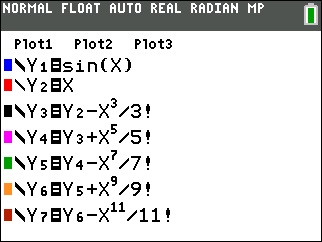
Each successive term of a Taylor polynomial consists of all the previous terms plus one new term. To show students how Taylor polynomials closely approximate a function (in the interval of convergence, of course), enter the function as Y1. Then enter the first term of the polynomial as Y2. Enter the next polynomial as Y3 = Y2 + the second term; enter the next as y4 = Y3 + the next term, and so on.

The example is the McLaurin series for sin(x) centered at the origin:

\displaystyle \sin \left( x \right)=x-\frac{{{x}^{3}}}{3!}+\frac{{{x}^{5}}}{5!}+\cdots +\frac{{{(-1)}^{2n-1}}{{x}^{2n-1}}}{\left( 2n-1 \right)!}=\sum\limits_{n=1}^{\infty }{{{\left( -1 \right)}^{n+1}}\frac{{{x}^{2n-1}}}{\left( 2n-1 \right)!}}

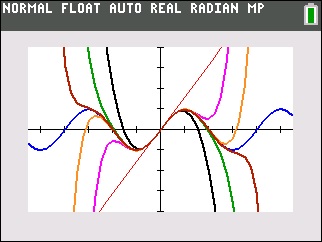
Each will graph one at a time. Watching them graph, one at a time, is instructive as well; each curve approximates the sine curve (in black) further and further away from the origin.
series-1

series-2

Another way to graph the polynomials is to enter them as a sequence of sums. The example this time is ln(x) centered at x = 2:

\displaystyle \ln \left( x \right)=\ln \left( 2 \right)+\frac{x-2}{2}-\frac{{{\left( x-2 \right)}^{2}}}{8}+\frac{{{\left( x-2 \right)}^{3}}}{24}+...=\ln \left( 2 \right)+\sum\limits_{n=1}^{\infty }{{{\left( -1 \right)}^{n+1}}\frac{{{\left( x-2 \right)}^{n}}}{{{2}^{n}}n}}

The syntax is seq( series in sigma notation, indexing variable, start value, end value [,step]). Notice from the figure that the indexing variable, K, is above the sigma.

series-4

The individual polynomials graph in the same color (blue); the function is shown in red.
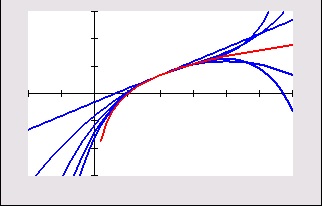
series-3Comparing the two graphs (sin(x) and ln(x)) is a good way to start a discussion about the interval of convergence – ask what is different about the graphs as more polynomials are graphed on each. Notice that unlike the sin(x) series the ln(x) polynomials only come close to the function in a limited interval (0, 4) centered at x = 2.


Desmos is also a good program to use to illustrate Taylor and McLaurin polynomials (as are Geogebra and Winplot). The use of the sliders makes it possible to see the successive polynomials quickly. They also help students see the interval of convergence as higher degree polynomials hug the graph on wider intervals (sin(x)), or stay within the same interval (ln(x)). The Desmos illustration with slider for the sin(x) centered at the origin is here and for ln(x)  centered at x = 2 is here. Study the input on the left side and enter Taylor polynomials for other functions.
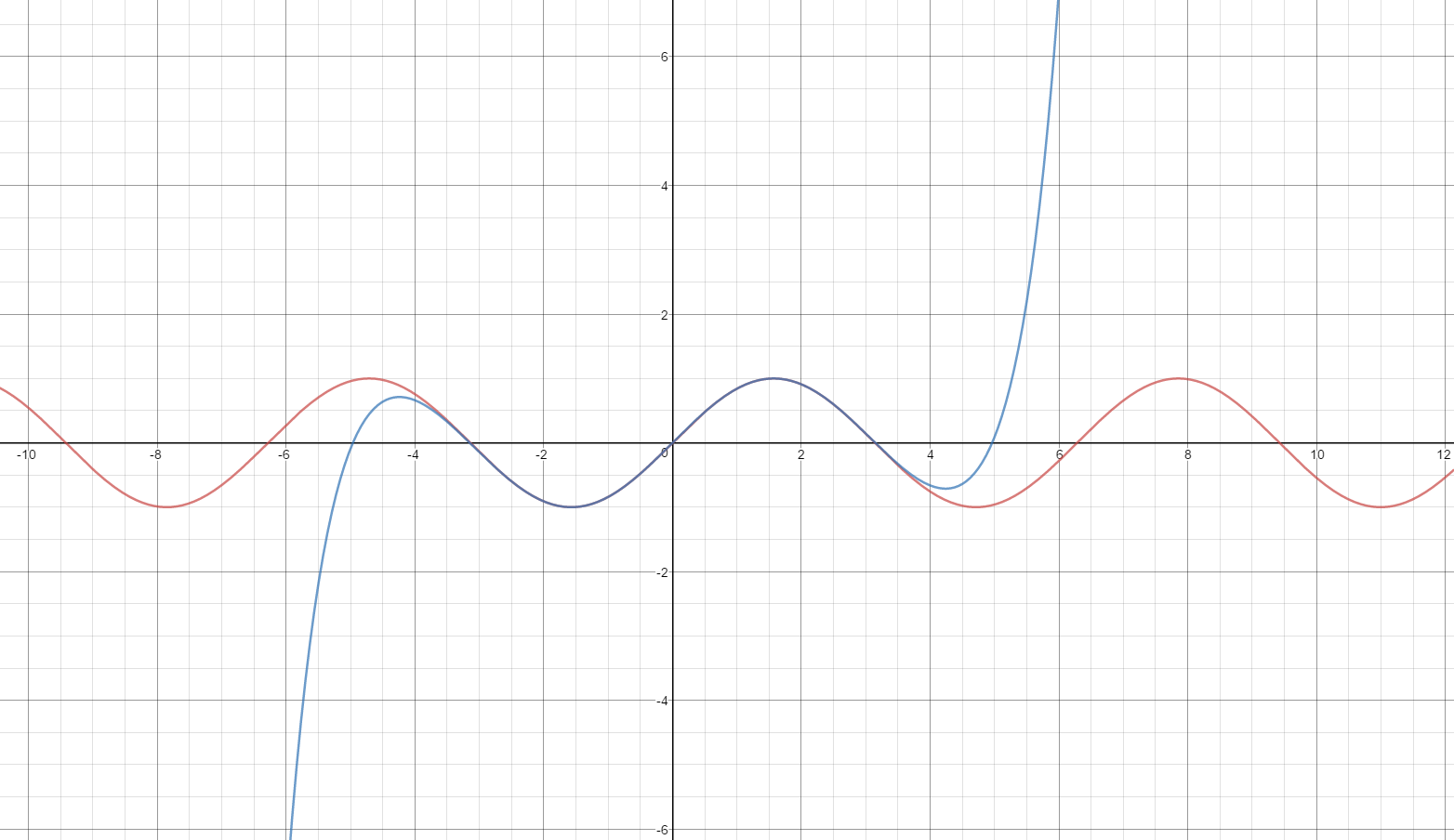
The fifth degree Taylor polynomial for sin(x) centered at the origin.The interval of convergence is all real numbers. Each polynomial “hugs” the graph on wider intervals.
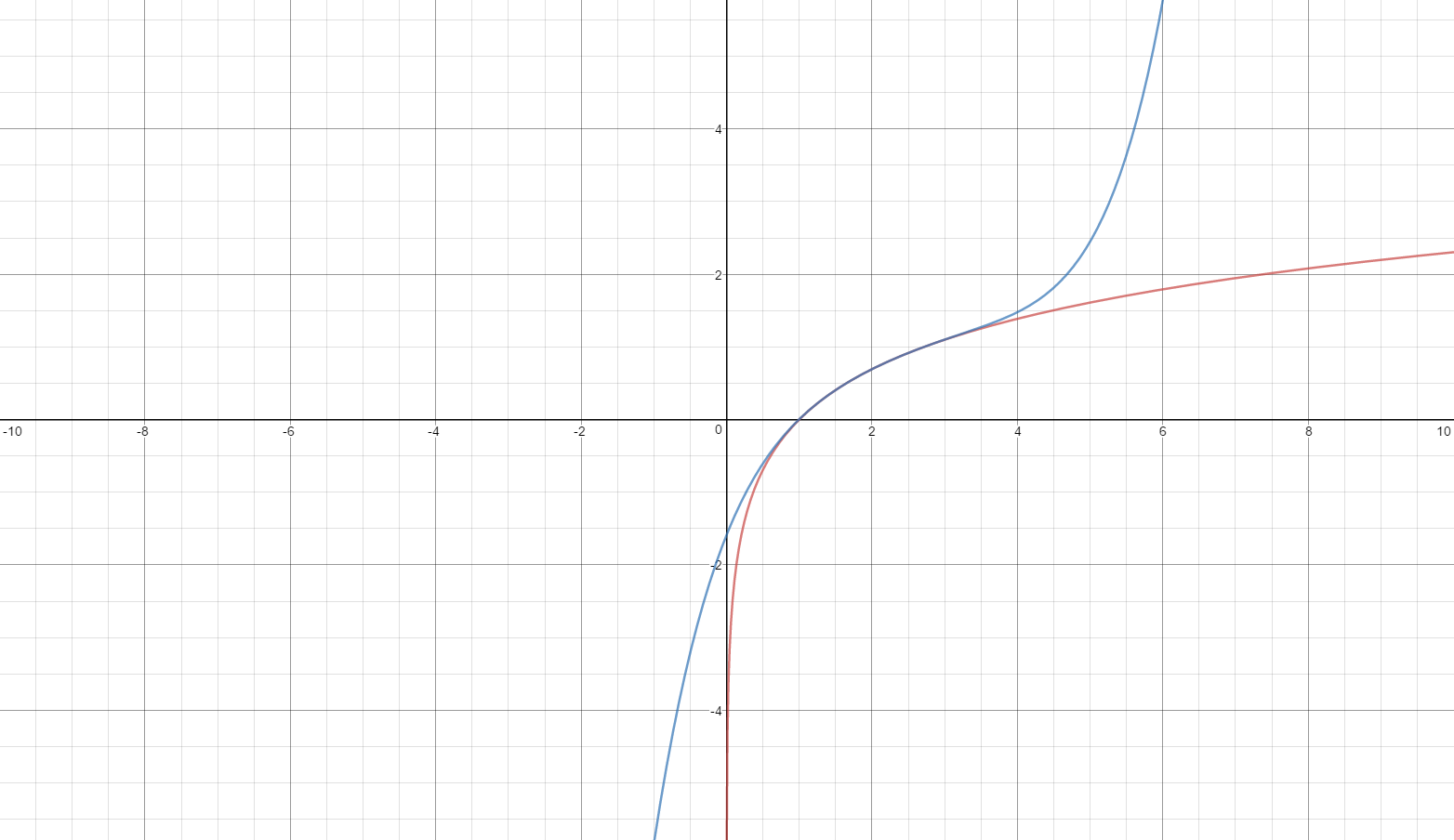
The fifth degree Taylor polynomial for ln(x) centered at x = 2. The interval of convergence is 0 < x < 4. The polynomials all leave the graph outside of this interval.


Coming soon

Feb 14th, Geometric Series – Far Out


The Lagrange Highway

Recently, there was an interesting discussion on the AP Calculus Community discussion boards about the Lagrange error bound. You may link to it by clicking here. The replies by James L. Hartman and Daniel J. Teague were particularly enlightening and included files that you may download with the proof of Taylor’s Theorem (Hartman) and its geometric interpretation (Teague).

There are also two good Kahn Academy videos on Taylor’s theorem and the error bound on YouTube. The first part is here (11:26 minutes) and the second part is here (15:08 minutes).

I wrotean earlier blog post on the topic of error bounds on February 22, 2013, that you can find here.

Taylor’s Theorem says that

If f is a function with derivatives through order n + 1 on an interval I containing a, then, for each x in I , there exists a number c between x and a such that

\displaystyle f\left( x \right)=\sum\limits_{k=1}^{n}{\frac{{{f}^{\left( k \right)}}\left( a \right)}{k!}{{\left( x-a \right)}^{k}}}+\frac{{{f}^{\left( n+1 \right)}}\left( c \right)}{\left( n+1 \right)!}{{\left( x-a \right)}^{n+1}}

The number \displaystyle R=\frac{{{f}^{\left( n+1 \right)}}\left( c \right)}{\left( n+1 \right)!}{{\left( x-a \right)}^{n+1}} is called the remainder.

The equation above says that if you can find the correct c the function is exactly equal to Tn(x) + R.

Tn(x) is called the n th  Taylor Approximating Polynomial. (TAP). Notice the form of the remainder is the same as the other terms, except it is evaluated at the mysterious c that we don’t know and usually are not able to find without knowing the value we are trying to approximate.

Lagrange Error Bound. (LEB)

\displaystyle \left| \frac{{{f}^{\left( n+1 \right)}}\left( c \right)}{\left( n+1 \right)!}{{\left( x-a \right)}^{n-1}} \right|\le \left( \text{max}\left| {{f}^{\left( n+1 \right)}}\left( x \right) \right| \right)\frac{{{\left| x-a \right|}^{n+1}}}{\left( n+1 \right)!}

The number \displaystyle \left( \text{max}\left| {{f}^{\left( n+1 \right)}}\left( x \right) \right| \right)\frac{{{\left| x-c \right|}^{n+1}}}{\left( n+1 \right)!}\ge \left| R \right| is called the Lagrange Error Bound. The expression \left( \text{max}\left| {{f}^{\left( n+1 \right)}}\left( x \right) \right| \right) means the maximum absolute value of the (n + 1) derivative on the interval between the value of x and c.


The LEB is then a positive number greater than the error in using the TAP to approximate the function f(x). In symbols \left| {{T}_{n}}\left( x \right)-f\left( x \right) \right|<LEB.

Here is a little story that I hope will help your students understand what all this means.

Building A Road

Suppose you were tasked with building a road through the interval of convergence of a Taylor Series that the function could safely travel on. Here is how you could go about it.

Build the road so that the graph of the TAP is its center line. The edges of the road are built LEB units above and below the center line. (The width of the road is about twice the LEB.) Now when the function comes through the interval of convergence it will travel safely on the road. I will not necessarily go down the center but will not go over the edges. It may wander back and forth over the center line but will always stay on the road. Thus, you know where the function is; it is less than LEB units (vertically) from the center line, the TAP.

Building a Wider Road

As shown in the example at the end of my previous post, it is often necessary to use a number larger than the minimum we could get away with for the LEB. This is because the maximum value of the derivative may be difficult to find. This amounts to building a road that is wider than necessary. The function will still remain within LEB units of the center line but will not come as close to the edges of our wider road as it may on the original road.  As long as the width of the wider road is less than the accuracy we need, this will not be a problem: the TAP will give an accurate enough approximation of the function.

Sequences and Series

AP Type Question 10

Sequences and Series – for BC only

Convergence tests for series appear on both sections of the BC Calculus exam. In the multiple-choice section students may be asked to say if a sequence or series converges or which of several series converge.

The Ratio test is used most often to determine the radius of convergence and the other tests to determine the exact interval of convergence by checking the convergence at the end points. Click here for a Convergence test chart students should be familiar with; this list is also on the resource page.

On the free-response section there is usually one full question devoted to sequences and series. This question usually involves writing a Taylor or Maclaurin polynomial for a series.

Students should be familiar with and able to write several terms and the general term of a series. They may do this by finding the derivatives and constructing the coefficients from them, or they may produce the series by manipulating a known or given series. They may do this by substituting into a series, differentiating it or integrating it.

What Students Should be Able to Do 

  • Use the various convergence tests to determine if a series converges. The test to be used is rarely given so students need to know when to use each of the common tests. For a summary of the tests click: Convergence test chart.
  • Write the terms of a Taylor or Maclaurin series by calculating the derivatives and constructing the coefficients of each term.
  • Distinguish between the Taylor series for a function and the function. Do NOT say that the Taylor polynomial is equal to the function; say it is approximately equal.
  • Determine a specific coefficient without writing all the previous coefficients.
  • Write a series by substituting into a known series, by differentiating or integrating a known series or by some other algebraic manipulation of a series.
  • Know (from memory) the Maclaurin series for sin(x), cos(x), ex and \displaystyle \tfrac{1}{1-x} and be able to find other series by substituting into them.
  • Find the radius and interval of convergence. This is usually done by using the Ratio test and checking the endpoints.
  • Be familiar with geometric series, its radius of convergence, and be able to find the number to which it converges, \displaystyle {{S}_{\infty }}=\frac{{{a}_{1}}}{1-r}. Re-writing a rational expression as the sum of a geometric series and then writing the series has appeared on the exam.

  • Be familiar with the harmonic and alternating harmonic series.
  • Use a few terms of a series to approximate the value of the function at a point in the interval of convergence.
  • Determine the error bound for a convergent series (Alternating Series Error Bound and Lagrange error bound). See my post of  February 22, 2013.
  • Use the coefficients (the derivatives) to determine information about the function (e.g. extreme values).

This list is quite long, but only a few of these items can be asked in any given year. The series question on the exam is usually quite straightforward. As I have suggested before, look at and work as many past exam questions to get an idea of what is asked and the difficulty of the questions. Click on Power Series in the “Posts by Topic” list on the right side of the screen to see previous posts on Power Series.

Error Bounds

How Good is Your Approximation?

Whenever you approximate something, you should be concerned about how good your approximation is. The error, E, of any approximation is defined to be the absolute value of the difference between the actual value and the approximation. If Tn(x) is the Taylor/Maclaurin approximation of degree n for a function f(x) then the error is E=\left| f\left( x \right)-{{T}_{n}}\left( x \right) \right|.  This post will discuss the two most common ways of getting a handle on the size of the error: the Alternating Series error bound, and the Lagrange error bound.

Both methods give you a number B that will assure you that the approximation of the function at x={{x}_{0}} in the interval of convergence is within B units of the exact value. That is,

\left( f\left( {{x}_{0}} \right)-B \right)<{{T}_{n}}\left( {{x}_{0}} \right)<\left( f\left( {{x}_{0}} \right)+B \right)

or

{{T}_{n}}\left( {{x}_{0}} \right)\in \left( f\left( {{x}_{0}} \right)-B,\ f\left( {{x}_{0}} \right)+B \right).

Stop for a moment and consider what that means: f\left( {{x}_{0}} \right)-B and f\left( {{x}_{0}} \right)+B   are the endpoints of an interval around the actual value and the approximation will lie in this interval. Ideally, B is a small (positive) number.

Alternating Series

If a series \sum\limits_{n=1}^{\infty }{{{a}_{n}}} alternates signs, decreases in absolute value and \underset{n\to \infty }{\mathop{\lim }}\,\left| {{a}_{n}} \right|=0 then the series will converge. The terms of the partial sums of the series will jump back and forth around the value to which the series converges. That is, if one partial sum is larger than the value, the next will be smaller, and the next larger, etc. The error is the difference between any partial sum and the limiting value, but by adding an additional term the next partial sum will go past the actual value. Thus, for a series that meets the conditions of the alternating series test the error is less than the absolute value of the first omitted term:
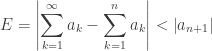
\displaystyle E=\left| \sum\limits_{k=1}^{\infty }{{{a}_{k}}}-\sum\limits_{k=1}^{n}{{{a}_{k}}} \right|<\left| {{a}_{n+1}} \right|.

Example: \sin (0.2)\approx (0.2)-\frac{{{(0.2)}^{3}}}{3!}=0.1986666667 The absolute value of the first omitted term is \left| \frac{{{(0.2)}^{5}}}{5!} \right|=0.26666\bar{6}\times {{10}^{-6}}. So our estimate should be between \sin (0.2)\pm 0.266666\times {{10}^{-6}} (that is, between 0.1986666641 and 0.1986719975), which it is. Of course, working with more complicated series, we usually do not know what the actual value is (or we wouldn’t be approximating). So an error bound like 0.26666\bar{6}\times {{10}^{-6}} assures us that our estimate is correct to at least 5 decimal places.

The Lagrange Error Bound

Taylor’s Theorem: If f is a function with derivatives through order n + 1 on an interval I containing a, then, for each x in I , there exists a number c between x and a such that

\displaystyle f\left( x \right)=\sum\limits_{k=1}^{n}{\frac{{{f}^{\left( k \right)}}\left( a \right)}{k!}{{\left( x-a \right)}^{k}}}+\frac{{{f}^{\left( n+1 \right)}}\left( c \right)}{\left( n+1 \right)!}{{\left( x-a \right)}^{n+1}}

The number \displaystyle R=\frac{{{f}^{\left( n+1 \right)}}\left( c \right)}{\left( n+1 \right)!}{{\left( x-a \right)}^{n+1}} is called the remainder.

The equation above says that if you can find the correct c the function is exactly equal to Tn(x) + R. Notice the form of the remainder is the same as the other terms, except it is evaluated at the mysterious c. The trouble is we almost never can find the c without knowing the exact value of f(x), but; if we knew that, there would be no need to approximate. However, often without knowing the exact values of c, we can still approximate the value of the remainder and thereby, know how close the polynomial Tn(x) approximates the value of f(x) for values in x in the interval, i.

Corollary – Lagrange Error Bound. 

\displaystyle \left| \frac{{{f}^{\left( n+1 \right)}}\left( c \right)}{\left( n+1 \right)!}{{\left( x-a \right)}^{n+1}} \right|\le \left( \text{max}\left| {{f}^{\left( n+1 \right)}}\left( x \right) \right| \right)\frac{{{\left| x-a \right|}^{n+1}}}{\left( n+1 \right)!}

The number \displaystyle \left( \text{max}\left| {{f}^{\left( n+1 \right)}}\left( x \right) \right| \right)\frac{{{\left| x-c \right|}^{n+1}}}{\left( n+1 \right)!}\ge \left| R \right| is called the Lagrange Error Bound. The expression \left( \text{max}\left| {{f}^{\left( n+1 \right)}}\left( x \right) \right| \right) means the maximum absolute value of the (n + 1) derivative on the interval between the value of x and c. The corollary says that this number is larger than the amount we need to add (or subtract) from our estimate to make it exact. This is the bound on the error. It requires us to, in effect, substitute the maximum value of the n + 1 derivative on the interval from a to x for {{f}^{(n+1)}}\left( x \right). This will give us a number equal to or larger than the remainder and hence a bound on the error.

Example: Using the same example sin(0.2) with 2 terms. The fifth derivative of \sin (x) is -\cos (x) so the Lagrange error bound is \displaystyle \left| -\cos (0.2) \right|\frac{\left| {{\left( 0.2-0 \right)}^{5}} \right|}{5!}, but if we know the cos(0.2) there are a lot easier ways to find the sine. This is a common problem, so we will pretend we don’t know cos(0.2), but whatever it is its absolute value is no more than 1. So the number \left( 1 \right)\frac{\left| {{\left( 0.2-0 \right)}^{5}} \right|}{5!}=2.6666\bar{6}\times {{10}^{-6}} will be larger than the Lagrange error bound, and our estimate will be correct to at least 5 decimal places.

This “trick” is fairly common. If we cannot find the number we need, we can use a value that gives us a larger number and still get a good handle on the error in our approximation.

FYI: \displaystyle \left| -\cos (0.2) \right|\frac{\left| {{\left( 0.2-0 \right)}^{5}} \right|}{5!}\approx 2.61351\times {{10}^{-6}}

Corrected: February 3, 2015, June 17, 2022

New Series from Old 3

Rational Functions and a “mistake”

A geometric series is one in which each term is found by multiplying the preceding term by the same number or expression. This number is called the common ratio, r. Geometric series converge if, and only if, \left| r \right|<1. If a geometric series converges, then the sum of the (infinite number of) terms is \displaystyle \frac{{{a}_{1}}}{1-r} where a1 is the first term.

We can use this to write series for rational expressions.

Example 1. The series for \displaystyle \frac{1}{1+{{x}^{2}}} that we assumed in the last post can be rewritten as \displaystyle \frac{1}{1-\left( -{{x}^{2}} \right)}.   This has the same form as the sum of the geometric series so we can write it as a geometric series with a1 = 1 and r = –x2 . The result is

 \displaystyle \frac{1}{1+{{x}^{2}}}=1-{{x}^{2}}+{{x}^{4}}-{{x}^{6}}+\cdots +{{\left( -1 \right)}^{2n-1}}{{x}^{2n-2}}+\cdots ,\quad -1<x<1

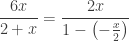
Example 2: \displaystyle \frac{6x}{2+x}=\frac{2x}{1-\left( -\tfrac{x}{2} \right)}. Letting {{a}_{1}}=3x and r=-\tfrac{x}{2} we have

\displaystyle \frac{6x}{2+x}=\frac{3x}{1-\left( -\tfrac{x}{2} \right)}=3x+3x\left( -\tfrac{x}{2} \right)+3x{{\left( -\tfrac{x}{2} \right)}^{2}}+3x{{\left( -\tfrac{x}{2} \right)}^{3}}+\cdots

\displaystyle \frac{6x}{2+x}=3x-\tfrac{3}{2}{{x}^{2}}+\tfrac{3}{4}{{x}^{3}}-\tfrac{3}{8}{{x}^{4}}+\tfrac{3}{16}{{x}^{5}}+\cdots +\tfrac{{{\left( -1 \right)}^{2n-1}}}{{{2}^{n-1}}}3{{x}^{n}}+\cdots

The interval of convergence is \left| -\tfrac{x}{2} \right|<1  or -2<x<2.

Many power series for rational functions can be obtained in this way.

An instructive “mistake.”

I have heard of students making an interesting mistake with this kind of problem. Instead of dividing by 2, they divide by x and arrive at \displaystyle \frac{6x}{2+x}=\frac{6}{1-\left( -\tfrac{2}{x} \right)} and then write the series as

\displaystyle \frac{6x}{2+x}=\frac{6}{1-\left( -\tfrac{2}{x} \right)}=6+6\left( -\tfrac{2}{x} \right)+6{{\left( -\tfrac{2}{x} \right)}^{2}}+6{{\left( -\tfrac{2}{x} \right)}^{3}}+\cdots

\displaystyle \frac{6x}{2+x}=6-\frac{12}{x}+\frac{24}{{{x}^{2}}}-\frac{48}{{{x}^{3}}}+\frac{96}{{{x}^{4}}}-\cdots

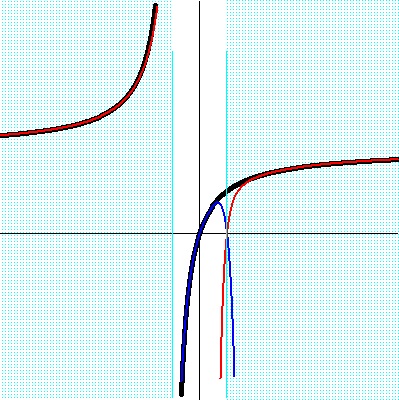
With an interval of convergence of \left| -\tfrac{2}{x} \right|<1 or x<-2\text{ or }x>2. Now this is not a Taylor series since the powers are in the denominators, but it is nevertheless interesting. Let’s look at the graphs.
rational expression

The rational expression is the black graph and partly hidden by the other graphs where they converge. The blue graph is the 5th degree Taylor Polynomial and its interval of convergence is the white strip in the center of the graph. The red graph is the “mistake” (also 5th degree) with the two blue regions as its interval of convergence.  Both series fit the rational function but only in their own interval of convergence.

New Series from Old 2

Differentiating and integrating a known series can help you find other series. Since \frac{d}{dx}\sin \left( x \right)=\cos \left( x \right) we can find the series for cos(x) this way


\frac{d}{dx}\sin \left( x \right)=\frac{d}{dx}(x-\frac{{{x}^{3}}}{3!}+\frac{{{x}^{5}}}{5!}-\frac{{{x}^{7}}}{7!}+\cdots +\frac{{{\left( -1 \right)}^{n-1}}{{x}^{2n-1}}}{\left( 2n-1 \right)!}+\cdots )

\frac{d}{dx}\sin \left( x \right)=1-\frac{3{{x}^{2}}}{3!}+\frac{5{{x}^{4}}}{5!}-\frac{7{{x}^{6}}}{7!}+\cdots \frac{{{\left( -1 \right)}^{n-1}}\left( 2n-1 \right){{x}^{2n}}}{\left( 2n-1 \right)!}+\cdots

\cos \left( x \right)=1-\frac{{{x}^{2}}}{2!}+\frac{{{x}^{4}}}{4!}-\frac{{{x}^{6}}}{6!}+\cdots \frac{{{\left( -1 \right)}^{n-1}}{{x}^{2n}}}{\left( 2n \right)!}+\cdots

 Of course, we could also have integrated the series for sin(x) to get the series for –cos(x) and then changed the signs.

In our next post we will find that

 \frac{1}{1+{{x}^{2}}}=1-{{x}^{2}}+{{x}^{4}}-{{x}^{6}}+\cdots +{{\left( -1 \right)}^{2n+1}}{{x}^{2n-2}}+\cdots

Recall that \frac{d}{dx}\arctan \left( x \right)=\frac{1}{1+{{x}^{2}}}, so we can integrate the series above to find the series for arctan(x).

\arctan \left( x \right)=\int_{{}}^{{}}{(1-{{x}^{2}}+{{x}^{4}}-{{x}^{6}}+\cdots +{{\left( -1 \right)}^{2n-1}}{{x}^{2n-2}}+\cdots )dx}

\arctan \left( x \right)=C+x-\tfrac{1}{3}{{x}^{3}}+\tfrac{1}{5}{{x}^{5}}-\tfrac{1}{7}{{x}^{7}}+\cdots +\tfrac{{{\left( -1 \right)}^{2n+1}}}{2n-1}{{x}^{2n-1}}+\cdots

Since \arctan \left( 0 \right)=0 it follows that the constant  of integration C=0 so

 \arctan \left( x \right)=x-\tfrac{1}{3}{{x}^{3}}+\tfrac{1}{5}{{x}^{5}}-\tfrac{1}{7}{{x}^{7}}+\cdots +\tfrac{{{\left( -1 \right)}^{2n+1}}}{2n-1}{{x}^{2n-1}}+\cdots

When differentiating or integrating the interval of convergence cannot get any larger, but it can get smaller. If the endpoints are included before differentiating or integrating then you must check to see if they are included in the new series.

Next post: Rational functions and geometric series.

New Series from Old 1

There are three common ways to get new series from old series without calculating all the derivatives and substituting into the Taylor Series general term.

  • Substituting into known series
  • Differentiating and integrating
  • Approaching rational functions as geometric series

This will be  the subject of this and my next two posts.

Substituting

As you might expect the Taylor/Maclaurin series for the “parent” functions are known. We’ve seen the series for ln(x) and sin(x) and you can develop or look up series for ex, cos(x) and so on. The power series for compositions involving these series can be found by substituting.

Example 1: To find the Maclaurin series for sin(3x), substitute 3x for x in the sin(x) series

 \sin (x)=x-\frac{{{x}^{3}}}{3!}+\frac{{{x}^{5}}}{5!}-\frac{{{x}^{7}}}{7!}+\cdots +\frac{{{\left( -1 \right)}^{n-1}}{{x}^{2n-1}}}{\left( 2n-1 \right)!}+\cdots

\sin (3x)=\left( 3x \right)-\frac{{{\left( 3x \right)}^{3}}}{3!}+\frac{{{\left( 3x \right)}^{5}}}{5!}-\frac{{{\left( 3x \right)}^{7}}}{7!}+\cdots +\frac{{{\left( -1 \right)}^{n-1}}{{\left( 3x \right)}^{2n-1}}}{\left( 2n-1 \right)!}+\cdots

Substituting along with some algebra also works, as the next example shows.

Example 2: To find the series for multiply the last answer by x2

{{x}^{2}}\sin (3x)=\left( 3x \right){{x}^{2}}-\frac{{{\left( 3x \right)}^{3}}{{x}^{2}}}{3!}+\frac{{{\left( 3x \right)}^{5}}{{x}^{2}}}{5!}-\cdots +\frac{{{\left( -1 \right)}^{n-1}}{{\left( 3x \right)}^{2n-1}}{{x}^{2}}}{\left( 2n-1 \right)!}+\cdots

{{x}^{2}}\sin (3x)=3{{x}^{3}}-\frac{{{3}^{3}}{{x}^{5}}}{3!}+\frac{{{3}^{5}}{{x}^{7}}}{5!}-\cdots +\frac{{{\left( -1 \right)}^{n-1}}{{3}^{2n-1}}{{x}^{2n+1}}}{\left( 2n-1 \right)!}+\cdots

Example 3: You must be a little careful sometimes. A recent AP Calculus exam asked for the first 4 terms of the Maclaurin series for \sin \left( 5x+\tfrac{\pi }{4} \right). Substituting \sin \left( 5x+\tfrac{\pi }{4} \right) into the sin(x) series gives a series centered at x=-\tfrac{\pi }{20} but the questions required a series centered at x = 0. Almost all students calculated derivatives and used them in the general form of a Maclaurin series. But with a little trigonometry you can substitute after some rewriting:

 \sin \left( 5x+\tfrac{\pi }{4} \right)=\sin \left( 5x \right)\cos \left( \tfrac{\pi }{4} \right)+\cos \left( 5x \right)\sin \left( \tfrac{\pi }{4} \right)

\sin \left( 5x+\tfrac{\pi }{4} \right)=\tfrac{\sqrt{2}}{2}\left( \sin \left( 5x \right)+\cos \left( 5x \right) \right)

Now we can substitute into the series for the sin(x) and cos(x):

 \sin \left( 5x+\tfrac{\pi }{4} \right)=\tfrac{\sqrt{2}}{2}\left( \left( 5x-\frac{{{\left( 5x \right)}^{3}}}{3!} \right)+\left( 1-\frac{{{\left( 5x \right)}^{2}}}{2!} \right) \right)

\sin \left( 5x+\tfrac{\pi }{4} \right)=\tfrac{\sqrt{2}}{2}+\tfrac{5\sqrt{2}}{2}x-\tfrac{25\sqrt{2}}{4}{{x}^{2}}-\tfrac{125\sqrt{2}}{12}{{x}^{3}}

As you can see from the last two examples, any sort of “legal” algebra or trigonometry can be used to find a new series from one you already know.

Next post: Differentiating and Integrating