Parts and More Parts

At an APSI this summer the participants and I got to discussing the “tabular method” for integration by parts. Since we were getting far from what is tested on the BC Calculus exams, I ended the discussion and said for those that were interested I would post more on the tabular method this blog going farther than just the basic set up. So here goes.

Here are some previous posts on integration by parts and the tabular method

 Integration by Parts 1 discusses the basics of the method. This is as far as a BC course needs to go.

Integration by Parts 2 introduces the tabular method

Modified Tabular Integration presents a very quick and slick way of doing the tabular method without making a table. This is worth knowing.

There is also a video on integration by parts here. Scroll down to “Antiderivatives 5: A BC topic – Integration by parts.” The tabular method is discussed starting about time 15:16. There are several ways of setting up the table; one is shown here and a slightly different way is in the Integration by Parts 2 post above. There are others.

Going further with the tabular method.

The tabular method works well if one of the factors in the original integrand is a polynomial; eventually its derivative will be zero and you are done. These are shown in the examples in the posts above and Example 1 below. To complete the topic, this post will show two other things that can happen when using integration by parts and the tabular method.

First we look at an example with a polynomial factor and learn how to stop midway through. Why stop? Because often there will be no end if you don’t stop. There are ways to complete the integration as shown in the examples.

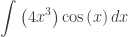
Example 1:  Find \displaystyle \int_{{}}^{{}}{\left( 4{{x}^{3}} \right)\cos \left( x \right)dx} by the tabular method (See Integration by Parts 2 for more detail on how to set the table up)
Capture

Adding the last column gives the antiderivative:

\displaystyle \int_{{}}^{{}}{\left( 4{{x}^{3}} \right)\cos \left( x \right)dx}=4{{x}^{3}}\sin \left( x \right)+12{{x}^{2}}\cos \left( x \right)-24x\sin \left( x \right)-24\sin \left( x \right)+C

Now say you wanted to stop after 12{{x}^{2}}\cos \left( x \right). Example 2 shows why you want (need) to stop. In Example 1 you will have

\displaystyle \int_{{}}^{{}}{\left( 4{{x}^{3}} \right)\cos \left( x \right)dx}=4{{x}^{3}}\sin \left( x \right)+12{{x}^{2}}\sin \left( x \right)+\int_{{}}^{{}}{-24x\cos \left( x \right)}dx

The integrand on the right is the product of the last column in the row at which you stopped and the first two columns in the next row, as shown in yellow above.

Example 2 Find \displaystyle \int_{{}}^{{}}{{{e}^{x}}\cos \left( x \right)dx}

Tabular 4

As you can see things are just repeating the lines above sometimes with minus signs. However, if we stop on the third line we can write:

\displaystyle \int_{{}}^{{}}{{{e}^{x}}\cos \left( x \right)dx={{e}^{x}}\sin \left( x \right)}+{{e}^{x}}\cos \left( x \right)-\int_{{}}^{{}}{{{e}^{x}}\cos \left( x \right)dx}

The integral at the end is identical to the original integral.  We can continue by adding the integral to both sides:

\displaystyle 2\int_{{}}^{{}}{{{e}^{x}}\cos \left( x \right)dx={{e}^{x}}\sin \left( x \right)}+{{e}^{x}}\cos \left( x \right)

Finally, we divide by 2 and have the antiderivative we were trying to find:

\displaystyle \int_{{}}^{{}}{{{e}^{x}}\cos \left( x \right)dx=\tfrac{1}{2}{{e}^{x}}\sin \left( x \right)}+\tfrac{1}{2}{{e}^{x}}\cos \left( x \right)+C

In working this type of problem you must be aware of that the original integrand showing up again can happen and what to do if it does. As long as the coefficient is not +1, we can proceed as above. The same thing happens if we do not use the tabular method. (If the coefficient is +1 then the other terms on the right will add to zero and you need to make different choices for u and dv.)

Reduction Formulas.

Another use of integration by parts is to produce formulas for integrals involving powers. An integral whose integrand is of less degree than the original, but of the same form results. The formula is then iterated to continually reduce the degree until the final integral can be integrated easily.

Example 3: Find \displaystyle \int_{{}}^{{}}{{{x}^{n}}{{e}^{x}}dx}

Let u={{x}^{n}},\ du=n{{x}^{n-1}}dx,\ dv={{e}^{x}}dx,\ v={{e}^{x}}

\displaystyle \int_{{}}^{{}}{{{x}^{n}}{{e}^{x}}dx}={{x}^{n}}{{e}^{x}}-n\int_{{}}^{{}}{{{x}^{n-1}}{{e}^{x}}dx}

This is a reduction formula; the second integral is the same as the first, but of lower degree. Here is how it is used.  At each step the integrand is the same as the original, but one degree lower. So the formula can be applied again, three more times in this example.

Tabular 7

Most textbooks have a short selection of reduction formulas.

Final Thoughts.

Back in the “old days”, BC (before calculators), beginning calculus courses spent a lot of time on the topic of “Techniques of Integration.” This included integration by parts, algebraic techniques, techniques known as trig-substitutions, and others. Mathematicians and engineers had tables of integrals listing over a thousand forms and students were taught how to use the tables and distinguish between similar forms in the tables. (See the photo below from the fourteenth edition of the CRC tables (c) 1965.) Current textbooks often contain such sections still.

Today, none of this is necessary. CAS calculators can find the antiderivatives of almost any integral. Websites such as WolframAlpha are also available to do this work.

I’m not sure why the College Board recently expanded slightly the list of types of antiderivatives tested on the exams. Certainly a few of the basic types should be included in a course, but what students really need to know is how to write the integral appropriate to a problem, and what definite and indefinite integrals mean. This, in my opinion, is far more important than being able to crank out antiderivatives of increasingly complicated expressions: let technology do that – or buy yourself an integral table. Just saying … .


tabular130

Modified Tabular Integration

Several weeks ago, Dr. Qibo Jing, an AP teacher at Rancho Solano Preparatory School in Scottsdale, Arizona, posted a new way to approach tabular integration to the AP Calculus Community discussion group.  He calls this the Modified Tabular Method. The algorithm makes repeated integration by parts quicker and more streamlined than the usual method. The usual method is explained here.

Here is Dr. Jing’s method outlined and illustrated with this example \displaystyle I=\int{\left( {{x}^{3}}+7{{x}^{2}} \right)\cos \left( x \right)dx}

Step 1: Identify u and dv in the usual way and rewrite the given integral in terms of u={{x}^{3}}+7{{x}^{2}} and dv=\cos \left( x \right)=\tfrac{d}{dx}\sin \left( x \right).

\displaystyle I=\int{\left( {{x}^{3}}+7{{x}^{2}} \right)\cos \left( x \right)dx}=\int{\left( {{x}^{3}}+7{{x}^{2}} \right)\left( \tfrac{d}{dx}\left( \sin x \right) \right)}

Step 2: The first term of the antiderivative is the product of the two functions that appear in the revised integral:

\displaystyle I=\int{\left( {{x}^{3}}+7{{x}^{2}} \right)\left( \tfrac{d}{dx}\left( \sin x \right) \right)}=\left( {{x}^{3}}+7{{x}^{2}} \right)\sin \left( x \right)\cdots

Step 3: The remaining terms alternate sign. The next term has subtraction sign etc. The first factor of the next term is the derivative of the first factor of the current term. The second factor is the antiderivative of the second factor of the current term – differentiate the first factor; integrate the second factor.

\displaystyle I =\int{\left( {{x}^{3}}+7{{x}^{2}} \right)\left( \tfrac{d}{dx}\left( \sin x \right) \right)}=\left( {{x}^{3}}+7{{x}^{2}} \right)\sin \left( x \right)-\left( 3{{x}^{2}}+14x \right)\left( -\cos \left( x \right) \right)\cdots

Step 4: Alternate signs and repeat step 3 until the term becomes zero or until the original form appears (See next example). DO NOT simplify either factor until you are done as this may change later terms.

Modified A

The simplified result is

\displaystyle I=\left( {{x}^{3}}+7{{x}^{2}}-6x-14 \right)\sin \left( x \right)+\left( 3{{x}^{2}}+14x-6 \right)\cos \left( x \right)+C

Here is a second example.  In this example the original integral returns as the third term.

\displaystyle I=\int{{{e}^{x}}\sin \left( x \right)dx=\int{\sin \left( x \right)\left( \tfrac{d}{dx}{{e}^{x}}dx \right)}}

=\sin \left( x \right)\left( {{e}^{x}} \right)-\cos \left( x \right)\left( {{e}^{x}} \right)+\left( -\sin \left( x \right) \right)\left( {{e}^{x}} \right)

={{e}^{x}}\sin \left( x \right)-\cos \left( x \right)\left( {{e}^{x}} \right)-I

2I={{e}^{x}}\sin \left( x \right)-\cos \left( x \right)\left( {{e}^{x}} \right)

I=\tfrac{1}{2}\left( {{e}^{x}}\sin \left( x \right)-\cos \left( x \right)\left( {{e}^{x}} \right) \right)+C

This really is a simpler algorithm than the usual tabular method.

Integration by Parts 2

Sometimes when doing an Antidifferentiation by Parts, the resulting integral is simpler than the one you started with but requires another, perhaps several more, antidifferentiations. You can do this but it can get a little complicated keeping track of everything especially with all the minus signs. There is an easier way.

Let’s consider an example: \int{{{x}^{4}}\sin \left( x \right)dx}.

Begin by making a table as shown below. After the headings:

    • In the first column leave the first cell blank and then alternate plus and minus signs down the column.
    • In the second column leave the first cell blank and then enter u and then under it list its successive derivatives.
    • In the third column enter dv in the first cell and then list its successive antiderivatives under it

Tabular 5

The antiderivative is found by multiplying across each row starting with the row with the  first plus sign and adding the products:

\int{{{x}^{4}}\sin \left( x \right)dx}=

-{{x}^{4}}\cos \left( x \right)+4{{x}^{3}}\sin \left( x \right)+12{{x}^{2}}\cos \left( x \right)-24x\sin \left( x \right)-24\cos \left( x \right)+C

Integration by Parts 1

The antidifferentiation technique known as Integration by Parts or Antidifferentiation by Parts is based on the formula for the Product Rule: d\left( uv \right)=udv+vdu.
Solve this equation for the second term on the right: udv=d\left( uv \right)-vdu.
Integrating this gives the formula \int{udv}=\int{d\left( uv \right)}-\int{vdu}. By the FTC the first term on the right can be simplified giving the formula for Integration by Parts:

\int{udv}=uv-\int{vdu}

The technique is used to find antiderivatives of expressions such as \int{x\sin \left( x \right)dx} in which there is a combination of functions that are usually of different types – here a polynomial and a trig function.

The parts of the integrand must be matched to the parts of \int{udv}. Here we make the substitutions u=x,dv=\sin \left( x \right)dx and from these we compute du=dx\text{ and }v=-\cos \left( x \right). (There is no need for the +C here; it will be included later). Making these substitutions gives


\int{x\sin \left( x \right)dx}=-x\cos \left( x \right)-\int{-\cos \left( x \right)dx}

The integral on the right is simple so we end with

\int{x\sin \left( x \right)dx}=-x\cos \left( x \right)+\sin \left( x \right)+C

As the problems get more difficult the first question students ask is which part should by u and which dv? The rules of thumb are (1) Chose u to be something that gets simpler when differentiated, and (2) chose dv to be something you can antidifferentiated or at least something that does not get more complicated when you antidifferentiate. For example, in the problem above if we were to choose u=\sin \left( x \right) and  dv=xdx the result is

\int{x\sin \left( x \right)dx}=\tfrac{{{x}^{2}}}{2}\sin \left( x \right)-\int{\tfrac{{{x}^{2}}}{2}\cos \left( x \right)dx}

This is correct, but the integral on the right is more complicated than the one we started with. When this happens, go back and start over.

For AP Calculus teachers: Note that Antidifferentiation by Parts is a BC only topic. It is something you can do in AB classes after the AP exam if you have time.

















