Logarithms

Students first encounter logarithms in Algebra 2 or their last pre-calculus course. They are usually defined as exponents and their properties “proven” by reference to the corresponding properties of exponents. This is good enough at the time, but in calculus we are ready to define logarithms properly. The result is the definition in terms of a function defined by an integral.

In fact, the definition flows naturally from the properties of inverse functions (no pun intended, because the flow is quite natural). But is this a definition? Or a proof? The solution of certain differential equations discussed in my last post may be used to derive the logarithm function.

Let’s begin by pretending we know nothing about logarithms, and investigate the inverse of ex.  (See The Derivative of Exponential Functions)

This function ex contains points of the form \left( X,{{e}^{X}} \right) so its inverse will contain points of the form \left( {{e}^{X}},X \right), which, since we like the first coordinate of functions to be x, we may also call \left( x,\ln \left( x \right) \right), where ln(x) will be the name of the inverse of ex. Remember, at the moment ln(x) is just a notation for the inverse of ex, we do not know anything about logarithms (yet).

So \left( {{e}^{X}},X \right) =\left( x,\ln \left( x \right) \right) and X\ne x. For example, (0, 1) is a point on eX, so (1, 0) is a point on the ln(x) function, and so ln(1) = 0.

In a previous post  we defined the number e and the function ex in such a way that \displaystyle \frac{d}{dx}{{e}^{x}}={{e}^{x}}. Now, at \left( X,{{e}^{X}} \right) the derivative is eX, so at the corresponding point on its inverse, \left( {{e}^{X}},X \right), the derivative is the reciprocal of the derivative of eX which is \frac{1}{{{e}^{X}}}=\frac{1}{x}. That is

\displaystyle \frac{d}{dx}\ln \left( x \right)=\frac{1}{x}

We can use this idea to define ln(x) as a function defined by an integral. Solving the differential equation by the method suggested in a recent post we get:

\displaystyle \ln \left( x \right)=\ln \left( a \right)+\int_{a}^{x}{\frac{1}{t}dx}

We can pick any positive number for a and a convenient one is the one we already found a = 1 where  ln(1) = 0, so

\displaystyle \ln \left( x \right)=\int_{1}^{x}{\frac{1}{t}dx},\quad x>0

This then is the “official definition” of the natural logarithm function. The domain is x > 0 (the range of ex) and the range is all real numbers (the domain of ex).

Graphically, ln(x) is the area between the graph of \displaystyle \frac{1}{t} and the t-axis between 1 and x. If 0<x<1, then \ln \left( x \right)<0 and if x>1, \ln \left( x \right)>0.

logarithm

From this definition we can prove all the familiar properties of logarithms \left( \ln \left( ab \right)=\ln \left( a \right)+\ln \left( b \right)\text{ etc}\text{.} \right) and show that this is a function of the kind we called “logarithm” all along. This is in all the textbooks so I will not go into this here.

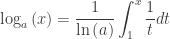
One of these properties tells us that for a>0\text{ and }a\ne 1, \displaystyle {{\log }_{a}}\left( x \right)=\frac{\ln \left( x \right)}{\ln \left( a \right)} and since ln(a) is a constant

\displaystyle {{\log }_{a}}\left( x \right)=\frac{1}{\ln \left( a \right)}\int_{1}^{x}{\frac{1}{t}dt}

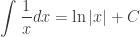
Finally, you will see this antiderivative formula: \displaystyle \int_{{}}^{{}}{\frac{1}{x}dx=\ln \left| x \right|+C}. The absolute value sign is to remind you that the argument of the logarithm function must be positive, since in some situations x itself may be negative.

Revised slightly 8-28-2018

Accumulation and Differential Equations

Accumulation 6: Differential equations

When students first learn about antiderivatives, they are given simple initial value problems to solve such as \frac{dy}{dx}=3-2x,\quad y\left( 1 \right)=-5. They are instructed to find the antiderivative, then tack on a +C , then substitute in the initial condition, then solve for C and finally write the particular solution. So we hope to see:

 \frac{dy}{dx}=3-2x

y=3x-{{x}^{2}}+C

-5=3(1)-{{1}^{2}}+C

-7=C

y=3x-{{x}^{2}}-7

But thinking of it as an accumulation problem you can write

\displaystyle y=-5+\int_{1}^{x}{3-2t\,dt}

y=-5+\left. \left( 3t-{{t}^{2}} \right) \right|_{1}^{x}

 y=-5+\left( 3x-{{x}^{2}} \right)-\left( 3(1)-{{1}^{2}} \right)

y=3x-{{x}^{2}}-7

Now I’ll admit there is not too much difference in the amount of work involved there, but once the first line is on the paper there is not much to remember in what to do from there on. Common student mistakes in the first method include entirely forgetting the +C and not using the initial condition correctly.

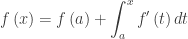
A differential equation in which dy/dx can be written as a function of x only, \frac{dy}{dx}={f}'\left( x \right), with an initial condition \left( a,f\left( a \right) \right) has the solution

\displaystyle f\left( x \right)=f\left( a \right)+\int_{a}^{x}{{f}'\left( t \right)dt}

Look familiar? Yes, that’s my favorite accumulation equation.

Furthermore, if all you need is some function values, this expression can be entered into a graphing calculator and the values calculated without finding an antiderivative.

In my first post on accumulation, I discussed the AP exam question 2000 AB 4. The solution to part (a) looks like this

\displaystyle \int_{0}^{3}{\sqrt{t+1}dt}=\left. \tfrac{2}{3}{{\left( t+1 \right)}^{3/2}} \right|_{0}^{3}=\tfrac{2}{3}\left( {{4}^{3/2}}-{{0}^{3/2}} \right)=\tfrac{14}{3}\text{ gallons}

The scoring standard included a second method that went this way:

L(t)=\text{ gallons leaked in first }t\text{ minutes}

\frac{dL}{dt}=\sqrt{t+1};\quad L\left( t \right)=\tfrac{2}{3}{{\left( t+1 \right)}^{3/2}}+C

L(0)=0;\quad C=-\tfrac{2}{3}

L(t)=\tfrac{2}{3}{{\left( t+1 \right)}^{3/2}}-\tfrac{2}{3};\quad L(3)=\tfrac{14}{3}

You decide which is easier. If you’re still not sure compare the two methods shown for part (c) on the scoring standard.