Past AP Exams

Recently, the College Board removed all the past AP Calculus exams dating back to 1998. This included free-0response questions and full exam with multiple-choice questions. The questions will be included in the AP Classroom section.

From now on, only free-response questions from the most recent three years will be available along with their scoring guidelines and other data. I understand that they will release a new full exam in January 2026, and then every three years after that as they did in the past.

While I have many favorite questions and exams from long ago, three years is enough for practice for the AP Exams in the spring.

So, two things:

  1. I suggest you download the exams, so you’ll have a copy when they “disappear.” If you really need older exams, I suggest you contact colleagues who may have downloaded copies.
  2. In this blog, I have referred to and discussed questions from past exams. Due to copyright regulations, I have not quoted the questions exactly. I have always tried to paraphrase enough of a question, so the discussion makes sense. There may be links to past exams that are no longer live. There are far too many to attempt to “fix” them. Sorry. I hope that will suffice.

Why Review?

The reason you review is TO MAKE MISTAKES!

When you’re reviewing for the AP Calculus exams your goal is to make mistakes. Why make mistakes? Easy: to find out what you’re doing wrong so you can fix it. And to find out what you don’t know so you can learn it.  

Your teacher will assign free-response questions, FRQs, from real AP Calculus exams from past years. Give yourself about 15 minutes and try to answer the question. (Fifteen minutes is about the time you have for each FRQ on the exam.) After fifteen minutes, stop. Check your work.

The questions, answers, solutions, and most importantly the scoring guidelines for FRQs are all online here for AB, and here for BC. Each FRQ is worth nine points. The scoring guidelines will show you what must be on your paper to earn each point.

Now you can copy the absolutely perfect answer for your FRQs and hand it in to your teacher. This won’t impress or fool your teacher because he or she has the guidelines too. More importantly this won’t help you. When reviewing mistakes are good. Study your mistakes and learn from them.

  • If you made a simple arithmetic or algebra mistake, learn to be more careful. One very common mistake is simplifying your answer incorrectly. Remember, you do not have to simplify numerical or algebraic answers. If you write “ 1 + 1 “ and the correct answer is 2, the “ 1 + 1 ” earns the point. But if you simplified it to 3, you lose the point you already earned. (The standards show simplified answers, so the readers will know what they are for (foolish?) students who chose to simplify.) simplifying also wastes time.
  • If you’re unsure how to write justifications, explanations, and other written answers, use the scoring guidelines as samples or templates. Learn to say what you need to say. Don’t say too much. You will not earn full credit for the correct answer and correct work if the question asks for a justification, and you don’t write one.
  • If you really don’t know how to answer a question you’ve made an important mistake. This is the thing you need to work on until you understand the concept or method. This requires more than just reading the solution on the guideline. Go back to your notes, ask your friends, ask your teacher, find out what you’re missing and learn it. Look at similar questions from other exams.
  •  For multiple-choice questions only the answers are available. Nevertheless, be sure you understand your mistakes.

There are 7 types of questions on the AB exam and an additional 3 on the BC exam. These are not the same as the ten units you’ve been studying, because AP exam questions often have parts from more than one unit. On March 5, I will post links to all the types. The discussion of each type will include a list of what you should know and be able to do for each type along with other hints.           

Now, when you actually take the AP Calculus exam your goal changes. Here you want to earn all the points you can. If you run across something you know you don’t know on the exam, leave it. Go onto something you do know. Don’t waste your time on something you’re not sure of. You can always come back if you have time.

Missteaks our heplfull.

AP Calculus Review 2023

For several years now, I’ve been posting a series of notes on reviewing for the AP Calculus Exams. The questions on the AP Calculus exams, both multiple-choice and free response, fall into ten types. I’ve published posts on each. The ten types have not changed over the years, so there is not much to add. They are updated from time to time. The posts may be found under the “Blog Guide” tab above: click on AP Exam Review. The same links are below with a brief explanation of each.

I hope these will help as you review for this year’s exam.

General information and suggestions

  • AP Exam Review – Suggestions, hints, information, and other resources for reviewing. How to get started. What to tell your students. Simulated (mock) exams.
  • To dx or not dx – Yes, use past exams and the scoring guideline to review, but don’t worry about the fine points of scoring; be more stringent than the readers.
  • Practice Exams – A Modest Proposal Like it or not (and the AP folks certainly do not) the answers are all online. What to do about that. Don’t overlook the replies at the end of this post.

The Ten Type Questions.

Other than simply finding a limit, a derivative, an antiderivative, or evaluating a definite integral, the AP Calculus exam questions fall into these ten types. These are different from the ten units in the CED. Students are often expected to use knowledge from more than one unit in a single question.

These posts outline what each type of question covers and what students should be able to do. They include references to good questions, free-response and multiple-choice, and links to other posts on the topic.

  • Type 3 questions – Graph analysis. Given the derivative often as a graph, students must answer questions about the function – extreme values, increasing, decreasing, concavity, etc.
  • Type 6 questions – Differential equations. Students are asked to solve a first-order separable differential equation, work with a slope field, or other related ideas. BC students may be asked to use Euler’s Method to approximate a value and discuss the logistic equation.
  • Type 7 questions – Miscellaneous. These include finding the first and second derivative of implicitly defined relation, solving a related rate problem or other topics not included in the other types.
  • Type 10 questions – Sequences and Series (BC topic) Questions ask student to determine the convergence of series using various convergence tests and to write and work with a Taylor and Maclaurin series, find its radius and interval of convergence.

Also, Calc-Medic has posted a searchable database of all the AP Calculus Free-response questions from 1998 on. The link is here. While you’re there take a look at their website which has lots of resources and free lesson plans. For mor on Calc-medic see this post.

This year’s exam will be given on Monday May 8, 2023, at 8:00 am local time.


Update March 9, 2023 – Calc-medic

Lesson Plans

A half-dozen decades ago (really!), when I first started out teaching, we were given a large grade book that included pages for lesson plans. For each week of the year there were two facing pages ruled into thirty two-inch squares.

We were expected to write our lesson plans in the squares. A lesson plan consisted of something like “Product and Chain rule” or “Factor perfect square trinomials” or even just “Section 4.7.” Also, you were expected to include the homework assignment. We had to have plans written for at least two weeks in advance. Principals could collect these (although they rarely did) and check up on you.

Lesson planning changed over the years. Even though no one ever checked up on us, I soon started including more in my lesson plans. The suggested structure came to include “behavioral objectives:” brief statements of what the student should be able to do once the lesson was taught. Not a bad idea. Schools started to require the teacher to write these on the board at the beginning of the class, so students would know what they were expected to learn to do. An even better idea.

As time went on and lecturing got a bad name, you were supposed to include activities (other than copying down what you wrote on the board) in your lesson. Also, a good idea.

 All this came to mind when I was asked to look at a website that offered FREE lesson plans for AP Calculus AB.

The website is Calc-medic.com. There are 150 daily lesson plans closely following the AB Calculus Course and Exam Description. The lessons are free and available to AP Calculus AB teachers. All you need to do is register. (BC lessons are planned, but since all AB topics are also BC topics, the plans will help BC teachers as well.)

If nothing more, they are a good pacing guide. BUT there is a lot more.

Before you continue, I suggest you read Tips for Lesson Planning from the Calc-Medic Blog. It discusses lesson planning, and I am sure it will be helpful whether you follow their lesson or write your own.

They call their approach “Experience First, Formalize Later” (EFFL). Each of the Calc-Medic EFFL lesson plans is organized like this:

Learning Objectives: A statement of what the lesson will teach.

Success Criteria: One or more succinct first-person statements of what students should be able to do: “I can use …”, “I can determine …”, “I can reason …”, “I can distinguish ….”

Quick Lesson Plan: Each lesson consists of four segments: (1) an activity – 15 minutes, (2) debrief [the activity] – 10 minutes, (3) Important Ideas – 10 minutes, and (4) check your understanding – 20 minutes. More about this shortly.

A brief Overview of the topic.

Teaching Tips – items you should be sure to mention with hints.

Exam Insights – notes on how the topic may appear on the exams and reference to specific AP exam questions.

Student Misconceptions – a discussion of things that may confuse students or that they may overlook.


The Activity.

Each lesson has a handout in PDF or DOCX (so you can adapt it) and an annotated Answer Key to the activity. This is the heart of the lesson plan.

The entire lesson is in the activity handout. It begins with a set of questions that will lead the students to the topic of the lesson. These are often close to AP format and have questions based on analytic, graphic, tabular and/or a written stem. Regardless of the way the question is presented, student writing is usually included.

The activity includes a box for student notes (summarized in the answer key).

Practice questions are in the “check your understanding” part of the lesson. Teachers can use the annotated answer sheet to help decide what to present to the students and help them make their notes. To help the teacher, answers are in blue, and annotations are in red.

The lessons do not include any homework assignments. Nor are the lessons linked to any textbook. This allows you to adapt them to your textbook and situation. The authors do assign homework. They explain their philosophy in “How Do We Assign Homework?” from the blog.

There is the old generic lesson plan: (1) Tell them what you’re going to tell them, (2) Tell them, and (3) Tell them what you’ve told them. This works for classes that are primarily lectures. The EFFL lessons at Calc-Medic are more of a discovery approach. The “Activity” leads students up to the new concept(s) presented. This is then firmed up in the “Debrief” and “Important Ideas” parts of the plan and practiced in “Check Your Understanding.”

There are occasional suggestions of where to find off-site information related to the lesson, such as College Board Curriculum Modules and this blog. Links to this information are not provided; it would be helpful if they were.

Tests and Quizzes are not included. However, when the lesson calls for a test or quiz there are detailed suggestions on how to write and grade the assessment. These are generic, but nonetheless useful. There are suggestions of what to include when writing the assessment (e.g., calculator problems), what question topics to include (specific to the topics assessed), grading tips, and reflections.

The last twenty lessons are a 4-week day-by-day review for the AP Exam. Some, but by no means all, of the review lessons are linked to the Calc-medic “Review Course.” Everything mentioned above is free; the full “Review Course” is available for a per student fee.

Calc-medic has added a searchable database to all the AP Calculus free-response questions since 1998. You may find it here.


Also worth your time is the Calc-Medic Blog with posts on topics related to AP Calculus and teaching AP Calculus. There are posts on pedagogy, the AP Exams, original videos by the authors, slide decks, and discussion of individual topics in more detail. These provide helpful insights for the teacher. It would help if these were linked to and from the lesson(s) they discuss, and if they had “tags.”


Mathmedic.com, companion website. contains similar lesson plans for Algebra 1, Geometry, Algebra 2, and Precalculus. The 180 Days of Precalculus lesson plans are not aligned with the upcoming AP Precalculus course, but lessons for this course are planned in time for the 2023 – 2024 school year. BC lesson plans are also in the works.


The sites are the work of Sarah Stecher and Barb Montgomery, teachers at East Kenwood High School in Kenwood, Michigan. They are both experienced AP Calculus Teachers. They have done a fabulous job with the lessons and their Calc-Medic Website. Both new and experienced teachers will find the lesson plans and blog helpful.

I cannot recommend Calc-Medic more highly.


ALSO:Last year I reviewed an iPad app called A Little Calculus. This app demonstrates graphically all the main concepts of AB and BC Calculus. It is quite easy to use and a quick way to prepare and present good visual examples for your class. The app has recently been updated to allow you to save and recall your own examples. Several new topics have been added. If you are not familiar with it, take a look.


P.S. Hope you like the Blog’s new look!

Updated August 15, 18, 22, 2022, March 9, 2923

To dx or not to dx

As exam time nears, teachers become concerned about exactly what to give credit for and what not to give credit for when grading their students’ work on past AP free-response questions.

Former Chief Reader Stephen Davis recently posted a note on the grading of a fictitious exam question showing how 2 points might have been awarded on a L’Hospital’s Rule question.  The note is interesting because it shows the details that exam leaders consider when deciding what to accept and what not to accept. It shows the details that readers must keep in mind while grading. This level of detail with examples is given to the readers in writing for each part of every question. With hundreds of thousands of exams each year and millions of questions to grade, this level of detail is necessary for fairness and consistency in scoring.

BUT as teachers preparing your students for the exam you really don’t need to be as concerned about all these fine points as readers are. Encourage your students to answer the question correctly and show the required work using correct notation. Even thought the guidelines show what is necessary to earn each and every point, there are still fine points and close calls that do not show up on the guidelines.

Don’t worry about the fine points. What if I say this, instead of that? What if I forget to write dx? Why show your students the minimum they can get away with? How does that help them? Do your students a favor: score the review problems more stringently than the readers. If a student’s answer is close but maybe not quite right, take off some credit and help them learn how to do better. It will help them in the long run. 

If your students try to answer and show their work but miss or overlook something, the readers will do their best to follow the student’s work and give her or him the points they have earned.


Revised February 17, 2024

Sequences and Series (Type 10)

AP Questions Type 10: Sequences and Series (BC Only)

The last BC question on the exams usually concerns sequences and series. The question may ask students to write a Taylor or Maclaurin series and to answer questions about it and its interval of convergence, or about a related series found by differentiating or integrating. The topics may appear in other free-response questions and in multiple-choice questions. Questions about the convergence of sequences may appear as multiple-choice questions. With about 8 multiple-choice questions and a full free-response question this is one of the major topics on the BC exams.

Convergence tests for series appear on both sections of the BC Calculus exam. In the multiple-choice section, students may be asked to say if a sequence or series converges or which of several series converge.

The Ratio test is used most often to determine the radius of convergence and the other tests to determine the exact interval of convergence by checking the convergence at the end points. Click here for a convergence test chart students should be familiar with; this list is also on the resource page.

Students should be familiar with and able to write a few terms and the general term of a Taylor or Maclaurin series. They may do this by finding the derivatives and constructing the coefficients from them, or they may produce the series by manipulating a known or given series. They may do this by substituting into a series, differentiating it, or integrating it.

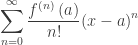
The general form of a Taylor series is \displaystyle \sum\limits_{{n=0}}^{\infty }{{\frac{{{{f}^{{\left( n \right)}}}\left( a \right)}}{{n!}}{{{\left( {x-a} \right)}}^{n}}}}; if a = 0, the series is called a Maclaurin series.

What Students Should be Able to Do 

  • Use the various convergence tests to determine if a series converges. The test to be used is rarely given so students need to know when to use each of the common tests. For a summary of the tests click: Convergence test chart.  and the posts “What Convergence Test Should I use?” Part 1 and Part 2. In 2022 BC 6 (a) students were asked to state the condition (hypotheses) of the convergence test they were asked to use.
  • Understand absolute and conditional convergence. If the series of the absolute values of the terms of a series converges, then the original series is said to be absolutely convergent (or converges absolutely). If a series is absolutely convergent, then it is convergent. If the series of absolute values diverges, then the original series may or may not converge; if it converges it is said to be conditionally convergent.
  • Write the terms of a Taylor or Maclaurin series by calculating the derivatives and constructing the coefficients of each term.
  • Distinguish between the Taylor series for a function and the function. DO NOT say that the Taylor polynomial is equal to the function (this will lose a point); say it is approximately equal.
  • Determine a specific coefficient without writing all the previous coefficients.
  • Write a series by substituting into a known series, by differentiating or integrating a known series, or by some other algebraic manipulation of a series.
  • Know (from memory) the Maclaurin series for sin(x), cos(x), ex and \displaystyle \frac{1}{{1-x}}and be able to find other series by substituting into one of these.
  • Find the radius and interval of convergence. This is usually done by using the Ratio test to find the radius and then checking the endpoints. for a geometric series, the interval of convergences is the open interval \displaystyle -1<r<1 where r is the common ration of the series.
  • Be familiar with geometric series, its radius of convergence, and be able to find the number to which it converges, \displaystyle {{S}_{\infty }}=\frac{{{{a}_{1}}}}{{1-r}}. Re-writing a rational expression as the sum of a geometric series and then writing the series has appeared on the exam.

  • Be familiar with the harmonic and alternating harmonic series. These are often useful series for comparison.
  • Use a few terms of a series to approximate the value of the function at a point in the interval of convergence.
  • Determine the error bound for a convergent series (Alternating Series Error Bound or Lagrange error bound). See my posts on Error Bounds and the Lagrange Highway
  • Use the coefficients (the derivatives) to determine information about the function (e.g., extreme values).

This list is quite long, but only a few of these items can be asked in any given year. The series question on the free-response section is usually quite straightforward. Topics and convergence tests may appear on the multiple-choice section. As I have suggested before, look at and work as many past exam questions to get an idea of what is asked, how it is a sked, and the difficulty of the questions. Click on Power Series in the “Posts by Topic” list on the right side of the screen to see previous posts on Power Series or any other topic you are interested in.

Free-response questions:

  • 2004 BC 6 (An alternate approach, not tried by anyone, is to start with \displaystyle \sin \left( {5x+\tfrac{\pi }{4}} \right)=\sin \left( {5x} \right)\cos \left( {\tfrac{\pi }{4}} \right)+\cos \left( {5x} \right)\sin \left( {\tfrac{\pi }{4}} \right)). See Good Question 16
  • 2011 BC 6 (Lagrange error bound)
  • 2016 BC 6
  • 2017 BC 6
  • 2019 BC 6
  • 2021 BC 5 (a)
  • 2021 BC 6 – note that in (a) students were required to state the conditions of the convergence test they were asked to use.
  • 2022 BC 6 – Ratio test, interval of conversion with endpoint analysis, Alternating series error bound, series for derivative, geometric series.
  • 2023 BC 6 – Taylor polynomials, Lagrange error bound

Multiple-choice questions from non-secure exams:

  • 2008 BC 4, 12, 16, 20, 23, 79, 82, 84
  • 2012 BC 5, 9, 13, 17, 22, 27, 79, 90

These questions come from Unit 10 of the CED.


Revised March 12, 2021, April 12, 16, and May 14, 2022, June 4, 2023


Polar Equation Questions (Type 9)

AP Questions Type 9: Polar Equations (BC Only)

Ideally, as with parametric and vector functions, polar curves should be introduced and covered thoroughly in a pre-calculus course. Questions on the BC exams have been concerned only with calculus ideas related to polar curves. Students have not been asked to know the names of the various curves (rose curves, limaçons, etc.). The graphs are usually given in the stem of the problem; students are expected to be able to determine which is which if more than one is given. Students should know how to graph polar curves on their calculator, and the simplest by hand. Intersection(s) of two graphs may be given or easy to find.

What students should know how to do:

  • Calculate the coordinates of a point on the graph,
  • Find the intersection of two graphs (e.g. to use as limits of integration).
  • Find the area enclosed by a graph or graphs: \displaystyle A=\frac{1}{2}\int_{{{{\theta }_{1}}}}^{{{{\theta }_{2}}}}{{{{{\left( {r\left( \theta \right)} \right)}}^{2}}d\theta }}
  • Use the formulas \displaystyle x\left( \theta \right)=r\left( \theta \right)\cos \left( \theta \right)\text{ and }y\left( \theta \right)=r\left( \theta \right)\sin \left( \theta \right)  to convert from polar to parametric form,
  • Calculate \displaystyle \frac{{dy}}{{d\theta }} and \displaystyle \frac{{dx}}{{d\theta }} (Hint: use the product rule on the equations in the previous bullet).
  • Discuss the motion of a particle moving on the graph by discussing the meaning of \displaystyle \frac{{dr}}{{d\theta }} (motion towards or away from the pole), \displaystyle \frac{{dy}}{{d\theta }} (motion in the vertical direction), and/or \displaystyle \frac{{dx}}{{d\theta }} (motion in the horizontal direction).
  • Find the slope at a point on the graph, \displaystyle \frac{{dx}}{{dx}}=\frac{{dy/d\theta }}{{dx/d\theta }}

When this topic appears on the free-response section of the exam there is no Parametric/vector motion question and vice versa. When not on the free-response section there are one or more multiple-choice questions on polar equations.

This question typically covers topics from Unit 9 of the CED.


Free-response questions:

  • 2013 BC 2
  • 2014 BC 2
  • 2017 BC 2
  • 2018 BC 5
  • 2019 AB 2

Multiple-choice questions from non-secure exams:

  • 2008 BC 26
  • 2012 BC 26, 91

Other posts on Polar Equations

Polar Basics

Polar Equations for AP Calculus

Extreme Polar Conditions

Polar Equations (Review 2018)

         Visualizing Unit 9 Desmos Demonstrations for Polar, Vector and Parametric Curves


Revised March 12, 2021, April 8, 2022