Theorems and Axioms

Continuing with some thoughts on helping students read math books, we will now look at the main things we find in them in addition to definitions which we discussed previously: theorems and axioms.

An implication is a sentence in the form IF (one or more things are true), THEN (something else is true). The IF part gives a list of requirements, so to speak, and when the requirements are all met we can be sure the THEN part is true. The fancy name for the IF part is hypothesis; the THEN part is called the conclusion.

Implications are sometimes referred to as conditional statements – the conclusion is true based on the conditions in the hypothesis.

An example from calculus: If a function is differentiable at a point, then it is continuous at that point. The hypothesis is “a function is differentiable at a point”, the conclusion is “the function is continuous at that point.”

This is often shortened to, “Differentiability implies continuity.” Many implications are shortened to make them easier to remember or just to make the English flow better. When students get a new idea in a shortened form, they should be sure to restate it so that the IF part and the THEN part are clear to them. Don’t let them skip this.

Related to any implication are three other implications. The 4 related implications are:

  1. The original implication: if p, then q.
  2. The converse is formed by interchanging the hypothesis and the conclusion of the original implication: if q, then p. Even if the implication is true, the converse may be either true or false. For example, the converse of the example above, if a function is continuous then it is differentiable, is false.
  3. The inverse is formed by negating both the hypothesis and the conclusion: if  p is false, then q is false. For our example: if a function is not differentiable, then it is not continuous. As with the converse, the inverse may be either true or false. The example is false.
  4. Finally, the contrapositive is formed by negating both the original hypothesis and conclusion and interchanging them, if q is false, then p is false. For our example the contrapositive is “If a function is not continuous at a point, then it is it is not differentiable there.” This is true, and it turns out a useful. One of the quickest ways of determining that a function is not differentiable is to show that it is not continuous. Another example is a theorem that say if an infinite series, an, converges, then \displaystyle \underset{n\to \infty }{\mathop{\lim }}\,{{a}_{n}}=0. This is most often used in the contrapositive form when we find a series for which  \displaystyle \underset{n\to \infty }{\mathop{\lim }}\,{{a}_{n}}\ne 0; we immediately know that it does not converge (called the nth-term test for divergence).

The original statement and its contrapositive are both true or both false. Likewise, the converse and the inverse are both true or both false.

Any of the 4 types of statements could be taken as the original and the others renamed accordingly. For example, the original implication is the converse of the converse; the contrapositive of the inverse is the converse, and so on.

Definitions are implications for which the statement and its converse are both true. This is the real meaning of the reversibility of definitions. For this reason, definitions are sometimes called bi-conditional statements.

Axioms and Theorems

There are two kinds of if …, then… statements, axioms (also called assumptions or postulates) and theorems. Theorems can be proved to be true; axioms are assumed to be true without proof. A proof is a chain of reasoning starting from axioms, definitions, and/or previously proved theorems that convince us that the theorem is true. (More on proof in a future post.)

It would be great if everything could be proved, but how can you prove the first few theorems? Thus, mathematical reasoning starts with (a few carefully chosen) axioms and accepts them as true without proof. Everything else should be proved. If you can prove it, it should not be an axiom.

Theorems abound. All of the important ideas, concepts, “laws” and formulas of calculus are theorems.  You will probably see few, if any, axioms in a calculus book, since they came long before in the study of algebra and geometry.

Learning Theorems

When teaching students and helping them read and understand their textbook, it is important that they understand what a theorem is and how it works. They should understand what the hypothesis and conclusion are and how they relate to each other. They should understand how to check that the parts of the hypothesis are all true about the function or situation under consideration, before they can be sure the conclusion is true.

For the AP teachers this kind of thing is tested on the exams. See 2005 AB-5/BC-5 part d, or 2007 AB-3 parts a and b (which literally almost no one got correct). These questions can be used as models for making up your own questions of other theorems.

Definitions 2

In helping students read and understand mathematics knowing about definitions, axioms (aka assumptions, postulates) and theorems. By this I mean knowing the parts of a definition or theorem and how they relate to each other should increase the students’ understanding. Today I’ll discuss definitions; theorems and assumptions will be discussed in a future post.

A definition names some mathematical “thing.” A good definition (in mathematics or elsewhere) names the thing defined in a sentence. The sentence may contain symbols, which are really just shorthand for words. A definition has 4 characteristics:

  1. It should put the thing defined into the nearest group of similar things.
  2. It should give the characteristics that distinguish it from the other things in the group.
  3. It should use simpler terms (previously defined terms).
  4. It should be reversible.

I will discuss each of these with an example first from geometry and then from calculus. First however, a word or two about “reversible.” Definitions are what are known technically as bi-conditional statement, meaning that the statement and its converse are true. More on this in the next post.

An example from geometry:

Definition: An equilateral triangle is a triangle with three congruent sides.

The term defined is “equilateral triangle.”

  1. Nearest group of similar things: triangles
  2. Distinguishing characteristic: 3 congruent sides. We all know that an equilateral triangle also has 3 congruent angles, and that all the angles have a measure of \displaystyle \tfrac{\pi }{3}, and all the angles add up to a straight angle, and lots of other great things, but for the definition we only mention the feature that distinguishes equilateral triangles from other triangles. It would be possible to use instead the 3 congruent angles or the fact that all three angles measure are \displaystyle \tfrac{\pi }{3}, as the distinguishing characteristic, but whoever wrote the definition choose the sides. (We could not use the fact that the angles add to a straight angle, because that is true for all triangles and therefore doesn’t distinguish equilateral triangles from the others.) Definitions do not list all the things that may be true, only those that make it different.
  3. Simpler terms: triangle, sides (of a triangle) and congruent. We assume that these key terms are already known to the student. Of course there were no previously defined terms for the very first things (points, lines and planes) but by now we are past that and have lots of previously defined terms to work with.
  4. Reversible: If we know that this object is an equilateral triangle, then without looking further we know it has 3 congruent sides AND if we run across a triangle with 3 congruent sides, we know it must be an equilateral triangle.

An example from the calculus:

Definition: A function, f, is increasing on an interval if, and only if, for all pairs of numbers a and b in the interval, if a < b, then f (a) < f (b).

This is a little more complicated. The term being defined is increasing on an interval. This becomes important and can lead to confusion because sometimes we are tempted to think functions are increasing at a point. There is no definition for the latter: functions increase only on intervals.

  1. Nearest group of similar things: functions
  2. Distinguishing characteristic: for all pairs of numbers a and b in the interval, if a < b, then f (a) < f (b).
    1. The if …, then … construction indicates a conditional statement (discussed in the next post) inside of the definition. This is not uncommon. It means that if can establish that this is true, then we can say then function is increasing on the interval.
    2. The phrase “for all” is also common in mathematics. It means the same thing as “for any” and “for every.” When you come across one of these it is a very good idea to rephrase the sentence with each of them: “for all numbers a and b in the interval…”, “for any pair of numbers a and b in the interval …” and “for every two numbers a and b in the interval…” This greatly helps understanding definitions.
    3. Simpler terms: function, interval (could be open, closed or half-open), less than (<), the meaning of symbols like f (a).
    4. Reversible:
      1. the phrase “if, and only if” indicates that what goes before and what comes after it, each imply the other. This phrase is implicit in all (any, every) definitions although English usage often omits it. The first definition could be written “A triangle is equilateral if, and only if, it has 3 congruent sides” but is a little more user-friendly the way it is stated above.
      2. If you can establish that “for all pairs of numbers a and b in the interval, if a < b, then f (a) < f (b)”, then you can be sure the function increases on the interval. AND if you are told f is increasing on the interval, then without checking further you can be sure that “for all (any, every) pairs of numbers a and b in the interval, if a < b, then f (a) < f (b).”

Now that’s a fairly detailed discussion (definition?) of a definition. But it is worth going through any new definition for your students to help them learn what the definition really means. First identify the four features for you students and then as new definitions come along have them identify the parts. Encourage them to pull definitions apart this way. It is worth the little extra time spent.

Teaching How to Read Mathematics

At this time of year many teachers are picking the calculus book for their class to use next year. At the same time, you will find teachers complaining, quite correctly, that their students don’t read their math textbooks. Authors, editors and their focus groups try their very best to make books “readable,” to no avail, since students won’t read them anyway.

Maybe this is because students have never learned to read math books, because no one has ever taught them how. Have you? Here are some thoughts and suggestions gathered from several sources that may help.

First, some obvious (to us) comments, which, alas, probably won’t make much of a change in students’ ways:

  • It takes time to read a math book. Unlike a novel or a non-fiction book, a few pages of mathematics will take longer than reading a story or essay.
  • Readers should stop every few lines and make sure they understand what they’ve read
  • Readers should have a pencil and paper handy both to take notes, to draw graphs, to work through some of the examples.
  • Math books contain examples to help the reader understand what’s going on; so readers should work (i.e. with paper and pencil) through the examples.
  • Readers should make note of what they don’t understand and ask about it in class.

Here are some things you can do to help your students at all levels learn to read a mathematics textbook. The sooner students learn to read mathematics the better. Work with your pre-Algebra and Algebra 1 teachers (or earlier) to get them started. The sooner the better, but if they have not done it before they get to your calculus class do it then.

  1. Start with short reading assignments and spend some time before and after discussing both what they read and how they read it. Do not do this forever, rather
  2. Don’t reread the text to them or follow the text exactly in you class discussions; make them responsible for understanding what you’ve assigned them to read. Of course, you should answer questions on anything they didn’t understand, but expect them (eventually) to learn from what they read.
  3. A brief but structured reading organizer can be a help. Have them make notes on what they read in a form like this:
    1. In your textbook read section ___.__,  pages ____ to ____
    2. What is this section about? What is the main idea?
    3. There are ____ new definitions (or vocabulary words) in this section. For each, express the definition in your own words, include a drawing if appropriate.
    4. There are ____ new theorems (rules, laws, formulas) in this section. For each, write its hypothesis and conclusion and explain what it means in your own words, include a sketch if appropriate.
    5. Which application or example was most interesting or instructive for you? Why?
    6. Is there anything you find confusing or do not understand in the reading?

The next day in class meet in groups of 3 or 4 and compare answers: Does everyone in the group agree on the new vocabulary? Which paraphrase is better? Which example/application was the most interesting? Why? What questions do you still have?

Hold the students responsible for doing this work by not repeating what they have just read as a formal lesson on the same material. Approach the material from a different way; probe their understanding with questions.

Instead of a lecture on the material they read, just have a discussion on it. Let the students lead the way explaining what they think the text means, why the examples were chosen, and what they are still unsure of.

In my next two posts I intend to discuss definitions and theorems in more detail – their structure and how to help students use the structure to increase their understanding.

The Electronic Discussion Group or EDG run by the College Board for AP Calculus which has now become the AP Calculus Community is an excellent source of help and information. Some of the ideas here are taken from an EDG discussion on helping students read mathematics textbooks. I’ve also used and expanded ideas from Dixie Ross, Stephanie Sains, Jon Stark, and David Wang that appeared on the EDG. Thanks to them all.

Stamp Out Slope-intercept Form!

Accumulation 5: Lines

Ban Slope Intercept

If you have a function y(x), that has a constant derivative, m, and contains the point \left( {{x}_{0}},{{y}_{0}} \right) then, using the accumulation idea I’ve been discussing in my last few posts, its equation is

\displaystyle y={{y}_{0}}+\int_{{{x}_{0}}}^{x}{m\,dt}

\displaystyle y={{y}_{0}}+\left. mt \right|_{{{x}_{0}}}^{x}

\displaystyle y={{y}_{0}}+m\left( x-{{x}_{0}} \right)

This is why I need your help!

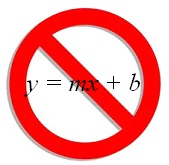
I want to ban all use of the slope-intercept form, y = mx + b, as a method for writing the equation of a line!

The reason is that using the point-slope form to write the equation of a line is much more efficient and quicker. Given a point \left( {{x}_{0}},{{y}_{0}} \right) and the slope, m, it is much easier to substitute into  y={{y}_{0}}+m\left( x-{{x}_{0}} \right) at which point you are done; you have an equation of the line.

Algebra 1 books, for some reason that is beyond my understanding, insist using the slope-intercept method. You begin by substituting the slope into y=mx+b and then substituting the coordinates of the point into the resulting equation, and then solving for b, and then writing the equation all over again, this time with only m and b substituted. It’s an algorithm. Okay, it’s short and easy enough to do, but why bother when you can have the equation in one step?

Where else do you learn the special case (slope-intercept) before, long before, you learn the general case (point-slope)?

Even if you are given the slope and y-intercept, you can write y=b+m\left( x-0 \right).

If for some reason you need the equation in slope-intercept form, you can always “simplify” the point-slope form.

But don’t you need slope-intercept to graph? No, you don’t. Given the point-slope form you can easily identify a point on the line,\left( {{x}_{0}},{{y}_{0}} \right), start there and use the slope to move to another point. That is the same thing you do using the slope-intercept form except you don’t have to keep reminding your kids that the y-intercept, b, is really the point (0, b) and that’s where you start. Then there is the little problem of what do you do if zero is not in the domain of your problem.

Help me. Please talk to your colleagues who teach pre-algebra, Algebra 1, Geometry, Algebra 2 and pre-calculus. Help them get the kids off on the right foot.

Whenever I mention this to AP Calculus teachers they all agree with me. Whenever you grade the AP Calculus exams you see kids starting with y = mx + b and making algebra mistakes finding b.

Show me the Math!

Is God a Mathematician? by Mario Livio begins

When you work in cosmology … one of the facts of life becomes the weekly letter, e-mail, or fax from someone who wants to describe to you his own theory of the universe (yes, they are invariably men). The biggest mistake you can make is to politely answer that you would like to learn more. This immediately results in an endless barrage of messages. So how can you prevent the assault? The particular tactic I found to be quite useful (short of the impolite act of not answering at all) is to point out the true fact that as long as his theory is not precisely formulated in the language of mathematics, it is impossible to assess its relevance. This response stops most amateur cosmologists in their tracks. … Mathematics is the solid scaffolding that holds together any theory of the universe.

Is God a Mathematician? discusses the question of whether mathematics was invented or discovered. Dr. Livio’s other popular books include The Accelerating Universe (cosmology), The Golden Ratio: The Story of Phi, the World’s most Astounding Number, and The Equation that Couldn’t be Solved: How Mathematical Genius Discovered the Language of Symmetry. All are excellent reads for teachers and students. 

Absolutely

Absolute Value

The majority of students learn about absolute value long before high school. That is, they learn a lot of wrong things about absolute value.

  • They learn that “the absolute value of a number is the number without its sign” or some such nonsense. All numbers, except zero have a sign!  This sort of works with numbers, but becomes a problem when variables appear. True or false | x | = x? True or false | –x | = x? Most kids will say they are both true; in fact, as you know, they are both false.
  • They also learn that “the absolute value of a number is its distance from zero on the number line.” True and works for numbers, but what about variables?
  • They learn that “the absolute value of a number is the larger of the number and its opposite.” True again. How do you use it with variables?
  • They learn \left| x \right|=\sqrt{{{x}^{2}}} which is correct, useful for order-of-operation practice, and useful in other ways later, But they still compute \sqrt{{{\left( -3 \right)}^{2}}}=-3 and  \sqrt{{{x}^{2}}}=x since the square and square “cancel each other out.”

So here is a good vertical team topic. Get to those teachers in elementary and middle school and be sure they are not doing any of the above. They should start with the correct definition in words:

  • The absolute value of a negative number is its opposite.
  • The absolute value of a positive number (or zero) number is the same number.

This works all the time and will continue to work all the time. Teaching anything else will eventually require unlearning what they are using, and unlearning is far more difficult than learning.

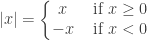
When they start using variables and reading symbols translated into English, then the definition becomes their first piecewise define function:

  • \text{ If }x\ge 0,\text{ then }\ \left| x \right|=x;  and if x<0,\text{ then }\left| x \right|=-x
  • \left| x \right|=\left\{ \begin{matrix} x & \text{ if }x\ge 0 \\ -x & \text{ if }x<0 \\ \end{matrix} \right.

When reading this definition be sure to say “the opposite of the number” not “negative x” which in this case is probably a positive number.

Give variations of the two True-False questions above on every quiz and test until everyone gets it right!

When you see absolute value bars and want to be rid of them the first question to ask is, “Is the argument positive or negative? “Any time there is an absolute value situation, this is the way to proceed.

And yes, this does show up on the AP Calculus exams. Consider \int_{0}^{1}{\left| x-1 \right|dx} which appeared as a multiple-choice question a few years ago. Give it a try before reading on.

On the interval of integration, [0,1], \left( x-1 \right)\le 0 so \left| x-1 \right|=-\left( x-1 \right)

\displaystyle \int_{0}^{1}{\left| x-1 \right|dx}=\int_{0}^{1}{-\left( x-1 \right)}dx=\left. -\tfrac{1}{2}{{x}^{2}}+x \right|_{0}^{1}=-\tfrac{1}{2}+1-0=\tfrac{1}{2}

Now try \displaystyle \int_{0}^{1}{\sqrt{{{x}^{2}}-2x+1}\,dx}, or did we do this one already?

Definitions

Definitions are similar to theorems, but are true in both directions; technically, this means that the statement and its converse are both true (p\leftrightarrow q). The double arrow is read “if, and only if.” Both parts are either true or both parts are false. Definitions usually name some thing or some property.  Definitions are not proved.

The definition of continuity is a good example: A function f is continuous at xa if, and only if, these three things are true

(1)  f\left( a \right) exist (i.e. is a finite number)

(2)  \underset{x\to a}{\mathop{\lim }}\,f\left( x \right) exist (i.e. is a finite number)

(3) \underset{x\to a}{\mathop{\lim }}\,f\left( x \right)=f\left( a \right)  (“The limit equals the value.”)

“Play” with it: consider cases where only 2 of the 3 requirements are true – is the function still continuous? What would happen if you removed the requirements about finite numbers?

To use a theorem, one must be sure all the hypotheses are true. To use a definition, one may say that either part is true once you have established that the other part is true. So, if you know a function is continuous at a point, then the three statements are true; or if you can show the three statements are true, you may say the function is continuous.

Here’s an example: A typical AP problem might give a piecewise defined function and ask if it is continuous at the place where the domain is divided.

To get credit for justifying an answer of “yes”, students must show that all the requirements of the definition are met. Specifically, they must show that the limit as x approaches that point must equal the value of  the function at that point (and both are finite).  In turn, to show that this limit exist the student must show that the hypotheses of the theorem that says if the two one-sided limits are equal to the same number, then that number is the limit.

To get credit for an answer of “no”, the student must show that (only) one of the hypotheses is false.

Finally, as with theorems, express definitions in words. With your students, “play” with the theorem or definition by making changes to the hypotheses and seeing how that affects the conclusion. Look at the graphs. Don’t just state the definition and expect students to understand it, remember it and use it correctly.