Why the Derivative?

You’re now ready to learn about the derivative – one of the two big tools of calculus.

If you graph a function on your calculator and Zoom-In several times at a point on it graph, your graph will eventually look like a straight line. Try it now; pick your favorite function and Zoom in where it looks most curvey. Very close up most functions look like lines. (There are exceptions.) The “slope” of this “line” is the derivative.

A little more precisely, the derivative is the slope of the line tangent to the graph at the point you compute it. It is found by considering a line that intersects the graph at two points and then moving the second point to the first using a limiting process. So, derivatives are always limits.

 The derivative is derived from the function itself. (That’s where the name comes from.)

The difference between the slope of a line and the slope of the curve is this: lines have a constant slope; curves have slopes that change as you move along the graph.

Since the derivative changes as you move along the graph, “derivative” also means the function that gives the derivative (slope) at each point. You will learn how to derive this function from the equation of the curve.

You will often need to write the equations of this tangent line. No, biggie: you have the point and the slope. That’s all you need.

(Hint: Forget slope-intercept! When writing the equation of a line is easiest way is to use the point-slope form, \displaystyle y=f\left( a \right)+{f}'\left( a \right)\left( {x-a} \right) where the point is \displaystyle \left( {a,f\left( a \right)} \right) and the slope is the derivative denoted by \displaystyle {f}'\left( a \right). You only need these three numbers – the two coordinates of a point and the derivative at that point). Drop them into the point-slope equation and you’re done.)

The tangent line is not your geometry teacher’s tangent line. Curves are not circles, so the tangent line may cross the curve at another point, or several other points. Sometimes the tangent line will even cross the curve at the point at the point of tangency!

You will begin by learning how to find the derivative using limits (all derivatives are limits). Then you will learn how to find the derivatives by bypassing the limiting process. That’s a good-news-bad-news thing. The good news is the formulas for finding derivatives make your work very easy and straightforward. The bad news is you’ll have to memorize the formulas. Sorry! Just giving you a heads-up.

Units: Like the slope of a line, the derivative is the instantaneous rate of change of the function at the point you calculate it. Since it is a rate of change, it has rate-of-change units: miles per hour, meters per second, furlongs per fortnight, figs per Newton.

Units are important:


Using the derivative, you will be able to find out useful things about a function. You can find exactly where the function is increasing and decreasing, exactly where it has its extreme values (its maximum and minimum), where it has “problems,” and other things. These in turn lead to practical considerations for the solution of problems in engineering, science, economics, finance, and any field that uses numbers.

Summary: Derivative has several meanings:

  • The slope of the tangent line to the curve, a/k/a “the slope of the curve.”
  • The function that gives the slope at any point.
  • The instantaneous rate of change of the of the dependent variable (y) with respect to the independent variable (x). Therefore, its units are the units of y divided by the units of x.

Derivatives are important and useful. So, let’s drive ahead.


Course and Exam Description Unit 2 topics 2.1 to 2.4

Good Question 18: 2018 BC 2(b)

In this post we look at another part of the AP Calculus BC exam. Good Question 15 discussed the unusual units in 2018 BC 2(a). In this post we look at 2018 BC 2(b) where units help us find the correct integral to answer the question.

How do you answer a question of a type you’ve never seen before? I expect that’s what many of the students taking the 2018 AP Calculus exam were asking when they got to BC 5. If you’ve never done a density question how do you handle this one? 

The question concerns density. Density gives you how much of something exists in a certain length, area, or volume.  Density questions have appeared on the exam now and then, most recently 2008 AB 92 (which really isn’t recent, but then there are a lot of questions we never see). I have a blog post about the density here with several examples. In that post the alternate solution to example 3 explained how I used a unit analysis to find the answer; I used a similar approach here.

2018 BC 2 (b)

The stem of the question tells us that at a depth of meters, 0 < h < 30, the number of plankton in a cubic meter of sea water is modeled by p\left( h \right)=0.2{{h}^{2}}{{e}^{{-0.0025{{h}^{2}}}}} million cells per cubic meter. Part (b) asks for the number of million of plankton in a column of water whose horizontal cross sections have a constant area of 3 square meters.

If the density were constant, then it is just a matter of multiplying the volume of the column times the constant density. Alas, the density is not constant; it varies with the depth. What to do?

Since an amount is asked for, you usually look around for a rate to integrate. Density is a kind of rate: the units are millions of cells per cubic meter. You need to integrate something concerning the density so that you end up with millions of cells; something that will “cancel” the cubic meters.

Consider a horizontal slice thru the column at depth h meters. While I’m not sure plankton is a good topping for pizza, you could picture this as a rather large pizza box whose sides are \sqrt{3} meters long and whose height is  \Delta h meters. This box has a volume of 3 \Delta h cubic meters. For small values of \Delta h the number of million plankton in the box is nearly constant, so at depth hi , there are p(hi) million plankton per cubic meter or {3p\left( {{{h}_{i}}} \right)\Delta h} million plankton in the box.

Notice how the units of the individual quantities combine to assure you the final quantity has the correct units:

\displaystyle (3\text{ square meters)}\cdot \left( {p\left( {{{h}_{i}}} \right)\text{ }\frac{{\text{million plankton}}}{{\text{cubic meters}}}} \right)\left( {\Delta h\text{ meters}} \right)=3p\left( {{{h}_{i}}} \right)\Delta h\text{ million plankton}

Now to find the amount in the column of water we can add up a stack of “pizza boxes.” The sum is \sum\limits_{{i=1}}^{n}{{3p\left( {{{h}_{i}}} \right)\Delta h}}. Now, if we take thinner boxes by letting \Delta h\to 0, we are looking at a Riemann sum. And calculus gives us the answer.

\displaystyle \underset{{n\to \infty }}{\mathop{{\lim }}}\,\sum\limits_{{i=1}}^{n}{{3p\left( {{{h}_{i}}} \right)\Delta h}}=\int_{0}^{{30}}{{3p\left( h \right)dh}}\approx 1,675 million plankton in the column of water (rounded to the nearest million as directed in the question.)


Previous Good Questions can be found under the “Thru the Year” tab on the black navigation bar at the top of the page, or here.


Renumbered 3-14-24 Was Question 16.

Good Question 15: 2018 BC 2(a)

My choices for the Good Question series are somewhat eclectic. Some are chosen because they are good, some because they are bad, some because I learned something from them, some because they can be extended, and some because they can illustrate some point of mathematics. This question and the next, Good Question 16, are in the latter group. They both concern units. They both are taken from this year’s AP calculus BC exam; both are suitable for AB classes. In this question 2018 BC 2(a) has some unusual units and in the next 2018 BC 2(b) the units help you figure out what to do. Part (c) concerns an improper integral and pard (d) is about parametric equation, neither of these are AB topics. 

2018 BC 2(a)

2018 BC 2 gave an equation that modeled the density p(h) of plankton in a sea in units of millions of cells per cubic meter, as a function of the depth, h, in meters.  Specifically, p\left( h \right)=0.2{{h}^{2}}{{e}^{{-0.0025{{h}^{2}}}}} for 0\le h\le 30. Part (a) asked for the value of {p}'\left( {25} \right) and also asked students “Using correct units, [to] interpret the meaning of {p}'\left( {25} \right) in the context of the problem.”

Plankton

This was a calculator active question, so the computation is easy enough: {p}'\left( {25} \right)=-1.17906

Now units of the derivative are always very easy to determine; this should be automatic. The derivative is the limit of a difference quotient, so its units are the units of the numerator divided by the units of the denominator. In this case that’s millions of cells per cubic meter per meter of depth.

While “millions of cells per meter to the fourth power” is technically correct and will probably earn credit, what is a meter to the fourth power?

It is similar to the better-known situation with velocity and acceleration. I never liked the idea of saying the acceleration is so many meters per square second. What’s a square second? Are there round seconds? Acceleration is the change in velocity in meters per second per second; that is, at a particular time the velocity is changing at the rate of so-many meters per second each second

Returning to the question, a cubic meter (volume) and a meter of depth (linear) are not things that you should combine. The notational convenience of writing meters to the fourth power hides the true meaning. So, a better interpretation is “At depth of  25 meters, the number cells is decreasing at the rate of 1.179 million cells per cubic meter per meter of depth.” or “The number of cells changing at the rate of -1.179 million cells per cubic meter per meter of depth.”

Had the model been given using volume units such as millions of cells per liter, then the units of the derivative would be millions of cells per liter per meter. That makes more sense.

But what does it mean?

Let’s look at the graph of the derivative. The window is 0 < h < 30 and –2.5 < p(x) < 2.5

It means, that as we pass thru that thin (thickness \Delta h\to 0) film of water 25 meters down, there are approximately 1.179 million cells per cubic meter less than in the thin film right above it and more than in the thin film right below it.

For reference, p\left( {25} \right)\approx 26.2014 million cells per cubic meter. Of course, that thin (thickness \Delta h\to 0) film of water has very little volume; it is kind of difficult to think of a cubic meter exactly 25 meters below the surface (maybe a cube extending from 24.5 meters to 25.5 meters?). As \Delta h\to 0 does a cubic meter approach a square meter?

The cubic meter above h = 25 has \displaystyle \int_{{24}}^{{25}}{{p\left( h \right)(1)dh}}=26.763 cells and the cubic meter below has 25.586 million cells. This is a decrease of 1.1767 million cells. So, the derivative is reasonable.
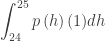
(To make the units of \displaystyle \int_{{24}}^{{25}}{{p\left( h \right)(1)dh}} correct, I included a factor of 1 square meter, this multiplied by p(h) million cells per cubic meter and by dh in meters give a result of millions of cells. More on why this is necessary in Good Question 16 on density.)


Previous Good Questions can be found under the “Thru the Year” tab on the black navigation bar at the top of the page, or here.