Why the Derivative?

You’re now ready to learn about the derivative – one of the two big tools of calculus.

If you graph a function on your calculator and Zoom-In several times at a point on it graph, your graph will eventually look like a straight line. Try it now; pick your favorite function and Zoom in where it looks most curvey. Very close up most functions look like lines. (There are exceptions.) The “slope” of this “line” is the derivative.

A little more precisely, the derivative is the slope of the line tangent to the graph at the point you compute it. It is found by considering a line that intersects the graph at two points and then moving the second point to the first using a limiting process. So, derivatives are always limits.

 The derivative is derived from the function itself. (That’s where the name comes from.)

The difference between the slope of a line and the slope of the curve is this: lines have a constant slope; curves have slopes that change as you move along the graph.

Since the derivative changes as you move along the graph, “derivative” also means the function that gives the derivative (slope) at each point. You will learn how to derive this function from the equation of the curve.

You will often need to write the equations of this tangent line. No, biggie: you have the point and the slope. That’s all you need.

(Hint: Forget slope-intercept! When writing the equation of a line is easiest way is to use the point-slope form, \displaystyle y=f\left( a \right)+{f}'\left( a \right)\left( {x-a} \right) where the point is \displaystyle \left( {a,f\left( a \right)} \right) and the slope is the derivative denoted by \displaystyle {f}'\left( a \right). You only need these three numbers – the two coordinates of a point and the derivative at that point). Drop them into the point-slope equation and you’re done.)

The tangent line is not your geometry teacher’s tangent line. Curves are not circles, so the tangent line may cross the curve at another point, or several other points. Sometimes the tangent line will even cross the curve at the point at the point of tangency!

You will begin by learning how to find the derivative using limits (all derivatives are limits). Then you will learn how to find the derivatives by bypassing the limiting process. That’s a good-news-bad-news thing. The good news is the formulas for finding derivatives make your work very easy and straightforward. The bad news is you’ll have to memorize the formulas. Sorry! Just giving you a heads-up.

Units: Like the slope of a line, the derivative is the instantaneous rate of change of the function at the point you calculate it. Since it is a rate of change, it has rate-of-change units: miles per hour, meters per second, furlongs per fortnight, figs per Newton.

Units are important:


Using the derivative, you will be able to find out useful things about a function. You can find exactly where the function is increasing and decreasing, exactly where it has its extreme values (its maximum and minimum), where it has “problems,” and other things. These in turn lead to practical considerations for the solution of problems in engineering, science, economics, finance, and any field that uses numbers.

Summary: Derivative has several meanings:

  • The slope of the tangent line to the curve, a/k/a “the slope of the curve.”
  • The function that gives the slope at any point.
  • The instantaneous rate of change of the of the dependent variable (y) with respect to the independent variable (x). Therefore, its units are the units of y divided by the units of x.

Derivatives are important and useful. So, let’s drive ahead.


Course and Exam Description Unit 2 topics 2.1 to 2.4
Why Continuity?

We would like to study nice well-behaved functions; functions that are smooth and that don’t do strange things. Yeah, well good luck with that.

One of the things that might be nice is that you could draw the graph of a function from one end of its domain to the other without taking your pen off the paper. And a lot of functions are like that, but not all.

Some functions have holes in them, others jump from one y-value to another without hitting points in between. Some “go off to infinity” and come right back; others go off the top of the graph and come back from the bottom. Some go really crazy around a point.  

Functions that you can draw from one end of their domain to the other without lifting your pen are said to be continuous.

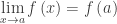
More mathematically: A function is continuous at a point (that is, at a single value of x) if, and only if, as you travel along the graph towards the value (from either side of the x-value), the -values on the graph are approaching the ­y­-value at the point. In symbols:  \displaystyle \underset{{x\to a}}{\mathop{{\lim }}}\,f\left( x \right)=f\left( a \right).

A function is continuous on an interval if, and only if, it is continuous at every value in the interval.

Wait! What?? I have to check all the points??

Technically, yes; practically, no. Most of the time you can easily show that a function is continuous everywhere by looking at its limit in general.

Moreover, you will learn to see where a function is not continuous. This is an important skill: looking at a function and suspecting there is a problem with continuity.

Take a quick look at some of the problems that functions may have at a point. Graph these on your calculator. They all have a “problem” at x = 3. Graph each example and you will see what they look like. Try to figure out why they have a “problem” and what causes it.  

  •  \displaystyle f\left( x \right)=\frac{1}{{x-3}}.
  •  \displaystyle g\left( x \right)=\frac{1}{{{{{\left( {x-3} \right)}}^{2}}}}
  • \displaystyle h\left( x \right)=\frac{{{{x}^{2}}-3x}}{{x-3}}. This function has a single hole in the graph at (3, 3); It one may be difficult to see. Try using ZDecimal. A single point is missing because there is no value at x= 3 because the denominator is zero.
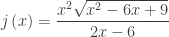
  •  \displaystyle j\left( x \right)=\frac{{{{x}^{2}}\sqrt{{{{x}^{2}}-6x+9}}}}{{2x-6}}.
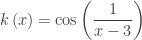
  • \displaystyle k\left( x \right)=\cos \left( {\frac{1}{{x-3}}} \right) Zoom in several times at (3, 0) where the function has no value.
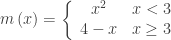
  • \displaystyle m\left( x \right)=\left\{ {\begin{array}{*{20}{c}} {{{x}^{2}}} & {x<3} \\ {4-x} & {x\ge 3} \end{array}} \right.

Learn to suspect that a function may have a discontinuity. (It’s not always at x = 3) The problem is often a zero denominator.

This is not just a game or some curious functions. One of the main tools of calculus called the derivative, which you will study next, is defined as the limit of a special function which is never continuous at the point you are interested in.

So, let’s continue on to continuity.


AP Calculus Course and Exam Description

Unit 1 topics 1-10 – 1.16, Unit 2 topic 2.4

Why Infinity?

First, right from the start: Infinity is NOT a number.

Lots of folks think of infinity as the largest number possible, greater than anything else. That’s understandable because infinity, denoted by the symbol \displaystyle \infty , is often used that way by those unlucky folks who don’t understand mathematics.

We’ll start with an example: Consider the fraction \displaystyle \frac{1}{{{{{\left( {x-3} \right)}}^{2}}}}. This fraction has no value when x = 3 because there the denominator is zero. And you cannot divide by zero. Nothing personal, no one, no matter how smart, can divide by zero. Ever.  Permanently and forever not allowed. Don’t even think about it! (Actually, think about it; just don’t do it.)

What you should say in such cases is that the expression has no value, or is “undefined,” or “the limit does not exist,” abbreviated DNE.

In situations like the example we say, “the limit of the fraction as x approaches 3 equals infinity,” abbreviated  \displaystyle \underset{{x\to 3}}{\mathop{{\lim }}}\,\frac{1}{{{{{\left( {x-3} \right)}}^{2}}}}=\infty . This means that the expression gets larger as x gets closer to three. The expression will be greater than any (large) number you want, if you are close enough to three.

You don’t believe me? Okay pick a large number, maybe \displaystyle {{10}^{8}}. I say pick any value for x between 2.9999 and 3.0001 (\displaystyle 3-{{10}^{{-4}}}<x<3+{{10}^{4}}) and the expression will be larger than \displaystyle {{10}^{8}}. Try it on your calculator.

How about \displaystyle {{10}^{{20}}}? Try a number between 2.9999999999 and 3.0000000001. I can play this game all day.

Try graphing the \displaystyle y=\frac{1}{{{{{\left( {x-3} \right)}}^{2}}}} on your calculator. (Hint: Whenever you come across something like this, it is a great idea to graph the expression on your graphing calculator. Graphs can help you see what’s going on. Keep that in mind for the future.)

That’s the way to think about infinity: Infinity is what you say when you’re working with an expression that grows greater than any number you choose.

You may also use infinity to say what happens all the way to the left or right of the graph, its end behavior. The variable, x, may “approach infinity,” that is x moves further to the right (or is greater than any number you choose) the fraction above gets closer to zero: \displaystyle \underset{{x\to \infty }}{\mathop{{\lim }}}\,\frac{1}{{{{{\left( {x-3} \right)}}^{2}}}}=0.

You may not do arithmetic with infinity.

\displaystyle \infty +\infty \ne 2\infty

\displaystyle \infty -\infty \ne 0

Arithmetic is for numbers.

You will see a number of expressions whose limit is equal to infinity, like \displaystyle \underset{{x\to 3}}{\mathop{{\lim }}}\,\frac{1}{{{{{\left( {x-3} \right)}}^{2}}}}=\infty . Which really means, just what we saw above: that as you (not “you” but x) get closer to 3, the value of the expression will be greater than any number you pick. The \displaystyle \infty symbol is a shorthand way of saying this.

The opposite of infinity, \displaystyle -\infty , sometimes called “negative infinity,” means that the expression gets less than (i.e. more negative), than any negative number you choose.

Even though the expression has no limit, you are allowed to say the limit equals infinity. That’s funny when you think about it. It might be better if everyone said “undefined” or DNE, but they don’t. What can I say?

A word of warning: You may only say “equals infinity” is situations like the example above.

There are other similar expressions that have no limit where it is incorrect to say the limit equals infinity. For example,

  • \displaystyle \frac{{\left| x \right|}}{x} has no value, is “undefined,” when x = 0, but \displaystyle \underset{{x\to 0}}{\mathop{{\lim }}}\,\frac{{\left| x \right|}}{x}\ne \infty . (Hint: this is where you should look at a graph on your graphing calculator to see why.)
  • \displaystyle \underset{{x\to 3}}{\mathop{{\lim }}}\,\frac{1}{{\left( {x-3} \right)}} does not exist. This is very similar to the first example but look at the graph and you’ll see a big difference.
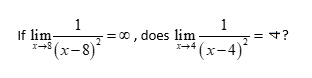
So, good luck and enjoy your limitless journey through the infinite reaches of calculus. (Oh, wait! Can I say that?)

Finally,


Course and Exam Description Unit 1 topics 1.3, 1.14, 1.5 and others.

Why Limits?

Welcome to AP Calculus.

Your journey into calculus starts with the topic of limits. Why? Because limits make calculus work. The two big things in calculus are called the derivative and the definite integral; both are limits.  

The first use of limits will be when you study continuity. A continuous function is one, roughly speaking, whose graph can be drawn without taking your pen off the paper. Limits will make this concept firm mathematically.

After that, if you flip through your book, you won’t see that many limits after the limit chapter. You will see derivatives and definite integrals – they are limits under a different name.

Notation: There is a new notation to learn for limits. It looks like this \displaystyle \underset{{x\to 6}}{\mathop{{\lim }}}\,\sin \left( {\tfrac{\pi }{x}} \right)=\tfrac{1}{2}. This is read, “The limit as x approaches 6 of the sine of π divided by 6 equals ½.”

You will start by finding the limits of various functions. Sometimes the limit is easy to find – just substitute the number x is approaching into the (that’s what happened above); what you get is the limit. If a limit exists, it is a number. If you get a number by substituting, usually that’s the limit – end of problem.

But other times you get expressions that are not numbers when you substitute (like maybe you end up trying to divide by zero). In that case, you will need to do some sort of algebraic or trigonometric simplification. Your teacher will help you learn the “tricks” involved. Derivatives and the definite integral are both limits involving dividing by zero.

Some limits may not exist at all; in this case, you say, “Does not exist” or “DNE.” Others do not exist, but we say they are “equal to infinity.” Infinity will be the subject of the next post in this series.

As you learn to find limits, look for patterns. The limits of similar looking expressions are often found in similar ways.

One good way to see what a limit is, or is not, is to graph the expression. Use your graphing calculator.

Your calculator may “misinform” you sometimes! But even that is a help. (Hint: when your calculator does misinform you, about limits or anything else, that’s a time to look deeper into the situation: something interesting is going on.)

Producing a table of values (on your calculator) can often help you see what’s happening, as well.  (Hint: while tables are useful, what happens between the values in the table is not always clear; that’s where the trouble may be.)

The first thing you will use limits for is to investigate continuity. When limits do not exist, continuity is usually the problem. Continuity will be the subject of a later post.

So, get ready for your trip through calculus: it’s an unlimited journey.


The next post in this series, “Why Infinity?”, will appear on Friday August 25, 2023.


Course and Exam Description: Unit 1 all topics

Starting the Year

As you get ready to start school, here are some thoughts on the first week in AP Calculus. I looked back recently at several of the “first week of school” advice posts I offered in the past. Here’s a summary with some new ideas.

  • DON’T REVIEW! Yes, students have forgotten everything they ever learned in mathematics, but if you reteach it now, they will forget it again by the time they need it next week or next January. So, don’t waste the time, rather, plan to review material from kindergarten through pre-calculus when the topics come up during the year. Plan for short reviews. For instance, when you study limits, you will need to simplify rational expressions – that’s when you review rational expressions. Months from now you’ll be looking at inverse functions, that’s when you review inverses.
  • Make a copy of the “Mathematical Practices” and the “Course at a Glance” from the Current AP Calculus Course and Exam Description (p. 14 and p. 20 – 23) and give them to your students. Check off the topics as you do them during the year. Or give them the more detailed Unit Guide (e.g., p. 32 – 33 for Unit 1 Limits) as you start each unit. Either way, have your students check off the topics (1) as you teach them and (2) when they understand them.
  • In keeping with Unit 1 Topic 1, you may want to start with a brief introduction to calculus. Several years ago, when I first started this blog, Paul A. Foerster, was nice enough to share some preview problems. They give a taste of derivatives and integrals in the first week of school and get the kids into calculus right off the bat. Here is an updated version. Paul, who retired a few years ago after 50 (!) years of teaching, is Teacher Emeritus of Mathematics of Alamo High Heights School in San Antonio, Texas. He is the author of several textbooks including Calculus: Concepts and Applications. More information about the text and accompanying explorations can be found on the first page of the explorations. Thank you, Paul!
  • If you are not already a member, I suggest you join the AP Calculus Community. We have over 23,000 members all interested in AP Calculus. The community has an active bulletin board where you can ask and answer questions about the courses. Questions often ask how to better teach a topic – get hints and share your ideas. Teachers and the College Board post resources for you. College Board official announcements are also posted here. I moderate of the community, and I hope to see you there!
  • If you haven’t done so already, read your Instructional Planning Report (IPR). Especially helpful will by the comparison of your classes mean scores with the state and global mean scores for each question. If yours are higher great; if lower, that’s where you might need to do something different.

This blog has been written with teachers in mind. Students are always welcome to read it. You may give links to any of the posts you think your class may be interested in.

This year I plan to write a new series of posts especially for students. It will be called “The Why Series.” The inspiration was Why Radians, one of my most read posts. The posts will be short pieces introducing units and parts of units that (I hope) will explain why the topic is important, where the topic is leading. The first post “Why Limits” will appear soon.