A Problem with 4 Solutions and 2 Morals

A friend of mine e-mailed me yesterday with a question: Her class was using the Law of Cosines and came up with a solution of \sqrt{8-4\sqrt{3}}, but the “correct” answer was \sqrt{2}\left( \sqrt{3}-1 \right). She wanted to know, having gotten the first answer, how do you get to the second from it. The answers are equivalent: radical I figured it out this way

\sqrt{8-4\sqrt{3}}=\sqrt{6-4\sqrt{3}+2}=\sqrt{{{\left( \sqrt{6}-\sqrt{2} \right)}^{2}}}=\left| \sqrt{6}-\sqrt{2} \right|=\sqrt{2}\left( \sqrt{3}-1 \right)

But in fact, I had worked that from the second back to the first. So I sent the problem to another friend who sent this back: radical 5 This is a more formal way of what I did. (The solution k = 6 gives the same expression.) But the real question is how is a student supposed to know any of this? My friend wrote, “This problem seems really complicated for multiple=choice.  Remember that this is what we had to do AFTER we had done law of cosines to get to that first step.” I agree. Then I asked her for the original problem, which is what I should have done in the first place. The original problem was to find the base of an isosceles triangle with a vertex angle of 30o and congruent sides of 2. Well that’s a whole different story:  radical 3 x=2\cos \left( 75 \right)=2\cos \left( 45+30 \right) x=2\left( \cos (45)\cos (30)-\sin (45)\sin (30) \right) x=2\left( \left( \frac{\sqrt{2}}{2} \right)\left( \frac{\sqrt{3}}{2} \right)-\left( \frac{\sqrt{2}}{2} \right)\left( \frac{1}{2} \right) \right) Base=2x=\sqrt{6}-\sqrt{2} And also x=2\sin \left( 15 \right)=2\sin \left( 45-30 \right) works the same way. But there is yet another way: we could draw a different perpendicular and get a 30-60-90 triangle (not to scale): radical 4b Then using the Pythagorean Theorem on the lower triangle: base=\sqrt{{{\left( 2-\sqrt{3} \right)}^{2}}+{{1}^{2}}}=\sqrt{\left( 4-4\sqrt{3}+3 \right)+1}=\sqrt{8-4\sqrt{3}}

The morals of the story:

  • First as we have all discovered, when a student asks, “What do I do now?” or “How can I get from here to here?” Go back to the original question. Do not jump in the middle and answer the wrong question.
  • Second, while I am definitely not against multiple-choice problems, this is a horrible multiple-choice question. It is horrible because there are so many good ways to do it, but they lead to different looking answers. Students should not be penalized for doing good mathematics. It is fine to require a student to do a problem by a certain method if you are currently teaching that method. But with no method specified, the students should not get a correct answer and then have to really struggle to get your answer. On the other hand, this is a very good questions, precisely because there are so many ways to do it and because the answers look different.

My Favorite Function

My favorite function is f\left( x \right)=\sin \left( \ln \left( x \right) \right). I like to ask folks how many zeros this function has on the interval 0<x\le 1.

Most folks will get their calculator out and graph the function on the interval

Fav 1

Two zeros: one at 1 and the other about 0.05 more or less.

So then I suggest they look at 0<x\le 0.1. This is the left 10% of the first window.

Fav 2

Sure enough there is the zero near 0.05 but there is another near 0

So another window 0<x\le 0.01

Fav 3

Pretty soon they get the idea. Every time we stretch out the graph, there are more roots.

What is going on? The first thing is that this is not a question to be answered on a graphing calculator, the nice graphs notwithstanding.

So try to solve it by hand. Since \sin \left( x \right)=0 for x=k\pi  where k is an integer, we need to see when \ln \left( x \right)=k\pi . That will be when \displaystyle x={{e}^{k\pi }}. And since our domain is proper fractions it must be that k\le 0. So the zeros are infinite in number, namely \displaystyle x={{e}^{0}},{{e}^{-\pi }},{{e}^{-2\pi }},{{e}^{-3\pi }},\cdots . Which answers the original question but raises others.

Why can’t we see the zeros on the graph?

This is not a calculator glitch; in fact computers can do no better. Each root is the next largest root divided by \displaystyle {{e}^{\pi }}\approx 23. So each root is about \displaystyle \tfrac{1}{23}of the larger next root.

The calculator screen is made up of pixels. The number you choose for xmin is the center of the column of pixels; the number you choose for xmax is the center of the right-most column of pixels. The distance between the two ends is divided and assigned evenly to the centers of the other columns of pixels. The y-coordinates of the pixels are calculated the same way. The calculator evaluates the function at each pixel value and turns on the pixel in that column closest to (rarely at) the function’s value. A lot can go on between the pixels and the graphing calculator and its operator will not see what is happening there.

In this example, all the missing roots are between the first and second pixels on the left! When you change xmax to see the left 10% of the screen you see one and every now and then two roots, but the rest are still between the two pixels on the left.

Would a wider screen help? Perhaps a little, but not much.

Here’s a good exercise for a class: Suppose you could print the graph on a paper 1 mile (5280 feet) wide with the root at x = 1 on the right edge. Where would the next several roots be?

  •  \displaystyle {{e}^{-\pi }} is 228.169 feet from the left edge
  •  \displaystyle {{e}^{-2\pi }} is 9.860 feet from the left edge
  •  \displaystyle {{e}^{-3\pi }} is 0.426 feet or 5.113 inches from the left edge
  •  \displaystyle {{e}^{-4\pi }} is 0.221 inches from the left edge (less than ¼ inch)
  • And all the remaining roots are within 0.00955 inches from the left edge.

If the paper stretched from the earth to the sun you could see a few more. At 93,000,000 miles, the zero at \displaystyle {{e}^{-10\pi }} is about 0.134 inches from the edge.

So why do I like this problem?

Look at all the math we did.

  • We learned that graphing is not always the path to the answer.
  • We learned how calculators choose the points they graph, and which they miss.
  • We practiced how to solve a trig equation.
  • We practiced how to solve a natural logarithm equation.
  • We consider the actual size of the negative powers of e and saw how they got exponentially smaller.
  • We did a practical problem in scaling to illustrate how fast the numbers diminish.

Why do I like this function?

What’s not to like?

Update (February 7, 2015) Chip Rollinson made this cool Geogebra applet to illustrate My Favorite Function. Use the slider on the screen and notice the x-axis scale as it changes. Thank you, Chip. 


Absolute Value

The answers to the True-False quiz at the end of the last post are all false. This brings us to absolute value, another topic I want to concentrate on for my upcoming Algebra 1 class. Absolute value becomes a concern in calculus too which I will discuss as the last example below.

There a several “definitions” of absolute value that I’ve seen over the years which I mostly do not like

  • The number without a sign – awful: all numbers except zero have a sign
  • The distance from zero on the number line – true, but not too useful especially with variables
  • The larger of a number and its opposite – true, but not to useful with variables

So I propose to give them an algorithm: If the number is positive, then the absolute value is the same number; if the number is negative, then its absolute value is its opposite. Of course, this is really the definition.

So I’ll soon express this in symbols

\left| a \right|=\left\{ \begin{matrix} a & \text{if }a\ge 0 \\ -a & \text{if }a<0 \\ \end{matrix} \right.

Now interestingly this is probably the first piecewise defined function an Algebra 1 student may see, or at least the first one that’s not artificial.  So this is a good place to start talking about piecewise defined function and the importance of talking about the domain. And of course, we’ll have to take a look at the graph.

Sometimes we will have to start solving equations and inequalities with absolute values. So here is the next thing I understand but do not like and will try to avoid. Solve the equation: \left| x \right|=3 , Answer including work: x=\pm 3. But I think a longer way around is also better:

If x<0 then \left| x \right|=-x=3 so x=-3 or if x>0, then \left| x \right|=x=3 Solution: x=3 or x=-3.

Longer? Sure. I hope that by making the students write that a few times that when they get to solving  \left| x \right|>3 that it will be natural to say

If  x<0 then \left| x \right|=-x>3  so x<-3 or if x>0, then \left| x \right|=x>3 Solution:  x<-3 or x>3

The last case may take a little more discussion. Solve \left| x \right|<3. Starting the same way

If x<0 then \left| x \right|=-x<3 so x>-3 which really means -3<x<0

if x>0, then \left| x \right|=x<3 which really means 0\le x<3 . Then the union of these two sets looks like an intersection. The solution is -3<x<3

Quite often the equation and the two types of inequalities are treated as separate problems: with = you go with \pm  on the other side, with > you have a union pointing away from the origin and with < you have somehow an intersection.  Who needs to remember all that when this idea works all the time?

Example:  Solve \left| 4x-10 \right|<8

If 4x-10<0, then x<\tfrac{5}{2} and \left| 4x-10 \right|=-\left( 4x-10 \right)=-4x+10<8, so -4x<-2 and x>\tfrac{1}{2} or more precisely  \tfrac{1}{2}  If latex 4x-10\ge 0$, then x\ge \tfrac{5}{2}  and \left| 4x-10 \right|=4x-10<8, so 4x<18 and x<\tfrac{9}{2} or more precisely \tfrac{5}{2}<x<\tfrac{9}{2}. The union again becomes an intersection and the answer is \tfrac{1}{2}<x<\tfrac{9}{2}

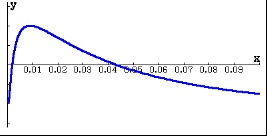
Finally an example from calculus. On the 2008 AB exam, question 5 asked student to find the particular solution of a differential equation with the initial condition f\left( 2 \right)=0. After separating the variables, integrating, including the “+C” and substituting the initial condition students arrived at this equation which they now need to solve for y:

 \displaystyle \left| y-1 \right|={{e}^{\tfrac{1}{2}-\tfrac{1}{x}}}

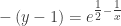
How can you lose the absolute value sign? Simple, near the initial condition where y = 0,  \left( y-1 \right)<0 so replace \left| y-1 \right| with -\left( y-1 \right) and then go ahead and solve for y

 \displaystyle -\left( y-1 \right)={{e}^{\tfrac{1}{2}-\tfrac{1}{x}}}

\displaystyle y=1-{{e}^{\tfrac{1}{2}-\tfrac{1}{x}}}

I don’t think I’ll try this one in Algebra 1, but maybe it will come in handy when they get to calculus.

The Opposite of Negative

Next year, for the first time in 15 years, I am going to be teaching high school full-time. While I have enjoyed writing and working primarily with teachers for the last 15 years, I’m looking forward to “going back to the classroom” as they say. It looks like I’ll be teaching BC calculus and Algebra 1 – two of my favorite classes. I’m very positive about that.

With that in mind I have been thinking of some of the things I want to be sure I get right in the Algebra 1 classes to get the kids off to a good start. So a few of my blogs in the coming year may be on Algebra 1 topics with the view of having students do things right from the start and not having to relearn things when they get to calculus.

So here is the first thing I want to be sure to work on: the m-dash also known as the minus sign.

According to Wikipedia:

The minus sign () has three main uses in mathematics:

  1. The subtraction operator: A binary operator to indicate the operation of subtraction, as in 5 − 3 = 2. Subtraction is the inverse of addition.
  2. Directly in front of a number and when it is not a subtraction operator it means a negative number. For instance −5 is negative 5.
  3. unary operator that acts as an instruction to replace the operand by its opposite. For example, if x is 3, then −x is −3, but if x is −3, then −x is 3. Similarly, −(−2) is equal to 2.

Using the same symbol understandably can confuse beginning math students. I am not going to invent new symbols so I will just have to be careful with what I say and let the kids say. And I have to say it right , if I expect them to.

When used between two numbers or two expressions with variables the symbol means subtraction. That’s pretty easy to spot and understand in context.  But when used alone in front of something the minus sign means different things.

The m-dash may always be read “opposite.” So “–a” is read “the opposite of a” and not “negative a.”  Likewise, –5 is read “the opposite of five.”

There is only one instance where the m-dash may be read “negative.” When it is used in front of a number it indicates a negative number so      “–5” is also correctly read “negative five.” This is the only time the m-dash should be read “negative.”  Things like “–a” should always be read “the opposite of a” and never read “negative a.”

There was a time when the folks who write math books tried to make the distinction by using a slightly raised dash to indicate negative number so negative 3 was written  “3.” This has carried over into calculators where the key marked “(–)” is used for “negative” and “opposite.” and is printed on the screen as a shorter and slightly raised dash. The subtraction key is only used for subtraction.

Oh, if it were only that simple. What do you do with –(–5)? Not really a problem the “opposite of the opposite of 5” and the “opposite of negative 5” are both 5.

I’ll know I’ve succeeded when everyone can get 100% on this little True-False quiz:

  1. The opposite of a number is a negative.
  2. x < 0
  3. x > 0
  4. | x | = x
  5. |– x |= x

Answers are in my next post.


Revised 10-27-2018

Theorems and Axioms

Continuing with some thoughts on helping students read math books, we will now look at the main things we find in them in addition to definitions which we discussed previously: theorems and axioms.

An implication is a sentence in the form IF (one or more things are true), THEN (something else is true). The IF part gives a list of requirements, so to speak, and when the requirements are all met we can be sure the THEN part is true. The fancy name for the IF part is hypothesis; the THEN part is called the conclusion.

Implications are sometimes referred to as conditional statements – the conclusion is true based on the conditions in the hypothesis.

An example from calculus: If a function is differentiable at a point, then it is continuous at that point. The hypothesis is “a function is differentiable at a point”, the conclusion is “the function is continuous at that point.”

This is often shortened to, “Differentiability implies continuity.” Many implications are shortened to make them easier to remember or just to make the English flow better. When students get a new idea in a shortened form, they should be sure to restate it so that the IF part and the THEN part are clear to them. Don’t let them skip this.

Related to any implication are three other implications. The 4 related implications are:

  1. The original implication: if p, then q.
  2. The converse is formed by interchanging the hypothesis and the conclusion of the original implication: if q, then p. Even if the implication is true, the converse may be either true or false. For example, the converse of the example above, if a function is continuous then it is differentiable, is false.
  3. The inverse is formed by negating both the hypothesis and the conclusion: if  p is false, then q is false. For our example: if a function is not differentiable, then it is not continuous. As with the converse, the inverse may be either true or false. The example is false.
  4. Finally, the contrapositive is formed by negating both the original hypothesis and conclusion and interchanging them, if q is false, then p is false. For our example the contrapositive is “If a function is not continuous at a point, then it is it is not differentiable there.” This is true, and it turns out a useful. One of the quickest ways of determining that a function is not differentiable is to show that it is not continuous. Another example is a theorem that say if an infinite series, an, converges, then \displaystyle \underset{n\to \infty }{\mathop{\lim }}\,{{a}_{n}}=0. This is most often used in the contrapositive form when we find a series for which  \displaystyle \underset{n\to \infty }{\mathop{\lim }}\,{{a}_{n}}\ne 0; we immediately know that it does not converge (called the nth-term test for divergence).

The original statement and its contrapositive are both true or both false. Likewise, the converse and the inverse are both true or both false.

Any of the 4 types of statements could be taken as the original and the others renamed accordingly. For example, the original implication is the converse of the converse; the contrapositive of the inverse is the converse, and so on.

Definitions are implications for which the statement and its converse are both true. This is the real meaning of the reversibility of definitions. For this reason, definitions are sometimes called bi-conditional statements.

Axioms and Theorems

There are two kinds of if …, then… statements, axioms (also called assumptions or postulates) and theorems. Theorems can be proved to be true; axioms are assumed to be true without proof. A proof is a chain of reasoning starting from axioms, definitions, and/or previously proved theorems that convince us that the theorem is true. (More on proof in a future post.)

It would be great if everything could be proved, but how can you prove the first few theorems? Thus, mathematical reasoning starts with (a few carefully chosen) axioms and accepts them as true without proof. Everything else should be proved. If you can prove it, it should not be an axiom.

Theorems abound. All of the important ideas, concepts, “laws” and formulas of calculus are theorems.  You will probably see few, if any, axioms in a calculus book, since they came long before in the study of algebra and geometry.

Learning Theorems

When teaching students and helping them read and understand their textbook, it is important that they understand what a theorem is and how it works. They should understand what the hypothesis and conclusion are and how they relate to each other. They should understand how to check that the parts of the hypothesis are all true about the function or situation under consideration, before they can be sure the conclusion is true.

For the AP teachers this kind of thing is tested on the exams. See 2005 AB-5/BC-5 part d, or 2007 AB-3 parts a and b (which literally almost no one got correct). These questions can be used as models for making up your own questions of other theorems.

Definitions 2

In helping students read and understand mathematics knowing about definitions, axioms (aka assumptions, postulates) and theorems. By this I mean knowing the parts of a definition or theorem and how they relate to each other should increase the students’ understanding. Today I’ll discuss definitions; theorems and assumptions will be discussed in a future post.

A definition names some mathematical “thing.” A good definition (in mathematics or elsewhere) names the thing defined in a sentence. The sentence may contain symbols, which are really just shorthand for words. A definition has 4 characteristics:

  1. It should put the thing defined into the nearest group of similar things.
  2. It should give the characteristics that distinguish it from the other things in the group.
  3. It should use simpler terms (previously defined terms).
  4. It should be reversible.

I will discuss each of these with an example first from geometry and then from calculus. First however, a word or two about “reversible.” Definitions are what are known technically as bi-conditional statement, meaning that the statement and its converse are true. More on this in the next post.

An example from geometry:

Definition: An equilateral triangle is a triangle with three congruent sides.

The term defined is “equilateral triangle.”

  1. Nearest group of similar things: triangles
  2. Distinguishing characteristic: 3 congruent sides. We all know that an equilateral triangle also has 3 congruent angles, and that all the angles have a measure of \displaystyle \tfrac{\pi }{3}, and all the angles add up to a straight angle, and lots of other great things, but for the definition we only mention the feature that distinguishes equilateral triangles from other triangles. It would be possible to use instead the 3 congruent angles or the fact that all three angles measure are \displaystyle \tfrac{\pi }{3}, as the distinguishing characteristic, but whoever wrote the definition choose the sides. (We could not use the fact that the angles add to a straight angle, because that is true for all triangles and therefore doesn’t distinguish equilateral triangles from the others.) Definitions do not list all the things that may be true, only those that make it different.
  3. Simpler terms: triangle, sides (of a triangle) and congruent. We assume that these key terms are already known to the student. Of course there were no previously defined terms for the very first things (points, lines and planes) but by now we are past that and have lots of previously defined terms to work with.
  4. Reversible: If we know that this object is an equilateral triangle, then without looking further we know it has 3 congruent sides AND if we run across a triangle with 3 congruent sides, we know it must be an equilateral triangle.

An example from the calculus:

Definition: A function, f, is increasing on an interval if, and only if, for all pairs of numbers a and b in the interval, if a < b, then f (a) < f (b).

This is a little more complicated. The term being defined is increasing on an interval. This becomes important and can lead to confusion because sometimes we are tempted to think functions are increasing at a point. There is no definition for the latter: functions increase only on intervals.

  1. Nearest group of similar things: functions
  2. Distinguishing characteristic: for all pairs of numbers a and b in the interval, if a < b, then f (a) < f (b).
    1. The if …, then … construction indicates a conditional statement (discussed in the next post) inside of the definition. This is not uncommon. It means that if can establish that this is true, then we can say then function is increasing on the interval.
    2. The phrase “for all” is also common in mathematics. It means the same thing as “for any” and “for every.” When you come across one of these it is a very good idea to rephrase the sentence with each of them: “for all numbers a and b in the interval…”, “for any pair of numbers a and b in the interval …” and “for every two numbers a and b in the interval…” This greatly helps understanding definitions.
    3. Simpler terms: function, interval (could be open, closed or half-open), less than (<), the meaning of symbols like f (a).
    4. Reversible:
      1. the phrase “if, and only if” indicates that what goes before and what comes after it, each imply the other. This phrase is implicit in all (any, every) definitions although English usage often omits it. The first definition could be written “A triangle is equilateral if, and only if, it has 3 congruent sides” but is a little more user-friendly the way it is stated above.
      2. If you can establish that “for all pairs of numbers a and b in the interval, if a < b, then f (a) < f (b)”, then you can be sure the function increases on the interval. AND if you are told f is increasing on the interval, then without checking further you can be sure that “for all (any, every) pairs of numbers a and b in the interval, if a < b, then f (a) < f (b).”

Now that’s a fairly detailed discussion (definition?) of a definition. But it is worth going through any new definition for your students to help them learn what the definition really means. First identify the four features for you students and then as new definitions come along have them identify the parts. Encourage them to pull definitions apart this way. It is worth the little extra time spent.

Teaching How to Read Mathematics

At this time of year many teachers are picking the calculus book for their class to use next year. At the same time, you will find teachers complaining, quite correctly, that their students don’t read their math textbooks. Authors, editors and their focus groups try their very best to make books “readable,” to no avail, since students won’t read them anyway.

Maybe this is because students have never learned to read math books, because no one has ever taught them how. Have you? Here are some thoughts and suggestions gathered from several sources that may help.

First, some obvious (to us) comments, which, alas, probably won’t make much of a change in students’ ways:

  • It takes time to read a math book. Unlike a novel or a non-fiction book, a few pages of mathematics will take longer than reading a story or essay.
  • Readers should stop every few lines and make sure they understand what they’ve read
  • Readers should have a pencil and paper handy both to take notes, to draw graphs, to work through some of the examples.
  • Math books contain examples to help the reader understand what’s going on; so readers should work (i.e. with paper and pencil) through the examples.
  • Readers should make note of what they don’t understand and ask about it in class.

Here are some things you can do to help your students at all levels learn to read a mathematics textbook. The sooner students learn to read mathematics the better. Work with your pre-Algebra and Algebra 1 teachers (or earlier) to get them started. The sooner the better, but if they have not done it before they get to your calculus class do it then.

  1. Start with short reading assignments and spend some time before and after discussing both what they read and how they read it. Do not do this forever, rather
  2. Don’t reread the text to them or follow the text exactly in you class discussions; make them responsible for understanding what you’ve assigned them to read. Of course, you should answer questions on anything they didn’t understand, but expect them (eventually) to learn from what they read.
  3. A brief but structured reading organizer can be a help. Have them make notes on what they read in a form like this:
    1. In your textbook read section ___.__,  pages ____ to ____
    2. What is this section about? What is the main idea?
    3. There are ____ new definitions (or vocabulary words) in this section. For each, express the definition in your own words, include a drawing if appropriate.
    4. There are ____ new theorems (rules, laws, formulas) in this section. For each, write its hypothesis and conclusion and explain what it means in your own words, include a sketch if appropriate.
    5. Which application or example was most interesting or instructive for you? Why?
    6. Is there anything you find confusing or do not understand in the reading?

The next day in class meet in groups of 3 or 4 and compare answers: Does everyone in the group agree on the new vocabulary? Which paraphrase is better? Which example/application was the most interesting? Why? What questions do you still have?

Hold the students responsible for doing this work by not repeating what they have just read as a formal lesson on the same material. Approach the material from a different way; probe their understanding with questions.

Instead of a lecture on the material they read, just have a discussion on it. Let the students lead the way explaining what they think the text means, why the examples were chosen, and what they are still unsure of.

In my next two posts I intend to discuss definitions and theorems in more detail – their structure and how to help students use the structure to increase their understanding.

The Electronic Discussion Group or EDG run by the College Board for AP Calculus which has now become the AP Calculus Community is an excellent source of help and information. Some of the ideas here are taken from an EDG discussion on helping students read mathematics textbooks. I’ve also used and expanded ideas from Dixie Ross, Stephanie Sains, Jon Stark, and David Wang that appeared on the EDG. Thanks to them all.