Mathematical Practices

In March, I attending a training session given by the College Board on the new 2019 AP Calculus Course and Exam Description (2019 CED). I was impressed by the copious other materials the College Board had prepared for the roll-out that will be available at summer institutes. Among these was Mathematical Practices. The MPACs (Mathematical Practices) from the 2016 CED have been revised and condensed from six down to four. In both forms they summarize how mathematicians work, think, and communicate. Therefore, they outline what students need to learn and do when learning mathematics.

The Practices are summarized on page 13 – 14 of the 2019 CED and discussed in detail in the “Developing the Mathematical Practices” chapter (p. 214 – 220) where, included with each of the skills, are Key Questions, Sample Activities, and Sample Instructional Strategies. Each unit in the 2019 CED starts with a short discussion of the Mathematical Practices that apply to that unit.

While the Practices are listed with examples specifically for the AP Calculus courses, they really apply to the entirety of a student’s mathematical learning and thinking from grade school on. If your school district has a Math Vertical Team, an ongoing discussion of the Practices is certainly an appropriate topic. Otherwise, share them with the teachers from the lower grades and sending schools. They are relevant at all grade levels.

One thing you can do to help students with the Practices is to make and keep them aware of them. Put them on a poster in the room. Make a handout of pages 13 and 14 for the front of their notebook. Refer to them whenever you use one of the items on the list.

The practices are these. (I have slightly edited them to remove the numbering and the calculus-specific examples.) My thoughts and comments are below the quotes.

Practice 1: Implementing Mathematical Processes – Determine expressions and values using mathematical procedures.

  • Identify the question to be answered or problem to be solved.
  • Identify key and relevant information to answer a question or solve a problem.
  • Identify an appropriate mathematical rule or procedure based on the classification of a given expression.
  • Identify an appropriate mathematical rule or procedure based on the relationship between concepts or processes to solve problems.
  • Apply appropriate mathematical rules or procedures, with and without technology.
  • Explain how an approximated value relates to the actual value.

The first Practice really describes the problem-solving process. This Practice is applicable throughout a student’s study of mathematics from grade school on.

The first two bullets while marked as “not assessed [on the AP Calculus exams]” are the beginning of the problem-solving process. The next two are how you start the work of problem solving, and the fifth applies to carrying out the rules and procedure you’ve decided upon. The last needs to be considered whenever your answer is not exact – which may be most of the time.

Practice 2: Connecting Representations – Translate mathematical information from a single representation or across multiple representations.

  • Identify common underlying structures in problems involving different contextual situations.
  • Identify mathematical information from graphical, numerical, analytical, and/or verbal representations.
  • Identify a re-expression of mathematical information presented in a given representation.
  • Identify how mathematical characteristics or properties of functions are related in different representations.
  • Describe the relationships among different representations of functions ….

Multiple representations, often called the “Rule of Four”, help one see and delve deeper into mathematical situations. Graphs, tables, and symbolic expressions representing the same thing show different ways of expressing and understanding mathematical ideas. Expressing the relationships in words by writing, talking, discussing, and arguing about them helps students understand and internalize the mathematics (see Practice 4). Technology is invaluable in doing this.

All four should be considered in every situation and for every concept. Sometimes one is more informative and useful than the others, other times a different perspective sheds additional light on the concept. And, once again, this should be done from the beginning of a student’s mathematical career.

Practice 3: Justification – Justify reasoning and solutions

  • Apply technology to develop claims and conjectures.
  • Identify an appropriate mathematical definition, theorem, or test to apply.
  • Confirm whether hypotheses or conditions of a selected definition, theorem, or test have been satisfied.
  • Apply an appropriate mathematical definition, theorem, or test.
  • Provide reasons or rationales for solutions and conclusions.
  • Explain the meaning of mathematical solutions in context.
  • Confirm that solutions are accurate and appropriate.

Technologies (in the broad sense of anything other than paper and pencil: blocks, beads on wires, and other manipulatives in grade school, to computer programs, spreadsheets, CAS, and Oh BTW, graphing calculators) are an increasingly important tool for mathematicians. Technology should be incorporated at all grades and levels. Students should learn how to use them no only to do and check their work, but also to explore mathematics and discover mathematical ideas (even if these are already known to more advanced students).

Definitions and theorems formalize the results of mathematical exploration and point the way to other discoveries. Students should become familiar, not just with a few theorems and definitions, but with the structure of them and relationships between them (converses, inverses, and contrapositives). They need to know that if the hypotheses are true, then the conclusion is true. They need to be able to show (confirm) that the hypotheses are true before they apply a theorem or definition to a given situation.

In early grades, stating theorem formally is not always necessary or desirable. Still, students should be aware that there are certain rules (which after all are theorems) and they may be used only when appropriate. I’ve often told students that in real life you can do whatever you want unless there is a law saying you can’t, but in mathematics you can’t do anything unless there is a law that say you can.

Part of the problem-solving process in Practice 1 should include making sure your result makes sense in context. That means student mathematicians need to understand the meaning of their results and be able to confirm that the work and the solution are accurate and appropriate. Explaining this verbally to other and in writing, a communication skill from Practice 4, is a way to do this. This can be does at all grade levels.

The previous MPACs from the 2016 CED list “Students can … analyze, evaluate, and compare the reasoning of others.” (MPAC 6f.) At all levels, this is one way to have students confirm and explain their results and understanding.

Practice 4: Communication and Notation – Use correct notation, language, and mathematical conventions to communicate results or solutions.

  • Use precise mathematical language.
  • Use appropriate units of measure.
  • Use appropriate mathematical symbols and notation
  • Use appropriate graphing techniques.
  • Apply appropriate rounding procedures.

As we’ve all learned early in our teaching careers, after teaching a topic two or three times we understand it much better. We see the fine points and appreciate the connections. It was that communication, the teaching of it, that helped us understand it. Activities where students communicate help them understand as well.

The items under Practice 4, are important because communication with others orally and in writing will help your students learn and understand mathematics. To use the language of mathematics, students need to know the structure of mathematical reasoning (return to Practice 3 – theorems and definitions), and the tools for doing so (notation, units, etc.). At all grade levels, students should practice in communicating and using the language and notation – this will help them learn.

Take a good look at the Mathematical Practices and incorporate them into your thinking and teaching. Help your students look at what they are doing, to look at the big picture. It will help with the details.

The 2019 CED and This Blog

The new 2019 AP Calculus AB and BC Course and Exam Description is now available. New and experienced AP Calculus teachers should download a copy and read it carefully. (A paper copy with binder can be ordered here – it’s FREE.)

The main sections of the book are here with notes on each.

Part 1: General information about the program

  • About AP
  • AP Resources including a preview of the online AP Classroom opening on August 1, 2019
  • Prerequisites (p. 7)
    • 4 years of math high school before AP
    • Study of Elementary functions, and the language and properties of function in general
    • Students who take AP Calculus BC should have basic familiarity with sequences and series, as well as some exposure to parametric and polar equations. This is new and indicates that students should not be seeing sequences, series, parametric equation, vector equation, and polar equation for the first time in their BC course.

Part 2: The course framework

  • The revised Mathematical Practices. The practices have been reorganized into 4 categories with detail under each (p. 14).While written with the calculus in mind, these really apply to all mathematics courses. They make a good topic for several of your department or Math Vertical team meetings. Make a copy for your students and your colleagues.
    • Implementing Mathematical Processes
    • Connecting Representations
    • Justification
    • Communication and Notation
  • The course content.
      • The big ideas have been reorganized into three ideas.
        • Change
        • Limits
        • Analysis of Functions
      • In addition to the organization of the course content into 10 units there is information about how much of the exams test each unit, how to spiral the big ideas.
      • The online AP Classroom available on August 1, 2019 will include “Personal Progress Checks” with which each student can determine how well he or she has mastered the units.
      • Unit Guides: These guides serve almost as the lesson plans for the year and will certainly help in preparing your syllabus. This is the longest section.
          • Each of the 10 units breaks the required course content giving the Enduring Understandings (EU), Learning Objectives (LO), and Essential Knowledge (EK) for each topic.
          • There are 6 – 15 topics in each unit.
          • Each unit begins with a paragraph on Developing Understanding, Building the Mathematical Practices, and Preparing for the AP Exam.
          • Sample instruction activates list activities for instruction for each topic in the unit.
          • In the sidebars are link to other resources.

Part 3: Instructional Approaches

  • Notes on textbooks, calculators, and professional organizations.
  • Instructional strategies – an outline of dozens of strategies you can use in your class. Each is defined and explained briefly.
  • Developing the Mathematical Practices – this section identifies skills, sample key questions, activities and instructional strategies for each
  • Exam Overview – gives information on the exams, how topics are weighted, how each unit is weighted, how the learning is assessed etc.
  • A list of “task verbs” given the meaning of the task students are asked to do on the free-response questions. This should be very helpful. Make a copy for your students. (p. 227)
  • Sample multiple-choice and free response questions with answers. Each is indexed to unit and LO to give you an idea of how each LO can be tested.

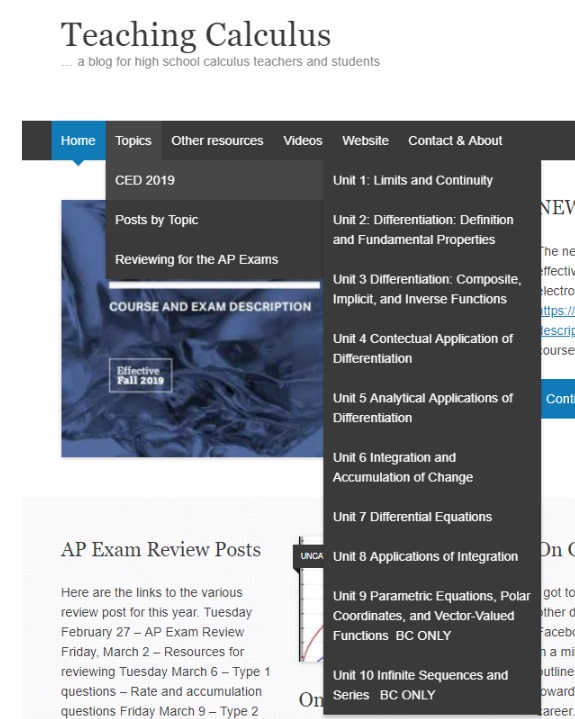
I have written a correlation between the topics in each unit and my blog posts. This can be found under the “Topics” tab in the menu bar at the top of the page (see figure below). The blog posts, written over the past 7 years, do not align perfectly with the topics and units. There are some posts that apply to several topics and some topics with (alas) no posts. I will update these with new posts from time to time and add any posts I’ve overlooked. I hope this will help you find your way around.

As always, I appreciate any feedback, suggestions, corrections etc.


Tuesday and Beyond

So, Tuesday is the day. My usual suggestion for Monday is to get the kids both relaxed and psyched. They know it by now; not much more you can pour into their heads. So, not last minute advice or hints.

Good Luck and best wishes.

Looking ahead – May: the new Course and Exam Description for 2019

The College Board has some very major and important things coming up.

Next week, May 20 or thereabout, the new Course and Exam Description, CED-2019, will be published. It will be available electronically at the course homepages. Look for it here: Homepage for AB and homepage for BC.- the document is the same on both pages:

There will be no change in the exam style and format, and no change in what is tested on the exams.

The organization has changed from the 2016 CED. Instead of a list of topics the course is organized into 10 Units with the topics for each unit. It is almost the start of a syllabus for the course. (No one is required to follow the outline. You may do your own thing, so long as you teach the required content.)  The electronic version contains live links to other resources and addition material to help you organize and teach your course.

The CED-2019 is also available free, gratis, for nothing in a binder so you can intersperse your own notes, worksheet, and activities in each unit. AP teachers in the United States who have completed the AP Course Audit can request a free copy of the binder by January 31, 2020. The binders will be mailed beginning in June 2019. Sign up to get yours here.

Looking ahead – August: the AP Classroom.

On August 1, 2019 the new AP Classroom will open online. This includes thousands of actual AP exam questions from past exams, AP files, and 1200 new questions. They are organized by the Units in the CED-2019. Teachers may access them and allow their students to do so by assigning them electronically. Feedback for students will include not just the correct answers but a discussion of the mistakes that may lead to the wrong answers of the multiple-choice questions. For more information and the other features of the AP Classroom use the links above to go to the course homepage and scroll down. You may also like this short video. It has more information about the AP Classroom.

Other AP Courses.

A new CED and the AP Classroom material will be available for all AP 35 Courses (except AP Computer Science Principles, AP Seminar, and AP Research) on the same dates as above. Please be sure teachers of other AP Courses in your school and district are aware of this.


Type 10: Sequences and Series Questions

The last BC question on the exams usually concerns sequences and series. The question usually asks students to write a Taylor or Maclaurin series and to answer questions about it and its interval of convergence, or about a related series found by differentiating or integrating. The topics may appear in other free-response questions and in multiple-choice questions. Questions about the convergence of sequences may appear as multiple-choice questions. With about 8 multiple-choice questions and a full free-response question this is one of the largest topics on the BC exams.

Convergence tests for series appear on both sections of the BC Calculus exam. In the multiple-choice section, students may be asked to say if a sequence or series converges or which of several series converge.

The Ratio test is used most often to determine the radius of convergence and the other tests to determine the exact interval of convergence by checking the convergence at the end points. Click here for a convergence test chart students should be familiar with; this list is also on the resource page.

Students should be familiar with and able to write several terms and the general term of a Taylor or Maclaurin series. They may do this by finding the derivatives and constructing the coefficients from them, or they may produce the series by manipulating a known or given series. They may do this by substituting into a series, differentiating it or integrating it.

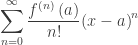
The general form of a Taylor series is \displaystyle \sum\limits_{n=0}^{\infty }{\frac{{{f}^{\left( n \right)}}\left( a \right)}{n!}{{\left( x-a \right)}^{n}}}; if a = 0, the series is called a Maclaurin series.

What Students Should be Able to Do 

  • Use the various convergence tests to determine if a series converges. The test to be used is rarely given so students need to know when to use each of the common tests. For a summary of the tests click: Convergence test chart.  and the posts “What Convergence Test Should I use?” Part 1 and Part 2
  • Understand absolute and conditional convergence. If the series of the absolute values of the terms of a series converges, then the original series is said to absolutely convergent (or converges absolutely). If the series of absolute values diverges, then the original series may or may not converge; if it converges it is said to be conditionally convergent.
  • Write the terms of a Taylor or Maclaurin series by calculating the derivatives and constructing the coefficients of each term.
  • Distinguish between the Taylor series for a function and the function. DO NOT say that the Taylor polynomial is equal to the function (this will lose a point); say it is approximately equal.
  • Determine a specific coefficient without writing all the previous coefficients.
  • Write a series by substituting into a known series, by differentiating or integrating a known series, or by some other algebraic manipulation of a series.
  • Know (from memory) the Maclaurin series for sin(x), cos(x), ex and \displaystyle \tfrac{1}{1-x} and be able to find other series by substituting into them.
  • Find the radius and interval of convergence. This is usually done by using the Ratio test and checking the endpoints.
  • Be familiar with geometric series, its radius of convergence, and be able to find the number to which it converges, \displaystyle {{S}_{\infty }}=\frac{{{a}_{1}}}{1-r}. Re-writing a rational expression as the sum of a geometric series and then writing the series has appeared on the exam.

  • Be familiar with the harmonic and alternating harmonic series. These are often useful series for comparison.
  • Use a few terms of a series to approximate the value of the function at a point in the interval of convergence.
  • Determine the error bound for a convergent series (Alternating Series Error Bound and Lagrange error bound). See my posts on Error Bounds and the Lagrange Highway
  • Use the coefficients (the derivatives) to determine information about the function (e.g. extreme values).

This list is quite long, but only a few of these items can be asked in any given year. The series question on the free-response section is usually quite straightforward. Topics and convergence test may appear on the multiple-choice section. As I have suggested before, look at and work as many past exam questions to get an idea of what is asked and the difficulty of the questions. Click on Power Series in the “Posts by Topic” list on the right side of the screen to see previous posts on Power Series or any other topic you are interested in.

Free-response questions:

  • 2004 BC 6 (An alternate approach, not tried by anyone, is to start with \displaystyle \sin \left( {5x+\tfrac{\pi }{4}} \right)=\sin (5x)\cos \left( {\tfrac{\pi }{4}} \right)+\cos (5x)\sin \left( {\tfrac{\pi }{4}} \right))
  • 2016 BC 6
  • 2017 BC 6

Multiple-choice questions from non-secure exams:

  • 2008 BC 4, 12, 16, 20, 23, 79, 82, 84
  • 2012 BC 5, 9, 13, 17, 22, 27, 79, 90,


The concludes the series of posts on the type questions in review for the AP Calculus exams.


Type 9: Polar Equation Questions

Ideally, as with parametric and vector functions, polar curves should be introduced and covered thoroughly in a pre-calculus course. Questions on the BC exams have been concerned with calculus ideas related to polar curves. Students have not been asked to know the names of the various curves (rose curves, limaçons, etc.). The graphs are usually given in the stem of the problem, but students should know how to graph polar curves on their calculator, and the simplest by hand. Intersection(s) of two graph may be given or easy to find.

What students should know how to do:

  • Calculate the coordinates of a point on the graph,
  • Find the intersection of two graphs (to use as limits of integration).
  • Find the area enclosed by a graph or graphs: Area =\displaystyle A=\tfrac{1}{2}\int_{{{\theta }_{1}}}^{{{\theta }_{2}}}{(r(}θ\displaystyle ){{)}^{2}}dθ
  • Use the formulas x\left( \theta  \right)\text{ }=~r\left( \theta  \right)\text{cos}\left( \theta  \right)~~\text{and}~y\left( \theta  \right)\text{ }=~r(\theta )\text{sin}\left( \theta  \right)~  to convert from polar to parametric form,
  • Calculate \displaystyle \frac{dy}{d\theta } and \displaystyle \frac{dx}{d\theta } (Hint: use the product rule on the equations in the previous bullet).
  • Discuss the motion of a particle moving on the graph by discussing the meaning of \displaystyle \frac{dr}{d\theta } (motion towards or away from the pole), \displaystyle \frac{dy}{d\theta } (motion in the vertical direction), and/or \displaystyle \frac{dx}{d\theta } (motion in the horizontal direction).
  • Find the slope at a point on the graph, \displaystyle \frac{dy}{dx}=\frac{dy/d\theta }{dx/d\theta }.

When this topic appears on the free-response section of the exam there is no Parametric/vector motion question and vice versa. When not on the free-response section there are one or more multiple-choice questions on polar equations.

Free-response questions:

  • 2013 BC 2
  • 2014 BC 2
  • 2017 BC 2

Multiple-choice questions from non-secure exams:

  • 2008 BC 26
  • 2012 BC 26, 91


Type 8: Parametric and Vector Questions

The parametric/vector equation questions only concern motion in a plane.

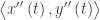
In the plane, the position of a moving object as a function of time, t, can be specified by a pair of parametric equations x=x\left( t \right)\text{ and }y=y\left( t \right) or the equivalent vector \left\langle x\left( t \right),y\left( t \right) \right\rangle . The path is the curve traced by the parametric equations or the tips of the position vector. .

The velocity of the movement in the x- and y-direction is given by the vector \left\langle {x}'\left( t \right),{y}'\left( t \right) \right\rangle . The vector sum of the components gives the direction of motion. Attached to the tip of the position vector this vector is tangent to the path pointing in the direction of motion.

The length of this vector is the speed of the moving object. \text{Speed }=\sqrt{{{\left( {x}'\left( t \right) \right)}^{2}}+{{\left( {y}'\left( t \right) \right)}^{2}}}. (Notice that this is the same as the speed of a particle moving on the number line with one less parameter: On the number line \text{Speed}=\left| v \right|=\sqrt{{{\left( {x}'\left( t \right) \right)}^{2}}}.)

The acceleration is given by the vector \left\langle {{x}'}'\left( t \right),{{y}'}'\left( t \right) \right\rangle .

What students should know how to do:

  • Vectors may be written using parentheses, ( ), or pointed brackets, \left\langle {} \right\rangle , or even \vec{i},\vec{j} form. The pointed brackets seem to be the most popular right now, but all common notations are allowed and will be recognized by readers.
  • Find the speed at time t\text{Speed }=\sqrt{{{\left( {x}'\left( t \right) \right)}^{2}}+{{\left( {y}'\left( t \right) \right)}^{2}}}
  • Use the definite integral for arc length to find the distance traveled \displaystyle \int_{a}^{b}{\sqrt{{{\left( {x}'\left( t \right) \right)}^{2}}+{{\left( {y}'\left( t \right) \right)}^{2}}}}dt. Notice that this is the integral of the speed (rate times time = distance).
  • The slope of the path is \displaystyle \frac{dy}{dx}=\frac{{y}'\left( t \right)}{{x}'\left( t \right)}. See this post for more on finding the first and second derivatives with respect to x.
  • Determine when the particle is moving left or right,
  • Determine when the particle is moving up or down,
  • Find the extreme position (farthest left, right, up, down, or distance from the origin).
  • Given the position find the velocity by differentiating; given the velocity find the acceleration by differentiating.
  • Given the acceleration and the velocity at some point find the velocity by integrating; given the velocity and the position at some point find the position by integrating. These are just initial value differential equation problems (IVP).
  • Dot product and cross product are not tested on the BC exam, nor are other aspects.

When this topic appears on the free-response section of the exam there is no polar equation question and vice versa. When not on the free-response section there are one or more multiple-choice questions on parametric equations.


Free-response questions:

  • 2012 BC 2
  • 2016 BC 2

Multiple-choice questions from non-secure exams

  • 2003 BC 4, 7, 17, 84
  • 2008 BC 1, 5, 28
  • 2012 BC 2


Type 7 Questions: Miscellaneous

Any topic in the Course and Exam Description may be the subject of a free-response or multiple-choice question. There are topics that are not asked often enough to be classified as a type of their own. The two topics listed here have been the subject of full free-response questions or major parts of them. Other topics occasionally asked are mentioned in the question list at the end of the post.

Implicitly defined relations and implicit differentiation

These questions may ask students to find the first or second derivative of an implicitly defined relation. Often the derivative is given and students are required to show that it is correct. (This is because without the correct derivative the rest of the question cannot be done.) The follow-up is to answer questions about the function such as finding an extreme value, second derivative test, or find where the tangent is horizontal or vertical.

What students should know how to do

  • Know how to find the first derivative of an implicit relation using the product rule, quotient rule, chain rule, etc.
  • Know how to find the second derivative, including substituting for the first derivative.
  • Know how to evaluate the first and second derivative by substituting both coordinates of a given point. (Note: If all that is needed is the numerical value of the derivative then the substitution is often easier if done before solving for dy/dx or d2y/dx2, and as usual the arithmetic need not be done.)
  • Analyze the derivative to determine where the relation has horizontal and/or vertical tangents.
  • Write and work with lines tangent to the relation.
  • Find extreme values. It may also be necessary to show that the point where the derivative is zero is actually on the graph and to justify the answer.

Simpler questions about implicit differentiation my appear on the multiple-choice sections of the exam.

Related Rates

Derivatives are rates and when more than one variable is changing over time the relationships among the rates can be found by differentiating with respect to time. The time variable may not appear in the equations. These questions appear occasionally on the free-response sections; if not there, then a simpler version may appear in the multiple-choice sections. In the free-response sections they may be an entire problem, but more often appear as one or two parts of a longer question.

What students should know how to do

  • Set up and solve related rate problems.
  • Be familiar with the standard type of related rate situations, but also be able to adapt to different contexts.
  • Know how to differentiate with respect to time. That is, find dy/dt even if there is no time variable in the given equations using any of the differentiation techniques.
  • Interpret the answer in the context of the problem.
  • Unit analysis.

Shorter questions on this concept also appear in the multiple-choice sections. As always, look over as many questions of this kind from past exams as you can find.

For some previous posts on related rate see October 8, and 10, 2012 and for implicit relations see November 14, 2012.


Free response questions (many of the BC questions are suitable for AB)

  • Finding derivatives using the chain rule, the quotient rule, etc. from tables of values: 2016 AB 6 and 2015 AB 6
  • Implicit differentiation 2004 AB and 2016 BC 4
  • L’Hospital’s Rule 2016 BC 4
  • Continuity and piecewise defined functions: 2012 AB 4, 2011 AB 6 and 2014 BC 5
  • Related rate: 2014 AB4/BC4, 2016 AB5/BC5
  • Arc length (BC Topic) 2014 BC 5
  • Partial fractions (BC Topic) 2015 BC 5
  • Improper integrals (BC topic): 2017 BC 5

Multiple-choice questions from non-secure exams:

  • 2012 AB 27 (implicit differentiation), 77 (IVT), 88 (related rate)
  • 2012 BC 4 (Curve length), 7 (Implicit differentiation), 11 (continuity/differentiability), 12 (Implicit differentiation), 77 (dominance), 82 (average value), 85 (related rate) , 92 (compositions)

Schedule of review postings: