AP Accumulation Questions

Accumulation 2: AP Exam Rate/Accumulation Questions

I assume that a number of my readers are AP Calculus teachers. In following up my last post on accumulation, today I’m going to discuss a very common type of AP Calculus exam question, the rate question which is loaded with accumulation ideas. The three posts following this one will show how accumulation can help with graphing problems.

If you do not have them, these two links will take you to them. Click on the question number for links to the question and scoring standard.

2000 AB 4: In this questions water was being pumped into a tank at the constant rate of 8 gallons per minute and leaking out at the rate of \sqrt{t+1} gallons per minute. At time t = 0 we are told there are 30 gallons of water in the tank. (Many AP exams problems have two rates acting at the same time, one increasing the amount and the other decreasing it.)

  • The first part of the question asked for the amount of water that leaked out of the tank in the first 3 minutes. This is like the situation discussed in the last post: If you need an amount, look around for a rate to integrate. The answer is \displaystyle\int_{0}^{3}{\sqrt{t+1}dt}=\tfrac{14}{3}\text{ gallons}\text{.}
  • The next part asked for the amount of water in the tank after t minutes. So, we start with 30 gallons and add the amount put in which is 8 gallons per minute for 3 minutes of 24 gallons. Of course, we could also get this by integrating \displaystyle \int_{0}^{3}{8dt}=24. Then we subtract the amount that leaked out from the first part. The amount is 30 + 24 – 14/3 gallons. This was to help students with the next part.
  • The third part asked for an expression for A(t), the amount of water at any time t. So following on the second part we have either \displaystyle A\left( t \right)=30+8t-\int_{0}^{x}{\sqrt{t+1}dt} or \displaystyle A\left( t \right)=30+\int_{0}^{x}{8-\sqrt{t+1}\,dt}. Either form, especially the latter, is the form of an accumulation function: the initial amount plus the integral of the rate of change. It was not required to actually do the integration, but if someone did then \displaystyle A\left( t \right)=8t-\tfrac{2}{3}{{\left( t+1 \right)}^{3/2}}+\tfrac{92}{3}
  • The last part asked when the maximum amount of water was in the tank. As in any extreme value problem you can find this by differentiating any of the expressions for the amount found in the third part: {A}'\left( t \right)=8-\sqrt{t+1} by the FTC. (This could also be found by simply subtracting the two rates.) This will change from positive to negative when t = 63; this is when the maximum amount of water is in the tank. Notice that this is when the amount leaking out becomes greater than the amount being pumped into the tank; the total change becomes negative.

2009 AB 3: This question had a different twist or two on the accumulation idea. This proved rather difficult for the majority of the students (The mean score was 1.92 out of a possible 9 points.) The problem said that the Mighty Cable Company sold their cable for $120 per meter. The cost of producing the cable was given as 6\sqrt{x} dollars per meter. (Notice that these are rates as evidenced by their units $/m; the word “rate” was not used. It is important that students recognize when something is a rate.) The stem also defined profit as the difference between the amount of money received for the cable and the cost of producing the cable.

  • The first part of the question asked for the profit on 25 meters of cable. The amount the company receives is 25 meters times $120 dollars per meter (an amount so we could integrate the rate here, but that’s overkill). The amount the 25 meters costs to produce is (remember if you need an amount, integrate the  rate): \displaystyle \int_{0}^{25}{6\sqrt{x}\,dx}, so the \displaystyle \text{Profit }=120\cdot 25-\int_{0}^{25}{6\sqrt{x}\,dx}=\$2,500
  • The third part built on the first part by asking for the profit earned for a cable k meters long: \displaystyle \text{Profit =}120k-\int_{0}^{k}{6\sqrt{x}\,dx} or \displaystyle P(x)=\int_{0}^{k}{120-6\sqrt{x}\,dx}.  There is your accumulation function. The initial value is $0.
  • The second part was the most interesting. In it students were asked to explain the meaning of  \displaystyle \int_{25}^{30}{6\sqrt{x}\,dx} in the context of the problem. One way to see what this represents is to think about the FTC. The integral of the rate in dollars per meter is the cost per meter. If we call the cost C, then \displaystyle \int_{25}^{30}{6\sqrt{x}\,dx}=C\left( 30 \right)-C\left( 25 \right). Now students did not need to do a computation here; they just have to read what the symbols mean. C\left( 30 \right)-C\left( 25 \right) is the difference between the cost of manufacturing a 25-meter cable and a 30-meter table.  When you integrate a rate, you get the net amount.
  • As in the previous question the fourth part asked for the maximum profit. This was found by differentiating the profit expression from the third part by the FTC, {P}'\left( x \right)=120-6\sqrt{x} and finding when the derivative changed from positive to negative, at x = 400 meters and substituting this into the profit equation.

Accumulation: Need an Amount?

Accumulation 1: If you need an amount, look around for a rate to integrate.

While most textbooks barely mention the word, the concept of accumulation is extremely useful in a variety of situations. This is the first of several posts will be on the topic of accumulation. We will discuss what accumulation is all about, look at some typical rate problems, discuss functions defined by integrals, see how the concept can be applied to graphing and differential equations.

The Fundamental Theorem of Calculus tells us that

\displaystyle \int_{a}^{b}{{f}'\left( x \right)x}=f\left( b \right)-f\left( a \right)

The integral of a rate of change (derivative) gives the net amount of change of the function over the interval. This equation tells us a lot more than just how to evaluate a definite integral. It tell us that if you are looking for the amount that something changes by, you need only integrate the rate at which it is changing: If you need an amount, integrate a rate.

So if water is pumped into a tank at the rate of \sqrt{t+1} gallons per minute then the amount that is pumped in, in 5 minutes is \displaystyle \int_{0}^{5}{\sqrt{t+1}\,dt} gallons. It’s as simple as that!

If a car is traveling with a velocity (rate) given by v\left( t \right)={{t}^{2}}+6t+12 miles per hour then the distance it travels (amount of miles) in three hours is \displaystyle \int_{0}^{3}{{{t}^{2}}+6t+12}\,dt miles.

But it gets better. By changing the variables in the FTC equation a little you can write

f\left( x \right)=f\left( a \right)+\int_{a}^{x}{{f}'\left( t \right)dt}

This defines the function f (x) in terms of an integral whose upper limit of integration is the independent variable x. The integral gives the amount of change from t = a to t = x. This is added to the initial amount, f (a). The amount, f (x), at any time x is the initial amount, f (a), plus the amount of change between t = a and t = x, given by the integral.

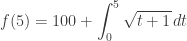
If there was 100 gallons of water in the tank in the first example above, then after 5 hours there is \displaystyle f(5)=100+\int_{0}^{5}{\sqrt{t+1}\,dt} gallons in the tank.

If in the second example above the car is 53 miles from its starting point and traveling in a straight line, then after 3 hours it is \displaystyle s\left( 3 \right)=53+\int_{0}^{3}{{{t}^{2}}+6t+12}\,dt miles from where it started.

If you need an amount, integrate a rate.

Most Triangles Are Obtuse!

What is the probability that a triangle picked at random will be acute? An average value problem.

The thing here is to define what you mean by picking a triangle “at random.” You could open a Geometry book and take the first triangle you come to, but are the triangles in a Geometry book really a good sample space? I doubt it.

Let’s try this: let A, B, and C be the measures, in degrees, of the angles of \Delta ABC. Let A be a random number between 0 and 180, and let B be a random number between 0 and 180 – A. Then, let C = 180 – AB.

Then P(A<90)=\tfrac{1}{2}

For any A < 90, B and C are chosen from the interval \left( 0,180-A \right). In order for the triangle to be acute B and C must be within 90 of both ends of this interval. That is, B and C must both be in the interval [90-A,90].

This is an interval of length A and the probability of picking numbers, B and C, at random in this interval is \frac{A}{180-A}. At this point you may want to stop and calculate a typical probability. For instance, if A= 30 then the probability of both B and C being acute is \frac{30}{180-30}=0.20.

In general P\left( A<90\text{ and }\left( B<90\text{ and }C<90 \right) \right)=\frac{1}{2}\cdot \frac{A}{180-A}. What we need is the average of (all) these values.

This average is \displaystyle \frac{1}{2}\frac{1}{90-0}\int_{0}^{90}{\frac{A}{180-A}dA}\approx 0.19315

So about 19.3% of triangles are acute, the rest are obtuse (or right). Leaving one to believe that most triangles are obtuse.

Challenge: Try writing a calculator or computer program that picks the measures of the angles of a triangle as described above. Repeat this many times while the program counts the number of acute triangles and the total number of triangles and finds their ratio. Does it come close to 19.3%?
_______________
This problem was posted on the AP Calculus Electronic Discussion Group (11/22/03) by Stu Schwartz an AP Calculus teacher at Wissahickon High School in Ambler, Pennsylvania. The solution is by one of Mr. Schwartz’s students Kurt Schneider, a tenth grader at the time who completed AB calculus in eighth grade and BC calculus in ninth grade!

Average Value of a Function

Today I want to consider a way of developing the expression for finding the average value of a function, f (x), on an interval [a, b].

Ask students how to find the average of a bunch of numbers and they will say, “add them up and divide by the number of numbers.” Then ask if they can average an infinite number of numbers. Most will say no since you cannot divide by infinity.

Well, what if the numbers were all the same?

Such as all the y-values of f (x) = 2 between x =1 and x = 5. Isn’t the average 2? So, apparently, you can sometimes average an infinite number of numbers.

Next suggest something like f (x) = x between x = 0 and x = 3. Since half the values are obviously above 1.5 and half below, can’t 1.5 be their average? Sketch this situation and draw the segment at y = 1.5 to help them see this.

Suggest another situation, say f (x) = 2 + sin(x) on the interval \left[ 0,2\pi \right] and some others. The average appears to be 2, again since half the values are above and half below 2.

When you draw the line that is the apparent average, lead the students to see that the rectangle formed by this line, the x-axis and the ends of the interval has the same area as between the function and the x-axis.

Continue with more difficult examples until someone hits on the idea of finding the “area” with an integral and then dividing the result by the width of the interval to find the height of the rectangle that is also the average value:

\displaystyle \overline{y}=\frac{\text{''area''}}{\text{length of interval}}=\frac{\int_{a}^{b}{f\left( x \right)dx}}{b-a}

Click here for an activity that you can use to develop this idea from scratch.

The next post: A fun application of average value – Most Triangles Are Obtuse.

Why You Never Need Cylindrical Shells

Don’t get me wrong; finding volumes of solids of rotation by the method of cylindrical shells is a great method. It’s just that you can always work around it; you don’t ever need to use it. The work-around is often longer and involves more work, but it is interesting mathematically. So here’s an example of how to do it.

The region bounded by the graph of y={{x}^{3}}+x+1, and the lines y = 1 and x = 2, is revolved around the y-axis. What is the volume of the resulting solid?
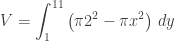

Supposedly this volume must be found by the shell method. Using the washer method the volume is set up as the integral of the area of the outside circle with constant radius of 2, minus the area of the inside circle of radius x, times the “thickness” of a slice. This “thickness” is in the y-direction and so is dy. The dy also determines the limits of integration.

\displaystyle V=\int_{1}^{11}{\left( \pi {{2}^{2}}-\pi {{x}^{2}} \right)\,dy}

Since the integral contains a dy the usual way is to change the x to a function of y, which in this case involves solving a cubic polynomial. In this case that is very difficult to find x as a function of y and with a different function that may even be impossible. But do we really have to do that? In fact, what is required is to have only one variable and the variable may be x! So we find dy in terms of x and dx and substitute into the expression above. We also change the limits of integration to the corresponding x-values.

dy=\left( 3{{x}^{2}}+1 \right)dx
\displaystyle V=\int_{0}^{2}{\left( \pi {{2}^{2}}-\pi {{x}^{2}} \right)\,\left( 3{{x}^{2}}+1 \right)dx}
\displaystyle V=\pi \int_{0}^{2}{\left( 4+11{{x}^{2}}-3{{x}^{4}}\, \right)dx}

This integral is easy to evaluate and will give the same value, \tfrac{272}{15}\pi, as the shell integral.

To use this idea, the function must either be one-to-one on the interval or the solid must be broken into sections that are one-to-one. This may make the problem longer. Most problems that you want to do by shells are easier by shells. The point is that washers (or disks) may always be used; not that the washer approach is the easiest way.

Volumes of Revolution

Applications of Integration 3 – Volumes of Rotation

In our last post we discussed volumes of figures with regular cross sections. Many common figures can be analyzed as some region rotated around a line, possibly one of its edges. For example, the region between the x-axis and the segment with equation y=\frac{r}{h}x from x = 0 to
x = h when rotated around the x-axis generates a cone with height h and a base with a radius of r. This has regular cross-sections which are circles for any value of x between 0 and h. Their areas are. So based on the idea in my previous post the volume is the integral of the cross-section area times the thickness:

\displaystyle \underset{n\to \infty }{\mathop{\lim }}\,\sum\limits_{i=1}^{n}{\pi {{\left( \tfrac{r}{h}{{x}_{i}} \right)}^{2}}\Delta {{x}_{i}}}=\int_{0}^{h}{\pi {{\left( \tfrac{r}{h}x \right)}^{2}}}dx=\tfrac{1}{3}\pi {{r}^{2}}h

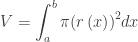
Since circular cross-sections are very common (at least in calculus books) this is often treated as a separate topic with its own ideas and formulas. It really is not. It’s the basic idea applied to figures with circular sections; the cross-section area as a function of x is \pi {{\left( r(x) \right)}^{2}}; the thickness is \Delta x

\displaystyle V=\int_{a}^{b}{\pi {{\left( r\left( x \right) \right)}^{2}}dx}.

If the figure has a hole through it one subtracts the inside volume (radius = r\left( x \right) ) from the outside volume (radius = R\left( x \right)). This may be done with two integrals or combined into one.

\displaystyle \int_{a}^{b}{\pi {{\left( R\left( x \right) \right)}^{2}}dx}-\int_{a}^{b}{\pi {{\left( r\left( x \right) \right)}^{2}}}dx=\int_{a}^{b}{\pi {{\left( R\left( x \right) \right)}^{2}}-\pi {{\left( r\left( x \right) \right)}^{2}}dx}

Looking at the last integral we see that this is the same as treating the cross-section as an annulus (aka a “washer”). The \pi is often factored out in front of the integral sign to make things look neater; I suggest you leave it where it is to remind students that they are subtracting the areas of two circles.

To help students see what the figures look like you can do several things. You can cut the region out of light cardboard and tape it to the end of a pencil. Then rotate the pencil quickly to see the volume. Another way is to use a good graphing program, such as Winplot, which will let you see a three-dimensional figure being formed. One of my favorites is to use paper wedding bells that start flat and then open into a three-dimensional figure.

Volume of Solids with Regular Cross-sections

Applications of Integration 2 – Solids with Regular Cross-sections

In Vino Veritas. And not only truth, but the start of an important application of the calculus. After Johannes Kepler’s (1571–1630) first wife died he decided to marry again. Naturally, he bought wine for the festivities. There was some disagreement with the wine merchant concerning how he calculated the volume of the barrel of wine. This led Kepler, a mathematician, to study the problem of finding the volume of barrels. The barrels, then as now, had circular cross sections of different diameters. His idea was to consider the wine as a stack of thin cylinders (with height of as we would say today). He then calculated the volume of each cylinder and added them together to find the volume of the barrel. There is a nice animation of the idea and more information on Kepler here.

The basic problem is this: you have a solid object whose volume you need to compute. If you can slice the object perpendicular to the axis in such a way that you get regular cross sections (i.e. similar figures) whose area you can compute, then by multiplying the area times the thickness and adding the results, you can have the volume. This kind of addition is done nicely by integration, since the volume of the slices form a Riemann sum.

You need to set up a coordinate system so that you can slice the figure into thin slices (whose width is ) and express the cross-section’s dimensions as a function of x and then the area as A(x). The result always looks like this where A(x) is the area of the cross-section:

\displaystyle \underset{n\to 0}{\mathop{\lim }}\,\sum\limits_{i=1}^{n}{A\left( {{x}_{i}} \right)\Delta {{x}_{i}}}=\int_{a}^{b}{A\left( x \right)dx}

Think of this as the integral of the cross-section area times the thickness

Since you are probably not allowed to have wine in your calculus class, you may want to illustrate the idea some way other than using a wine barrel. Think of a loaf of sliced bread, or a deck of cards. Find some object that the students can measure and calculate the volume, such as a tree trunk, a statue, or a Coke-Cola bottle.

Another interesting exercise is to develop (prove) the formulas for volumes that students have known and used without proof since grade school: a cone, a pyramid, a sphere, the frustum of a cone.