Then there is this – Existence Theorems

Existence Theorems

An existence theorem is a theorem that says, if the hypotheses are met, that something, usually a number, must exist.

For example, the Mean Value Theorem is an existence theorem: If a function f is defined on the closed interval [a, b] and differentiable on the open interval (a, b), then there exists a number c in the open interval (a, b) such that \displaystyle {f}'\left( c \right)\left( {b-a} \right)=f\left( b \right)-f\left( a \right).

The phrase “there exists” can also mean “there is” and “there is at least one.” In fact, it is a good idea when seeing an existence theorem to reword it using each of these other phrases. “There is at least one” reminds you that there may be more than one number that satisfies the condition. The mathematical symbol for these phrases is an upper-case E written backwards: \displaystyle \exists .

Textbooks, after presenting an existence theorem, usually follow-up with some exercises asking students to find the value for a given function on a given interval: “Find the value of c guaranteed by the Mean Value Theorem for the function … on the interval ….” These exercises may help students remember the formula involved but are not very useful otherwise.

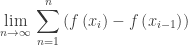
The important thing about most existence theorems is that the number exists, not what the number is. To illustrate this, let’s consider the Fundamental Theorem of Calculus. After partitioning the interval [a, b] into subintervals at various values, xi, we consider the limit of the sum

\displaystyle \underset{{n\to \infty }}{\mathop{{\lim }}}\,\sum\limits_{{n=1}}^{n}{{\left( {f\left( {{{x}_{i}}} \right)-f\left( {{{x}_{{i-1}}}} \right)} \right)}}.

Write out a few terms and you will see that is a telescoping series and its limit is \displaystyle f\left( b \right)-f\left( a \right).

The expression \displaystyle {f\left( {{{x}_{i}}} \right)-f\left( {{{x}_{{i-1}}}} \right)} resembles the right side of the Mean Value Theorem above. Since all the conditions are met, the MVT tells us that in each subinterval \displaystyle [{{x}_{{i-1}}},{{x}_{i}}] there exists a number, call it ci , such that

\displaystyle {f}'\left( {{{c}_{i}}} \right)\left( {{{x}_{i}}-{{x}_{{i-1}}}} \right)=f\left( {{{x}_{i}}} \right)-f\left( {{{x}_{{i-1}}}} \right) and therefore

\displaystyle \underset{{n\to \infty }}{\mathop{{\lim }}}\,\sum\limits_{{n=1}}^{n}{{\left( {f\left( {{{x}_{i}}} \right)-f\left( {{{x}_{{i-1}}}} \right)} \right)}}=\underset{{n\to \infty }}{\mathop{{\lim }}}\,\sum\limits_{{n=1}}^{n}{{{f}'\left( {{{c}_{i}}} \right)\left( {{{x}_{i}}-{{x}_{{i-1}}}} \right)}}=f\left( b \right)-f\left( a \right)

No one is concerned what these ci are, just that there are such numbers, that they exist. (The second limit above is then defined as the definite integral so \displaystyle \underset{{n\to \infty }}{\mathop{{\lim }}}\,\sum\limits_{{n=1}}^{n}{{{f}'\left( {{{c}_{i}}} \right)\left( {{{x}_{i}}-{{x}_{{i-1}}}} \right)}}=\int_{a}^{b}{{{f}'\left( x \right)dx=}}f\left( b \right)-f\left( a \right) – The Fundamental Theorem of Calculus.)

Other important existence theorems in calculus

The Intermediate Value Theorem

If f is continuous on the interval [a, b] and M is any number between f(a) and f(b), then there exists a number c in the open interval (a, b) such that f(c) = M.

If f is continuous on an interval and f changes sign in the interval, then there must be at least one number c in the interval such that f(c) = 0

Extreme Value Theorem

If f is continuous on the closed interval [a, b], then there exists a number c in [a, b] such that \displaystyle f\left( c \right)\ge f\left( x \right) for all x in the interval. Every function continuous on a closed interval has (i.e. there exists) a maximum value in the interval.

If f is continuous on the closed interval [a, b], then there exists a number c in [a, b] such that \displaystyle f\left( c \right)\le f\left( x \right) for all x in the interval. Every function continuous on a closed interval has (i.e. there exists) a minimum value in the interval.

Critical Points

If f is differentiable on a closed interval and \displaystyle {f}'\left( x \right) changes sign in the interval, then there exists a critical point in the interval.

Rolle’s theorem

If a function f is defined on the closed interval [a, b] and differentiable on the open interval (a, b) and f(a) = f(b), then there must exist a number c in the open interval (a, b) such that \displaystyle {f}'\left( c \right)=0.

MVT – other forms

If I drive a car continuously for 150 miles in three hours, then there is a time when my speed was exactly 50 mph.

If a function f is defined on the closed interval [a, b] and differentiable on the open interval (a, b), then there is a point on the graph of f where the tangent line is parallel to the segment between the endpoints.

Taylor’s Theorem

If f is a function with derivatives through order n + 1 on an interval I containing a, then, for each x in I , there exists a number c between x and a such that

\displaystyle f\left( x \right)=\sum\limits_{k=0}^{n}{\frac{{{f}^{\left( k \right)}}\left( a \right)}{k!}{{\left( x-a \right)}^{k}}}+\frac{{{f}^{\left( n+1 \right)}}\left( c \right)}{\left( n+1 \right)!}{{\left( x-a \right)}^{n+1}}

The number \displaystyle R=\frac{{{f}^{\left( n+1 \right)}}\left( c \right)}{\left( n+1 \right)!}{{\left( x-a \right)}^{n+1}} is called the remainder. The equation above says that if you can find the correct c the function is exactly equal to Tn(x) + R. Notice the form of the remainder is the same as the other terms, except it is evaluated at the mysterious c. The trouble is we almost never can find the c without knowing the exact value of f(x), but; if we knew that, there would be no need to approximate. However, often without knowing the exact values of c, we can still approximate the value of the remainder and thereby, know how close the polynomial Tn(x) approximates the value of f(x) for values in x in the interval, i. See Error Bounds and the Lagrange error bound.

Cogito, ergo sum

And finally, we have Descartes’ famous “theorem” Cogito, ergo sum (in Latin) or the original French, Je pense, donc je suis, translated as “I think, therefore I am” proving his own existence.


AP Calculus Prerequisites

College Board Prerequisites

Whenever I led a calculus workshop or APSI, I always spent a little time discussing the prerequisites for AP Calculus. Unfortunately, in some schools AP Calculus is a course for only the talented and little time is spent aligning the mathematics program and courses from 7th grade on so that more students will be able to take AP Calculus. But a program that includes the prerequisite for calculus will be a good program because of this. Such a program will also benefit students who do not take AP Calculus, but still need a good mathematics program for when they attend college.

Teachers in the earlier courses are usually appreciative of guidance from the AP Calculus teacher as to what should be included to prepare students for calculus. This is part of the rationale of the AP’s math Vertical Team program.

Below in blue is the entire prerequisite paragraph from the 2019 AP Calculus Course and Exam Description p. 7. I have separated the parts and commented on each.

Before studying calculus, all students should complete the equivalent of four years of secondary mathematics designed for college-bound students:

The four years is needed. Students should not be rushed.

In some respects, this is a political statement: four years means starting in 8th grade or earlier. While some of the most talented students can probably catch up by doing two years in one or three years in two, this is not the usual case. Learning math thoroughly takes four years.

Once in my district, our junior high decided to raise the standards for their “advanced” course that taught Algebra I in 8th grade. No one told us, so the next year we found only one class, instead of two, that could be ready for AP Calculus by the time they were seniors. We tried a three-years-in-two approach. It met with only limited success. Algebra I in 8th grade is required and really should be for everyone otherwise you are denying students the chance to even consider AP Calculus when they are seniors.

 courses that should prepare them with a strong foundation in reasoning with algebraic symbols and working with algebraic structures.

Using and understanding the use of mathematical notation is a must. Throughout the four years, algebra and its structure should be emphasized.  So, it’s not just 4 years of math, but four years of a good algebra-based math program. But algebra is not the only thing:

Prospective calculus students should take courses in which they study algebra, geometry, trigonometry, analytic geometry, and elementary functions.

All these courses are related and lead to a fuller understanding of high school math topics.

These functions include linear, polynomial, rational, exponential, logarithmic, trigonometric, inverse trigonometric, and piecewise-defined functions.

This is a list of the types of functions that should be included. They are the basic functions studied in the calculus. Linear and simple polynomial functions start in Algebra I and the others are added later. Piecewise-define functions also start early – the absolute value function is a piecewise-defined function.

In particular, before studying calculus, students must be familiar with the properties of functions, the composition of functions, the algebra of functions, and the graphs of functions.

The algebra of functions means learning how to add, subtract, multiply, divide, and compose functions and how doing so affects the properties and graphs of the resulting functions. The graphs of these functions and how doing algebra, composition, and transformations affects the graph is important.

Students must also understand the language of functions (domain and range, odd and even, periodic, symmetry, zeros, intercepts, and descriptors such as increasing and decreasing).

The list of the language functions is too short. Some terms such as increasing, decreasing, maximum and minimum values, concavity and others often considered the province of calculus all come up in the study of functions and can and should be discussed when they arise using the correct terminology and notation. There is no need to wait for calculus to use them to describe functions, graphs and transformations. An informal use and understanding of continuity and limits should be included. Asymptotes should not be overlooked (they are the graphical manifestation of limits and continuity or the lack of same). The more students learn before calculus, the less you’ll have to do in calculus.

Students should also know how the sine and cosine functions are defined from the unit circle and know the values of the trigonometric functions at the numbers 0,\tfrac{\pi }{6},\tfrac{\pi }{4},\tfrac{\pi }{3},\tfrac{\pi }{2} and their multiples.

Yes, with all the technology available these basic trig facts should be learned (learned, not just memorized); they are always tested on the AP Exams.

Students who take AP Calculus BC should have basic familiarity with sequences and series, as well as some exposure to parametric and polar equations.

Here I disagree. Parametric equations, vector equations and polar equations should be a part of the curriculum for all students. Students who do not take BC calculus, may well take more math courses in college and should understand these ways of working with the plane and with functions defined in different ways.


This list does not define the entire high school math program. There are other topics that can and probably should be included – statistics, systems of equations, linear algebra and matrices, proofs, probability to name a few. What it does define is what should be included so that students will be ready for calculus.

What I think is missing here is the use of technology. In the world today mathematics is done with technology. The proper use of technology should be an integral part of the program from before Algebra I.

AP Statistics is a great course. Students who have completed Algebra II should consider this course. However, AP Statistics it is not an algebra-based course. About three-quarters of the course and its exam is writing; there is very little algebra involved. Therefore, students should not be taking AP Statistics instead of AP Calculus, or if they are not taking calculus, instead of a third year of Algebra. The AP Statistic prerequisites state:

Students who wish to leave open the option of taking calculus in college should include precalculus [i.e. a third year of algebra] in their high school program and perhaps take AP Statistics concurrently with precalculus.

Students with the appropriate mathematical background are encouraged to take both AP Statistics and AP Calculus in high school.

AP Statistics 2019 Course and Exam Description p. 7, emphasis added.

The point is that students should not have a year in high school without an algebra course. A year in which to forget their algebra before going to college where they may need it again is not a good idea.


I like to think of all the mathematics courses before calculus as “precalculus.” In many schools, “precalculus” is the name of the last course before calculus. That’s okay, I guess. What I disagree with is that often the precalculus teacher, with the good intention of preparing their students for calculus, teaches them “derivatives.” By which they mean the rules for computing derivatives. This really does not help the students or the calculus teacher.

Derivatives are limits and derivatives are slopes; computing derivatives is the least of your worries. If students have learned all the other precalculus topics (including parametric, vector, and polar equations) well and there is time left, consider delving further into limits and continuity. Limits seem to be more difficult to understand and some repeating of the topic when students arrive in calculus will do no harm. Leave the calculus for the calculus class. (The exception is when the precalculus class is intentionally meant to get an early start on the calculus; when it is taught by the calculus teacher or a teacher who is aware of the Essential Knowledge and Learning objective of the AP Calculus course.)  – Just my opinion.


High School Prerequisites

Some high schools add their own prerequisites to enter AP Calculus courses. This usually means students have to earn a significantly higher score than just a passing grade in the precalculus course(s). I do not agree with such a policy.  It excludes students who may benefit. If your student passed the precalculus course, even with a low grade, how can you say they are not ready for calculus? What will make them more ready? True, they may have to struggle, but that won’t hurt them. You may want to council them (and their parents) and explain, without discouraging them, the amount of work and time required in a college level course like AP. Explain the amount of time and work they will have to spend once they get to college in a course that meets far fewer times then AP Calculus to cover the same material. Even if they end up without earning a qualifying score on the AP Exam, they will still benefit by putting in the time and effort. If they want to try, encourage them.


Mathematical Practices

In March, I attending a training session given by the College Board on the new 2019 AP Calculus Course and Exam Description (2019 CED). I was impressed by the copious other materials the College Board had prepared for the roll-out that will be available at summer institutes. Among these was Mathematical Practices. The MPACs (Mathematical Practices) from the 2016 CED have been revised and condensed from six down to four. In both forms they summarize how mathematicians work, think, and communicate. Therefore, they outline what students need to learn and do when learning mathematics.

The Practices are summarized on page 13 – 14 of the 2019 CED and discussed in detail in the “Developing the Mathematical Practices” chapter (p. 214 – 220) where, included with each of the skills, are Key Questions, Sample Activities, and Sample Instructional Strategies. Each unit in the 2019 CED starts with a short discussion of the Mathematical Practices that apply to that unit.

While the Practices are listed with examples specifically for the AP Calculus courses, they really apply to the entirety of a student’s mathematical learning and thinking from grade school on. If your school district has a Math Vertical Team, an ongoing discussion of the Practices is certainly an appropriate topic. Otherwise, share them with the teachers from the lower grades and sending schools. They are relevant at all grade levels.

One thing you can do to help students with the Practices is to make and keep them aware of them. Put them on a poster in the room. Make a handout of pages 13 and 14 for the front of their notebook. Refer to them whenever you use one of the items on the list.

The practices are these. (I have slightly edited them to remove the numbering and the calculus-specific examples.) My thoughts and comments are below the quotes.

Practice 1: Implementing Mathematical Processes – Determine expressions and values using mathematical procedures.

  • Identify the question to be answered or problem to be solved.
  • Identify key and relevant information to answer a question or solve a problem.
  • Identify an appropriate mathematical rule or procedure based on the classification of a given expression.
  • Identify an appropriate mathematical rule or procedure based on the relationship between concepts or processes to solve problems.
  • Apply appropriate mathematical rules or procedures, with and without technology.
  • Explain how an approximated value relates to the actual value.

The first Practice really describes the problem-solving process. This Practice is applicable throughout a student’s study of mathematics from grade school on.

The first two bullets while marked as “not assessed [on the AP Calculus exams]” are the beginning of the problem-solving process. The next two are how you start the work of problem solving, and the fifth applies to carrying out the rules and procedure you’ve decided upon. The last needs to be considered whenever your answer is not exact – which may be most of the time.

Practice 2: Connecting Representations – Translate mathematical information from a single representation or across multiple representations.

  • Identify common underlying structures in problems involving different contextual situations.
  • Identify mathematical information from graphical, numerical, analytical, and/or verbal representations.
  • Identify a re-expression of mathematical information presented in a given representation.
  • Identify how mathematical characteristics or properties of functions are related in different representations.
  • Describe the relationships among different representations of functions ….

Multiple representations, often called the “Rule of Four”, help one see and delve deeper into mathematical situations. Graphs, tables, and symbolic expressions representing the same thing show different ways of expressing and understanding mathematical ideas. Expressing the relationships in words by writing, talking, discussing, and arguing about them helps students understand and internalize the mathematics (see Practice 4). Technology is invaluable in doing this.

All four should be considered in every situation and for every concept. Sometimes one is more informative and useful than the others, other times a different perspective sheds additional light on the concept. And, once again, this should be done from the beginning of a student’s mathematical career.

Practice 3: Justification – Justify reasoning and solutions

  • Apply technology to develop claims and conjectures.
  • Identify an appropriate mathematical definition, theorem, or test to apply.
  • Confirm whether hypotheses or conditions of a selected definition, theorem, or test have been satisfied.
  • Apply an appropriate mathematical definition, theorem, or test.
  • Provide reasons or rationales for solutions and conclusions.
  • Explain the meaning of mathematical solutions in context.
  • Confirm that solutions are accurate and appropriate.

Technologies (in the broad sense of anything other than paper and pencil: blocks, beads on wires, and other manipulatives in grade school, to computer programs, spreadsheets, CAS, and Oh BTW, graphing calculators) are an increasingly important tool for mathematicians. Technology should be incorporated at all grades and levels. Students should learn how to use them no only to do and check their work, but also to explore mathematics and discover mathematical ideas (even if these are already known to more advanced students).

Definitions and theorems formalize the results of mathematical exploration and point the way to other discoveries. Students should become familiar, not just with a few theorems and definitions, but with the structure of them and relationships between them (converses, inverses, and contrapositives). They need to know that if the hypotheses are true, then the conclusion is true. They need to be able to show (confirm) that the hypotheses are true before they apply a theorem or definition to a given situation.

In early grades, stating theorem formally is not always necessary or desirable. Still, students should be aware that there are certain rules (which after all are theorems) and they may be used only when appropriate. I’ve often told students that in real life you can do whatever you want unless there is a law saying you can’t, but in mathematics you can’t do anything unless there is a law that say you can.

Part of the problem-solving process in Practice 1 should include making sure your result makes sense in context. That means student mathematicians need to understand the meaning of their results and be able to confirm that the work and the solution are accurate and appropriate. Explaining this verbally to other and in writing, a communication skill from Practice 4, is a way to do this. This can be does at all grade levels.

The previous MPACs from the 2016 CED list “Students can … analyze, evaluate, and compare the reasoning of others.” (MPAC 6f.) At all levels, this is one way to have students confirm and explain their results and understanding.

Practice 4: Communication and Notation – Use correct notation, language, and mathematical conventions to communicate results or solutions.

  • Use precise mathematical language.
  • Use appropriate units of measure.
  • Use appropriate mathematical symbols and notation
  • Use appropriate graphing techniques.
  • Apply appropriate rounding procedures.

As we’ve all learned early in our teaching careers, after teaching a topic two or three times we understand it much better. We see the fine points and appreciate the connections. It was that communication, the teaching of it, that helped us understand it. Activities where students communicate help them understand as well.

The items under Practice 4, are important because communication with others orally and in writing will help your students learn and understand mathematics. To use the language of mathematics, students need to know the structure of mathematical reasoning (return to Practice 3 – theorems and definitions), and the tools for doing so (notation, units, etc.). At all grade levels, students should practice in communicating and using the language and notation – this will help them learn.

Take a good look at the Mathematical Practices and incorporate them into your thinking and teaching. Help your students look at what they are doing, to look at the big picture. It will help with the details.


The 2019 CED and This Blog

The new 2019 AP Calculus AB and BC Course and Exam Description is now available. New and experienced AP Calculus teachers should download a copy and read it carefully. (A paper copy with binder can be ordered here – it’s FREE.)

The main sections of the book are here with notes on each.

Part 1: General information about the program

  • About AP
  • AP Resources including a preview of the online AP Classroom opening on August 1, 2019
  • Prerequisites (p. 7)
    • 4 years of math high school before AP
    • Study of Elementary functions, and the language and properties of function in general
    • Students who take AP Calculus BC should have basic familiarity with sequences and series, as well as some exposure to parametric and polar equations. This is new and indicates that students should not be seeing sequences, series, parametric equation, vector equation, and polar equation for the first time in their BC course.

Part 2: The course framework

  • The revised Mathematical Practices. The practices have been reorganized into 4 categories with detail under each (p. 14).While written with the calculus in mind, these really apply to all mathematics courses. They make a good topic for several of your department or Math Vertical team meetings. Make a copy for your students and your colleagues.
    • Implementing Mathematical Processes
    • Connecting Representations
    • Justification
    • Communication and Notation
  • The course content.
      • The big ideas have been reorganized into three ideas.
        • Change
        • Limits
        • Analysis of Functions
      • In addition to the organization of the course content into 10 units there is information about how much of the exams test each unit, how to spiral the big ideas.
      • The online AP Classroom available on August 1, 2019 will include “Personal Progress Checks” with which each student can determine how well he or she has mastered the units.
      • Unit Guides: These guides serve almost as the lesson plans for the year and will certainly help in preparing your syllabus. This is the longest section.
          • Each of the 10 units breaks the required course content giving the Enduring Understandings (EU), Learning Objectives (LO), and Essential Knowledge (EK) for each topic.
          • There are 6 – 15 topics in each unit.
          • Each unit begins with a paragraph on Developing Understanding, Building the Mathematical Practices, and Preparing for the AP Exam.
          • Sample instruction activates list activities for instruction for each topic in the unit.
          • In the sidebars are link to other resources.

Part 3: Instructional Approaches

  • Notes on textbooks, calculators, and professional organizations.
  • Instructional strategies – an outline of dozens of strategies you can use in your class. Each is defined and explained briefly.
  • Developing the Mathematical Practices – this section identifies skills, sample key questions, activities and instructional strategies for each
  • Exam Overview – gives information on the exams, how topics are weighted, how each unit is weighted, how the learning is assessed etc.
  • A list of “task verbs” given the meaning of the task students are asked to do on the free-response questions. This should be very helpful. Make a copy for your students. (p. 227)
  • Sample multiple-choice and free response questions with answers. Each is indexed to unit and LO to give you an idea of how each LO can be tested.

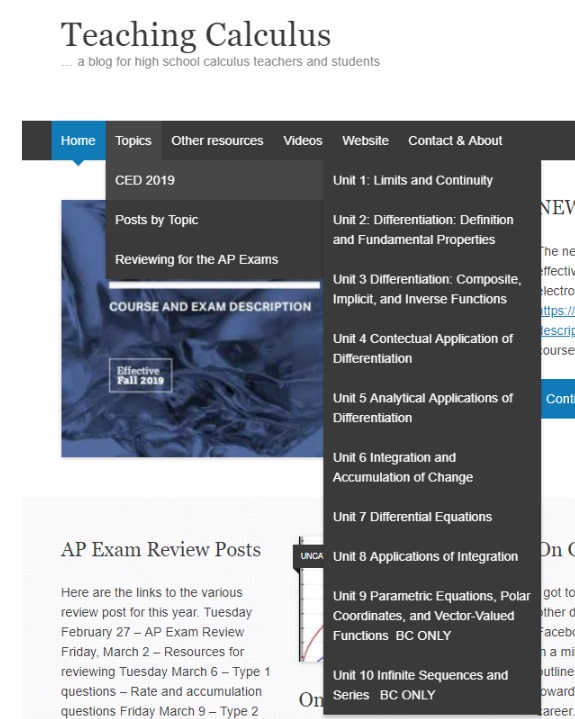
I have written a correlation between the topics in each unit and my blog posts. This can be found under the “Topics” tab in the menu bar at the top of the page (see figure below). The blog posts, written over the past 7 years, do not align perfectly with the topics and units. There are some posts that apply to several topics and some topics with (alas) no posts. I will update these with new posts from time to time and add any posts I’ve overlooked. I hope this will help you find your way around.

As always, I appreciate any feedback, suggestions, corrections etc.