A Lesson on Sequences

This blog post describes a lesson that investigates some ideas about sequences that are not stressed in the AP Calculus curriculum. The lesson could be an introduction to sequences. I think the lesson would work in an Algebra I course and is certainly suitable for a pre-calculus course. The investigation is of irrational numbers and their decimal representation. The successive decimal approximations to the square root of 2 is an example of a non-decreasing sequence that is bounded above and therefore converges.

Students do not need to know any of that as it will be developed in the lesson. Specifically, don’t even mention square roots, the square root of 2, or even irrational numbers until a student mention something of the sort.

This is not an efficient algorithm for finding square roots. There are far more efficient ways.

We begin with some preliminaries.

Preliminaries

  • There is a blank table that you can copy for students to use here.
  • There is a summary of the new terms used and completed table Sequence Notes. Do not give this out until after the lesson is completed.
  • We will be working with some rather long decimal numbers that will need to be squared. Scientific and graphing calculators usually compute with 14 digits and give their results rounded to 12 digits. Since ours will quickly get longer than that, I suggest you use WolframAlpha. This can be used with a computer online (at wolframalpha.com) or with an app available for smart phones and tablets. It is best if students have this website or app for their individual use.

Students will enter their numbers as shown below. Specifying “30 digits” will produces answers long enough for our purpose. To speed things up, students can edit the current number by changing the last digit in the entry line. When you get started you may have to show students how to do this. Students will need internet access.

  Computer                                                                                 Smart phone

The Lesson

The style of the lesson is Socratic. You, the teacher, will present the problem, explain how they are to go about it, and ask leading questions as appropriate. Some questions are suggested; be ready to ask others.  Later, you will have to explain (define) some new words, but as much as possible let the class suggest what to do. Drag things out of them, rather than telling them.

To begin – Produce some data

Explain to the class that they are going to generate and investigate two lists of numbers (technically called sequences). Each new member of the lists will be a number with one more decimal place than the preceding number.

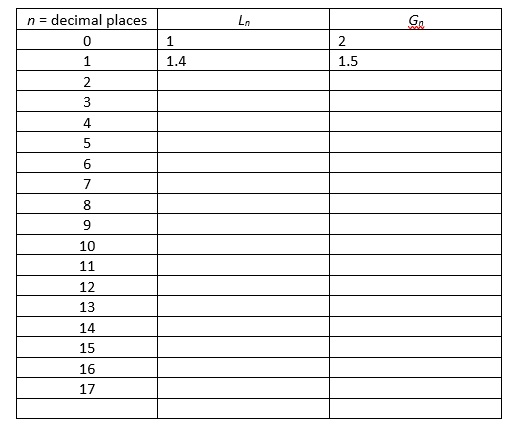
The first list, whose members are called Ln, will be the largest number with the given number of decimal places, n, whose square is less than two. The subscript, n, stands for the number of decimal places in the number.

Ask: “What is the largest integer whose square is less than 2?” Answer 1, so, L0 = 1. Ask: What is the largest one place decimal whose square is less than 2?”  Answer L1 =1.4.

The second list, Gn, will be the smallest number whose square is greater than 2. So, G0 = 2 and G1 = 1.5. Notice that 1.42 = 1.96 < 2 and 1.52 = 2.25 > 2

Divide the class into 10 groups named Group 0, Group 1, Group 2, …, Group 9. In each round the groups will append their “name” to the preceding decimal and square the resulting number. Group 0 squares 1.40, group 1, squares 1.41, group 2 squares 1.42, etc. using WolframAlpha.

Ask which groups have squares less than two and enter the largest in Ln, the next number will be the smallest number whose square is greater than 2; enter it in Gn.

Complete the table by entering the largest number whose square is less than 2 in the Ln column and the smallest number whose square is greater than 2 in the Gn column. At each stage, each group appends their digit to the most recent Ln . Project or write the table on the board. Students may fill in their own copy. A completed table is here: Sequence Notes and definitions
Next – Lead a discussion

When the table is complete, prompt the students to examine the lists and come up with anything and everything they observe whether it seems important or not. Accept and discuss each observation and let the others say what they think about each observation. (Obviously, don’t deprecate or laugh at any answer – after all at this point, we don’t know what is and is not significant.)

There are (at least) three observations that are significant to what we will consider next. Hopefully, someone will mention them; keep questioning them until they do. They are these, although students may use other terms:

  1. Ln is non-decreasing. Students may first say Ln is increasing. Pause if they do and look at L12 and L13, and L15 and L16. Ask how they know Ln is non-decreasing (because each time we add a digit on the end, you get a bigger number).
  2. Likewise, Gn is non-increasing.
  3. For all n, Ln < Gn, and the numbers differ only in the last digit, and with the last digits differing by 1.

Direct instruction: Explain these ideas and terms (definition)

  • A sequence is a list or set of numbers in a given order.
  • A sequence is bounded above if there exists a number greater than or equal to all the terms of the sequence. The smallest upper bound of a sequence is called its least upper bound (l.u.b.)
  • A sequence is bounded below if there exists a number less than or equal to all the terms of the sequence. The largest lower bound is called the greatest lower bound (g.l.b.)

More questions: Apply these terms to the sequence Ln with questions like these:

  • Is Ln bounded above, below, or not bounded? (Bounded above)
  • Give an example of a number greater than all the terms of Ln. (Many answers: 1,000,000, 4, 2, 1.415, etc. and, in fact, any and every number in Gn)
  • What is the l.u.b. of Ln? Can you think of the smallest number that is an upper bound of this sequence? (Yes, \sqrt{2}. Don’t tell them this – drag it out of them if necessary.) Why? How do you know this?
  • Make the class convince you that for all n, \displaystyle \underset{{n\to \infty }}{\mathop{{\lim }}}\,\left\{ {{{L}_{n}}} \right\}=\sqrt{2}

Ask similar questions about Gn.

  • Is Gn bounded above, below, or not bounded? (Bounded below)
  • Give an example of a number less than all the terms of Ln. (Many answers: any negative number, zero, 1, 1.414, etc. Any and every number in Ln)
  • What is the g.l.b. of Gn? Can you think of the greatest number that is a lower bound of this sequence? (Yes, \sqrt{2}) Why? How do you know this?
  • Make the class convince you that for all n, \displaystyle \underset{{n\to \infty }}{\mathop{{\lim }}}\,\left\{ {{{G}_{n}}} \right\}=\sqrt{2}


Summing Up

Ask, “What’s happening with the numbers in the Ln sequence?” and “What’s happening to the numbers in the Gn sequence?”

The answer you want is that they are getting closer to \sqrt{2}, one from below, the other from above. (As always, wait for a student to suggest this and then let the others discuss it.)

Once everyone is convinced, explain how mathematicians say and write, “gets closer to”:

Mathematicians say that \sqrt{2} is the limiting value (or limit) of both sequences. They write \displaystyle \underset{{n\to \infty }}{\mathop{{\lim }}}\,\left\{ {{{L}_{n}}} \right\}=\sqrt{2} and \displaystyle \underset{{n\to \infty }}{\mathop{{\lim }}}\,\left\{ {{{G}_{n}}} \right\}=\sqrt{2}.
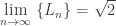
Explain very carefully that while n\to \infty is read, “n approaches infinity,” that infinity, \infty , is not a number. The symbol n\to \infty means that n gets larger without bound or that n gets larger than all (any, every) positive numbers.

In a more technical sense there is an infinite series \displaystyle \sum\limits_{{n=0}}^{\infty }{{{{a}_{n}}\cdot {{{10}}^{{-n}}}}} where \displaystyle {{a}_{n}} is one of the digits 0, 1, 2, 3, …, 9, but there is no formula for listing the values of \displaystyle {{a}_{n}}. However, the sequence of partial sum of this series is the sequence \displaystyle \left\{ {{{L}_{n}}} \right\} which converges to \displaystyle \sqrt{2}. Therefore, \displaystyle \sum\limits_{{n=0}}^{\infty }{{{{a}_{n}}\cdot {{{10}}^{{-n}}}=\sqrt{2}}}

\displaystyle \sqrt{2} is an Irrational number, but this same procedure may be used to find decimal approximation of roots of rational numbers as well. However, for Rational numbers, there are easier ways.

Finally, Irrational numbers are exactly those that cannot be written as repeating (or terminating) decimals. They “go on forever” with no pattern. The decimals you can calculate eventually stop and are rounded to the last digit. Even WolframAlpha and similar computers must eventually do this. Irrational numbers are the limits of sequences like the one we looked at today.

Exercises

  1. Follow the procedure above to find the sequence whose limit is \sqrt{{\frac{{16}}{{121}}}} . Find this number the usual way (simplify and use long division) and compare the results.
  2. Follow the procedure above to find the sequence whose limit is \sqrt{{0.390625}} . Find this number the usual way and compare the results.
  3. Using WolframAlpha determine if the computer is using Ln, Gn. both, or neither when it gives a value for \sqrt{2}. (Hint: enter “square root 2 to 5 digits” and change to 6, 7, and 8 digits; compare the answer with the sequences, you found.)

Answers:

  1. 0.363636…
  2. 0.625
  3. For n = 5 and 6 the numbers are from Ln, for n = 7 and 8 they are from Gn. WolframAlpha is using a different algorithm to compute the square root of 2; the numbers appear from both sequences due to the rounding of the answers. To see WolframAlpha’s algorithm type “square root algorithm” on the entry line. This method also produces a sequence of approximations a/b.

Revised July 28, 2021

Type 10: Sequences and Series Questions

The last BC question on the exams usually concerns sequences and series. The question usually asks students to write a Taylor or Maclaurin series and to answer questions about it and its interval of convergence, or about a related series found by differentiating or integrating. The topics may appear in other free-response questions and in multiple-choice questions. Questions about the convergence of sequences may appear as multiple-choice questions. With about 8 multiple-choice questions and a full free-response question this is one of the largest topics on the BC exams.

Convergence tests for series appear on both sections of the BC Calculus exam. In the multiple-choice section, students may be asked to say if a sequence or series converges or which of several series converge.

The Ratio test is used most often to determine the radius of convergence and the other tests to determine the exact interval of convergence by checking the convergence at the end points. Click here for a convergence test chart students should be familiar with; this list is also on the resource page.

Students should be familiar with and able to write several terms and the general term of a Taylor or Maclaurin series. They may do this by finding the derivatives and constructing the coefficients from them, or they may produce the series by manipulating a known or given series. They may do this by substituting into a series, differentiating it or integrating it.

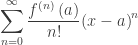
The general form of a Taylor series is \displaystyle \sum\limits_{n=0}^{\infty }{\frac{{{f}^{\left( n \right)}}\left( a \right)}{n!}{{\left( x-a \right)}^{n}}}; if a = 0, the series is called a Maclaurin series.

What Students Should be Able to Do 

  • Use the various convergence tests to determine if a series converges. The test to be used is rarely given so students need to know when to use each of the common tests. For a summary of the tests click: Convergence test chart.  and the posts “What Convergence Test Should I use?” Part 1 and Part 2
  • Understand absolute and conditional convergence. If the series of the absolute values of the terms of a series converges, then the original series is said to absolutely convergent (or converges absolutely). If the series of absolute values diverges, then the original series may or may not converge; if it converges it is said to be conditionally convergent.
  • Write the terms of a Taylor or Maclaurin series by calculating the derivatives and constructing the coefficients of each term.
  • Distinguish between the Taylor series for a function and the function. DO NOT say that the Taylor polynomial is equal to the function (this will lose a point); say it is approximately equal.
  • Determine a specific coefficient without writing all the previous coefficients.
  • Write a series by substituting into a known series, by differentiating or integrating a known series, or by some other algebraic manipulation of a series.
  • Know (from memory) the Maclaurin series for sin(x), cos(x), ex and \displaystyle \tfrac{1}{1-x} and be able to find other series by substituting into them.
  • Find the radius and interval of convergence. This is usually done by using the Ratio test and checking the endpoints.
  • Be familiar with geometric series, its radius of convergence, and be able to find the number to which it converges, \displaystyle {{S}_{\infty }}=\frac{{{a}_{1}}}{1-r}. Re-writing a rational expression as the sum of a geometric series and then writing the series has appeared on the exam.

  • Be familiar with the harmonic and alternating harmonic series. These are often useful series for comparison.
  • Use a few terms of a series to approximate the value of the function at a point in the interval of convergence.
  • Determine the error bound for a convergent series (Alternating Series Error Bound and Lagrange error bound). See my posts on Error Bounds and the Lagrange Highway
  • Use the coefficients (the derivatives) to determine information about the function (e.g. extreme values).

This list is quite long, but only a few of these items can be asked in any given year. The series question on the free-response section is usually quite straightforward. Topics and convergence test may appear on the multiple-choice section. As I have suggested before, look at and work as many past exam questions to get an idea of what is asked and the difficulty of the questions. Click on Power Series in the “Posts by Topic” list on the right side of the screen to see previous posts on Power Series or any other topic you are interested in.

Free-response questions:

  • 2004 BC 6 (An alternate approach, not tried by anyone, is to start with \displaystyle \sin \left( {5x+\tfrac{\pi }{4}} \right)=\sin (5x)\cos \left( {\tfrac{\pi }{4}} \right)+\cos (5x)\sin \left( {\tfrac{\pi }{4}} \right))
  • 2016 BC 6
  • 2017 BC 6

Multiple-choice questions from non-secure exams:

  • 2008 BC 4, 12, 16, 20, 23, 79, 82, 84
  • 2012 BC 5, 9, 13, 17, 22, 27, 79, 90,


The concludes the series of posts on the type questions in review for the AP Calculus exams.


Sequences

This is a BC topic.

SEQUENCES

Everyday series (1-17-2017) The most familiar series: Numbers

Amortization (2-9-2015) An important use of a (finite) series – Find you mortgage payment without calculus.

Convergence Test List A summary of the tests. Download and copy for your students (and yourself)

Which Convergence Test Should I Use? Part 1 (2-9-2018) You have a big choice

Which Convergence Test Should I Use? Part 2 (2-16-2018) Making the best choice.

REVIEW NOTES Type 10: Sequence and Series Questions (4-6-2018) A summary for reviewing sequences and series.


The College Board is pleased to offer a new live online event for new and experienced AP Calculus teachers on March 5th at 7:00 PM Eastern.

I will be the presenter.

The topic will be AP Calculus: How to Review for the Exam:  In this two-hour online workshop, we will investigate techniques and hints for helping students to prepare for the AP Calculus exams. Additionally, we’ll discuss the 10 type questions that appear on the AP Calculus exams, and what students need know and to be able to do for each. Finally, we’ll examine resources for exam review.

Registration for this event is $30/members and $35/non-members. You can register for the event by following this link: http://eventreg.collegeboard.org/d/xbqbjz


Good Question 14

Good Question 14 – The Integral Test

I have no criteria for what constitutes a “Good Question” for this series of occasional posts. They are just questions that I found interesting, or that seem more than usually instructive, or that I learn something from. I cannot quote this question (2016 BC 92) since it is on a secure exam. What made it interesting is that to answer it students pretty much needed to know the proof of the Integral Test and the figures that go with it.

I recall only one AP question from many years ago that asked students to “prove” something – usually students are asked to show that a result was true by citing the theorem that applied and showing the hypotheses were met. The directions are often “justify your answer.”

Doing an original proof is not, in my opinion, a fair question and proving some known theorem is just a matter of memorization. For these reasons, students are not asked to prove things on the exams. So, should you prove things in class? Probably, yes.

Here is the usual proof of the integral test. Afterwards I’ll discuss the question from the exam.

The Integral Test

Hypotheses: Let f\left( x \right) be a function that is positive, decreasing, and continuous for x\ge 1 ; and let {{a}_{n}}=f\left( n \right) for x\ge 1

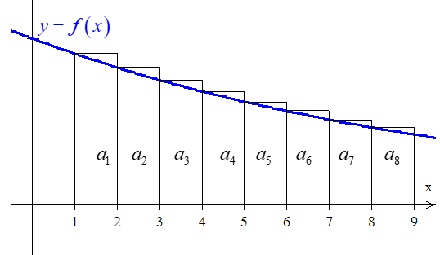
In the first drawing the rectangles have a height of an and a width of 1. The area is of each is an, and the sum of their areas the series is \sum\limits_{{n=1}}^{\infty }{{{{a}_{n}}}}.

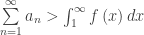
Part 1: Notice that \sum\limits_{{n=1}}^{\infty }{{{{a}_{n}}}}>\int_{1}^{\infty }{{f\left( x \right)dx}} Assume that the improper integral \int_{1}^{\infty }{{f\left( x \right)dx}} diverges.

  • Conclusion 1: If the improper integral \int_{1}^{\infty }{{f\left( x \right)dx}}  diverges, then the series \sum\limits_{{n=1}}^{\infty }{{{{a}_{n}}}} diverges.
  • Conclusion 2: (The contrapositive of conclusion 1) If the series \sum\limits_{{n=1}}^{\infty }{{{{a}_{n}}}} converges, then the improper integral \int_{1}^{\infty }{{f\left( x \right)dx}} converges.

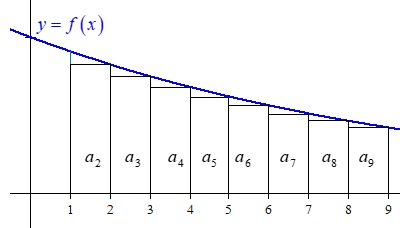
Part 2: In the second drawing below, assume that the improper integral \int_{1}^{\infty }{{f\left( x \right)dx}} converges. The sum of the areas of the rectangles is \sum\limits_{{n=2}}^{\infty }{{{{a}_{n}}}}. (NB: this series starts at n = 2.) Since \sum\limits_{{n=2}}^{\infty }{{{{a}_{n}}}} is less than the convergent improper integral it will also converge. Adding {{a}_{1}} to this gives the original series, \sum\limits_{{n=1}}^{\infty }{{{{a}_{n}}}}; this series also converges.

  • Conclusion 3: If the improper integral \int_{1}^{\infty }{{f\left( x \right)dx}} converges, then the series \sum\limits_{{n=1}}^{\infty }{{{{a}_{n}}}} converges.
  • Conclusion 4: (The contrapositive of conclusion 3) If the series   \sum\limits_{{n=1}}^{\infty }{{{{a}_{n}}}} diverges, then the improper integral \int_{1}^{\infty }{{f\left( x \right)dx}} diverges.

Putting the four conclusions together is the Integral Test: If the hypotheses above are met, then the series and the improper integral will both converge, or both diverge.


To answer the multiple-choice question (2106 BC 92) on the exams students were told that the improper integral converges. Therefore, the associated series converges. They then had to determine whether the series or the improper integral has the greater value. Stop here and see if you can figure that out.


Return to the first figure above, only this time assume that the improper integral and the series converge. It is pretty obvious that \sum\limits_{{n=1}}^{\infty }{{{{a}_{n}}}}>\int_{1}^{\infty }{{f\left( x \right)dx}}.

So, even though students were not asked to prove anything, a familiarity with the proof and its figures is necessary to answer the question. That’s why I liked it,

On the other hand, it is kind of an obscure point and I’m not sure it has any practical value.


More on Power Series

Continuing with post on sequences and series

New Series from Old 1 Rewriting using substitution

New Series from Old 2 Finding series by differentiating and integrating

New Series from Old 3  Rewriting rational expressions as geometric series

Geometric Series – Far Out A look at doing a question the right way and the “wrong” way?

Error Bounds The Alternating Series Error Bound and the Lagrange Error Bound

The Lagrange Highway An example explaining error bounds

Synthetic Summer Fun Using synthetic division, the Remainder Theorem, the Factor Theorem and finding the terms of a Taylor Series (Probably more than you want to know, but possibly an enrichment idea.)

Sequences and Series (Type 10 for BC only)

Convergence tests for series appear on both sections of the BC Calculus exam. In the multiple-choice section, students may be asked to say if a sequence or series converges or which of several series converge.

The Ratio test is used most often to determine the radius of convergence and the other tests to determine the exact interval of convergence by checking the convergence at the end points. Click here for a Convergence test chart students should be familiar with; this list is also on the resource page.

On the free-response section there is usually one full question devoted to sequences and series. This question usually involves writing a Taylor or Maclaurin polynomial for a series.

Students should be familiar with and able to write several terms and the general term of a series. They may do this by finding the derivatives and constructing the coefficients from them, or they may produce the series by manipulating a known or given series. They may do this by substituting into a series, differentiating it or integrating it.

The general form of a Taylor series is \displaystyle \sum\limits_{n=0}^{\infty }{\frac{{{f}^{\left( n \right)}}\left( a \right)}{n!}{{\left( x-a \right)}^{n}}}; if a = 0, the series is called a Maclaurin series.

What Students Should be Able to Do 

  • Use the various convergence tests to determine if a series converges. The test to be used is rarely given so students need to know when to use each of the common tests. For a summary of the tests click: Convergence test chart.
  • Write the terms of a Taylor or Maclaurin series by calculating the derivatives and constructing the coefficients of each term.
  • Distinguish between the Taylor series for a function and the function. Do NOT say that the Taylor polynomial is equal to the function (this will lose a point); say it is approximately equal.
  • Determine a specific coefficient without writing all the previous coefficients.
  • Write a series by substituting into a known series, by differentiating or integrating a known series, or by some other algebraic manipulation of a series.
  • Know (from memory) the Maclaurin series for sin(x), cos(x), ex and \displaystyle \tfrac{1}{1-x} and be able to find other series by substituting into them.
  • Find the radius and interval of convergence. This is usually done by using the Ratio test and checking the endpoints.
  • Be familiar with geometric series, its radius of convergence, and be able to find the number to which it converges, \displaystyle {{S}_{\infty }}=\frac{{{a}_{1}}}{1-r}. Re-writing a rational expression as the sum of a geometric series and then writing the series has appeared on the exam.
  • Be familiar with the harmonic and alternating harmonic series. These are often useful series for comparison.
  • Use a few terms of a series to approximate the value of the function at a point in the interval of convergence.
  • Determine the error bound for a convergent series (Alternating Series Error Bound and Lagrange error bound). See my post of  February 22, 2013.
  • Use the coefficients (the derivatives) to determine information about the function (e.g. extreme values).
  • Understand absolute and conditional convergence. If the series of the absolute values of the terms of a series converges, then the original series is said to absolutely convergent (or converges absolutely). If the series of absolute values diverges, then the original series may (or may not) converge; if it converges it is said to be conditionally convergent.


This list is quite long, but only a few of these items can be asked in any given year. The series question on the free-response section is usually quite straightforward. Topics and convergence test may appear on the multiple-choice section. As I have suggested before, look at and work as many past exam questions to get an idea of what is asked and the difficulty of the questions. Click on Power Series in the “Posts by Topic” list on the right side of the screen to see previous posts on Power Series.


The concludes the series of posts on the type questions in review for the AP Calculus exams.


Next Post

Friday April 7, 2017 The Domain of the solution of a differential equation.


Everyday Series

A Square Root

A Square Root

Our BC friends will soon be starting to teach series. Today, to emphasize that series are all around us, I would like to discuss series that we see every day: numbers.

Long ago I was taught that no one has ever seen a “number.” Have you ever seen a four? What we see are numerals, symbols or words that represent a number. These symbols come in two types: decimals and others. The others are better described as directions for finding the decimal representation. For example, ½ tells you to divide 1 by 2, that will give the decimal 0.5.

The place-value (decimal) representation of a number is a shortcut (and a nice one) for a series that gives the value of the number. Here 4203.876 is written as a finite series, or, if you prefer, an infinite series with the remaining terms all zero.

4203.876=4\left( {{10}^{3}} \right)+2\left( {{10}^{2}} \right)+0\left( {{10}^{1}} \right)+3\left( {{10}^{0}} \right)+8\left( {{10}^{-1}} \right)+7\left( {{10}^{-2}} \right)+6\left( {{10}^{-3}} \right)

Repeating decimals can also be written as infinite series. The first step is to follow the “directions” and divide 23 by 99:

\displaystyle \frac{23}{99}=0.23\overline{23}=\sum\limits_{n=1}^{\infty }{\left( 2\left( {{10}^{1-2n}} \right)+3\left( {{10}^{-2n}} \right) \right)}

Irrational numbers are a little different. What are they anyway? Where do they go on the number line? The decimal approximations will tell us that.

I will demonstrate a way of finding the decimals with a simple example \sqrt{2}. (There are many algorithms for doing this (see especially the digit-by-digit calculation), but it only applies to square roots and doesn’t really tell us what \sqrt{2} means.) The approach below lets us see what is going on.

The square root of two is the number that when multiplied by itself equals 2. The sequence 1, 1.4, 1.41, 1.414, 1.4142, 1.41421, 1.414213. … gives successively better approximation to \sqrt{2}.

Each successive number is found this way. At any place in the sequence the next number must one decimal place longer and end with one of the digits 0, 1, 2, 3, …, or 9.

Let’s try 6: 1.41421362 = 2.00000010642496 Too big!

So, let’s try 5: 1.41421352 = 1.99999982358225 Too small.

We’ll use the smaller one and then compute the next digit the same way: try digits until we find the largest digit that gives a square less than 2. (Or we could use the smallest digit that gives a result largest than 2; I’ll discuss that below.)

If we continue this way we will end up with a non-decreasing sequence, since putting a digit on the end always gives a slightly larger number, except for the digit zero which gives the same number. This series is also bounded (all the values are greater than 1 and less than 2).  Such a series must converge to its least upper bound. For this series, the least upper bound is the number we call \sqrt{2}; the number defined as \sqrt{2}.

Consider the series 2, 1.5, 1.42, 1,415, 1,4143, 1,41422, 1,414214, … in which each term has for its last digit one more than the corresponding term in the previous series above. This series is non-increasing and bounded, and, therefore, converges to its greatest lower bound, the same number \sqrt{2}.

In a way, these series define \sqrt{2}.

This is not a very efficient way to find values. Some irrational numbers, like π or e, cannot be found this way. But that is not the point. The point is that all numbers have a decimal representation. This decimal representation is a shorthand way of writing the finite or infinite series that converges to the number. Since we cannot write all the decimals for many numbers, the decimal form gives a series of gives better and better approximations.

So sequences and series are all around us every day.


A more formal approach goes like this. Let {{S}_{k}} be the k-place decimal found as described above for the first series. Then {{S}_{k}}+{{10}^{-k}} will be the k­-place decimal whose last digit is one more than the last digit of {{S}_{k}} . Then {{S}_{k}}^{2}<2<{{\left( {{S}_{k}}+{{10}^{-k}} \right)}^{2}} and {{S}_{k}}<\sqrt{2}<{{S}_{k}}+{{10}^{-k}},. This implies 0<\sqrt{2}-{{S}_{k}}<{{10}^{-k}}. Since {{10}^{-k}} can be made as small as we want, \underset{k\to \infty }{\mathop{\lim }}\,\left( \sqrt{2}-{{S}_{k}} \right)=0 and \underset{k\to \infty }{\mathop{\lim }}\,{{S}_{k}}=\sqrt{2}. The series converges to \sqrt{2}.


How the mind works (or at least how my mind works when it’s working):

None of this is original to me. Maybe I learned it years ago in college or graduate school; if so, I had forgotten it long ago. Four or five years ago while I was living in Texas, I started reading Calculus Deconstructed – A Second Course in First-year Calculus by Zbigniew Nitecki. He discusses this approach in a much more formal way without the example. In thinking about writing on this topic recently, I outlined the example above in my head (which is what I do when I’m trying to fall asleep). You can see where I ended up. While nothing like Nitecki’s work, it is the same idea.

I find this strange and fascinating: I absorbed that and put it all together in a different way without thinking about it in the intervening years. Strange how the mind works.


Coming soon:

  • Jan 24th, Logistic Growth – Real and Simulated
  • Jan 31st, The Logistic Equation
  • Feb 7th, Graphing Taylor Polynomials
  • Feb 14th,  Geometric Series – Far Out