

The question below appears in the new Course and Exam Description (CED) for AP Calculus, and has caused some questions since it is not something included in most textbooks and has not appeared on recent exams.
Example 1
Which of the following integral expressions is equal to
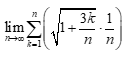
There were 4 answer choices that we will consider in a minute.
To the best of my recollection the last time a question of this type appeared on the AP Calculus exams was in 1997, when only about 7% of the students taking the exam got it correct. Considering that by random guessing about 20% should have gotten it correct, this was a difficult question. This question, the “radical 50” question is at the end of this post.
The first key to answering the question is to recognize the limit as a Riemann sum. In general, a right-side Riemann sum for the function f on the interval [a, b] with n equal subdivisions has the form:

To evaluate the limit and express it as an integral, we must identify, a, b, and f. I usually begin by looking for (b – a)/n. In this problem (b – a)/n = 1/n and from this conclude that b – a = 1, so b = a + 1.
Then rewriting the radicand as
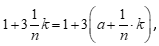
It appears that the function is

and the limit is
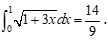
.This is the first answer choice. The choices are:

In this example, choices B, C, and D can be eliminated as soon as we determine that b = a + 1, but that is not always the case.
Let’s consider another example:
Example 2:
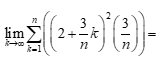
As before consider (b – a)/n = 3/n implies that b = a + 3. And the function appears to be

on the interval [0, 3], so the limit is
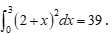
BUT
What is we take a = 2. If so, the limit is

And now one of the “problems” with this kind of question appears: the answer written as a definite integral is not unique!
Not only are there two answers, but there are many more possible answers. These two answers are horizontal translations of each other, and many other translations are possible, such as
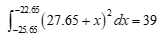
Returning to example 1, using something like a u-substitution, we can rewrite the original limit as .
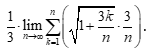
Now b = a + 3 and the limit could be either
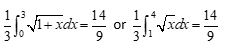
You will probably have your students write Riemann sums with a small value of n when you are teaching Riemann sums leading up to the Fundamental Theorem of Calculus. You can make up problems like this these by stopping after you get to the limit, giving your students just the limit, and have them work backwards to identify the function(s) and interval(s). You could also give them an integral and ask for the associated Riemann sum. Question writes call a question like this a reversal question, since the work is done in reverse of the usual way.
Another example appears in the 2016 “Practice Exam” available at your audit website. It is question AB 30. That question gives the definite integral and asks for the associate Riemann sum; a slightly different kind of reversal. Since this type of question appears in both the CED examples and the practice exam, chances of it appearing on future exams look good.
Critique of the problem
I’m not sure if this type of problem has any practical or real-world use. Certainly, setting up a Riemann sum is important and necessary to solve a variety of problems. After all, behind every definite integral there is a Riemann sum. But starting with a Riemann sum and finding the function and interval does not seem to me to be of practical use.
The CED references this question to MPAC 1: Reasoning with definitions and theorems, and to MPAC 5: Building notational fluency. They are appropriate, but still is the question ever done outside a test or classroom setting?
Another, bigger, problem is that the answer choices to Example 1 force the student to do the problem in a way that gets one of the answers. It is perfectly reasonable for the student to approach the problem a different way, and get another correct answer that is not among the choices. This is not good. The question could be fixed by giving the answer choices as numbers. These are the numerical values of the 4 choices:

As you can see that presents another problem.
Finally, here is the question from 1997, for you to try:
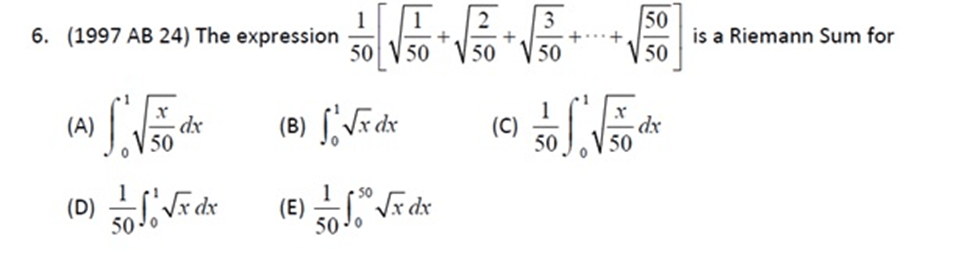
Answer B. Hint n = 50
_______________________________
Note: The original of this post was lost somehow. I’ve recreated it here. Sorry if anyone was inconvenienced. LMc May 5, 2024
 Teaching Calculus