A large amount of time in Unit 10 is devoted to convergence tests. These tests tell you under what conditions a series will converge, when the infinite sum will approach a finite number.
The tests are really theorems. As with all theorems, you should learn and understand the hypotheses. This summery of the convergence tests lists the hypotheses of the tests that you are expected to know for the AP Calculus BC exam. The conclusion (at the top) is always that the series will converge or will not converge. You will likely spend a day or two on each test, learning how and when to use it. Use the summary to help you.
Some series have both addition and subtraction signs between the terms (often alternating). A series is said to be absolutely convergent or to converge absolutely if the series of absolute values of its terms converges. In effect, this means you may determine convergence by ignoring the minus signs. If a series converges absolutely, then it converges. This is an important way that many alternating series and series with some minus signs may be tested for convergence. If a series does not converge absolutely, it may still converge. In this case the series are said to be conditionally convergent.
Your goals is to learn which test to use and when to use it. The short answer is that you may use whichever test works. There is often more than one. Here are two blog posts discussing this. Read these after you’ve learned the convergence tests (but before your teacher’s test). The first post shows how different tests may be used on the same series. The second post gives hints on which test to try first. The key is the standard advice: Practice. Practice. Practice.
The polynomial function approximates the value of correct to 5 decimal places:
This is not a fluke!
The graph of f(x) is in blue, the sin(x) in red. Note how close the two graphs are in the interval [-2, 2]
Now, approximating the value of a sine function is easier with a calculator. But sines are not the only functions in Math World.
In the Unit 10 you will learn how to write special polynomial functions, called Taylor and Maclaurin polynomials, to approximate any differentiable function you want to as many decimal places as you need. You already know a lot about polynomials. They are easy to understand, evaluate, and graph. The concept of using a polynomial to approximate much more complicated functions is very powerful.
You’ve already got a start on this! Recall that the local linear approximation of a function near x = a is . This is a Taylor Polynomial. And it is the first two terms all the higher degree Taylor polynomial for f near x = a.
To fully understand these polynomials, there is a fair amount of preliminary stuff you need to understand. First you study sequences – functions whose domains are whole numbers. Next comes infinite series. A series is written by adding the terms of a sequence. (Sequences and series may have a finite or infinite number of terms. There is not much to say about finite series; infinite sequences and infinite series are where the action is.) oThe terms 0f some sequences and series are numbers. Other series have powers of an independent variable; these are called power series.
Some power series approximate (converge to) the related function everywhere (i. e. for all Real numbers). Others provide a good approximation only on an interval of finite length. The intervals where the approximation is good is called the interval of convergence. Convergence tests – theorems really – help you determine if a series converges. These in tern help you find the interval of convergence. More on this in my next post.
Depending on your textbook and your teacher, you may study these topics in this order: sequences, convergence test, series, Taylor and Maclaurin polynimials for approximations, and power series. Others may change the order. The path may be different, but the destination will be the same.
Course and Exam Description Unit 10, Sections 10.1, 10.2, 10.11, 10.13, 10.14, 10.15. This is a BC only topic.
At first glance, the topic of series seems to be something encountered late in the year of a BC Calculus course. But everyone uses series any time they use numbers, which is to say very often. Let’s look at this particularly important series.
The way numerals were written way back when was clumsy. If you don’t believe me, try multiplying or dividing with Roman Numerals. Around AD 1200, Leonardo of Pisa introduce the Hindu-Arabic system for writing numbers to Europe. He learned this system during his travels in the Middle East. Leonardo is also known as Fibonacci although he was not given that name until the 1500s. While he is better known for his famous sequence, I think improving the way numbers are written is a much more important contribution to mathematics (even though it would have caught on eventually). This is the system used world-wide today.
A page of Fibonacci’s Liber Abaci from the Biblioteca Nazionale di Firenze showing (in box on right) the Fibonacci sequence with the position in the sequence labeled with Latin numbers and Roman numerals (black) and the value in Hindu-Arabic numerals (red). (Some numerals are slightly different than those in use today.)
Hindu – Arabic notation is a shorthand for a series, sometimes finite, often infinite. It is a sophisticated idea when thought of in modern terms. This “new” system is a place-value system: the value of each digit depends on its position relative to the decimal point, defined by a sequence. For example,
This notation has advantages over other methods of denoting numbers. The decimal representation of a number is unique (well almost, as we’ll see below), whereas every Rational number may be written as many different fractions. Certainly, makes computation easier. It also makes finding approximations and arranging numbers in order easier than writing them as fractions.
But other things also happen.
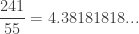
The Hindu-Arabic decimal system revealed that all Rational numbers written in this notation are repeating decimals. A repeating decimal is an expression containing a string of one or more digits that repeated forever. For example, 1/3 = 0.333333… with the “3” repeating forever and with “18” string repeating forever. (Some numbers repeat zeros forever; they are a special case called terminating decimals.)
The decimal form of a fraction may be found by using the division algorithm. Since only those numbers less than the divisor may appear as “remainders,” eventually one of them will appear again after which the succeeding digits will repeat.
Conversely, any repeating or terminating decimal can be written as a quotient of integers. This example shows the procedure.
Let
Then
Subtracting the first from the second
So, all the Rational numbers can be written as a repeating or terminating decimal, and conversely all repeating or terminating decimals are Rational numbers. Numbers that cannot be written as repeating or terminating decimals are exactly the Irrational numbers.
An Irrational Number – the Diagonals of a Square
The length of the diagonals of a square is a non-repeating decimal. That is, the length must be expressed as an infinitely long decimal that contains no string of digits that repeats. is an Irrational Number and there are a lot of others like it!
By the Pythagorean Theorem the diagonals of a square with sides of one unit have a length denoted by – the number whose square is 2. In a previous post, I showed a way, one of several, to find closer and closer decimal approximations to . The table below shows the results.
n = decimal places
Ln <
Gn >
0
1
2
1
1.4
1.5
2
1.41
1.42
3
1.414
1.415
4
1.4142
1.4143
5
1.41421
1.41422
6
1.414213
1.414214
7
1.4142135
1.4142136
8
1.41421356
1.41423157
9
1.414213562
1.414213563
10
1.4142135623
1.4142135624
11
1.41421356237
1.41421356238
12
1.414213562373
1.414213562374
13
1.4142135623730
1.4142135623731
14
1.41421356237309
1.41421356237310
15
1.414213562373095
1.414213562373096
16
1.4142135623730950
1.4142135623730951
17
1.41421356237309504
1.41421356237309505
Each number in list Ln was produced by taking the preceding number and affixing the digits 0, 1, 2, … , 9 to it, squaring that number, and finding the largest whose square was less than 2. The Gnis the next number, the smallest number with a square greater than 2. The numbers in Ln have squares less than 2; the numbers in Gn have squares greater than 2.
The Ln list is a sequence of numbers that has two important properties easily seen from how it was developed: (1) it is non-decreasing – each number is greater than or occasionally equal to the preceding number because each time we append an extra digit we get a greater number, and (2) the list is bounded above – the numbers never exceed 100, or 15, or , or 2, or in fact any number from the Gn list. The smallest number they never exceed is . We know this because this is how the list was developed.
The number that’s between the two lists is the number we’re looking for is , but we can never find an “exact” decimal representation. The two lists give better and better approximations to . They close in on it. But neither gets there.
So, how do we know that number exists?
The Axiom of Completeness
All the decimal numbers, the Rational Numbers, and the Irrational Numbers (and no others), make up a set called the Real Numbers.
If this list above can be continued forever, it will never get to . To handle this kind of situation a new rule (called an axiom) was imposed.
The Axiom of Completeness: Every non-decreasing sequence of Real numbers that is bounded above converges to – gets closer and closer to – its least upper bound.
Since this is an axiom, it is not proved; it is just accepted as fact.
The axiom says that even though there is no decimal to represent it, the number nevertheless exists.
Someone made the axiom up. This is very different than observing and naming a property of numbers like the commutative property or the associative property. It doesn’t have to be true, but it seems very reasonable, and no one has ever found a counterexample. [1]
In the example, the least upper bound is . How do we know that? Because that’s what we made the sequence to do. Any other method of “finding” , and there are many, gives us, not just the same kind of thing, but the exact same list! Creepy, isn’t it?
Thus,
Not only are all Irrational Numbers handled the same way, but all repeating decimals are also. They never repeat digits and, however you find their decimal approximations, the same thing happens: you have a non-increasing sequence of numbers that is bounded above and, by the Axiom of Completeness, converges to the fraction.
I mentioned above that the Hindu-Arabic system gives a unique expression for every number. Not quite. Consider 1/3 = 0.3333333 …. Since three times one-third is one, it must be that 3 times this decimal which is 0.9999999…. = 1.
At first, I disliked decimals because they were not “exact.” I got over that. For the cost of the Axiom of Completeness, we have a system for writing numbers that makes computation easy (if, often, only to a very good approximation). It’s worth the cost.
But does exist? Is it really there?
[1] As a corollary to the axiom, there is a theorem that says a non-increasing sequence that is bounded below, such as Gn, converges to its greatest lower bound, again .
AP Questions Type 10: Sequences and Series (BC Only)
The last BC question on the exams usually concerns sequences and series. The question may ask students to write a Taylor or Maclaurin series and to answer questions about it and its interval of convergence, or about a related series found by differentiating or integrating. The topics may appear in other free-response questions and in multiple-choice questions. Questions about the convergence of sequences may appear as multiple-choice questions. With about 8 multiple-choice questions and a full free-response question this is one of the major topics on the BC exams.
Convergence tests for series appear on both sections of the BC Calculus exam. In the multiple-choice section, students may be asked to say if a sequence or series converges or which of several series converge.
The Ratio test is used most often to determine the radius of convergence and the other tests to determine the exact interval of convergence by checking the convergence at the end points. Click here for a convergence test chart students should be familiar with; this list is also on the resource page.
Students should be familiar with and able to write a few terms and the general term of a Taylor or Maclaurin series. They may do this by finding the derivatives and constructing the coefficients from them, or they may produce the series by manipulating a known or given series. They may do this by substituting into a series, differentiating it, or integrating it.
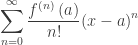
The general form of a Taylor series is ; if a = 0, the series is called a Maclaurin series.
What Students Should be Able to Do
Use the various convergence tests to determine if a series converges. The test to be used is rarely given so students need to know when to use each of the common tests. For a summary of the tests click: Convergence test chart. and the posts “What Convergence Test Should I use?” Part 1 and Part 2. In 2022 BC 6 (a) students were asked to state the condition (hypotheses) of the convergence test they were asked to use.
Understand absolute and conditional convergence. If the series of the absolute values of the terms of a series converges, then the original series is said to be absolutely convergent (or converges absolutely). If a series is absolutely convergent, then it is convergent. If the series of absolute values diverges, then the original series may or may not converge; if it converges it is said to be conditionally convergent.
Write the terms of a Taylor or Maclaurin series by calculating the derivatives and constructing the coefficients of each term.
Distinguish between the Taylor series for a function and the function. DO NOT say that the Taylor polynomial is equal to the function (this will lose a point); say it is approximately equal.
Determine a specific coefficient without writing all the previous coefficients.
Write a series by substituting into a known series, by differentiating or integrating a known series, or by some other algebraic manipulation of a series.
Know (from memory) the Maclaurin series for sin(x), cos(x), ex and and be able to find other series by substituting into one of these.
Find the radius and interval of convergence. This is usually done by using the Ratio test to find the radius and then checking the endpoints. for a geometric series, the interval of convergences is the open interval where r is the common ration of the series.
Be familiar with geometric series, its radius of convergence, and be able to find the number to which it converges, . Re-writing a rational expression as the sum of a geometric series and then writing the series has appeared on the exam.
Be familiar with the harmonic and alternating harmonic series. These are often useful series for comparison.
Use a few terms of a series to approximate the value of the function at a point in the interval of convergence.
Determine the error bound for a convergent series (Alternating Series Error Bound or Lagrange error bound). See my posts on Error Bounds and the Lagrange Highway
Use the coefficients (the derivatives) to determine information about the function (e.g., extreme values).
This list is quite long, but only a few of these items can be asked in any given year. The series question on the free-response section is usually quite straightforward. Topics and convergence tests may appear on the multiple-choice section. As I have suggested before, look at and work as many past exam questions to get an idea of what is asked, how it is a sked, and the difficulty of the questions. Click on Power Series in the “Posts by Topic” list on the right side of the screen to see previous posts on Power Series or any other topic you are interested in.
Free-response questions:
2004 BC 6 (An alternate approach, not tried by anyone, is to start with ). See Good Question 16
2011 BC 6 (Lagrange error bound)
2016 BC 6
2017 BC 6
2019 BC 6
2021 BC 5 (a)
2021 BC 6 – note that in (a) students were required to state the conditions of the convergence test they were asked to use.
2022 BC 6 – Ratio test, interval of conversion with endpoint analysis, Alternating series error bound, series for derivative, geometric series.
2023 BC 6 – Taylor polynomials, Lagrange error bound
Here is a list of past posts on the topics of sequences and series that I hope you find interesting and useful. The first two are suitable for precalculus students.
The first uses sequences and series for a very practical aim that affects almost everyone sometime in their life: paying off a loan. The next gives a good, and I hope, understandable explanation of what an irrational number is.
Amortization. When you have a mortgage on your home or your car, you make the same payment every month. Part of the money pays the interest on the outstanding balance for the last month; the rest pays down the principal so there is less to pay interest on next month. How is the payment computed?
A Lesson on Sequences. What is the square root of two? Really, what is it? This post is an outline of a lesson finding a sequence of numbers that converges to a specific number known in advance and by doing so defines that number.
The next three posts deal with convergences tests and are of interest to BC students at this time of year.
Reference Chart. An outline of the various convergence tests, and their hypotheses (when you can use them).
These two posts answer the question in their titles:
Unit 10 covers sequences and series. These are BC only topics (CED – 2019 p. 177 – 197). These topics account for about 17 – 18% of questions on the BC exam.
Topic 10.1: Defining Convergent and Divergent Series.
Topic 10. 2: Working with Geometric Series. Including the formula for the sum of a convergent geometric series.
Topics 10.3 – 10.9 Convergence Tests
The tests listed below are assessed on the BC Calculus exam. Other methods are not tested. However, teachers may include additional methods.
Topics 10.10 – 10.12 Taylor Series and Error Bounds
Topic 10.10: Alternating Series Error Bound.
Topic 10.11: Finding Taylor Polynomial Approximations of a Function.
Topic 10.12: Lagrange Error Bound.
Topics 10.13 – 10.15 Power Series
Topic 10.13: Radius and Interval of Convergence of a Power Series. The Ratio Test is used almost exclusively to find the radius of convergence. Term-by-term differentiation and integration of a power series gives a series with the same center and radius of convergence. The interval may be different at the endpoints.
Topic 10.14: Finding the Taylor and Maclaurin Series of a Function. Students should memorize the Maclaurin series for , sin(x), cos(x), and ex.
Topic 10.15: Representing Functions as Power Series. Finding the power series of a function by differentiation, integration, algebraic processes, substitution, or properties of geometric series.
Timing
The suggested time for Unit 9 is about 17 – 18 BC classes of 40 – 50-minutes, this includes time for testing etc.
Previous posts on these topics:
Before sequences
Amortization Using finite series to find your mortgage payment. (Suitable for pre-calculus as well as calculus)
A Lesson on Sequences. An investigation, which could be used as early as Algebra 1, showing how irrational numbers are the limit of a sequence of approximations. Also, an introduction to the Completeness Axiom.
Nine of nine. We continue our look at the 2021 free-response questions. We will look at ways to adapt, expand, and explore this question to help students better understand it and look at other questions that can be asked based on a similar stem.
2021 BC 6
This is a Sequence and Series (Type 10) question. Typically the topic of the last question on the BC exam, it tests the concepts in Unit 10 of the current Calculus Course and Exam Description. This year the previous question, 2021 BC 5, asked students to write a Taylor Polynomial. This question covers other related topics: convergence tests, radius of convergence, and the error bound.
There is a nuance here. In past years students were not asked to give the conditions for a convergence test and were expected to determine which test to use for themselves. I think the idea here, and perhaps going forward (?), is to make sure the students have considered the conditions necessary to use a test. This is in keeping with other questions where the hypotheses of the theorem students were using had to be checked (Cf. recent L’Hospital’s Rule questions).
Part (a): Students were asked to give the conditions for the integral test and use it to determine if a different series, converges.
Discussion and ideas for adapting this question:
Be sure your students know the conditions necessary for each convergence test. Phrase your questions as this one is phrased – at least sometimes.
Ask students to state the conditions for any convergence they use.
Discuss which tests (often plural) can be used for each series you study.
Make sure students can decide for themselves which test to use in case next year’s questions do not tell them.
Ask what other test(s) may be used with this series (Hint: the series is geometric). This is a question to ask for any series you study.
Part (b): Students are told to use the series from part (a) with the limit comparison test to show that the given series converges absolutely when x = 1. Again, students were asked to use a specific test. Notice that even if a student could not do part (a), they were not shut out of part (b).
Discussion and ideas for adapting this question:
Since you cannot count on being told which test to use for comparison, be sure to discuss how to decide which test(s) can be used with each series. Again see “Which Convergence Test Should I use?” Part 1 and Part 2.
Show students that proving absolute convergence is often a good way to eliminate the need for dealing with alternating series and other series with negative signs.
Part (c): Students were asked for the radius of convergence of the series. A standard question done by using the Ratio test.
Discussion and ideas for adapting this question:
The only extension here is to determine the interval of convergence, by checking the endpoints.
Part (d): Students were asked for the alternating series error bound using the first two terms to approximate the value of g(1). Even though there are only two error bounds students are expected to be able to compute (the other is the Lagrange error bound), students were again told which one to use. The result was not expected to be expressed as a decimal.
Discussion and ideas for adapting this question:
First, have students check that the conditions for using the alternating series error bound are met.
Increase the number of terms to be used.
Ask students to find the Lagrange error bound and compare the results.
This post on the series question concludes the series of posts (pun intended) considering how to expand and adapt the 2021 AP Calculus free-response questions. I hope you found them helpful.
As always, I happy to hear your ideas for other ways to use this question. Please share your thoughts and ideas.

 approximates the value of
  correct to 5 decimal places:


 . This is a Taylor Polynomial. And it is the first two terms all the higher degree Taylor polynomial for f near x = a.

 with “18” string repeating forever. (Some numbers repeat zeros forever; they are a special case called terminating decimals.)



 is an Irrational Number and there are a lot of others like it!
 , or 2, or in fact any number from the Gn list. The smallest number they never exceed is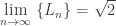
 ; if a = 0, the series is called a Maclaurin series.
 and be able to find other series by substituting into one of these.
 where r is the common ration of the series.
 . Re-writing a rational expression as the sum of a geometric series and then writing the series has appeared on the exam.
 ). See
  , sin(x), cos(x), and ex.
 converges.
  Teaching Calculus