Power Series 2

This is a BC topic

Good Question 16 (11-30-2018) What you get when you substitute.

Geometric Series – Far Out (2-14-2017) A very interesting and instructive mistake

Synthetic Summer Fun (7-10-2017) Finding the Taylor series coefficients without differentiating

Error Bounds (2-22-2013) The alternating series error bound, and the Lagrange error bound

The Lagrange Highway (5-20-15) a metaphor for the error bound

REVIEW NOTES Type 10: Sequence and Series Questions (4-6-2018) A summary for reviewing sequences and series.


Power Series 1

This is a BC topic

POWER SERIES (Maclaurin series and Taylor series)

Introducing Power Series 1 (2-8-2013) Making better approximations

Introducing Power Series 2 (2-11-2013) Graphing and seeing the interval of convergence

Introducing Power Series 3 (2-13-2013) Questions pointing the way to power series

Graphing Taylor Polynomials (2-7-2017) Using a graphing calculator to graphs Taylor series

New Series from Old 1 (2-15-2013) Substituting

New Series from Old 2 (2-18-2013) Differentiating and Integrating

New Series from Old 3 (2-20-2013) Rational functions as geometric series

REVIEW NOTES Type 10: Sequence and Series Questions (4-6-2018) A summary for reviewing sequences and series.


The College Board is pleased to offer a new live online event for new and experienced AP Calculus teachers on March 5th at 7:00 PM Eastern.

I will be the presenter.

The topic will be AP Calculus: How to Review for the Exam:  In this two-hour online workshop, we will investigate techniques and hints for helping students to prepare for the AP Calculus exams. Additionally, we’ll discuss the 10 type questions that appear on the AP Calculus exams, and what students need know and to be able to do for each. Finally, we’ll examine resources for exam review.

Registration for this event is $30/members and $35/non-members. You can register for the event by following this link: http://eventreg.collegeboard.org/d/xbqbjz


Good Question 16

I had an email last week from a teacher asking, how come I can use a substitution to find a power series for  \cos \left( {2x} \right), and for  {{e}^{{\left( {x-1} \right)}}}, but not for  \cos \left( {3x+\frac{\pi }{6}} \right)?

The answer is that you can. Substituting (2x) into the cosine’s series give you a Taylor series centered at x = 0, a Maclaurin Series. Substituting (x – 1) into the series for ex gives you a Taylor series centered at x = 1. And substituting \left( {3x+\frac{\pi }{6}} \right) into the cosine series gives you a Taylor series centered at  x=-\frac{\pi }{{18}}. I suspect that she was hoping for or was asked to find a Maclaurin series, not one with such a strange center.

The center of a Taylor series is the value of x that makes its argument zero.

AP Exam Question 2004 BC 6(a)

This brought to mind the AP Exam question 2004 BC 6(a) where students were asked to write the third-degree Taylor polynomial about x = 0 for the function f\left( x \right)=\sin \left( {5x+\frac{\pi }{4}} \right). The intended method was for students to find the first three derivative and substitute them into the general form for a Taylor series. That’s what students who got this correct did. This is the only time I can remember when students were expected to do that; usually they manipulate a given series or substitute into a known series.

A number of students tried to substitute \left( {5x+\frac{\pi }{4}} \right) into the series for the sine. This gets a very nice Taylor series centered at  x=-\frac{\pi }{{20}}. This earned no credit since a Maclaurin series was required.

But there is another way! (I originally wrote, “But there is an easier way!” but it’s only easier if you see how to do it.)

Trigonometry to the Rescue!

\sin \left( {5x+\frac{\pi }{4}} \right)=\sin (5x)\cos \left( {\frac{\pi }{4}} \right)+\cos \left( {5x} \right)\sin \left( {\frac{\pi }{4}} \right)=\frac{{\sqrt{2}}}{2}\left( {\sin \left( {5x} \right)+\cos \left( {5x} \right)} \right)

Then using the first two terms each from the series for sine and cosine you get the correct answer:

\displaystyle \frac{{\sqrt{2}}}{2}\left( {\left( {5x-{{{\frac{{\left( {5x} \right)}}{{3!}}}}^{3}}} \right)+\left( {1-\frac{{{{{\left( {5x} \right)}}^{2}}}}{{2!}}} \right)} \right)=\frac{{\sqrt{2}}}{2}+\frac{{5\sqrt{2}}}{2}x-\frac{{25\sqrt{2}}}{{2\left( {2!} \right)}}{{x}^{2}}-\frac{{125\sqrt{2}}}{{2\left( {3!} \right)}}{{x}^{3}}

This brings us to \cos \left( {3x+\frac{\pi }{6}} \right), which can be approached the same way. Here is the entire Maclaurin series.

\cos \left( {3x+\frac{\pi }{6}} \right)=\cos \left( {3x} \right)\cos \left( {\frac{\pi }{6}} \right)-\sin \left( {3x} \right)\sin \left( {\frac{\pi }{6}} \right)

\displaystyle =\frac{{\sqrt{3}}}{2}\cos \left( {3x} \right)-\frac{1}{2}\sin \left( {3x} \right)

\displaystyle =\frac{{\sqrt{3}}}{2}\sum\limits_{{n=0}}^{\infty }{{\frac{{{{{\left( {3x} \right)}}^{{2n}}}}}{{\left( {2n} \right)!}}}}-\frac{1}{2}\sum\limits_{{n=0}}^{\infty }{{\frac{{{{{\left( {3x} \right)}}^{{2n+1}}}}}{{\left( {2n+1} \right)!}}}}

\displaystyle =\sum\limits_{{n=0}}^{\infty }{{\left( {\frac{{\sqrt{3}\left( {{{3}^{{2n}}}} \right)}}{{2\left( {2n} \right)!}}{{x}^{{2n}}}-\frac{{1\left( {{{3}^{{2n+1}}}} \right)}}{{2\left( {2n+1} \right)!}}{{x}^{{2n+1}}}} \right)}}

Moral: Trig can be very useful.

Here is a previous post, Geometric Series – Far Out, that shows a “mistake” you may find interesting.


Introducing Power Series

The posts for the next several weeks will be on topics tested only on the BC Calculus exams. Continuing with some posts on introducing power series (the Taylor and Maclaurin series)

Introducing Power Series 1 Two examples to lead off with.

Introducing Power Series 2 Looking at the graph of a power series foreshadows the idea of the interval of convergence.

Introducing Power Series 3 The Taylor Approximating Polynomial with examples of using a series to approximate.

Graphing Taylor Polynomials Graphing calculator hints.


Synthetic Summer Fun

Today, for some summer fun, let’s look at synthetic division a/k/a synthetic substitution. I’ll assume you all know how to do that since it is a pretty common pre-calculus topic and even comes up again in calculus.

Why Does Synthetic Division Work?

An example: consider the polynomial

P(x)=2{{x}^{4}}-3{{x}^{3}}-11{{x}^{2}}+14x-1.

This can be written in nested form like this

P(x)=((((2x-3)x-11)x+14)x-1)

To evaluate this last expression at, say x = 2, we do the arithmetic as follows:

  1.   2 x 2 – 3 = 1
  2.   2 x 1 – 11 = –9
  3.   2 x (–9) + 14 = –4
  4.   2 x (–4) – 1 = – 9 = f(2)

Notice that this requires only multiplication and addition or subtraction, no raising to powers. More to the point, this is the same arithmetic, in the same order when you do the evaluation by synthetic division, and the work is a little easier to keep track of.

\begin{matrix} {} & 2 & -3 & -11 & 14 & -1 \\ 2) & 2 & 1 & -9 & -4 & -9 \\ \end{matrix}\begin{matrix} {} \\ \,=P(2) \\ \end{matrix}

Synthetic division has another advantage: the other numbers in the second row are the coefficients of a quotient polynomial, a polynomial of one less degree that the original. So,

\displaystyle \frac{P(x)}{x-2}=2{{x}^{3}}+{{x}^{2}}-9x-4+\frac{-9}{x-2}

The Remainder Theorem and the Factor Theorem

In general, a polynomial of degree n, divided by a linear factor (x – a) gives a polynomial Q(x) of degree n – 1 and a remainder R
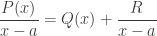
\displaystyle \frac{P(x)}{x-a}=Q(x)+\frac{R}{x-a}

Or

P(x)=Q(x)(x-a)+R

From here it is easy to see that P(a)=R. This is called the remainder theorem. It has a corollary called the factor theorem: If R = 0, then (x – a) is a factor of P(x).

Calculus

But wait there is more: differentiating the equation above using the product rule gives

{P}'(x)=Q(x)(1)+Q(x)(x-a)+0 and substituting x = a  gives

{P}'(a)=Q(a). The value of the quotient polynomial at a is the derivative of the original polynomial at a.

Of course, we could also rewrite the same equation as \displaystyle \frac{P(x)-P(a)}{x-a}=Q(x) . Then

\displaystyle {P}'(a)=\underset{x\to a}{\mathop{\lim }}\,\frac{P(x)-P(a)}{x-a}=\underset{x\to a}{\mathop{\lim }}\,Q(x)=Q(a)

Taylor Series

But wait, there’s even more.

A polynomial is a Maclaurin series in which all the terms after the nth term are zero. When you students are first learning how to write a Taylor series, by finding all the derivatives and substituting in the general term, a good exercise is to have them write the Taylor series for a polynomial centered away from the origin. For the example above:

P(x)=-9-2\left( x-2 \right)+19{{\left( x-2 \right)}^{2}}+13{{\left( x-2 \right)}^{3}}+2{{\left( x-2 \right)}^{4}}

Then ask them to expand the expression above and collect term etc. They should get the original polynomial again (and have some great practice expand powers of a binomial).

Can synthetic division help us? Yes, of course.  Here, is the original computation again:

\begin{matrix} {} & 2 & -3 & -11 & 14 & -1 \\ 2) & 2 & 1 & -9 & -4 & -9 \\ \end{matrix}\begin{matrix} {} \\ \,=P(2) \\ \end{matrix}

If we ignore the –9 and divide the quotient numbers by 2 we get

\begin{matrix} {} & 2 & 1 & -9 & -4 \\ 2) & 2 & 5 & 1 & -2 \\ \end{matrix}\begin{matrix} {} \\ \ ={P}'(2) \\ \end{matrix}

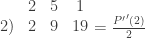
\begin{matrix} {} & 2 & 5 & 1 \\ 2) & 2 & 9 & 19 \\ \end{matrix}\begin{matrix} {} \\ \ =\frac{{{P}'}'(2)}{2} \\ \end{matrix}

And again

\begin{matrix} {} & 2 & 9 \\ 2) & 2 & 13 \\ \end{matrix}\begin{matrix} {} \\ \ =\frac{{{{P}'}'}'\left( 2 \right)}{3!} \\ \end{matrix}

One more time

\begin{matrix} {} & 2 \\ 2) & 2 \\ \end{matrix}\begin{matrix} {} \\ \ =\frac{{{P}^{(4)}}\left( 2 \right)}{4!} \\ \end{matrix}

What do you see? Right, the last numbers in each computation, –9, –2, 19, 13, and 2, are the coefficients of the Taylor polynomial!

If you really want to dive this home and have some more summer fun here’s the start of a proof (at least for n = 4). Let

P(x)={{c}_{4}}{{x}^{4}}+{{c}_{3}}{{x}^{3}}+{{c}_{2}}{{x}^{3}}+{{c}_{1}}x+{{c}_{0}} and divide this by a:

\begin{matrix} {} & {{c}_{4}} & {{c}_{3}} & {{c}_{2}} & {{c}_{1}} & {{c}_{0}} \\ a) & {{c}_{4}} & {{c}_{4}}a+{{c}_{3}} & {{c}_{4}}{{a}^{2}}{{+}_{{}}}{{c}_{3}}a+{{c}_{2}} & {{c}_{4}}{{a}^{3}}+{{c}_{3}}{{a}^{2}}+{{c}_{a}}a+{{c}_{1}} & {{c}_{4}}{{a}^{4}}+{{c}_{3}}{{a}^{3}}+{{c}_{a}}{{a}^{2}}+{{c}_{1}}a+{{c}_{0}}=P(a) \\ \end{matrix}

Again

\begin{matrix} {} & {{c}_{4}} & {{c}_{4}}a+{{c}_{3}} & {{c}_{4}}{{a}^{2}}{{+}_{{}}}{{c}_{3}}a+{{c}_{2}} & {{c}_{4}}{{a}^{3}}+{{c}_{3}}{{a}^{2}}+{{c}_{2}}a+{{c}_{1}} \\ a) & {{c}_{4}} & 2{{c}_{4}}a+{{c}_{3}} & 3{{c}_{4}}{{a}^{2}}+2{{c}_{3}}a+{{c}_{2}} & 4{{c}_{4}}{{a}^{3}}+3{{c}_{3}}{{a}^{2}}+2{{c}_{2}}a+{{c}_{1}} \\ \end{matrix}\begin{matrix} {} \\ \ ={P}'(a) \\ \end{matrix}

And I’ll leave the rest to you.  Really, why should I have all the fun?

.

Sequences and Series (Type 10 for BC only)

Convergence tests for series appear on both sections of the BC Calculus exam. In the multiple-choice section, students may be asked to say if a sequence or series converges or which of several series converge.

The Ratio test is used most often to determine the radius of convergence and the other tests to determine the exact interval of convergence by checking the convergence at the end points. Click here for a Convergence test chart students should be familiar with; this list is also on the resource page.

On the free-response section there is usually one full question devoted to sequences and series. This question usually involves writing a Taylor or Maclaurin polynomial for a series.

Students should be familiar with and able to write several terms and the general term of a series. They may do this by finding the derivatives and constructing the coefficients from them, or they may produce the series by manipulating a known or given series. They may do this by substituting into a series, differentiating it or integrating it.

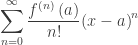
The general form of a Taylor series is \displaystyle \sum\limits_{n=0}^{\infty }{\frac{{{f}^{\left( n \right)}}\left( a \right)}{n!}{{\left( x-a \right)}^{n}}}; if a = 0, the series is called a Maclaurin series.

What Students Should be Able to Do 

  • Use the various convergence tests to determine if a series converges. The test to be used is rarely given so students need to know when to use each of the common tests. For a summary of the tests click: Convergence test chart.
  • Write the terms of a Taylor or Maclaurin series by calculating the derivatives and constructing the coefficients of each term.
  • Distinguish between the Taylor series for a function and the function. Do NOT say that the Taylor polynomial is equal to the function (this will lose a point); say it is approximately equal.
  • Determine a specific coefficient without writing all the previous coefficients.
  • Write a series by substituting into a known series, by differentiating or integrating a known series, or by some other algebraic manipulation of a series.
  • Know (from memory) the Maclaurin series for sin(x), cos(x), ex and \displaystyle \tfrac{1}{1-x} and be able to find other series by substituting into them.
  • Find the radius and interval of convergence. This is usually done by using the Ratio test and checking the endpoints.
  • Be familiar with geometric series, its radius of convergence, and be able to find the number to which it converges, \displaystyle {{S}_{\infty }}=\frac{{{a}_{1}}}{1-r}. Re-writing a rational expression as the sum of a geometric series and then writing the series has appeared on the exam.
  • Be familiar with the harmonic and alternating harmonic series. These are often useful series for comparison.
  • Use a few terms of a series to approximate the value of the function at a point in the interval of convergence.
  • Determine the error bound for a convergent series (Alternating Series Error Bound and Lagrange error bound). See my post of  February 22, 2013.
  • Use the coefficients (the derivatives) to determine information about the function (e.g. extreme values).
  • Understand absolute and conditional convergence. If the series of the absolute values of the terms of a series converges, then the original series is said to absolutely convergent (or converges absolutely). If the series of absolute values diverges, then the original series may (or may not) converge; if it converges it is said to be conditionally convergent.


This list is quite long, but only a few of these items can be asked in any given year. The series question on the free-response section is usually quite straightforward. Topics and convergence test may appear on the multiple-choice section. As I have suggested before, look at and work as many past exam questions to get an idea of what is asked and the difficulty of the questions. Click on Power Series in the “Posts by Topic” list on the right side of the screen to see previous posts on Power Series.


The concludes the series of posts on the type questions in review for the AP Calculus exams.


Next Post

Friday April 7, 2017 The Domain of the solution of a differential equation.


Geometric Series – Far Out

One of the great things – at least I like it – about the Taylor series of a function is that it is unique. There is only one Taylor series for any function centered at a given point, what that means is that any way you get it, it’s right.

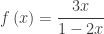
Faced with writing the power series for, say, \displaystyle f\left( x \right)=\frac{3x}{1-2x}, instead of cranking out a bunch of derivatives, we can say this looks a lot like the formula for the sum of a geometric series,

\displaystyle \sum\limits_{k=1}^{\infty }{a{{r}^{k-1}}}=\frac{a}{1-r}. Taking  a = 3x and r = 2x, the series is

\displaystyle \frac{3x}{1-2x}=3x+6{{x}^{2}}+12{{x}^{3}}+24{{x}^{4}}+\cdots =3\cdot \sum\limits_{k=1}^{\infty }{{{2}^{k-1}}{{x}^{k}}}.

Furthermore, since a geometric series converges only when \left| r \right|<1, the interval of convergence for this series is \left| 2x \right|<1 or -\tfrac{1}{2}<x<\tfrac{1}{2} and we don’t even have to check the endpoints.

There are other choices as well.  We could write \displaystyle f\left( x \right)=3x{{\left( 1-2x \right)}^{-1}} and then expand the binomial using the binomial theorem. Or we could use the technique of long division of polynomials to divide 3x by (1 – 2x) – leaving the divisor as written here.

This works even in more complicated situations. Let \displaystyle g\left( x \right)=\frac{3x}{{{x}^{2}}-4}. Begin by dividing each term by –4. This gives \displaystyle g\left( x \right)=\frac{-\tfrac{3}{4}x}{1-\tfrac{1}{4}{{x}^{2}}}. Then treating this as a geometric series
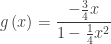

\displaystyle g\left( x \right)=\sum\limits_{k=1}^{\infty }{-\tfrac{3}{4}x{{\left( \tfrac{1}{4}{{x}^{2}} \right)}^{k-1}}=-\frac{3}{4}x-\frac{3}{16}{{x}^{3}}-\frac{3}{64}{{x}^{5}}-\frac{3}{256}{{x}^{7}}-\cdots }

The interval of convergence is \displaystyle \left| \tfrac{1}{4}{{x}^{2}} \right|<1, or –2 < x < 2

Now the fun part

I once heard of a student making one of those great “mistakes.” For the series above, she divided by (–x2) and found that \displaystyle g\left( x \right)=\frac{-\frac{3}{x}}{1-\frac{4}{{{x}^{2}}}} and then wrote:

\displaystyle g\left( x \right)=\sum\limits_{k=1}^{\infty }{\left( -\frac{3}{x} \right){{\left( \frac{4}{{{x}^{2}}} \right)}^{k-1}}=-\frac{3}{x}-\frac{12}{{{x}^{3}}}-\frac{48}{{{x}^{5}}}-\frac{192}{{{x}^{7}}}-\cdots }

So, what’s wrong with that?

Nothing actually.

Okay, it’s not a Taylor Series since a Taylor series is allowed only non-negative exponents, but it’s still a geometric series. Let’s take a look at its interval of convergence: \displaystyle \left| \frac{4}{{{x}^{2}}} \right|<1, or \displaystyle \left| \frac{{{x}^{2}}}{4} \right|>1,  or the union of x>2 and x<-2, Whoa, that’s different and not even an interval.
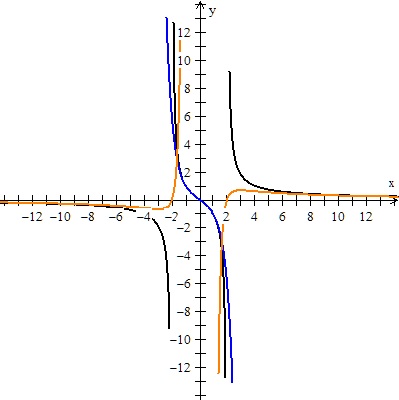
The graph will make things clear (as usual):

geom-series

The original function graphed as a rational expression is shown in black. The Taylor polynomial (4 terms) is shown in blue; it approximates the function well between –2 and 2 as we should expect. The red graph is the student’s series (4 terms) and it is a good approximation of the series outside of the interval (–2, 2), far outside! Way Cool!

Of course, this kind of series is not studied in beginning calculus. It may make a good topic for a report or project for someone in your class.