Why L’Hospital’s Rule?

Why L’Hospital’s Rule?

We are now at the point where we can look at a special technique for finding some limits. Graph on your calculator y = sin(x) and y = x near the origin. Zoom in a little bit. The line is tangent to sin(x) at the origin and their values are almost the same. Look at the two graphs near the origin and see if you can guess the limit of their ratio at the origin:   \displaystyle \underset{{x\to 0}}{\mathop{{\lim }}}\,\frac{{\sin \left( x \right)}}{x}?.

In this example, if you substitute zero into the expression you get zero divided by zero and there is no way to divide out the zero in the dominator as you could with rational expressions.  

This kind of thing is called an indeterminate form. The limit of an indeterminate form may have a value, but in its current form you cannot determine what it is. When you studied limits, you were often able to factor and divide out the denominator and find the limit for what was left. With \displaystyle \frac{{\sin \left( x \right)}}{x} you can’t do that.  

But by replacing the expressions with their local linear approximations, the offending factor will divide out leaving you with the ratio of the derivatives (slopes). This limit may be easier to find.

The technique is called L’Hospital’s Rule, after Guillaume de l’Hospital (1661 – 1704) whose idea it wasn’t! He sort of “borrowed’ it from Johann Bernoulli (1667 – 1784).

L’Hospital’s Rule gives you a way of finding limits of indeterminate forms. You will look at indeterminate forms of the types \displaystyle \tfrac{0}{0} and \displaystyle \tfrac{\infty }{\infty }. The technique may be expanded to other indeterminate forms like  \displaystyle {{1}^{\infty }},\ 0\cdot \infty ,\ \infty -\infty ,\ {{0}^{0}},\text{and }{{\infty }^{0}}, which are not tested on the AP Calculus exams.

Like other “rules” in math, L’Hospital’s Rule is really a theorem. Before you use it, you must check that the hypotheses are true. And on the AP Calculus exams you must show in writing that you have checked.


Course and Exam Description Unit 4 Topic 7

Why Continuity?

We would like to study nice well-behaved functions; functions that are smooth and that don’t do strange things. Yeah, well good luck with that.

One of the things that might be nice is that you could draw the graph of a function from one end of its domain to the other without taking your pen off the paper. And a lot of functions are like that, but not all.

Some functions have holes in them, others jump from one y-value to another without hitting points in between. Some “go off to infinity” and come right back; others go off the top of the graph and come back from the bottom. Some go really crazy around a point.  

Functions that you can draw from one end of their domain to the other without lifting your pen are said to be continuous.

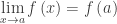
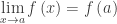
More mathematically: A function is continuous at a point (that is, at a single value of x) if, and only if, as you travel along the graph towards the value (from either side of the x-value), the -values on the graph are approaching the ­y­-value at the point. In symbols:  \displaystyle \underset{{x\to a}}{\mathop{{\lim }}}\,f\left( x \right)=f\left( a \right).

A function is continuous on an interval if, and only if, it is continuous at every value in the interval.

Wait! What?? I have to check all the points??

Technically, yes; practically, no. Most of the time you can easily show that a function is continuous everywhere by looking at its limit in general.

Moreover, you will learn to see where a function is not continuous. This is an important skill: looking at a function and suspecting there is a problem with continuity.

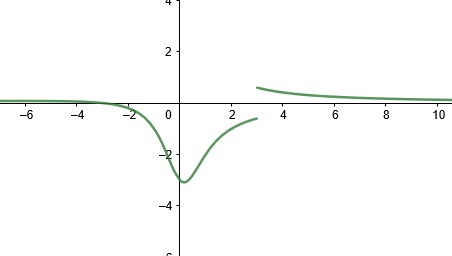
Take a quick look at some of the problems that functions may have at a point. Graph these on your calculator. They all have a “problem” at x = 3. Graph each example and you will see what they look like. Try to figure out why they have a “problem” and what causes it.  

  •  \displaystyle f\left( x \right)=\frac{1}{{x-3}}.
  •  \displaystyle g\left( x \right)=\frac{1}{{{{{\left( {x-3} \right)}}^{2}}}}
  • \displaystyle h\left( x \right)=\frac{{{{x}^{2}}-3x}}{{x-3}}. This function has a single hole in the graph at (3, 3); It one may be difficult to see. Try using ZDecimal. A single point is missing because there is no value at x= 3 because the denominator is zero.
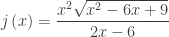
  •  \displaystyle j\left( x \right)=\frac{{{{x}^{2}}\sqrt{{{{x}^{2}}-6x+9}}}}{{2x-6}}.
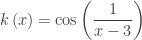
  • \displaystyle k\left( x \right)=\cos \left( {\frac{1}{{x-3}}} \right) Zoom in several times at (3, 0) where the function has no value.
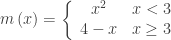
  • \displaystyle m\left( x \right)=\left\{ {\begin{array}{*{20}{c}} {{{x}^{2}}} & {x<3} \\ {4-x} & {x\ge 3} \end{array}} \right.

Learn to suspect that a function may have a discontinuity. (It’s not always at x = 3) The problem is often a zero denominator.

This is not just a game or some curious functions. One of the main tools of calculus called the derivative, which you will study next, is defined as the limit of a special function which is never continuous at the point you are interested in.

So, let’s continue on to continuity.


AP Calculus Course and Exam Description

Unit 1 topics 1-10 – 1.16, Unit 2 topic 2.4

Why Infinity?

First, right from the start: Infinity is NOT a number.

Lots of folks think of infinity as the largest number possible, greater than anything else. That’s understandable because infinity, denoted by the symbol \displaystyle \infty , is often used that way by those unlucky folks who don’t understand mathematics.

We’ll start with an example: Consider the fraction \displaystyle \frac{1}{{{{{\left( {x-3} \right)}}^{2}}}}. This fraction has no value when x = 3 because there the denominator is zero. And you cannot divide by zero. Nothing personal, no one, no matter how smart, can divide by zero. Ever.  Permanently and forever not allowed. Don’t even think about it! (Actually, think about it; just don’t do it.)

What you should say in such cases is that the expression has no value, or is “undefined,” or “the limit does not exist,” abbreviated DNE.

In situations like the example we say, “the limit of the fraction as x approaches 3 equals infinity,” abbreviated  \displaystyle \underset{{x\to 3}}{\mathop{{\lim }}}\,\frac{1}{{{{{\left( {x-3} \right)}}^{2}}}}=\infty . This means that the expression gets larger as x gets closer to three. The expression will be greater than any (large) number you want, if you are close enough to three.

You don’t believe me? Okay pick a large number, maybe \displaystyle {{10}^{8}}. I say pick any value for x between 2.9999 and 3.0001 (\displaystyle 3-{{10}^{{-4}}}<x<3+{{10}^{4}}) and the expression will be larger than \displaystyle {{10}^{8}}. Try it on your calculator.

How about \displaystyle {{10}^{{20}}}? Try a number between 2.9999999999 and 3.0000000001. I can play this game all day.

Try graphing the \displaystyle y=\frac{1}{{{{{\left( {x-3} \right)}}^{2}}}} on your calculator. (Hint: Whenever you come across something like this, it is a great idea to graph the expression on your graphing calculator. Graphs can help you see what’s going on. Keep that in mind for the future.)

That’s the way to think about infinity: Infinity is what you say when you’re working with an expression that grows greater than any number you choose.

You may also use infinity to say what happens all the way to the left or right of the graph, its end behavior. The variable, x, may “approach infinity,” that is x moves further to the right (or is greater than any number you choose) the fraction above gets closer to zero: \displaystyle \underset{{x\to \infty }}{\mathop{{\lim }}}\,\frac{1}{{{{{\left( {x-3} \right)}}^{2}}}}=0.

You may not do arithmetic with infinity.

\displaystyle \infty +\infty \ne 2\infty

\displaystyle \infty -\infty \ne 0

Arithmetic is for numbers.

You will see a number of expressions whose limit is equal to infinity, like \displaystyle \underset{{x\to 3}}{\mathop{{\lim }}}\,\frac{1}{{{{{\left( {x-3} \right)}}^{2}}}}=\infty . Which really means, just what we saw above: that as you (not “you” but x) get closer to 3, the value of the expression will be greater than any number you pick. The \displaystyle \infty symbol is a shorthand way of saying this.

The opposite of infinity, \displaystyle -\infty , sometimes called “negative infinity,” means that the expression gets less than (i.e. more negative), than any negative number you choose.

Even though the expression has no limit, you are allowed to say the limit equals infinity. That’s funny when you think about it. It might be better if everyone said “undefined” or DNE, but they don’t. What can I say?

A word of warning: You may only say “equals infinity” is situations like the example above.

There are other similar expressions that have no limit where it is incorrect to say the limit equals infinity. For example,

  • \displaystyle \frac{{\left| x \right|}}{x} has no value, is “undefined,” when x = 0, but \displaystyle \underset{{x\to 0}}{\mathop{{\lim }}}\,\frac{{\left| x \right|}}{x}\ne \infty . (Hint: this is where you should look at a graph on your graphing calculator to see why.)
  • \displaystyle \underset{{x\to 3}}{\mathop{{\lim }}}\,\frac{1}{{\left( {x-3} \right)}} does not exist. This is very similar to the first example but look at the graph and you’ll see a big difference.

So, good luck and enjoy your limitless journey through the infinite reaches of calculus. (Oh, wait! Can I say that?)

Finally,


Course and Exam Description Unit 1 topics 1.3, 1.14, 1.5 and others.

Unlimited

Or when is a limit not a limit?

I was discussing the definition of a limit equal to infinity with someone recently. It occurred to me that such functions have no limit! Of course, you say that’s why – sometimes – we say “infinity”. But should we? What does “∞” mean?

The definition we were discussing is this:

\underset{{x\to a}}{\mathop{{\lim }}}\,f\left( x \right)=\infty \text{ if, and only if, for any }M>0\text{ there is a number }\delta >0\text{ such that} \text{ if }\left| {x-a} \right|<\delta \text{, then }f(x)>M.

What is being defined here?

What this definition says is that if we can always find numbers close to x = a that make the function’s value larger than any (every, all) positive number we pick, then we say that the limit is (equal to) infinity (∞).

This is how we say mathematically that every (any, all) number in the open interval defined by \left| {x=a} \right|<\delta , also known as a-\delta <x<a+\delta , will generate function values greater than M.

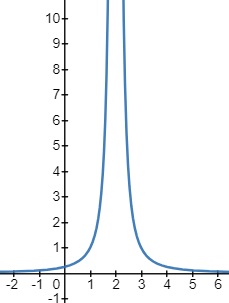
\displaystyle f\left( x \right)=\frac{1}{{{{{\left( {x-2} \right)}}^{2}}}}

For example, if \displaystyle f\left( x \right)=\frac{1}{{{{{\left( {x-2} \right)}}^{2}}}}, then \displaystyle \delta =\frac{1}{{\sqrt{M}}} will do the trick, since if

\displaystyle 0<\left| {x-2} \right|<\frac{1}{{\sqrt{M}}}

\displaystyle \Rightarrow \sqrt{M}>\left| {\frac{1}{{x-2}}} \right|

\displaystyle \Rightarrow M>\frac{1}{{{{{\left( {x-2} \right)}}^{2}}}}

The function has no value at exactly x = 2. As x get closer to 2, the graph just goes up and up; the values will eventually be greater than any value you choose. The line, x = 2 that the graph never gets to is called an asymptote. An asymptote is the graphical manifestation of a limit of infinity.

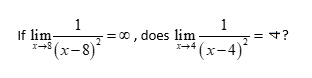
But wait a minute: this function has no limit; the values are unlimited. They just get larger and larger. It is correct to say, \underset{{x\to 2}}{\mathop{{\lim }}}\,\frac{1}{{{{{\left( {x-2} \right)}}^{2}}}}\text{ does not exist}. So, which is it “infinity” or does not exist”?

What is this ∞ thing?

An equal sign means that the numbers on both sides are the same. Now the limit part should be a number, but ∞ is not. So how can they be the same?

Is this an abuse of notation?

A definition must be phrased using previously defined terms. Have we defined ∞?

Up to the beginning of the calculus, we probably told students that infinity means something is greater than any value you choose. That’s true, but not much of a definition. (I hope you did not say “a number greater that any number you choose” or “the largest number,” because infinity is not a number.)

How can we tell if something is greater than any value we choose? The answer is that is exactly what the definition quoted above says! It defines what to say about situation where a function’s values get greater and greater, where they are unlimited. In doing so, it defines infinity as much as anything else, and maybe more so.


Disclaimer: There are functions whose limits fail to exist for other reasons and that “infinity” is not an appropriate description in those situations.

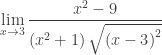
For example,  \displaystyle \underset{{x\to 3}}{\mathop{{\lim }}}\,\frac{{{{x}^{2}}-9}}{{\left( {{{x}^{2}}+1} \right)\sqrt{{{{{\left( {x-3} \right)}}^{2}}}}}} does not exist and is not ∞ .

\displaystyle f(x)=\frac{{{{x}^{2}}-9}}{{\left( {{{x}^{2}}+1} \right)\sqrt{{{{{\left( {x-3} \right)}}^{2}}}}}} has a finite jump discontinuity at x = 3.


Unit 1 – Limits and Continuity

This is a re-post and update of the first in a series of posts from last year. It contains links to posts on this blog about the topics of limits and continuity for your reference in planning. Other updated post on the 2019 CED will come throughout the year, hopefully, a few weeks before you get to the topic. 

Unit 1 contains topics on Limits and Continuity. (CED – 2019 p. 36 – 50). These topics account for about 10 – 12% of questions on the AB exam and 4 – 7% of the BC questions.

Logically, limits come before continuity since limit is used to define continuity. Practically and historically, continuity comes first. Newton and Leibnitz did not have the concept of limit the way we use it today. It was in the early 1800’s that the epsilon-delta definition of limit was first given by Bolzano (whose work was overlooked) and then by Cauchy, Jordan, and Weierstrass. But, their formulation did not use the word “limit”, rather the use was part of their definition of continuity. Only later was it pulled out as a separate concept and then returned to the definition of continuity as a previously defined term. See Which Came First?

Students should have plenty of experience in their math courses before calculus with functions that are and are not continuous. They should know the names of the types of discontinuities – jump, removable, infinite, oscillating etc.and the related terms such as asymptote. As you go through this unit, you may want to quickly review these terms and concepts as they come up.

(As a general technique, rather than starting the year with a week or three of review – which the students need but will immediately forget again – be ready to review topics as they come up during the year as they are needed – you will have to do that anyway. See Getting Started #2)

Topics 1.1 – 1.9: Limits

Topic 1.1: Suggests an introduction to calculus to give students a hint of what’s coming. See Getting Started #3

Topic 21.: Proper notation and multiple-representations of limits.

There is an exclusion statement noting that the delta-epsilon definition of limit is not tested on the exams, but you may include it if you wish. The epsilon-delta definition is not tested probably because it is too difficult to write good questions. Specifically, (1) the relationship for a linear function is always  delta =frac{varepsilon }{{left| m right|}}  where m is the slope and is too complicated to compute for other functions, and (2) for a multiple-choice question the smallest answer must be correct. (Why?)

Topic 1.3: One-sided limits.

Topic 1.4: Estimating limits numerically and from tables.

Topic 1.5: Algebraic properties of limits.

Topic 1.6: Simplifying expressions to find their limits. This can and should be done along with learning the other concepts and procedures in this unit.

Topic 1.7: Selecting the proper procedure for finding a limit. The first step is always to substitute the value into the limit. If this comes out to be number than that is the limit. If not, then some manipulation may be required. This can and should be done along with learning the other concepts and procedures in this unit.

Topic 1.8: The Squeeze Theorem is mainly used to determine  underset{{xto 0}}{mathop{{lim }}},frac{{sin left( x right)}}{x}=1 which in turn is used in finding the derivative of the sin(x). (See Why Radians?) Most of the other examples seem made up just for exercises and tests. (See 2019 AB 6(d)). Thus, important, but not too important.

Topic 1.9: Connecting multiple-representations of limit. This can and should be done along with learning the other concepts and procedures in this unit. Dominance, Topic 15, may be included here as well (EK LIM-2.D.5)

Topics 1.10 – 1.16 Continuity

Topic 1.10: Here you can review the different types of discontinuities with examples and graphs.

Topic 1.11: The definition of continuity. The EK statement does not seem to use the three-hypotheses definition. However, for the limit to exist and for f(c) to exist, they must be real numbers (i.e. not infinite). This is tested often on the exams, so students should have practice with verifying that (all three parts of) the hypothesis are met and including this in their answers.

Topic 1.12: Continuity on an interval and which Elementary Functions are continuous for all real numbers.

Topic 1.13: Removable discontinuities and handing piecewise – defined functions

Topic 1.14: Vertical asymptotes and unbounded functions. Here be sure to explain the difference between limits “equal to infinity” and limits that do not exist (DNE). See Good Question 5: 1998 AB2/BC2.

Topic 1.15: Limits at infinity, or end behavior of a function. Horizontal asymptotes are the graphical manifestation of limits at infinity or negative infinity. Dominance is included here as well (EK LIM-2.D.5)

Topic 1.16: The Intermediate Value Theorem (IVT) is a major and important result of a function being continuous. This is perhaps the first Existence Theorem students encounter, so be sure to stop and explain what an existence theorem is.


The suggested number of 40 – 50 minute class periods is 22 – 23 for AB and 13 – 14 for BC. This includes time for testing etc. If time seems to be a problem you can probably combine topics 3 – 5, topics 6 -7, topics 11 – 12. Topics 6, 7, and 9 are used with all the limit work.


There are three other important limits that will be coming in later Units:

The definition of the derivative in Unit 2, topics 1 and 2

L’Hospital’s Rule in Unit 4, topic 7

The definition of the definite integral in Unit 6, topic 3.

Posts on Continuity

CONTINUITY To help understand limits it is a good idea to look at functions that are not continuous. Historically and practically, continuity should come before limits. On the other hand, the definition of continuity requires knowing about limits. So, I list continuity first. The modern definition of limit was part of Weierstrass’ definition of continuity.

Which Came First? (7-28-2020)

Continuity (8-13-2012)

Continuity (8-21-2013) The definition of continuity.

Continuous Fun (10-13-2015) A fuller discussion of continuity and its definition

Right Answer – Wrong Question (9-4-2013) Is a function continuous even if it has a vertical asymptote?

Asymptotes (8-15-2012) The graphical manifestation of certain limits

Fun with Continuity (8-17-2012) the Diriclet function

Far Out! (10-31-2012) When the graph and dominance “disagree” From the Good Question series

Posts on Limits

Why Limits? (8-1-2012)

Deltas and Epsilons (8-3-2012) Why this topic is not tested on the AP Calculus Exams.

Finding Limits (8-4-2012) How to…

Dominance (8-8-2012) See limits at infinity

Determining the Indeterminate (12-6-2015) Investigating an indeterminate form from a differential equation. From the Good Question series.

Locally Linear L’Hôpital (5-31-2013) Demonstrating L’Hôpital’s Rule (a/k/a L’Hospital’s Rule)

L’Hôpital’s Rules the Graph (6-5-2013)

Unlimited


Here are links to the full list of posts discussing the ten units in the 2019 Course and Exam Description. the 2019 versions

2019 CED – Unit 1: Limits and Continuity

2019 CED – Unit 2: Differentiation: Definition and Fundamental Properties.

2019 CED – Unit 3: Differentiation: Composite , Implicit, and Inverse Functions

2019 CED – Unit 4 Contextual Applications of the Derivative  Consider teaching Unit 5 before Unit 4

2019 – CED Unit 5 Analytical Applications of Differentiation  Consider teaching Unit 5 before Unit 4

2019 – CED Unit 6 Integration and Accumulation of Change

2019 – CED Unit 7 Differential Equations  Consider teaching after Unit 8

2019 – CED Unit 8 Applications of Integration   Consider teaching after Unit 6, before Unit 7

2019 – CED Unit 9 Parametric Equations, Polar Coordinates, and Vector-Values Functions 

2019 CED Unit 10 Infinite Sequences and Series


Limits and Continuity – Unit 1

This is a re-post and update of the first in a series of posts from last year. It contains links to posts on this blog about the topics of limits and continuity for your reference in planning. Other updated post on the 2019 CED will come throughout the year, hopefully, a few weeks before you get to the topic. 

Unit 1 contains topics on Limits and Continuity. (CED – 2019 p. 36 – 50). These topics account for about 10 – 12% of questions on the AB exam and 4 – 7% of the BC questions.

Logically, limits come before continuity since limit is used to define continuity. Practically and historically, continuity comes first. Newton and Leibnitz did not have the concept of limit the way we use it today. It was in the early 1800’s that the epsilon-delta definition of limit was first given by Bolzano (whose work was overlooked) and then by Cauchy, Jordan, and Weierstrass. But, their formulation did not use the word “limit”, rather the use was part of their definition of continuity. Only later was it pulled out as a separate concept and then returned to the definition of continuity as a previously defined term. See Which Came First?

Students should have plenty of experience in their math courses before calculus with functions that are and are not continuous. They should know the names of the types of discontinuities – jump, removable, infinite, oscillating etc.and the related terms such as asymptote. As you go through this unit, you may want to quickly review these terms and concepts as they come up.

(As a general technique, rather than starting the year with a week or three of review – which the students need but will immediately forget again – be ready to review topics as they come up during the year as they are needed – you will have to do that anyway. See Getting Started #2)

Topics 1.1 – 1.9: Limits

Topic 1.1: Suggests an introduction to calculus to give students a hint of what’s coming. See Getting Started #3

Topic 21.: Proper notation and multiple-representations of limits.

There is an exclusion statement noting that the delta-epsilon definition of limit is not tested on the exams, but you may include it if you wish. The epsilon-delta definition is not tested probably because it is too difficult to write good questions. Specifically, (1) the relationship for a linear function is always  \delta =\frac{\varepsilon }{{\left| m \right|}}  where m is the slope and is too complicated to compute for other functions, and (2) for a multiple-choice question the smallest answer must be correct. (Why?)

Topic 1.3: One-sided limits.

Topic 1.4: Estimating limits numerically and from tables.

Topic 1.5: Algebraic properties of limits.

Topic 1.6: Simplifying expressions to find their limits. This can and should be done along with learning the other concepts and procedures in this unit.

Topic 1.7: Selecting the proper procedure for finding a limit. The first step is always to substitute the value into the limit. If this comes out to be number than that is the limit. If not, then some manipulation may be required. This can and should be done along with learning the other concepts and procedures in this unit.

Topic 1.8: The Squeeze Theorem is mainly used to determine  \underset{{x\to 0}}{\mathop{{\lim }}}\,\frac{{\sin \left( x \right)}}{x}=1 which in turn is used in finding the derivative of the sin(x). (See Why Radians?) Most of the other examples seem made up just for exercises and tests. (See 2019 AB 6(d)). Thus, important, but not too important.

Topic 1.9: Connecting multiple-representations of limit. This can and should be done along with learning the other concepts and procedures in this unit. Dominance, Topic 15, may be included here as well (EK LIM-2.D.5)

Topics 1.10 – 1.16 Continuity

Topic 1.10: Here you can review the different types of discontinuities with examples and graphs.

Topic 1.11: The definition of continuity. The EK statement does not seem to use the three-hypotheses definition. However, for the limit to exist and for f(c) to exist, they must be real numbers (i.e. not infinite). This is tested often on the exams, so students should have practice with verifying that (all three parts of) the hypothesis are met and including this in their answers.

Topic 1.12: Continuity on an interval and which Elementary Functions are continuous for all real numbers.

Topic 1.13: Removable discontinuities and handing piecewise – defined functions

Topic 1.14: Vertical asymptotes and unbounded functions. Here be sure to explain the difference between limits “equal to infinity” and limits that do not exist (DNE). See Good Question 5: 1998 AB2/BC2.

Topic 1.15: Limits at infinity, or end behavior of a function. Horizontal asymptotes are the graphical manifestation of limits at infinity or negative infinity. Dominance is included here as well (EK LIM-2.D.5)

Topic 1.16: The Intermediate Value Theorem (IVT) is a major and important result of a function being continuous. This is perhaps the first Existence Theorem students encounter, so be sure to stop and explain what an existence theorem is.


The suggested number of 40 – 50 minute class periods is 22 – 23 for AB and 13 – 14 for BC. This includes time for testing etc. If time seems to be a problem you can probably combine topics 3 – 5, topics 6 -7, topics 11 – 12. Topics 6, 7, and 9 are used with all the limit work.


There are three other important limits that will be coming in later Units:

The definition of the derivative in Unit 2, topics 1 and 2

L’Hospital’s Rule in Unit 4, topic 7

The definition of the definite integral in Unit 6, topic 3.

Posts on Continuity

CONTINUITY To help understand limits it is a good idea to look at functions that are not continuous. Historically and practically, continuity should come before limits. On the other hand, the definition of continuity requires knowing about limits. So, I list continuity first. The modern definition of limit was part of Weierstrass’ definition of continuity.

Which Came First? (7-28-2020)

Continuity (8-13-2012)

Continuity (8-21-2013) The definition of continuity.

Continuous Fun (10-13-2015) A fuller discussion of continuity and its definition

Right Answer – Wrong Question (9-4-2013) Is a function continuous even if it has a vertical asymptote?

Asymptotes (8-15-2012) The graphical manifestation of certain limits

Fun with Continuity (8-17-2012) the Diriclet function

Far Out! (10-31-2012) When the graph and dominance “disagree” From the Good Question series

Posts on Limits

Why Limits? (8-1-2012)

Deltas and Epsilons (8-3-2012) Why this topic is not tested on the AP Calculus Exams.

Finding Limits (8-4-2012) How to…

Dominance (8-8-2012) See limits at infinity

Determining the Indeterminate (12-6-2015) Investigating an indeterminate form from a differential equation. From the Good Question series.

Locally Linear L’Hôpital (5-31-2013) Demonstrating L’Hôpital’s Rule (a/k/a L’Hospital’s Rule)

L’Hôpital’s Rules the Graph (6-5-2013)


Here are links to the full list of posts discussing the ten units in the 2019 Course and Exam Description. the 2019 versions

2019 CED – Unit 1: Limits and Continuity

2019 CED – Unit 2: Differentiation: Definition and Fundamental Properties.

2019 CED – Unit 3: Differentiation: Composite , Implicit, and Inverse Functions

2019 CED – Unit 4 Contextual Applications of the Derivative  Consider teaching Unit 5 before Unit 4

2019 – CED Unit 5 Analytical Applications of Differentiation  Consider teaching Unit 5 before Unit 4

2019 – CED Unit 6 Integration and Accumulation of Change

2019 – CED Unit 7 Differential Equations  Consider teaching after Unit 8

2019 – CED Unit 8 Applications of Integration   Consider teaching after Unit 6, before Unit 7

2019 – CED Unit 9 Parametric Equations, Polar Coordinates, and Vector-Values Functions 

2019 CED Unit 10 Infinite Sequences and Series


Which Came First?

In one of my math classes – it may have been calculus – many decades ago, we started by determining what kind of functions we were going to study. A good part of the answer was continuous functions. Looking closely, you will find that almost all the theorems in beginning calculus require that the function be continuous on an interval as one of their hypotheses (The interval could be all Real numbers.) Later theorems require that the function be differentiable, but, as you will learn, if a function is differentiable, then it is continuous. So, calculus studies continuous functions (or those that are not continuous at only a few points).

A function is continuous on an interval, roughly speaking, you can draw its graph from one side of the interval to the other without taking the pencil off the paper. Thus, if a function has a hole, a vertical asymptote, a jump, or oscillates wildly it is not continuous. Continuity is first determined for a function at a point in it domain. Then this is extended to all the points in an interval.

Students come across functions that are not continuous long before they encounter calculus and limits. They see functions with asymptotes, jumps, and holes long before calculus. Discussing continuity gives a reason to talk about limits informally and how the idea of “getting closer to” a point works. This eventually leads to the idea of a limit and the need to define the term.

The definition of continuity at a point that is used most often is this:

A function f is continuous at x=a if, and only if, (1)  f\left( a \right) exists, (2)  \underset{{x\to a}}{\mathop{{\lim }}}\,f\left( x \right) exists, and (3)  \underset{{x\to a}}{\mathop{{\lim }}}\,f\left( x \right)=f\left( a \right).

The first two conditions are probably included to prevent beginning students from thinking that if the value and the limit are both “infinite” as in the case with some vertical asymptotes, then the function is continuous. In fact, the two things can only be equal if they are finite.

The definition of limit (which is not tested on either AP Calculus exam) states that

 \underset{{x\to a}}{\mathop{{\lim }}}\,f\left( x \right)=L, if, and only if, for every number \varepsilon >0 there exists a number  \delta >0 such that if \left| {x-a} \right|<\delta , then \left| {f\left( x \right)-L} \right|<\varepsilon .

It was in the early 1800’s that the epsilon-delta definition of limit was first given by Bolzano (whose work was overlooked) and then by Cauchy, Jordan, and Weierstrass..Historically, the definition of continuity was first given by Karl Weierstrass (1815 – 1897) and  Camille Jordan (1838 – 1922). Their definition is:

A Real valued function is continuous at  x=a, if and only if, for every number \varepsilon >0 there exists a number  \delta >0 such that if \left| {x-a} \right|<\delta , then \left| {f\left( x \right)-L} \right|<\varepsilon .

As you can see, the original definition is simply the modern definition of limit applied to the concept of continuity.

So, which came first, continuity or limits?

Calculus textbooks and the 2019 Course and Exam Description for AP Calculus’s first unit begins with limits (lessons 1.2 to 1.9) and then continuity (lessons 1.10 – 1.16). They are being logical: the concept of limit is needed to define continuity.

So, logically you need limits to talk about continuity. Practically, continuity, or lack thereof, comes first. Students should be familiar with continuous graphs and the types of discontinuities before they start calculus. The calculus course will formalize things and make the ideas precise using limits.

______________________________

Stretch your brain a bit: Almost all the functions you will study are continuous at all but a few (a finite number) of places. If that were not so, there would not be much calculus you could “do.” But, consider the Dirichlet function:

D\left( x \right)=\left\{ {\begin{array}{*{20}{c}} 0 & {\text{if }x\text{ is irrational}} \\ 1 & {\text{if }x\text{ is rational}} \end{array}} \right.

Since there are always rational numbers between any two irrational numbers, and irrational numbers between any to rational numbers, this function is not continuous anywhere! No point is adjacent to any other point.

And a little more stretch: Discuss the continuity at x = 1 of this function:

L\left( x \right)=\left\{ {\begin{array}{*{20}{c}} x & {\text{ if }x\text{ is irrational}} \\ 1 & {\text{if }x\text{ is rational}} \end{array}} \right.


Next Tuesday, I will begin posting the lists of references to blog posts about topics related to the units of the 2019 Course and Exam Description for AP Calculus beginning with Unit 1: Limits and Continuity.