
First, right from the start: Infinity is NOT a number.
Lots of folks think of infinity as the largest number possible, greater than anything else. That’s understandable because infinity, denoted by the symbol 
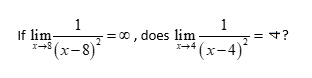
We’ll start with an example: Consider the fraction 
What you should say in such cases is that the expression has no value, or is “undefined,” or “the limit does not exist,” abbreviated DNE.
In situations like the example we say, “the limit of the fraction as x approaches 3 equals infinity,” abbreviated 
You don’t believe me? Okay pick a large number, maybe 

How about 
Try graphing the 
That’s the way to think about infinity: Infinity is what you say when you’re working with an expression that grows greater than any number you choose.
You may also use infinity to say what happens all the way to the left or right of the graph, its end behavior. The variable, x, may “approach infinity,” that is x moves further to the right (or is greater than any number you choose) the fraction above gets closer to zero: 
You may not do arithmetic with infinity.


Arithmetic is for numbers.
You will see a number of expressions whose limit is equal to infinity, like
The opposite of infinity, 
Even though the expression has no limit, you are allowed to say the limit equals infinity. That’s funny when you think about it. It might be better if everyone said “undefined” or DNE, but they don’t. What can I say?
A word of warning: You may only say “equals infinity” is situations like the example above.
There are other similar expressions that have no limit where it is incorrect to say the limit equals infinity. For example,
has no value, is “undefined,” when x = 0, but
. (Hint: this is where you should look at a graph on your graphing calculator to see why.)
does not exist. This is very similar to the first example but look at the graph and you’ll see a big difference.
So, good luck and enjoy your limitless journey through the infinite reaches of calculus. (Oh, wait! Can I say that?)
Finally,
Course and Exam Description Unit 1 topics 1.3, 1.14, 1.5 and others.


 , also known as
  , will generate function values greater than M.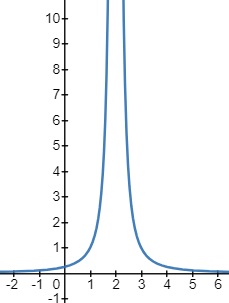

 will do the trick, since if


 . So, which is it “infinity” or does not exist”?
 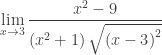 does not exist and is not ∞ .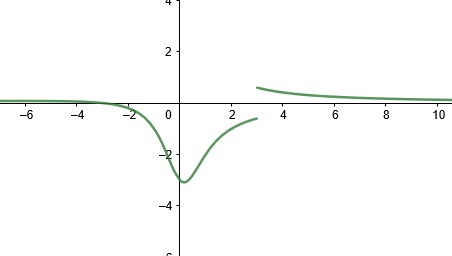
 has a finite jump discontinuity at x = 3.
  , because they think of it as a number, because
  . But what we really mean, and what this symbol means, is that by taking x close enough to 0,
  eventually becomes larger that any number they choose, no matter how large.
 where M is any real number? (And
  where M is all real numbers
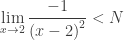 where N is any number, instead of saying the limit is
  .
. . Here, you cannot say the expression is larger than any number (because of the negative values approaching zero from the left), so obviously there is no limit, the limit does not exist, DNE, and using
  . The exponential function dominates the polynomial. As
  , the graph looks like an exponential approaching infinity; that is,
  . As
. As  the graph looks like an exponential with very small negative values (i.e. small in absolute value); so,
  .
. the numerator dominates, and the limit is infinite. If the denominator is of higher degree, the denominator dominates, and the limit is zero. (And if they are of the same degree, then the limit is the ratio of the leading coefficients. Dominance does not apply.)
 and
and  . In a standard graphing window, the graphs appear to intersect twice. But on the right side the exponential function is lower than the polynomial. Look farther out and farther up, the exponential dominates and will eventually lie above the polynomial (after x = 7.334).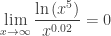
 or
or  the limit may exist. Simplify by factoring, or using different trig functions. Later in the year a method called L’Hôpital’s Rule can often be used in this situation.
 are common mistakes.
 does not exist, and DNE is a correct answer. However, it is a bit better to say the limit is (equals) infinity, indicating that the expression gets larger without bound as x approaches 3. Both answers will get credit on an AP exam.
  DNE since the one-sided limits (from the left and from the right) are different. Only DNE gets credit here.
 , in (b) they found the minimum value of
  is
is  and in (c) they had to state the range of the function is
  . Thus making the students show they knew that this kind of DNE is the kind where the value increases without bound.
 Teaching Calculus