Ideas for Reviewing for the AP Exams

Part of the purpose of reviewing for the AP calculus exams is to refresh your students’ memory on all the great things you’ve taught them during the year. The other purpose is to inform them about the format of the exam, the style of the questions, the way they should present their answer and how the exam is graded and scored.

Using AP questions all year is a good way to accomplish some of this. Look through the released multiple-choice exam and pick questions related to whatever you are doing at the moment. Free-response questions are a little trickier since the parts of the questions come from different units. These may be adapted or used in part.

At the end of the year, I suggest you review the free-response questions by type – table questions, differential equations, area/volume, rate/accumulation, graph, etc. That is, plan to spend a few days doing a selection of questions of one type so that student can see how the way that type question can be used to test a variety of topics. Then go onto the next type. Many teachers keep a collection of past free-response questions filed by type rather than year. This makes it easy to study them by type.

In the next few posts I will discuss each type in turn and give suggestions about what to look for and how to approach the question.

Simulated Exam

Plan to give a simulated exam. Each year the College Board makes a full exam available. The exams for 1998, 2003, 2008 are available at AP Central and the 2012 and the 2013 exams are available through your audit website. If possible find a time when your students can take the exam in 3.25 hours. Teachers often do this on a weekend. This will give your students a feel for what it is like to work calculus problems under test conditions. If you cannot get 3.25 hours to do this give the sections in class using the prescribed time. Some teachers schedule several simulated exam. Of course you need to correct them and go over the most common mistakes.

Explain the scoring

There are 108 points available on the exam; each half is worth the same – 54 points. The number of points required for each score is set after the exams are graded.

For the AB exam the points required for each score out of 108 point are, very approximately:

  • for a 5 – 69 points,
  • for a 4 – 52 points,
  • for a 3 – 40 points,
  • for a 2 – 28 points.

The numbers are similar for the BC exams are again very approximately:

  • for a 5 – 68 points,
  • for a 4 – 58 points,
  • for a 3 – 42 points,
  • for a 2 – 34 points.

The actual numbers are not what is important. What is important is that students can omit or get wrong a large number of questions and still get a good score. Students may not be used to this (since they skip or get wrong so few questions on your tests). They should not panic or feel they are doing poorly if they miss a number of questions. If they understand and accept this in advance they will calm down and do better on the exams. Help them understand they should gather as many points as they can, and not be too concerned if the cannot get them all. Doing only the first 2 parts of a free-response question will probably put them at the mean for that question. Remind them not to spend time on something that’s not working out, or that they don’t feel they know how to do.

Resources

Here are several resources that will help you get started:

  • “The AP Calculus Exam: How, not only to Survive, but to Prevail…” – Advice for students on the format of the exam and do’s and don’ts for the exam. Print this and share it with your students.
  • The  AB Directions and BC Directions. Yes, this is boiler plate stuff, but take a few minutes to go over it with your students. They should not have to see the directions for the first time on the day of the exam. I have highlighted some of the more important directions
  • Calculator Skills – share this information with your students, if you have not already done so. There are only about 12 -15 points on the entire exam which require a calculator. A calculator alone will not get anyone a 5 (or even a 2). Nevertheless, the points are there and usually pretty easy to earn. The real reason calculators and other technology are so important is that when used throughout the year, they help students better understand the calculus.

The next post: The Graph Stem Question

Error Bounds

How Good is Your Approximation?

Whenever you approximate something, you should be concerned about how good your approximation is. The error, E, of any approximation is defined to be the absolute value of the difference between the actual value and the approximation. If Tn(x) is the Taylor/Maclaurin approximation of degree n for a function f(x) then the error is E=\left| f\left( x \right)-{{T}_{n}}\left( x \right) \right|.  This post will discuss the two most common ways of getting a handle on the size of the error: the Alternating Series error bound, and the Lagrange error bound.

Both methods give you a number B that will assure you that the approximation of the function at x={{x}_{0}} in the interval of convergence is within B units of the exact value. That is,

\left( f\left( {{x}_{0}} \right)-B \right)<{{T}_{n}}\left( {{x}_{0}} \right)<\left( f\left( {{x}_{0}} \right)+B \right)

or

{{T}_{n}}\left( {{x}_{0}} \right)\in \left( f\left( {{x}_{0}} \right)-B,\ f\left( {{x}_{0}} \right)+B \right).

Stop for a moment and consider what that means: f\left( {{x}_{0}} \right)-B and f\left( {{x}_{0}} \right)+B   are the endpoints of an interval around the actual value and the approximation will lie in this interval. Ideally, B is a small (positive) number.

Alternating Series

If a series \sum\limits_{n=1}^{\infty }{{{a}_{n}}} alternates signs, decreases in absolute value and \underset{n\to \infty }{\mathop{\lim }}\,\left| {{a}_{n}} \right|=0 then the series will converge. The terms of the partial sums of the series will jump back and forth around the value to which the series converges. That is, if one partial sum is larger than the value, the next will be smaller, and the next larger, etc. The error is the difference between any partial sum and the limiting value, but by adding an additional term the next partial sum will go past the actual value. Thus, for a series that meets the conditions of the alternating series test the error is less than the absolute value of the first omitted term:
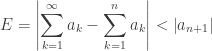
\displaystyle E=\left| \sum\limits_{k=1}^{\infty }{{{a}_{k}}}-\sum\limits_{k=1}^{n}{{{a}_{k}}} \right|<\left| {{a}_{n+1}} \right|.

Example: \sin (0.2)\approx (0.2)-\frac{{{(0.2)}^{3}}}{3!}=0.1986666667 The absolute value of the first omitted term is \left| \frac{{{(0.2)}^{5}}}{5!} \right|=0.26666\bar{6}\times {{10}^{-6}}. So our estimate should be between \sin (0.2)\pm 0.266666\times {{10}^{-6}} (that is, between 0.1986666641 and 0.1986719975), which it is. Of course, working with more complicated series, we usually do not know what the actual value is (or we wouldn’t be approximating). So an error bound like 0.26666\bar{6}\times {{10}^{-6}} assures us that our estimate is correct to at least 5 decimal places.

The Lagrange Error Bound

Taylor’s Theorem: If f is a function with derivatives through order n + 1 on an interval I containing a, then, for each x in I , there exists a number c between x and a such that

\displaystyle f\left( x \right)=\sum\limits_{k=1}^{n}{\frac{{{f}^{\left( k \right)}}\left( a \right)}{k!}{{\left( x-a \right)}^{k}}}+\frac{{{f}^{\left( n+1 \right)}}\left( c \right)}{\left( n+1 \right)!}{{\left( x-a \right)}^{n+1}}

The number \displaystyle R=\frac{{{f}^{\left( n+1 \right)}}\left( c \right)}{\left( n+1 \right)!}{{\left( x-a \right)}^{n+1}} is called the remainder.

The equation above says that if you can find the correct c the function is exactly equal to Tn(x) + R. Notice the form of the remainder is the same as the other terms, except it is evaluated at the mysterious c. The trouble is we almost never can find the c without knowing the exact value of f(x), but; if we knew that, there would be no need to approximate. However, often without knowing the exact values of c, we can still approximate the value of the remainder and thereby, know how close the polynomial Tn(x) approximates the value of f(x) for values in x in the interval, i.

Corollary – Lagrange Error Bound. 

\displaystyle \left| \frac{{{f}^{\left( n+1 \right)}}\left( c \right)}{\left( n+1 \right)!}{{\left( x-a \right)}^{n+1}} \right|\le \left( \text{max}\left| {{f}^{\left( n+1 \right)}}\left( x \right) \right| \right)\frac{{{\left| x-a \right|}^{n+1}}}{\left( n+1 \right)!}

The number \displaystyle \left( \text{max}\left| {{f}^{\left( n+1 \right)}}\left( x \right) \right| \right)\frac{{{\left| x-c \right|}^{n+1}}}{\left( n+1 \right)!}\ge \left| R \right| is called the Lagrange Error Bound. The expression \left( \text{max}\left| {{f}^{\left( n+1 \right)}}\left( x \right) \right| \right) means the maximum absolute value of the (n + 1) derivative on the interval between the value of x and c. The corollary says that this number is larger than the amount we need to add (or subtract) from our estimate to make it exact. This is the bound on the error. It requires us to, in effect, substitute the maximum value of the n + 1 derivative on the interval from a to x for {{f}^{(n+1)}}\left( x \right). This will give us a number equal to or larger than the remainder and hence a bound on the error.

Example: Using the same example sin(0.2) with 2 terms. The fifth derivative of \sin (x) is -\cos (x) so the Lagrange error bound is \displaystyle \left| -\cos (0.2) \right|\frac{\left| {{\left( 0.2-0 \right)}^{5}} \right|}{5!}, but if we know the cos(0.2) there are a lot easier ways to find the sine. This is a common problem, so we will pretend we don’t know cos(0.2), but whatever it is its absolute value is no more than 1. So the number \left( 1 \right)\frac{\left| {{\left( 0.2-0 \right)}^{5}} \right|}{5!}=2.6666\bar{6}\times {{10}^{-6}} will be larger than the Lagrange error bound, and our estimate will be correct to at least 5 decimal places.

This “trick” is fairly common. If we cannot find the number we need, we can use a value that gives us a larger number and still get a good handle on the error in our approximation.

FYI: \displaystyle \left| -\cos (0.2) \right|\frac{\left| {{\left( 0.2-0 \right)}^{5}} \right|}{5!}\approx 2.61351\times {{10}^{-6}}

Corrected: February 3, 2015, June 17, 2022

New Series from Old 3

Rational Functions and a “mistake”

A geometric series is one in which each term is found by multiplying the preceding term by the same number or expression. This number is called the common ratio, r. Geometric series converge if, and only if, \left| r \right|<1. If a geometric series converges, then the sum of the (infinite number of) terms is \displaystyle \frac{{{a}_{1}}}{1-r} where a1 is the first term.

We can use this to write series for rational expressions.

Example 1. The series for \displaystyle \frac{1}{1+{{x}^{2}}} that we assumed in the last post can be rewritten as \displaystyle \frac{1}{1-\left( -{{x}^{2}} \right)}.   This has the same form as the sum of the geometric series so we can write it as a geometric series with a1 = 1 and r = –x2 . The result is

 \displaystyle \frac{1}{1+{{x}^{2}}}=1-{{x}^{2}}+{{x}^{4}}-{{x}^{6}}+\cdots +{{\left( -1 \right)}^{2n-1}}{{x}^{2n-2}}+\cdots ,\quad -1<x<1

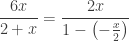
Example 2: \displaystyle \frac{6x}{2+x}=\frac{2x}{1-\left( -\tfrac{x}{2} \right)}. Letting {{a}_{1}}=3x and r=-\tfrac{x}{2} we have

\displaystyle \frac{6x}{2+x}=\frac{3x}{1-\left( -\tfrac{x}{2} \right)}=3x+3x\left( -\tfrac{x}{2} \right)+3x{{\left( -\tfrac{x}{2} \right)}^{2}}+3x{{\left( -\tfrac{x}{2} \right)}^{3}}+\cdots

\displaystyle \frac{6x}{2+x}=3x-\tfrac{3}{2}{{x}^{2}}+\tfrac{3}{4}{{x}^{3}}-\tfrac{3}{8}{{x}^{4}}+\tfrac{3}{16}{{x}^{5}}+\cdots +\tfrac{{{\left( -1 \right)}^{2n-1}}}{{{2}^{n-1}}}3{{x}^{n}}+\cdots

The interval of convergence is \left| -\tfrac{x}{2} \right|<1  or -2<x<2.

Many power series for rational functions can be obtained in this way.

An instructive “mistake.”

I have heard of students making an interesting mistake with this kind of problem. Instead of dividing by 2, they divide by x and arrive at \displaystyle \frac{6x}{2+x}=\frac{6}{1-\left( -\tfrac{2}{x} \right)} and then write the series as

\displaystyle \frac{6x}{2+x}=\frac{6}{1-\left( -\tfrac{2}{x} \right)}=6+6\left( -\tfrac{2}{x} \right)+6{{\left( -\tfrac{2}{x} \right)}^{2}}+6{{\left( -\tfrac{2}{x} \right)}^{3}}+\cdots

\displaystyle \frac{6x}{2+x}=6-\frac{12}{x}+\frac{24}{{{x}^{2}}}-\frac{48}{{{x}^{3}}}+\frac{96}{{{x}^{4}}}-\cdots

With an interval of convergence of \left| -\tfrac{2}{x} \right|<1 or x<-2\text{ or }x>2. Now this is not a Taylor series since the powers are in the denominators, but it is nevertheless interesting. Let’s look at the graphs.
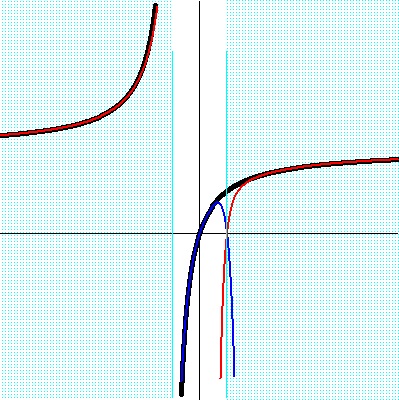
rational expression

The rational expression is the black graph and partly hidden by the other graphs where they converge. The blue graph is the 5th degree Taylor Polynomial and its interval of convergence is the white strip in the center of the graph. The red graph is the “mistake” (also 5th degree) with the two blue regions as its interval of convergence.  Both series fit the rational function but only in their own interval of convergence.

New Series from Old 2

Differentiating and integrating a known series can help you find other series. Since \frac{d}{dx}\sin \left( x \right)=\cos \left( x \right) we can find the series for cos(x) this way


\frac{d}{dx}\sin \left( x \right)=\frac{d}{dx}(x-\frac{{{x}^{3}}}{3!}+\frac{{{x}^{5}}}{5!}-\frac{{{x}^{7}}}{7!}+\cdots +\frac{{{\left( -1 \right)}^{n-1}}{{x}^{2n-1}}}{\left( 2n-1 \right)!}+\cdots )

\frac{d}{dx}\sin \left( x \right)=1-\frac{3{{x}^{2}}}{3!}+\frac{5{{x}^{4}}}{5!}-\frac{7{{x}^{6}}}{7!}+\cdots \frac{{{\left( -1 \right)}^{n-1}}\left( 2n-1 \right){{x}^{2n}}}{\left( 2n-1 \right)!}+\cdots

\cos \left( x \right)=1-\frac{{{x}^{2}}}{2!}+\frac{{{x}^{4}}}{4!}-\frac{{{x}^{6}}}{6!}+\cdots \frac{{{\left( -1 \right)}^{n-1}}{{x}^{2n}}}{\left( 2n \right)!}+\cdots

 Of course, we could also have integrated the series for sin(x) to get the series for –cos(x) and then changed the signs.

In our next post we will find that

 \frac{1}{1+{{x}^{2}}}=1-{{x}^{2}}+{{x}^{4}}-{{x}^{6}}+\cdots +{{\left( -1 \right)}^{2n+1}}{{x}^{2n-2}}+\cdots

Recall that \frac{d}{dx}\arctan \left( x \right)=\frac{1}{1+{{x}^{2}}}, so we can integrate the series above to find the series for arctan(x).

\arctan \left( x \right)=\int_{{}}^{{}}{(1-{{x}^{2}}+{{x}^{4}}-{{x}^{6}}+\cdots +{{\left( -1 \right)}^{2n-1}}{{x}^{2n-2}}+\cdots )dx}

\arctan \left( x \right)=C+x-\tfrac{1}{3}{{x}^{3}}+\tfrac{1}{5}{{x}^{5}}-\tfrac{1}{7}{{x}^{7}}+\cdots +\tfrac{{{\left( -1 \right)}^{2n+1}}}{2n-1}{{x}^{2n-1}}+\cdots

Since \arctan \left( 0 \right)=0 it follows that the constant  of integration C=0 so

 \arctan \left( x \right)=x-\tfrac{1}{3}{{x}^{3}}+\tfrac{1}{5}{{x}^{5}}-\tfrac{1}{7}{{x}^{7}}+\cdots +\tfrac{{{\left( -1 \right)}^{2n+1}}}{2n-1}{{x}^{2n-1}}+\cdots

When differentiating or integrating the interval of convergence cannot get any larger, but it can get smaller. If the endpoints are included before differentiating or integrating then you must check to see if they are included in the new series.

Next post: Rational functions and geometric series.

New Series from Old 1

There are three common ways to get new series from old series without calculating all the derivatives and substituting into the Taylor Series general term.

  • Substituting into known series
  • Differentiating and integrating
  • Approaching rational functions as geometric series

This will be  the subject of this and my next two posts.

Substituting

As you might expect the Taylor/Maclaurin series for the “parent” functions are known. We’ve seen the series for ln(x) and sin(x) and you can develop or look up series for ex, cos(x) and so on. The power series for compositions involving these series can be found by substituting.

Example 1: To find the Maclaurin series for sin(3x), substitute 3x for x in the sin(x) series

 \sin (x)=x-\frac{{{x}^{3}}}{3!}+\frac{{{x}^{5}}}{5!}-\frac{{{x}^{7}}}{7!}+\cdots +\frac{{{\left( -1 \right)}^{n-1}}{{x}^{2n-1}}}{\left( 2n-1 \right)!}+\cdots

\sin (3x)=\left( 3x \right)-\frac{{{\left( 3x \right)}^{3}}}{3!}+\frac{{{\left( 3x \right)}^{5}}}{5!}-\frac{{{\left( 3x \right)}^{7}}}{7!}+\cdots +\frac{{{\left( -1 \right)}^{n-1}}{{\left( 3x \right)}^{2n-1}}}{\left( 2n-1 \right)!}+\cdots

Substituting along with some algebra also works, as the next example shows.

Example 2: To find the series for multiply the last answer by x2

{{x}^{2}}\sin (3x)=\left( 3x \right){{x}^{2}}-\frac{{{\left( 3x \right)}^{3}}{{x}^{2}}}{3!}+\frac{{{\left( 3x \right)}^{5}}{{x}^{2}}}{5!}-\cdots +\frac{{{\left( -1 \right)}^{n-1}}{{\left( 3x \right)}^{2n-1}}{{x}^{2}}}{\left( 2n-1 \right)!}+\cdots

{{x}^{2}}\sin (3x)=3{{x}^{3}}-\frac{{{3}^{3}}{{x}^{5}}}{3!}+\frac{{{3}^{5}}{{x}^{7}}}{5!}-\cdots +\frac{{{\left( -1 \right)}^{n-1}}{{3}^{2n-1}}{{x}^{2n+1}}}{\left( 2n-1 \right)!}+\cdots

Example 3: You must be a little careful sometimes. A recent AP Calculus exam asked for the first 4 terms of the Maclaurin series for \sin \left( 5x+\tfrac{\pi }{4} \right). Substituting \sin \left( 5x+\tfrac{\pi }{4} \right) into the sin(x) series gives a series centered at x=-\tfrac{\pi }{20} but the questions required a series centered at x = 0. Almost all students calculated derivatives and used them in the general form of a Maclaurin series. But with a little trigonometry you can substitute after some rewriting:

 \sin \left( 5x+\tfrac{\pi }{4} \right)=\sin \left( 5x \right)\cos \left( \tfrac{\pi }{4} \right)+\cos \left( 5x \right)\sin \left( \tfrac{\pi }{4} \right)

\sin \left( 5x+\tfrac{\pi }{4} \right)=\tfrac{\sqrt{2}}{2}\left( \sin \left( 5x \right)+\cos \left( 5x \right) \right)

Now we can substitute into the series for the sin(x) and cos(x):

 \sin \left( 5x+\tfrac{\pi }{4} \right)=\tfrac{\sqrt{2}}{2}\left( \left( 5x-\frac{{{\left( 5x \right)}^{3}}}{3!} \right)+\left( 1-\frac{{{\left( 5x \right)}^{2}}}{2!} \right) \right)

\sin \left( 5x+\tfrac{\pi }{4} \right)=\tfrac{\sqrt{2}}{2}+\tfrac{5\sqrt{2}}{2}x-\tfrac{25\sqrt{2}}{4}{{x}^{2}}-\tfrac{125\sqrt{2}}{12}{{x}^{3}}

As you can see from the last two examples, any sort of “legal” algebra or trigonometry can be used to find a new series from one you already know.

Next post: Differentiating and Integrating


Introducing Power Series 3

In my two posts immediately preceding this one I suggested an approach to introducing power series by kind of sneaking up on them starting with the tangent line (local linear) approximation and then going for a second-, third- and higher-degree polynomial that had the same value and same derivative values as the function at a point. These polynomials are called Taylor Approximating Polynomials centered at xa.  If a = 0 then they are called Maclaurin polynomials.

Next, we looked at the graphs of two of these one for ln(x) and one for sin(x). If you tried some others, I suggest you be sure to look at their graphs. We saw that the graphs of the polynomials “hugged” the original function and the higher the degree the closer they came to the function. But there was a difference: the ln(x) polynomials were close only in an interval about two units wide with xa in the center, while the polynomials for sin(x) seemed to be close to sin(x) over wider and wider intervals.

This brought several questions to mind. Hopefully, you can draw these and other questions out of your class and then discuss them as a preview of coming ideas and motivation to learn more . Here are the questions.

1. If there were an infinite number of terms, would the polynomial (now more properly called an infinite series) be the same as the function? Equal, that is. We are of course used to thinking in terms of limits by now. For some functions, such as the sin(x), it appears that this might be the case. But for others, such as ln(x), certainly not.  

2. How do you add an infinite number of terms? Good question to which I don’t have a ready answer. In cases like the sin(x) it looks like the sum would be sin(x). 

3. Over what interval is the approximation “good”? How do you find the interval? We need a way to find this interval, called the interval of convergence. The interval, as it turns out, can usually be found using the Ratio Test or some other means, For example, if the polynomial turns out to be a geometric series, then the interval depends on the common ratio of the series.  Is the interval the same for all functions? No; look at the two examples we have been working with.

4. How good is the approximation? A question you should ask with any approximation. There are several ways of determining this. The two primary ones are the Alternating Series Error Bound and the Lagrange Error Bound. I will discuss error bounds in a later post. 

5. Is there an easier way to build the polynomial? Do you have to figure out and evaluate all of the derivatives? Luckily, no. There are easier ways to find a number of series and that too will be the subject of a later post. But not all series; occasionally you will need to find the derivatives and do all the computations. So some practice with that is in order.

6. So okay, this is a lot of fun, but why bother? Polynomials are really easy to handle. They are easy to evaluate, differentiate and integrate. Other functions, not so much. We all learned that \sin \left( \tfrac{\pi }{6} \right)=\tfrac{1}{2} and values for other “special angles”, but what is sin(0.2)? Of course you usually find such information on a calculator: sin(0.2) = 0.198669331, but you can also find it with a few terms of the series for sin(x):

\sin (0.2)\approx 0.2-\frac{{{0.2}^{3}}}{3!}+\frac{{{0.2}^{5}}}{5!}=0.198669333

Notice that using only three terms you have an answer correct to 8 decimal places. So one answer is that  you can use the approximating polynomials to, wait for it, approximate. But there are other uses as well. Stay tuned.

Inrtoducing Power Series 2

In our last post we found that we could produce better and better polynomial approximations to a function. That is, we produced a set of polynomials of increasing degree that had the same value for the functions and its derivatives at a given point. To see what is going on I suggest we graph these approximating polynomials along with the given function.

We found that the polynomials \left( x-1 \right), \left( x-1 \right)+\left( -\tfrac{1}{2} \right){{\left( x-1 \right)}^{2}}, \left( x-1 \right)+\left( -\tfrac{1}{2} \right){{\left( x-1 \right)}^{2}}+\left( \tfrac{1}{6} \right){{\left( x-1 \right)}^{3}}, and \left( x-1 \right)+\left( -\tfrac{1}{2} \right){{\left( x-1 \right)}^{2}}+\left( \tfrac{1}{6} \right){{\left( x-1 \right)}^{3}}+\left( -\tfrac{1}{4!} \right){{\left( x-1 \right)}^{4}} produced approximations to the natural logarithm function at the point (1, 0). To see how this works, graph each of these polynomials, one after the other. See the figure below.

This slideshow requires JavaScript.

Notice that each polynomial comes closer to the graph of the graph of y = ln(x), the black graph, in the figures.

You students can do this on their graphing calculators or with a graphing program. More on how to do  this below.

Now do the same thing with the polynomials found for the sine function.

This slideshow requires JavaScript.

However, there is a difference. The sine polynomials seem to hug the sine graph over increasingly wider intervals while the logarithm polynomials do not. This may not be a surprise since the logarithm function has no values for x\le 0 while the polynomials do. The polynomials cannot come close to the graph if there is no graph.

Students should notice these things:

  • Successively higher degree polynomials seem to come closer to the graph of the function than the previous one.
  • The polynomials may exist outside the domain of the function (outside of x>0 for ln(x) for example).
  • The interval where the graphs are near the function is limited.

Taken together these two examples suggest several questions (which you can perhaps draw out of your class):

  1. If there were an infinite number of terms would the Polynomial be the same as the function?
  2. How do you add an infinite number of terms?
  3. Over what interval is the approximation “good”? Is the interval the same for all functions? How do you find the interval?
  4. How good is the approximation?
  5. Is there an easier way to build the polynomial? Do you have to figure out and evaluate all of the derivatives?

These questions will be the topic of my next post.

________________________________________

How to Graph these Polynomials using Winplot

You can enter each polynomial separately of course, but here is an easier way.

  1. After setting your viewing window (CTRL+V), push [F1] to get the explicit equation entry window and enter sin(x) (or the function you are interested in) and click [OK] to graph y = sin(x).
  2. Then push [F1] again and enter Sum( (-1)^(n+1)x^(2n-1)/(2n-1)! ,n,1,A) and click [OK]. The underlined part may be changed to the general term of any series.  The n identifies the variable, the 1 is the starting value of n and the A will be the final value which we will change.
  3. Next click on [ANIM] > [Individual] > [A]. This will bring up a slider. Enter 100 in the box and click [Set R] and then enter 0 and click [Set L]. This will make the A values change by exactly 1 allowing you to look at A = 1, 2, 3, 4, … in order.
  4. Click the tab on the “A” slider window box and see the various approximating polynomials “hug” the graph











