Past AP Exams

Recently, the College Board removed all the past AP Calculus exams dating back to 1998. This included free-0response questions and full exam with multiple-choice questions. The questions will be included in the AP Classroom section.

From now on, only free-response questions from the most recent three years will be available along with their scoring guidelines and other data. I understand that they will release a new full exam in January 2026, and then every three years after that as they did in the past.

While I have many favorite questions and exams from long ago, three years is enough for practice for the AP Exams in the spring.

So, two things:

  1. I suggest you download the exams, so you’ll have a copy when they “disappear.” If you really need older exams, I suggest you contact colleagues who may have downloaded copies.
  2. In this blog, I have referred to and discussed questions from past exams. Due to copyright regulations, I have not quoted the questions exactly. I have always tried to paraphrase enough of a question, so the discussion makes sense. There may be links to past exams that are no longer live. There are far too many to attempt to “fix” them. Sorry. I hope that will suffice.

Back to School 2025

School starts soon. Some places have already started. Here are some links to posts that will give you some help and ideas for getting off to a good start.

Getting Started Some suggestions.

The First Week A short series of exercises that will introduce your students to the concepts they will be learning about all year: Limits, Derivatives, and Integrals. This is a contribution from Paul A. Foerster. Thank you, Paul.

Pacing for AP Calculus. Suggestions on planning the year in AP Calculus.

On Grading and On Scaling. Yes, you should scale your tests. Here’s why.

DESMOS

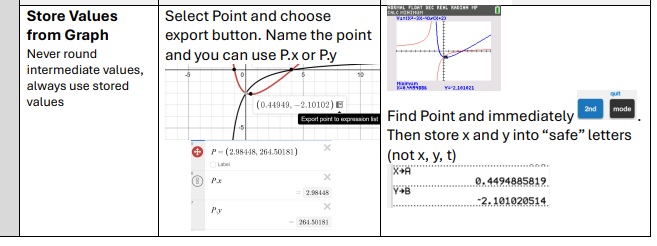
The online graphing utility Desmos has fast become a go-to site for AP Calculus. It is easy to learn and, in many ways, easier to use than graphing calculators. (Not to mention, cheaper.) Since Desmos is available during the exam there is no reason not to use it all year. It is available for computers, and as an app for smart phones and tablets.

Click here for an expanded note on how to use Desmos for the four things students are required to do with technology on the AP Calculus Exam. The note also shows and compares how to do the same things on a TI-84, so if you are familiar with the TI-84 the change will be easy enough. (August 20, 2025: The link is to a newer version than was published two days ago. It includes computing derivatives and definite integrals.)

This was developed by Crista Hamilton, who teaches AP Calculus at the Maggie Walker Governor’s School for Government and International Studies in Richmond, Virginia. She has kindly allowed me to share it with you. Thank you, Crista.  

The current image has no alternative text. The file name is: desmos.jpg

Whether Desmos or graphing calculators, you can and should use technology for more than the four things required for the exam. Students should use technology not just to verify their results but also as a tool to investigate, explore, and experiment. Encourage your students to use Desmos and/or their graphing calculator whenever they are doing math.

HAVE A GREAT YEAR!


The Teaching Calculus Blog 2025 – 2026

Another year and another AP Calculus exam: Thank you again for reading and using the blog. I am not going away. If something new or interesting comes up in calculus or the AP Calculus program, I will jump in with a new post.

I do monitor the site and If you have any questions on teaching calculus, calculus in general, or a specific mathematics question please email me here or add a comment to any post. (Don’t be bashful: I like to answer your questions.)

The blog and all its resources will be here. Please use them and give the links to your colleagues and students. As always, you are welcome to reproduce anything here for use in your classroom.

If you are new to the blog, the drop-down menus under the header will help you find your way around the blog.

  • The Blog Guide is the place to start. Most of my posts are linked to the appropriate unit in the AP Calculus Course and Exam Description (CED) and the other general topics in that list.
  • The AP Calculus CED has other links to posts to units in the AP Calculus Course and Exam Description.
  • An Exam Index and Type Analysis has past multiple-choice abd free-response questions indexed by my ten types.
  • The Resources tab lists post by month and other resources.
  • The Presentations tab has links to PowerPoints slides on various topics that I have done over the years. Feel free to download them and use them with your class if you think they will be useful to them.
  • The Videos tab has some very old videos on various topics. You can also find them directly on Vimeo.com; search for Lin McMullin.
  • The Website has some things from a previous website.

You may also find posts using the Search box, Post by Topic and Archives features on the right side of the page. Just enter or look for the topic you are interested in.

I hope you have another good year and find the blog helpful. Thanks again for reading all these years.

Teaching Calculus 2024 – 25

Review time is approaching. Here is the link to the AP Calculus Exams Review Posts

AP Calculus Exam Review Posts

Thank you for your support and encouragement for the Teaching Calculus blog. I’ve enjoyed writing the posts and answering your questions since 2012. This coming year, I will be stepping away from this blog; I am not planning any new posts.

The blog and all its resources will be here for the foreseeable future. Please use them and give the links to your colleagues and students. As always, you are welcome to reproduce anything here for use in your classroom.

I am not going away. If something new or interesting comes up in calculus or the AP Calculus program, I will jump in with a new post. If you have any questions on teaching calculus, calculus in general, or a specific mathematics question please email me here or add a comment to any post. (Don’t be bashful: I like to answer your questions.)

If you are new to the blog, the drop-down menus under the header will help you find your way around the blog.

  • The Blog Guide is the place to start. Most of my posts are linked to the appropriate unit in the AP Calculus Course and Exam Description (CED) and the other general topics in that list.
  • The AP Calculus CED has other links to posts to units in the AP Calculus Course and Exam Description.
  • An Exam Index and Type Analysis has past multiple-choice abd free-response questions indexed by my ten types.
  • The Resources tab lists post by month and other resources.
  • The Presentations tab has links to PowerPoints slides on various topics that I have done over the years. Feel free to download them and use them with your class if you think they will be useful to them.
  • The Videos tab has some very old videos on various topics. You can also find them directly on Vimeo.com; search for Lin McMullin.
  • The Website has some things from a previous website.

You may also find posts using the Search box, Post by Topic and Archives features on the right side of the page. Just enter or look for the topic you are interested in.

I hope you have a good year and find the blog helpful. Thanks again for reading all these years.

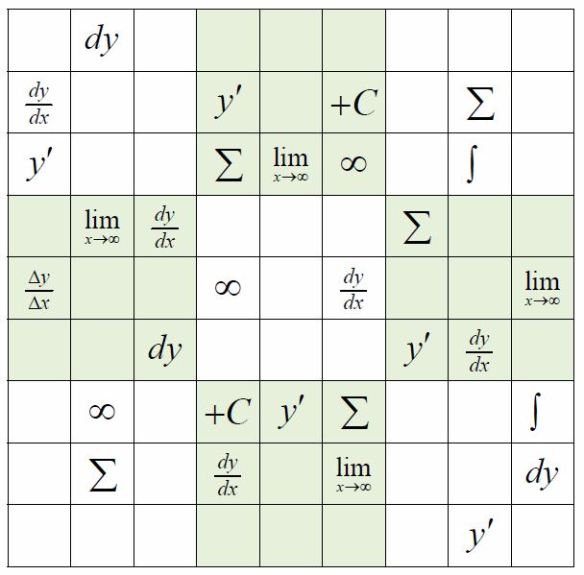
Meanwhile here is a little calculus sudoku to keep you busy.

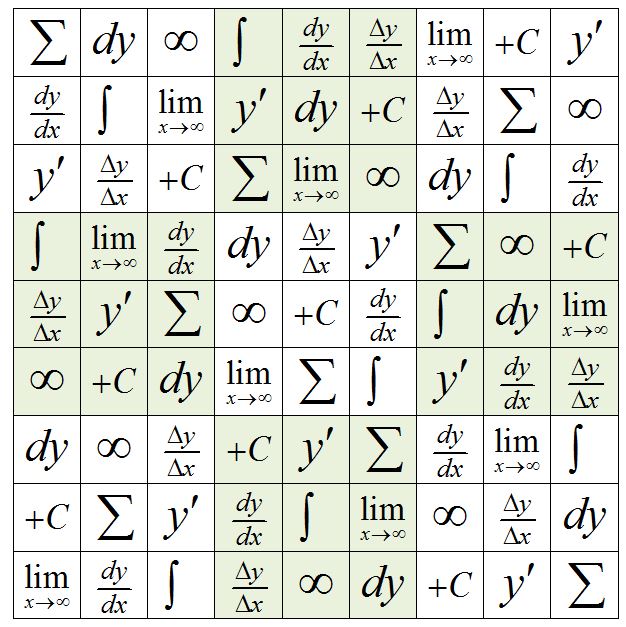
Solution

Phew…

Done at last. I hope your students all did well on the exam and those taking the late exam will also do well.

The free-response questions have been released. Here are the links:

AB Calculus 2024

BC Calculus 2024

Precalculus 2024

The scoring guidelines and other information from the reading are usually posted in the fall. I’m sure there will be teacher who post their solutions to the  AP Calculus Community starting today. So, look there to see how they compare to yours.

 Hope you have a nice summer.

AP Exam Review 2024

For several years now, I’ve been posting a series of notes on reviewing for the AP Calculus Exams. The questions on the AP Calculus exams, both multiple-choice and free response, fall into ten types. I’ve published posts on each. The ten types have not changed over the years, so there is not much to add. They are updated from time to time. The posts may be found under the “Blog Guide” tab above: click on AP Exam Review. The same links are below with a brief explanation of each.

This year’s AP Calculus exams will be given on Monday May 13, 2024, at 8:00 am local time.

I hope these will help as you, teachers and students, to review for this year’s exam.

General information and suggestions for teachers

  • AP Exam Review – Suggestions, hints, information, and other resources for reviewing. How to get started. What to tell your students. Simulated (mock) exams.
  • To dx or not to dx – Yes, use past exams and the scoring guideline to review, but don’t worry about the fine points of scoring; be more stringent than the readers.
  • Practice Exams – A Modest Proposal Like it or not (and the AP folks certainly do not) the answers are all online. What to do about that. Don’t overlook the replies at the end of this post.

General Information for students

Why Review? To make mistakes!

How, not only to survive, but to Prevail… Things students should know to do well on the exams. Copy this article for your students or share the link with them.

The Ten Type Questions.

Other than simply finding a limit, a derivative, an antiderivative, or evaluating a definite integral, the AP Calculus exam questions fall into these ten types. These are different from the ten units in the CED. Students are often expected to use knowledge from more than one AP Calculus unit in a single question.

These posts outline what each type of question covers and what students should be able to do. They include references to good questions, free-response and multiple-choice, and links to other posts on the topic.

These ten types appear in multiple-choice and free response questions. This type analysis provides an index to the questions by type. In addition the multiple-choice questions include straightforward questions (find a limit, compute a derivative, etc.)

Type 1 questions – Rate and accumulation questions. Contextual questions about things that are changing. Careful reading is the first step. Good graphing calculator skills are essential since this is usually a calculator active question.

  • Type 3 questions – Graph analysis. Given the derivative often as a graph, students must answer questions about the function – extreme values, increasing, decreasing, concavity, etc.
  • Type 4 questions – Area and volume problems. Student must find the area of a region enclosed by one or more curves, find the volume of a solid with regular cross-sections, and/or find the volume of a solid of revolution (which is, of course, a regular cross-section).
  • Type 6 questions – Differential equations. Students are asked to solve a first-order separable differential equation, work with a slope field, or other related ideas. BC students may be asked to use Euler’s Method to approximate a value and discuss the logistic equation.
  • Type 7 questions – Miscellaneous. These include finding the first and second derivative of implicitly defined relation, solving a related rate problem or other topics not included in the other types.
  • Type 10 questions – Sequences and Series (BC topic) Questions ask student to determine the convergence of series using various convergence tests and to write and work with a Taylor and Maclaurin series, find its radius and interval of convergence.

The notes always available from the menu line at the top of the page: click on Blog Guide > AP Exam Review


Also, Calc-Medic has posted a searchable database of all the AP Calculus Free-response questions from 1998 on. The link is here. While you’re there take a look at their website which has lots of resources and free lesson plans. For more on Calc-medic see this post.


Updates: March 9, 2023 – Calc-medic, March 2, 2024

Why Review?

The reason you review is TO MAKE MISTAKES!

When you’re reviewing for the AP Calculus exams your goal is to make mistakes. Why make mistakes? Easy: to find out what you’re doing wrong so you can fix it. And to find out what you don’t know so you can learn it.  

Your teacher will assign free-response questions, FRQs, from real AP Calculus exams from past years. Give yourself about 15 minutes and try to answer the question. (Fifteen minutes is about the time you have for each FRQ on the exam.) After fifteen minutes, stop. Check your work.

The questions, answers, solutions, and most importantly the scoring guidelines for FRQs are all online here for AB, and here for BC. Each FRQ is worth nine points. The scoring guidelines will show you what must be on your paper to earn each point.

Now you can copy the absolutely perfect answer for your FRQs and hand it in to your teacher. This won’t impress or fool your teacher because he or she has the guidelines too. More importantly this won’t help you. When reviewing mistakes are good. Study your mistakes and learn from them.

  • If you made a simple arithmetic or algebra mistake, learn to be more careful. One very common mistake is simplifying your answer incorrectly. Remember, you do not have to simplify numerical or algebraic answers. If you write “ 1 + 1 “ and the correct answer is 2, the “ 1 + 1 ” earns the point. But if you simplified it to 3, you lose the point you already earned. (The standards show simplified answers, so the readers will know what they are for (foolish?) students who chose to simplify.) simplifying also wastes time.
  • If you’re unsure how to write justifications, explanations, and other written answers, use the scoring guidelines as samples or templates. Learn to say what you need to say. Don’t say too much. You will not earn full credit for the correct answer and correct work if the question asks for a justification, and you don’t write one.
  • If you really don’t know how to answer a question you’ve made an important mistake. This is the thing you need to work on until you understand the concept or method. This requires more than just reading the solution on the guideline. Go back to your notes, ask your friends, ask your teacher, find out what you’re missing and learn it. Look at similar questions from other exams.
  •  For multiple-choice questions only the answers are available. Nevertheless, be sure you understand your mistakes.

There are 7 types of questions on the AB exam and an additional 3 on the BC exam. These are not the same as the ten units you’ve been studying, because AP exam questions often have parts from more than one unit. On March 5, I will post links to all the types. The discussion of each type will include a list of what you should know and be able to do for each type along with other hints.           

Now, when you actually take the AP Calculus exam your goal changes. Here you want to earn all the points you can. If you run across something you know you don’t know on the exam, leave it. Go onto something you do know. Don’t waste your time on something you’re not sure of. You can always come back if you have time.

Missteaks our heplfull.