Testing, but Not for Calculus

While calculus teachers are concerned with the new format of this year’s AP Calculus exams, there is other testing that is important now: tests for disease. Today’s post is not about calculus; mathematically, it is about conditional probability. In the big picture, it is about tests for disease and their accuracy. .

No test for any disease is totally accurate. Here are some notes on the concerns with testing.

The results of a health-related test fall into four categories. Before listing them I will define some variables:

  • Let n be the number of people tested
  • Let r be the proportion of the population tested who have the disease. 0 < r < 1. This number must be an estimate.
  • Let a be the accuracy of the test. That is, the proportion of the test results that are correct (true). No test is 100% accurate, so 0 < a < 1. The tests are developed with known samples, so a is based on that result. See [3] for values of actual tests.

The four categories of results are:

  • True positive results (T+). The person tested has the disease and the test correctly identifies indicates this \displaystyle T+=nra
  • True negative results (T-). The person tested does not have the disease and the test correctly indicates this \displaystyle T-=na\left( {1-r} \right)
  • False positive result (F+). The person tested does not have the disease, but the test incorrectly indicates they do.\displaystyle F+=n\left( {1-r} \right)\left( {1-a} \right)
  • False negative result (F-). The person tested has the disease and the test incorrectly indicates they do not. \displaystyle F-=nr\left( {1-a} \right)

The concern is with the latter two categories.

  • The proportion of positive results that are false is the false positive rate (also called the sensitivity) – the number of false positive results divided by the total number of positive results = \displaystyle \frac{{(1-r)(1-a)}}{{ra+(1-r)(1-a)}}. The n has simplified out of the expression. Even for accurate tests, this number may be quite large.
  • The proportion of negative results that are false is the false negative rate (also called the specificity) – the number of false negative results divided by the total number of false results = \displaystyle \frac{{r(1-a)}}{{a(1-r)+r(1-a)}}. The n has simplified out of the expression.

…[A]accuracy needs to be high. The prevalence of Covid-19 is estimated at around 5% in the US, and at this low level the risk of false positives becomes a major problem. If a serological test [a blood test for the virus’s antibodies] has 90% specificity, its positive predictive value will be 32.1% – meaning nearly 70% of positive results will be false. At this same disease prevalence, a test with 95% specificity will lead to a 50% false positive rate. Only at 99% specificity does the false positive rate become anywhere near acceptable, and even here 16% of positive results would still be wrong.

Elizabeth Cairns at Evaluate 

To examine the false positive rate, you may use this Desmos graph. Use the r-slider to adjust the proportion of the population that is believed to be affected. Use the a-slider to change the accuracy of the test. The number given by f(a) is the false positive rate.

Last week the results of a preliminary random sample of New York state residents for Covid-19 indicated a state-wide infection rate of 14% (r = 0.14). (This, I hope, is high, but it is what we have at the moment.) The accuracy of the test was not given. Assuming a 90% accuracy rate (a = 0.90), gives a false positive rate of just over 40% (f(0.90) = 0.406). Even at 95% accuracy (a = 0.95), the false positive rate is 50%. The graph below is set for these values. You may investigate other settings using the link above.
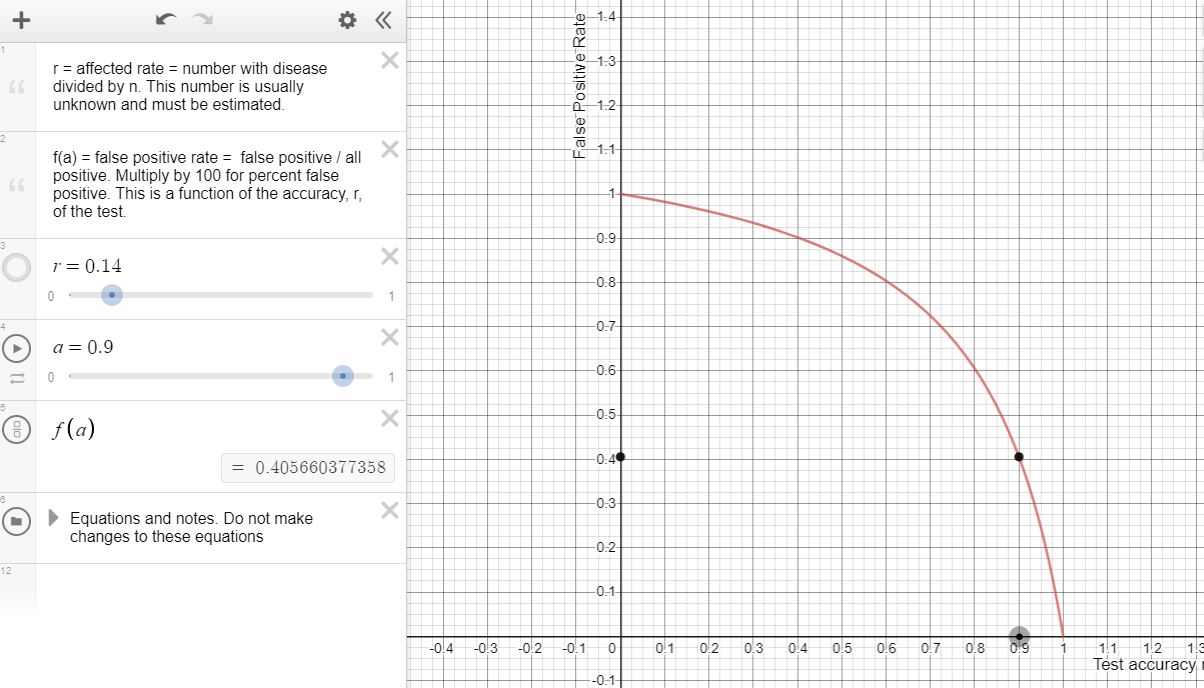
This is the concern. About 40% of the positive results are false; the people are told they have the disease, but they do not. Only about 60% of the positive results are correct. We don’t know which among the positive results really have the disease. We cannot tell for any individual, yet they all must be treated as though they have the disease using up valuable resources.

This happens because a very large number of people do not have the disease: the inaccuracy of the test produces a large number of false positive results. This concern is inherent in all such tests and must be accounted for. It is very important to have extremely accurate tests or to be able to account for the false positives.

A similar graph for the false negative results is here. Using the same values as above, the false negative rate is about 1.7%. These people have the disease but are told they don’t. This too is a concern, since they won’t get treated.

Please stay well and stay home.


REFERENCES

  1. False Positive Rates
  2. Sensitivity and Specificity
  3. Covid-19 Antibody Tests Face a Very Specific Problem This article contains a list of the accuracy figures (sensitivity (false positive rate) and  specificity (false negative rate)) of the currently available tests for SARS-CoV-2, the virus that causes Covid-19.
  4. The Evaluate website has good daily updates on worldwide Covid-19 data.

..


AP Calculus Exams Update

Here is the latest information on the 2020 AP Calculus Exams as of April 3, 2020. Updated 4/29/2020

Update: A message from the AP Program 4/28/2020

Subject: How to Prepare Your Students for the 2020 AP Exams

Dear Colleagues,

Additional information is now available to help guide you and your students through the exam day experience.

New Resources

 2020 AP Testing Guide (.pdf/10.9 MB): The guide, designed for educators to walk their students through test day, provides information about:

    • The AP Exam e-ticket
    • Five steps to take before test day
    • Understanding the test day experience
    • Exam scores, credit, and placement
  • 2020 AP Exam Day Checklist (.pdf/526 KB): Teachers should have their students complete this checklist for each exam they take and keep it next to them while testing.
  • Explainer Videos: New videos are available to give students quick, easily accessible information about their test day experience, what they need to do to prepare, exam security, and more. Explore the playlist.

Other Reminders

 AP Exam Demo (available May 4): AP students should use the clickable exam demo to practice the different ways to submit their exam responses. The demo will help students confirm that their testing device will be able to access and run the online exam. If they can’t access the demo, the final slide of the Testing Guide can help them troubleshoot. The sample content in the demo will be the same for all users and isn’t a practice exam. We’ll send educators and students an email to remind them when the demo is available. Please encourage your students to take this important preparation step.

  • Educator Webinars: Trevor Packer, the head of the AP Program, will walk participants through the 2020 AP Testing Guide. AP staff will answer questions during the presentation. This series of webinars includes:
    • The above exams will be administered using a new dedicated app, the AP World Languages Exam App. Students taking these exams must use this app on smartphones or tablets. This free app will be available for download from the Apple App Store and Google Play Store the week of May 11. We’ll email students and their teachers to let them know when the app is available to download. Visit our site for more details.

 A video walk-through of the test-taking experience will be available the week of May 4.

    • Details on accommodations for the above exams are also now available.
    • If your students are unsure about accessing the app, or if they don’t have a device, they can fill out this survey (or you can complete it on their behalf) as soon as possible so we can help support them (applicable to U.S. and U.S. territories).

Thank you for all that you’re doing for your students.

Sincerely,

Advanced Placement Program

General Information from the College Board

The previous announcement of March 20, 2020 from the College Board with details on the exam and what is and is not covered is here.

The College Board’s full email of April 3, 2020 is here.

A video of Trevor Packard’s online discussion on Thursday April 2, 2020 is here.

Video of the webinar for Math and Computer Science Teachers from April 14, 2020 is here.

The announcement regarding the exams published April 3, 2020 is here.  Scroll down to the calculus sections for full exam details. Highlights are below.

The College Board’s Coronavirus Update page is here with information for teachers and students. This includes a FAQ page.

AP Calculus AB and BC 

The AB exam will cover only Units 1 – 7 of the 2019 Course and Exam Description (NOT Unit 8)

The BC exam will cover only Units 1 – 8, and Unit 10 topics 2, 5, 7, 8, and 11 of the 2019 Course and Exam Description (NOT Unit 9 or Unit 10 topics 1, 3, 4, 6, 9, 10, 12, 13,14, and 15).

The format will be two free-response questions.

    • The first multi-focus free-response question counts 60% and assess knowledge and skills from 2 or more units. Students will be allowed 25 minutes followed by 5 minutes to upload the answers. Once uploaded, students may not return to this question.
    • The second multi-focus free-response question counts 40% assess knowledge and skills from 2 or more units. Students will be allowed 15 minutes followed by 5 minutes to upload the answer.
    • Questions on the 2020 AP Calculus BC Exam are designed such that a graphing calculator or other calculator is not required. However, use of a calculator is allowed. Simple (“four-function”) calculators are freely available as apps for computers and phones (i.e. most or all internet-connected devices), and can be installed beforehand for use on the exam.
    • No arithmetic or calculations will be required beyond what can readily be done with pencil and paper. As always, AP Calculus BC students are advised to submit “unsimplified” numeric answers, in order to avoid risking arithmetical errors not related to calculus.
    • Accommodations for students who are entitled to them will be allowed. At the moment, I have no information on how this will work. I will edit this if/when I know.
    • Video of the webinar for Math and Computer Science Teachers from April 14, 2020 is here.

Other information

Most exams will have one or two free-response questions, and each question will be timed separately. Students will need to write and submit their responses within the allotted time for each question.

    • Students will be able to take exams on any device they have access to—computer, tablet, or smartphone. They’ll be able to type and upload their responses or write responses by hand and submit a photo via their cell phones.
    • For most subjects, the exams will be 45 minutes long, plus an additional 5 minutes for uploading. Students will need to access the online testing system 30 minutes early to get set up.
    • Again, The announcement regarding the exams published April 3, 2020 is here.  Scroll down to the calculus sections for full exam details.

Exam Dates

The AP Calculus Exams AB and BC will be administered online on Tuesday May 12, 2020 simultaneously worldwide, specifically:

    • Eastern time zone at 2:00 p.m.
    • Central time zone at 1:00 p.m.
    • Mountain time zone at 12:00 noon
    • Pacific time zone at 11:00 a.m.
    • Alaska time zone at 10:00 a.m.
    • Hawai’i time zone at 8:00 a.m.
    • Greenwich Mean Time (GMT) 6:00 p.m. (18:00)

Make Up Exams for Calculus will be Tuesday June 2, 2020 at 20:00 GMT (8 p.m.) That’s

    • 4:00 p.m. Eastern,
    • 3:00 p.m. Central,
    • 2:00 p.m. Mountain,
    • 1:00 p.m. Pacific,
    • 12:00 noon Alaska
    • 10:00 a.m. Hawai’i

Review Links

Links to my review blogs are below. The “type” numbers are not the same as the CED unit numbers. One type may and probably does require knowledge from several of the CED Units.


Revised 4/9/2020: Additions and corrections.