All the important things in mathematics are written as theorems.
Theorems are statements of mathematical facts that have been proven to be true based on axioms, definitions, and previously proved theorems. They summarize information in a general way so that it may be applied to specific new situations.
All the rules, formulas, laws, etc. that you study in mathematics are really theorems.
The form of a theorem is IF one or more things are true, THEN something else is true. For example, IF a function is differentiable at a point, THEN it is continuous at the point.
The IF part is called the hypothesis (the function is differentiable at a point) and the THEN part is called the conclusion (the function is continuous at the point).
The word “implies” can replace the IF and the THEN. So, the theorem above may be shortened to “Differentiability implies continuity.” When this happens be sure you understand what has been omitted.
HINT: It is always a good idea when learning a new theorem to identify the hypothesis and the conclusion for yourself.
Proof
The proof of a theorem is an outline of the reasoning that shows how previous results (axioms, definitions, and previous theorems) lead to the conclusion. They are carefully written to convince mathematicians and other interested people that the theorem is true.
In AP Calculus, you will not prove every theorem. The reason you as beginning calculus students should look at proof is (1) to help you understand why the theorem is true, and (2) to begin learning how to do proof yourself.
Good news / bad news: You will not be asked to prove theorems on the AP Calculus exams. You will be asked to “justify your answer” or “show your reasoning” or the like. To do this you will need to state that hypotheses of the theorem you are using are true for the situation in the question and therefore, you may say that the conclusion applies in this case. To use the theorem in the example, you would have to establish that the function you are given is differentiable, then you may say it is continuous.
for any theorem, you need to know and understand both the hypothesis and the conclusion.
Related Statement: The Contrapositive
The contrapositive of a theorem is a statement that says if the original theorem’s conclusion is false, then its hypothesis is false. This makes sense: When the original hypothesis is true, the conclusion must be true. So, if the conclusion is false something must be wrong with the hypothesis. For any theorem, its contrapositive is always a true theorem.
The contrapositive of the example above is “If a function is not continuous at a point, then it is not differentiable there.” In fact, this particular contrapositive is one you will be using soon.
Related Statement: The Converse
The converse of a theorem is formed by interchanging the hypothesis and the conclusion. The converse of our example is “If a function is continuous at a point, then it is differentiable there.” This statement is false! There are continuous functions that are not differentiable. An example is the absolute value function at the origin.
Converses may or may not be true. They must be proved separately, if possible. It is a mistake to assume the converse is true without first proving it. This mistake is so common it has a name; it is called the fallacy of the converse.
Related Statement: The Inverse
The inverse is (hold on tight) the contrapositive of the converse. It states that if the original hypothesis is false, then the original conclusion is false. for our example: “If a function is not differentiable, then it is not continuous.” (This example is false.)
The inverse is not necessarily true; it is true if the converse is true. Like the theorem / contrapositive pair, the converse / inverse pair are true or false together. Sometimes all four are true, sometimes not.
Finally, any of the four statements may be considered “the theorem” and the other three will change their names accordingly. The theorem states the idea in the form in which it is usually used. The converse, if it is important and true, is given and proved separately at the same time. The contrapositive and the inverse go along for the ride and do not have to be proved separately.

 .
. .
.
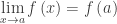
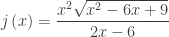
 . This function has a single hole in the graph at (3, 3); It one may be difficult to see. Try using ZDecimal. A single point is missing because there is no value at x= 3 because the denominator is zero.
 .
.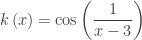 Zoom in several times at (3, 0) where the function has no value.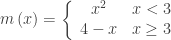
 , is often used that way by those unlucky folks who don’t understand mathematics.
 . This fraction has no value when x = 3 because there the denominator is zero. And you cannot divide by zero. Nothing personal, no one, no matter how smart, can divide by zero. Ever. Permanently and forever not allowed. Don’t even think about it! (Actually, think about it; just don’t do it.)
 . This means that the expression gets larger as x gets closer to three. The expression will be greater than any (large) number you want, if you are close enough to three.
 . I say pick any value for x between 2.9999 and 3.0001 (
 ) and the expression will be larger than
  ? Try a number between 2.9999999999 and 3.0000000001. I can play this game all day.
 on your calculator. (Hint: Whenever you come across something like this, it is a great idea to graph the expression on your graphing calculator. Graphs can help you see what’s going on. Keep that in mind for the future.)
 .
.

 , sometimes called “negative infinity,” means that the expression gets less than (i.e. more negative), than any negative number you choose.
  has no value, is “undefined,” when x = 0, but
  . (Hint: this is where you should look at a graph on your graphing calculator to see why.)
 does not exist. This is very similar to the first example but look at the graph and you’ll see a big difference.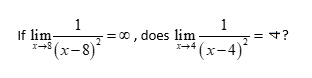
 Teaching Calculus