How Good is Your Approximation?
Whenever you approximate something, you should be concerned about how good your approximation is. The error, E, of any approximation is defined to be the absolute value of the difference between the actual value and the approximation. If Tn(x) is the Taylor/Maclaurin approximation of degree n for a function f(x) then the error is  . This post will discuss the two most common ways of getting a handle on the size of the error: the Alternating Series error bound, and the Lagrange error bound.
Both methods give you a number B that will assure you that the approximation of the function at  in the interval of convergence is within B units of the exact value. That is,

or
 .
.
Stop for a moment and consider what that means:  and
and  are the endpoints of an interval around the actual value and the approximation will lie in this interval. Ideally, B is a small (positive) number.
Alternating Series
If a series  alternates signs, decreases in absolute value and
  then the series will converge. The terms of the partial sums of the series will jump back and forth around the value to which the series converges. That is, if one partial sum is larger than the value, the next will be smaller, and the next larger, etc. The error is the difference between any partial sum and the limiting value, but by adding an additional term the next partial sum will go past the actual value. Thus, for a series that meets the conditions of the alternating series test the error is less than the absolute value of the first omitted term:
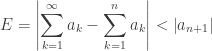 .
.
Example:  The absolute value of the first omitted term is
  . So our estimate should be between
  (that is, between 0.1986666641 and 0.1986719975), which it is. Of course, working with more complicated series, we usually do not know what the actual value is (or we wouldn’t be approximating). So an error bound like
  assures us that our estimate is correct to at least 5 decimal places.
The Lagrange Error Bound
Taylor’s Theorem: If f is a function with derivatives through order n + 1 on an interval I containing a, then, for each x in I , there exists a number c between x and a such that

The number  is called the remainder.
The equation above says that if you can find the correct c the function is exactly equal to Tn(x) + R. Notice the form of the remainder is the same as the other terms, except it is evaluated at the mysterious c. The trouble is we almost never can find the c without knowing the exact value of f(x), but; if we knew that, there would be no need to approximate. However, often without knowing the exact values of c, we can still approximate the value of the remainder and thereby, know how close the polynomial Tn(x) approximates the value of f(x) for values in x in the interval, i.
Corollary – Lagrange Error Bound.

The number  is called the Lagrange Error Bound. The expression
  means the maximum absolute value of the (n + 1) derivative on the interval between the value of x and c. The corollary says that this number is larger than the amount we need to add (or subtract) from our estimate to make it exact. This is the bound on the error. It requires us to, in effect, substitute the maximum value of the n + 1 derivative on the interval from a to x for
  . This will give us a number equal to or larger than the remainder and hence a bound on the error.
Example: Using the same example sin(0.2) with 2 terms. The fifth derivative of  is
is  so the Lagrange error bound is
  , but if we know the cos(0.2) there are a lot easier ways to find the sine. This is a common problem, so we will pretend we don’t know cos(0.2), but whatever it is its absolute value is no more than 1. So the number
  will be larger than the Lagrange error bound, and our estimate will be correct to at least 5 decimal places.
This “trick” is fairly common. If we cannot find the number we need, we can use a value that gives us a larger number and still get a good handle on the error in our approximation.
FYI: 
Corrected: February 3, 2015, June 17, 2022

 . If a geometric series converges, then the sum of the (infinite number of) terms is
  where a1 is the first term.
 that we assumed in the last post can be rewritten as
  . This has the same form as the sum of the geometric series so we can write it as a geometric series with a1 = 1 and r = –x2 . The result is
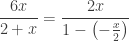 . Letting
  and
and  we have

 or
or  .
. and then write the series as

 or
or  . Now this is not a Taylor series since the powers are in the denominators, but it is nevertheless interesting. Let’s look at the graphs.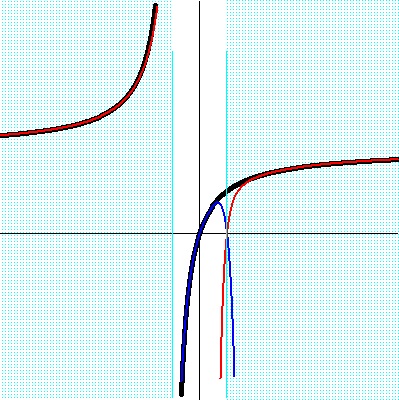
 we can find the series for cos(x) this way



 , so we can integrate the series above to find the series for arctan(x).

 it follows that the constant of integration
  so
so


 . Substituting
  but the questions required a series centered at x = 0. Almost all students calculated derivatives and used them in the general form of a Maclaurin series. But with a little trigonometry you can substitute after some rewriting:


 and values for other “special angles”, but what is sin(0.2)? Of course you usually find such information on a calculator: sin(0.2) = 0.198669331, but you can also find it with a few terms of the series for sin(x):

