Type 10: Sequences and Series Questions

The last BC question on the exams usually concerns sequences and series. The question usually asks students to write a Taylor or Maclaurin series and to answer questions about it and its interval of convergence, or about a related series found by differentiating or integrating. The topics may appear in other free-response questions and in multiple-choice questions. Questions about the convergence of sequences may appear as multiple-choice questions. With about 8 multiple-choice questions and a full free-response question this is one of the largest topics on the BC exams.

Convergence tests for series appear on both sections of the BC Calculus exam. In the multiple-choice section, students may be asked to say if a sequence or series converges or which of several series converge.

The Ratio test is used most often to determine the radius of convergence and the other tests to determine the exact interval of convergence by checking the convergence at the end points. Click here for a convergence test chart students should be familiar with; this list is also on the resource page.

Students should be familiar with and able to write several terms and the general term of a Taylor or Maclaurin series. They may do this by finding the derivatives and constructing the coefficients from them, or they may produce the series by manipulating a known or given series. They may do this by substituting into a series, differentiating it or integrating it.

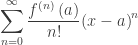
The general form of a Taylor series is \displaystyle \sum\limits_{n=0}^{\infty }{\frac{{{f}^{\left( n \right)}}\left( a \right)}{n!}{{\left( x-a \right)}^{n}}}; if a = 0, the series is called a Maclaurin series.
What Students Should be Able to Do 

  • Use the various convergence tests to determine if a series converges. The test to be used is rarely given so students need to know when to use each of the common tests. For a summary of the tests click: Convergence test chart.  and the posts “What Convergence Test Should I use?” Part 1 and Part 2
  • Understand absolute and conditional convergence. If the series of the absolute values of the terms of a series converges, then the original series is said to absolutely convergent (or converges absolutely). If the series of absolute values diverges, then the original series may or may not converge; if it converges it is said to be conditionally convergent.
  • Write the terms of a Taylor or Maclaurin series by calculating the derivatives and constructing the coefficients of each term.
  • Distinguish between the Taylor series for a function and the function. DO NOT say that the Taylor polynomial is equal to the function (this will lose a point); say it is approximately equal.
  • Determine a specific coefficient without writing all the previous coefficients.
  • Write a series by substituting into a known series, by differentiating or integrating a known series, or by some other algebraic manipulation of a series.
  • Know (from memory) the Maclaurin series for sin(x), cos(x), ex and \displaystyle \tfrac{1}{1-x} and be able to find other series by substituting into them.
  • Find the radius and interval of convergence. This is usually done by using the Ratio test and checking the endpoints.
  • Be familiar with geometric series, its radius of convergence, and be able to find the number to which it converges, \displaystyle {{S}_{\infty }}=\frac{{{a}_{1}}}{1-r}. Re-writing a rational expression as the sum of a geometric series and then writing the series has appeared on the exam.
  • Be familiar with the harmonic and alternating harmonic series. These are often useful series for comparison.
  • Use a few terms of a series to approximate the value of the function at a point in the interval of convergence.
  • Determine the error bound for a convergent series (Alternating Series Error Bound and Lagrange error bound). See my posts on Error Bounds and the Lagrange Highway
  • Use the coefficients (the derivatives) to determine information about the function (e.g. extreme values).

This list is quite long, but only a few of these items can be asked in any given year. The series question on the free-response section is usually quite straightforward. Topics and convergence test may appear on the multiple-choice section. As I have suggested before, look at and work as many past exam questions to get an idea of what is asked and the difficulty of the questions. Click on Power Series in the “Posts by Topic” list on the right side of the screen to see previous posts on Power Series or any other topic you are interested in.

Free-response questions:

  • 2004 BC 6 (An alternate approach, not tried by anyone, is to start with \displaystyle \sin \left( {5x+\tfrac{\pi }{4}} \right)=\sin (5x)\cos \left( {\tfrac{\pi }{4}} \right)+\cos (5x)\sin \left( {\tfrac{\pi }{4}} \right))
  • 2016 BC 6
  • 2017 BC 6

Multiple-choice questions from non-secure exams:

  • 2008 BC 4, 12, 16, 20, 23, 79, 82, 84
  • 2012 BC 5, 9, 13, 17, 22, 27, 79, 90,


The concludes the series of posts on the type questions in review for the AP Calculus exams.


Power Series 2

This is a BC topic

Good Question 16 (11-30-2018) What you get when you substitute.

Geometric Series – Far Out (2-14-2017) A very interesting and instructive mistake

Synthetic Summer Fun (7-10-2017) Finding the Taylor series coefficients without differentiating

Error Bounds (2-22-2013) The alternating series error bound, and the Lagrange error bound

The Lagrange Highway (5-20-15) a metaphor for the error bound

REVIEW NOTES Type 10: Sequence and Series Questions (4-6-2018) A summary for reviewing sequences and series.


Power Series 1

This is a BC topic

POWER SERIES (Maclaurin series and Taylor series)

Introducing Power Series 1 (2-8-2013) Making better approximations

Introducing Power Series 2 (2-11-2013) Graphing and seeing the interval of convergence

Introducing Power Series 3 (2-13-2013) Questions pointing the way to power series

Graphing Taylor Polynomials (2-7-2017) Using a graphing calculator to graphs Taylor series

New Series from Old 1 (2-15-2013) Substituting

New Series from Old 2 (2-18-2013) Differentiating and Integrating

New Series from Old 3 (2-20-2013) Rational functions as geometric series

REVIEW NOTES Type 10: Sequence and Series Questions (4-6-2018) A summary for reviewing sequences and series.


The College Board is pleased to offer a new live online event for new and experienced AP Calculus teachers on March 5th at 7:00 PM Eastern.

I will be the presenter.

The topic will be AP Calculus: How to Review for the Exam:  In this two-hour online workshop, we will investigate techniques and hints for helping students to prepare for the AP Calculus exams. Additionally, we’ll discuss the 10 type questions that appear on the AP Calculus exams, and what students need know and to be able to do for each. Finally, we’ll examine resources for exam review.

Registration for this event is $30/members and $35/non-members. You can register for the event by following this link: http://eventreg.collegeboard.org/d/xbqbjz


Sequences

This is a BC topic.

SEQUENCES

Everyday series (1-17-2017) The most familiar series: Numbers

Amortization (2-9-2015) An important use of a (finite) series – Find you mortgage payment without calculus.

Convergence Test List A summary of the tests. Download and copy for your students (and yourself)

Which Convergence Test Should I Use? Part 1 (2-9-2018) You have a big choice

Which Convergence Test Should I Use? Part 2 (2-16-2018) Making the best choice.

REVIEW NOTES Type 10: Sequence and Series Questions (4-6-2018) A summary for reviewing sequences and series.


The College Board is pleased to offer a new live online event for new and experienced AP Calculus teachers on March 5th at 7:00 PM Eastern.

I will be the presenter.

The topic will be AP Calculus: How to Review for the Exam:  In this two-hour online workshop, we will investigate techniques and hints for helping students to prepare for the AP Calculus exams. Additionally, we’ll discuss the 10 type questions that appear on the AP Calculus exams, and what students need know and to be able to do for each. Finally, we’ll examine resources for exam review.

Registration for this event is $30/members and $35/non-members. You can register for the event by following this link: http://eventreg.collegeboard.org/d/xbqbjz


Good Question 16

I had an email last week from a teacher asking, how come I can use a substitution to find a power series for  \cos \left( {2x} \right), and for  {{e}^{{\left( {x-1} \right)}}}, but not for  \cos \left( {3x+\frac{\pi }{6}} \right)?

The answer is that you can. Substituting (2x) into the cosine’s series give you a Taylor series centered at x = 0, a Maclaurin Series. Substituting (x – 1) into the series for ex gives you a Taylor series centered at x = 1. And substituting \left( {3x+\frac{\pi }{6}} \right) into the cosine series gives you a Taylor series centered at  x=-\frac{\pi }{{18}}. I suspect that she was hoping for or was asked to find a Maclaurin series, not one with such a strange center.

The center of a Taylor series is the value of x that makes its argument zero.

AP Exam Question 2004 BC 6(a)

This brought to mind the AP Exam question 2004 BC 6(a) where students were asked to write the third-degree Taylor polynomial about x = 0 for the function f\left( x \right)=\sin \left( {5x+\frac{\pi }{4}} \right). The intended method was for students to find the first three derivative and substitute them into the general form for a Taylor series. That’s what students who got this correct did. This is the only time I can remember when students were expected to do that; usually they manipulate a given series or substitute into a known series.

A number of students tried to substitute \left( {5x+\frac{\pi }{4}} \right) into the series for the sine. This gets a very nice Taylor series centered at  x=-\frac{\pi }{{20}}. This earned no credit since a Maclaurin series was required.


But there is another way! (I originally wrote, “But there is an easier way!” but it’s only easier if you see how to do it.)

Trigonometry to the Rescue!

\sin \left( {5x+\frac{\pi }{4}} \right)=\sin (5x)\cos \left( {\frac{\pi }{4}} \right)+\cos \left( {5x} \right)\sin \left( {\frac{\pi }{4}} \right)=\frac{{\sqrt{2}}}{2}\left( {\sin \left( {5x} \right)+\cos \left( {5x} \right)} \right)

Then using the first two terms each from the series for sine and cosine you get the correct answer:

\displaystyle \frac{{\sqrt{2}}}{2}\left( {\left( {5x-{{{\frac{{\left( {5x} \right)}}{{3!}}}}^{3}}} \right)+\left( {1-\frac{{{{{\left( {5x} \right)}}^{2}}}}{{2!}}} \right)} \right)=\frac{{\sqrt{2}}}{2}+\frac{{5\sqrt{2}}}{2}x-\frac{{25\sqrt{2}}}{{2\left( {2!} \right)}}{{x}^{2}}-\frac{{125\sqrt{2}}}{{2\left( {3!} \right)}}{{x}^{3}}

This brings us to \cos \left( {3x+\frac{\pi }{6}} \right), which can be approached the same way. Here is the entire Maclaurin series.

\cos \left( {3x+\frac{\pi }{6}} \right)=\cos \left( {3x} \right)\cos \left( {\frac{\pi }{6}} \right)-\sin \left( {3x} \right)\sin \left( {\frac{\pi }{6}} \right)

\displaystyle =\frac{{\sqrt{3}}}{2}\cos \left( {3x} \right)-\frac{1}{2}\sin \left( {3x} \right)

\displaystyle =\frac{{\sqrt{3}}}{2}\sum\limits_{{n=0}}^{\infty }{{\frac{{{{{\left( {3x} \right)}}^{{2n}}}}}{{\left( {2n} \right)!}}}}-\frac{1}{2}\sum\limits_{{n=0}}^{\infty }{{\frac{{{{{\left( {3x} \right)}}^{{2n+1}}}}}{{\left( {2n+1} \right)!}}}}

\displaystyle =\sum\limits_{{n=0}}^{\infty }{{\left( {\frac{{\sqrt{3}\left( {{{3}^{{2n}}}} \right)}}{{2\left( {2n} \right)!}}{{x}^{{2n}}}-\frac{{1\left( {{{3}^{{2n+1}}}} \right)}}{{2\left( {2n+1} \right)!}}{{x}^{{2n+1}}}} \right)}}

Moral: Trig can be very useful.

Here is a previous post, Geometric Series – Far Out, that shows a “mistake” you may find interesting.


Good Question 14

Good Question 14 – The Integral Test

I have no criteria for what constitutes a “Good Question” for this series of occasional posts. They are just questions that I found interesting, or that seem more than usually instructive, or that I learn something from. I cannot quote this question (2016 BC 92) since it is on a secure exam. What made it interesting is that to answer it students pretty much needed to know the proof of the Integral Test and the figures that go with it.

I recall only one AP question from many years ago that asked students to “prove” something – usually students are asked to show that a result was true by citing the theorem that applied and showing the hypotheses were met. The directions are often “justify your answer.”

Doing an original proof is not, in my opinion, a fair question and proving some known theorem is just a matter of memorization. For these reasons, students are not asked to prove things on the exams. So, should you prove things in class? Probably, yes.

Here is the usual proof of the integral test. Afterwards I’ll discuss the question from the exam.

The Integral Test

Hypotheses: Let f\left( x \right) be a function that is positive, decreasing, and continuous for x\ge 1 ; and let {{a}_{n}}=f\left( n \right) for x\ge 1

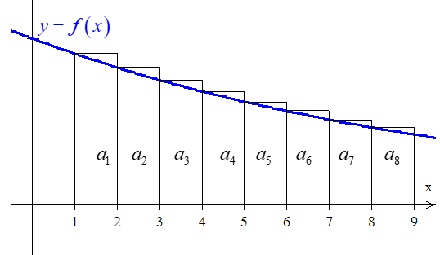
In the first drawing the rectangles have a height of an and a width of 1. The area is of each is an, and the sum of their areas the series is \sum\limits_{{n=1}}^{\infty }{{{{a}_{n}}}}.

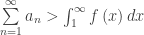
Part 1: Notice that \sum\limits_{{n=1}}^{\infty }{{{{a}_{n}}}}>\int_{1}^{\infty }{{f\left( x \right)dx}} Assume that the improper integral \int_{1}^{\infty }{{f\left( x \right)dx}} diverges.

  • Conclusion 1: If the improper integral \int_{1}^{\infty }{{f\left( x \right)dx}}  diverges, then the series \sum\limits_{{n=1}}^{\infty }{{{{a}_{n}}}} diverges.
  • Conclusion 2: (The contrapositive of conclusion 1) If the series \sum\limits_{{n=1}}^{\infty }{{{{a}_{n}}}} converges, then the improper integral \int_{1}^{\infty }{{f\left( x \right)dx}} converges.

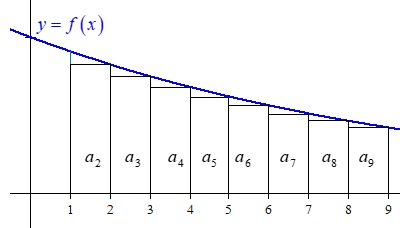
Part 2: In the second drawing below, assume that the improper integral \int_{1}^{\infty }{{f\left( x \right)dx}} converges. The sum of the areas of the rectangles is \sum\limits_{{n=2}}^{\infty }{{{{a}_{n}}}}. (NB: this series starts at n = 2.) Since \sum\limits_{{n=2}}^{\infty }{{{{a}_{n}}}} is less than the convergent improper integral it will also converge. Adding {{a}_{1}} to this gives the original series, \sum\limits_{{n=1}}^{\infty }{{{{a}_{n}}}}; this series also converges.

  • Conclusion 3: If the improper integral \int_{1}^{\infty }{{f\left( x \right)dx}} converges, then the series \sum\limits_{{n=1}}^{\infty }{{{{a}_{n}}}} converges.
  • Conclusion 4: (The contrapositive of conclusion 3) If the series   \sum\limits_{{n=1}}^{\infty }{{{{a}_{n}}}} diverges, then the improper integral \int_{1}^{\infty }{{f\left( x \right)dx}} diverges.

Putting the four conclusions together is the Integral Test: If the hypotheses above are met, then the series and the improper integral will both converge, or both diverge.


To answer the multiple-choice question (2106 BC 92) on the exams students were told that the improper integral converges. Therefore, the associated series converges. They then had to determine whether the series or the improper integral has the greater value. Stop here and see if you can figure that out.


Return to the first figure above, only this time assume that the improper integral and the series converge. It is pretty obvious that \sum\limits_{{n=1}}^{\infty }{{{{a}_{n}}}}>\int_{1}^{\infty }{{f\left( x \right)dx}}.

So, even though students were not asked to prove anything, a familiarity with the proof and its figures is necessary to answer the question. That’s why I liked it,

On the other hand, it is kind of an obscure point and I’m not sure it has any practical value.


What Convergence Test Should I Use? Part 2

In last Friday’s post I really didn’t answer this question. Rather, I tried to show that there is not only one convergence test that must be used on a given series. Nevertheless, the form of a series suggests a test that is likely to work. In this post, I’ll try to give some suggestions as to what test to try first based on the form of the series.

For reference, click here for a table summarizing the common convergence tests.

The goal is for students to be able to decide which test to start with at a glance.


Start with the nth-term test for divergence. If the limit of the general term as n goes to infinity is not zero, the sequence will diverge. The \underset{{n\to \infty }}{\mathop{{\lim }}}\,{{a}_{n}}=0 is a necessary condition for convergence. It is not sufficient; if the limit is zero then the series may converge. Look for a convergence test.


If the series alternates plus and minus signs, it is an alternating series and if it satisfies the other hypotheses use the Alternating Series Test. If the series contains positive and negative signs that do not alternate, or one of the other hypotheses is not met, then a different test must be used.


If the series is geometric then the Geometric Series Test may be used. If the common ratio (the number multiplied by each term to get the next term) is between –1 and 1 the series converges. If the common ratio is greater than or equal to 1, or less than or equal to –1, the series diverges.


The remaining tests are for series with all positive terms. They are tests for absolute convergence. If you series has negative terms then you may ignore the signs and try one of the following tests. If your series is absolutely convergent, then it is convergent. (If not, it may still be convergent.)

If the general term (written with x’s) looks like something that you can integrate, use the Integral Test.

The Direct Comparison Test and the Limit Comparison Test are used if you can find a test to compare them with.

A p-series, \sum\limits_{{n=1}}^{\infty }{{\frac{1}{{{{n}^{p}}}}}} converges if p>1  and diverges if p\le 1. A p-series is often a good test to use for comparison in the next two tests. However, any series whose convergence you are sure of may be used.

The Direct Comparison Test is used with fraction expressions. “Extra” factors in the denominator can often be ignored. Some examples

  •  \displaystyle \sum\limits_{{n=1}}^{\infty }{{\frac{1}{{{{5}^{n}}\sqrt{n}}}}} would be a geometric series except for the radical. Compare it with the geometric series \displaystyle \sum\limits_{{n=1}}^{\infty }{{\frac{1}{{{{5}^{n}}}}}}
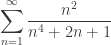
  • \displaystyle \sum\limits_{{n=1}}^{\infty }{{\frac{{{{n}^{2}}}}{{{{n}^{4}}+2n+1}}}} can be compared with the p-series \displaystyle \sum\limits_{{n=1}}^{\infty }{{\frac{1}{{{{n}^{2}}}}}}. The hint here is that ignoring the lower power terms in the denominator and reducing we see that the original series looks like \displaystyle \sum\limits_{{n=1}}^{\infty }{{\frac{1}{{{{n}^{2}}}}}}. Both series converge. But be careful \displaystyle \sum\limits_{{n=1}}^{\infty }{{\frac{{{{n}^{2}}}}{{{{n}^{4}}-2n-1}}}} while similar, has terms greater than the terms of \displaystyle \sum\limits_{{n=1}}^{\infty }{{\frac{1}{{{{n}^{2}}}}}}.)
  • The terms of the series \displaystyle \sum\limits_{{n=1}}^{\infty }{{\frac{1}{{{{{\left( {{{n}^{2}}+2} \right)}}^{{1/3}}}}}}} are larger than the harmonic series \displaystyle \sum\limits_{{n=1}}^{\infty }{{\frac{1}{n}}} a divergent p-series, so this series diverges.

The Limit Comparison Test may be used with the same kinds of series that are messy to use with direct comparison.

  • Returning to \displaystyle \sum\limits_{{n=1}}^{\infty }{{\frac{{{{n}^{2}}}}{{{{n}^{4}}+2n+1}}}}, try the limit comparison test with \displaystyle \sum\limits_{{n=1}}^{\infty }{{\frac{1}{{{{n}^{2}}}}}}. The limit is 1, so both series converge.
  • \displaystyle \sum\limits_{{n=1}}^{\infty }{{\frac{1}{{\sqrt{{{{n}^{2}}+3}}}}}} Series with radicals also are candidates for the limit comparison test. Since the general terms is approximately \displaystyle {\frac{1}{n}} Compare this with \displaystyle \sum\limits_{{n=1}}^{\infty }{{\frac{1}{n}}}. Both series diverge.

More complicated series, perhaps with exponential factors and/or factorials can be examined with the Ratio Test.

  • \displaystyle \sum\limits_{{n=1}}^{\infty }{{\frac{{{{3}^{n}}}}{{n!}}}} or \displaystyle \sum\limits_{{n=1}}^{\infty }{{\frac{{{{n}^{3}}}}{{{{5}^{n}}}}}} are candidates for the Ratio Test. Both Converge.
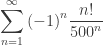
  • \displaystyle \sum\limits_{{n=1}}^{\infty }{{{{{\left( {-1} \right)}}^{n}}\frac{{n!}}{{{{{500}}^{n}}}}}} appears to be a candidate for the alternating series test. However, for large values of n > 530 the terms increase in absolute vale, so the alternating series test cannot be applied. The ratio test works here, but since the terms do not approach 0 as n increases, the nth-term test for divergence also works. This series diverges.

Practice, Practice, Practice

The AP Calculus BC exams rarely, if ever, specify which test to use. Often these are multiple-choice questions. If students can see whether the series converges or diverges, that is enough. But here again the key is practice, practice, practice. 

As you teach the various tests, pause to look at the form of the series in the exercises for each test that your book provides. Most books also have mixed sets of exercises where tests other than the one in that section are needed. One of the things you can do is assign these entire sets with the directions that students should determine what test they would try, and, for their comparison tests, to which series they would compare it. Discuss their opinions especially if there is more than one suggested or suggest others. Work only those those students are confused about or those for which they have divergent opinions; try to converge on a good test for each.


Revised July 18, 2021, January 29, 2023